BookBrief
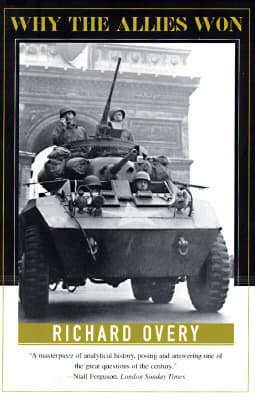
Why the Allies Won cover
Archivist's Choice

Why the Allies Won

Richard Overy (1995)

Genre

History

Reading Time

12-15 hours

Key Themes

See below

Track Your Reading

Sign in to track this book

Richard Overy challenges the idea of an inevitable Allied victory, showing how the world moved from near Axis control to Allied triumph through industry, battlefield strength, and moral resolve.

Core Idea

Richard Overy's "Why the Allies Won" argues that Allied victory in World War II was not guaranteed. Instead, it was a result of many material, strategic, and ideological factors. He disputes the idea that the Allies were always going to win, pointing out that the Axis powers, especially Germany, came close to winning and had significant advantages at different times. The book suggests that the Allies won because they were better at mobilizing and maintaining industrial production, using air and sea power effectively, changing their strategies, and presenting a more appealing ideology. This ideology helped create stronger internal unity and external support, particularly from the Soviet Union and the United States. Overy believes that the size of the Eastern Front, the crucial impact of Allied industry in producing both many and good quality materials, the strategic bombing campaigns, and the vital role of logistics in projecting power globally were most important. He also highlights key differences in leadership, the Allies' greater ability to learn and adapt, and their moral commitment to fighting a war against totalitarian ideologies. These factors, combined with Axis overreach and strategic mistakes, tilted the war towards the Allies.
Reading time
12-15 hours
Difficulty
Medium
✓ Read this if...
You want a comprehensive, analytical explanation of the multifaceted reasons behind Allied victory in WWII, going beyond simple narratives to explore industrial, strategic, ideological, and logistical factors.
✗ Skip this if...
You are looking for a narrative history focused on individual battles or biographies, or if you prefer a less academic, more accessible introduction to WWII.

Core idea

The central argument and framework that powers the entire book.

Richard Overy's "Why the Allies Won" argues that Allied victory in World War II was not guaranteed. Instead, it was a result of many material, strategic, and ideological factors. He disputes the idea that the Allies were always going to win, pointing out that the Axis powers, especially Germany, came close to winning and had significant advantages at different times. The book suggests that the Allies won because they were better at mobilizing and maintaining industrial production, using air and sea power effectively, changing their strategies, and presenting a more appealing ideology. This ideology helped create stronger internal unity and external support, particularly from the Soviet Union and the United States.

Overy believes that the size of the Eastern Front, the crucial impact of Allied industry in producing both many and good quality materials, the strategic bombing campaigns, and the vital role of logistics in projecting power globally were most important. He also highlights key differences in leadership, the Allies' greater ability to learn and adapt, and their moral commitment to fighting a war against totalitarian ideologies. These factors, combined with Axis overreach and strategic mistakes, tilted the war towards the Allies.

At a glance

Reading time

12-15 hours

Difficulty

Medium

Read this if...

You want a comprehensive, analytical explanation of the multifaceted reasons behind Allied victory in WWII, going beyond simple narratives to explore industrial, strategic, ideological, and logistical factors.

Skip this if...

You are looking for a narrative history focused on individual battles or biographies, or if you prefer a less academic, more accessible introduction to WWII.

Key Takeaways

1

Beyond Inevitability: The Contingent Victory

Allied victory was not predetermined, but a hard-won outcome against formidable odds.

Quote

The Allied victory in 1945 was not inevitable.

Overy challenges the common historical view that Allied victory was a sure thing, either because of Germany's mistakes or overwhelming material advantage. He argues that by 1942, Germany had vast resources from its conquests across Europe and was in a good position to expand further. The Soviet Union had lost much of its industry, and the United States was still getting ready for war. This initial disadvantage shows that the Allies had to actively regain military strength. Their eventual win was a result of adaptable strategy, resourc...

Supporting evidence

By 1942, Germany controlled most of continental Europe's resources, while the Soviet Union had lost significant industrial capacity and the US was not yet fully armed.

Apply this

When analyzing complex historical or contemporary conflicts, avoid deterministic thinking. Recognize the role of contingency, strategic adaptation, and individual and collective agency in shaping outcomes, rather than assuming an inevitable result based on initial conditions.


contingencyhistorical-revisionismstrategic-balance
2

The Eastern Front: Crucible of Victory

The Soviet Union's sacrifices and military prowess were indispensable to Allied success.

Quote

The Eastern Front was the decisive theatre of the land war, where the bulk of German military power was destroyed.

Overy stresses that the Eastern Front was not a secondary area but the main battleground where the German war machine was systematically destroyed. The sheer scale of fighting, the immense casualties the Soviet Union suffered and inflicted, and the constant drain on German resources ultimately prevented Germany from fighting effectively on multiple fronts. The Soviet ability to absorb huge losses, rebuild its forces, and launch powerful counter-offensives, especially in battles like Stalingrad and Kursk, fundamentally shaped the war's...

Supporting evidence

The vast majority of German divisions and resources were committed and destroyed on the Eastern Front, particularly in crucial battles like Stalingrad and Kursk.

Apply this

Recognize and acknowledge the disproportionate impact and sacrifices made by specific nations or groups in grand conflicts. In strategic planning, understand that 'decisive' fronts might not always align with initial expectations or popular narratives, but rather where the heaviest attrition and resource commitment occur.

eastern-frontsoviet-contributionattrition-warfare
3

Industrial Supremacy: Quality and Quantity

Allied industrial capacity, coupled with technological innovation, was a critical differentiator.

Quote

The Allies won the war of production because they were able to mobilize their resources more effectively and innovate faster.

While acknowledging Germany's initial resource advantage, Overy argues that Allied industrial strength, particularly that of the United States and the Soviet Union's relocated industries, became a decisive factor. It was not just about raw numbers, but the ability to innovate, adapt production methods, and maintain a consistent output of high-quality weapons, vehicles, and supplies. The US 'Arsenal of Democracy' provided a huge logistical and material advantage. Soviet industrial resilience, despite huge losses, ensured continued supp...

Supporting evidence

The immense output of American industry (e.g., Liberty ships, aircraft production) and the successful relocation and re-establishment of Soviet industry beyond the Urals.

Apply this

In any large-scale endeavor, understand that sustained output, adaptive production, and technological innovation are as crucial as initial resource accumulation. Invest in robust infrastructure and flexible manufacturing capabilities to ensure long-term resilience and competitive advantage.

industrial-capacityproduction-warfarearsenal-of-democracy
4

Air Power's Strategic Impact

Allied air superiority crippled Axis logistics and morale, paving the way for ground victories.

Quote

Air power was not merely a supporting arm but a strategic weapon that could fundamentally alter the course of the war.

Overy highlights the important role of Allied air power, moving beyond tactical support to strategic bombing campaigns that systematically broke down German and Japanese industrial capacity, transportation, and fuel supplies. The sustained bombing of German cities, though debated, significantly impacted morale and diverted critical resources to air defense. More importantly, Allied air superiority over battlefields provided valuable intelligence, stopped enemy supplies, and directly supported ground troops, severely hindering Axis ope...

Supporting evidence

The Allied strategic bombing campaigns against German industrial targets and cities, and the air superiority achieved over Normandy during D-Day.

Apply this

Recognize that technological advancements can fundamentally change the nature of conflict. In modern strategy, consider how control of critical domains (e.g., air, cyber, space) can profoundly impact the effectiveness of conventional forces and overall outcomes.

air-superioritystrategic-bombinglogistics-disruption
5

Leadership and Adaptability

Effective, pragmatic leadership and a willingness to adapt were crucial Allied advantages.

Quote

The Allies benefited from a more pragmatic and adaptable leadership structure, capable of making hard decisions and learning from mistakes.

Overy contrasts the often rigid and ideologically driven leadership of the Axis powers with the more practical and adaptable Allied command structures. Leaders like Churchill, Roosevelt, and Stalin, despite their faults and disagreements, showed a remarkable ability to make tough strategic decisions, form alliances, and learn from early failures. This adaptability extended from grand strategy down to battlefield tactics, allowing the Allies to change their approaches and overcome initial disadvantages. The ability to delegate effectiv...

Supporting evidence

The formation of the Grand Alliance, the strategic planning at conferences like Tehran and Yalta, and the Allied ability to recover from early defeats (e.g., Pearl Harbor, early Soviet losses).

Apply this

In leadership, prioritize pragmatism, adaptability, and the capacity for learning over rigid adherence to ideology or initial plans. Foster a culture where feedback is valued, and strategic adjustments can be made without losing sight of the ultimate objective. Effective delegation is key.

leadership-effectivenessstrategic-adaptationgrand-alliance
6

The Moral Dimension: A War of Ideologies

The clear moral imperative against fascism galvanized Allied resolve and unity.

Quote

The moral dimension of the war, the clear distinction between Allied aims and Axis barbarity, provided an essential foundation for Allied unity and resolve.

Overy argues that while resources and strategy were important, the clear moral purpose of the conflict greatly strengthened Allied resolve. The fight against Nazi Germany's genocidal ideology and imperial Japan's brutal expansionism provided a common goal that went beyond national interests. This moral high ground, though sometimes compromised by Allied actions, allowed for the formation of an unlikely coalition (the Grand Alliance) and sustained public support for the huge sacrifices required. The 'good versus evil' narrative, howeve...

Supporting evidence

The explicit denunciation of Nazi atrocities, the Atlantic Charter's principles, and the propaganda efforts highlighting the existential threat of Axis ideologies.

Apply this

In any major undertaking, especially those requiring sustained effort and sacrifice, a clear and morally defensible purpose can be a powerful unifying and motivating force. Articulate and reinforce the ethical underpinnings of your objectives to inspire commitment.

moral-warfareideological-conflictallied-unity
7

Logistics and Supply Chain Mastery

The ability to move men and materiel across vast distances was an unsung hero of Allied victory.

Quote

The mastery of logistics, the capacity to supply vast armies across oceans and continents, was as crucial as any battlefield victory.

Overy stresses that successfully fighting a global war depended on an unprecedented logistical effort. The Allies, particularly the United States and Great Britain, developed complex systems to transport millions of troops, tons of equipment, and vast amounts of supplies across oceans and continents. The 'Battle of the Atlantic,' ensuring supply lines to Britain and the Soviet Union, was a constant, critical struggle. The building of port facilities, railway networks, and supply depots in distant theaters (e.g., the Red Ball Express i...

Supporting evidence

The success of the Red Ball Express in France, the continuous convoys across the Atlantic, and the Lend-Lease program's distribution of supplies globally.

Apply this

In any large-scale operation, recognize that logistics and supply chain management are foundational. Invest heavily in efficient infrastructure, robust planning, and resilient systems to ensure the continuous flow of resources, as bottlenecks can cripple even the most brilliant strategies.

logisticssupply-chainbattle-of-the-atlantic
8

The War at Sea: Protecting the Lifeline

Allied naval dominance secured vital shipping lanes and projected power globally.

Quote

The war at sea was a continuous, brutal struggle, but its outcome was fundamental to the ability of the Allies to wage war on all other fronts.

Overy emphasizes the critical, often overlooked, role of naval power. The Allied navies, mainly the British Royal Navy and the United States Navy, fought a relentless battle against Axis U-boats and surface fleets to protect vital convoys carrying supplies, troops, and raw materials. The 'Battle of the Atlantic' was a long, difficult campaign that, if lost, would have starved Britain and severely hindered the Soviet war effort. Additionally, Allied naval superiority allowed for amphibious assaults (e.g., North Africa, Sicily, Normandy...

Supporting evidence

The development of sonar and radar, convoy systems, and the eventual defeat of the U-boat threat in the Atlantic, alongside the vast amphibious operations in Europe and the Pacific.

Apply this

Understand that control of critical global commons (e.g., oceans, space, cyberspace) is essential for projecting and sustaining power. Invest in capabilities to secure these domains, as their loss can severely cripple broader strategic objectives.

naval-warfarebattle-of-the-atlanticamphibious-assault
9

Axis Overreach and Strategic Blunders

Germany and Japan's strategic miscalculations contributed significantly to their ultimate defeat.

Quote

While Allied strengths were decisive, Axis strategic errors provided crucial opportunities for the Allies to gain the upper hand.

Overy acknowledges that while the Allies actively won the war, Axis strategic mistakes played a significant role in their defeat. Germany's decision to invade the Soviet Union while still fighting in the West, and its underestimation of Soviet resilience, created the devastating two-front war it had tried to avoid. Japan's attack on Pearl Harbor, though initially successful, spurred American entry into the war and underestimated the long-term industrial capacity and resolve of the United States. These acts of strategic overreach, ofte...

Supporting evidence

Germany's invasion of the Soviet Union (Operation Barbarossa) and Japan's attack on Pearl Harbor.

Apply this

When evaluating strategic decisions, carefully assess the potential for overextension and the long-term implications of aggressive actions. Avoid hubris and ensure that strategic objectives align with realistic resource capabilities and potential enemy responses.

strategic-miscalculationtwo-front-warhubris
10

The Human Element: Resilience and Training

The fighting ability and morale of Allied soldiers proved superior in the long run.

Quote

The quality of fighting men, their training, morale, and leadership, ultimately determined success on the battlefield.

Beyond material strength, Overy discusses the human factor: the fighting ability, resilience, and training of Allied soldiers. While early Axis forces often showed superior tactical skill, the Allies, through better training, combat experience, and effective leadership, steadily improved their fighting capabilities. The ability of Soviet soldiers to endure unimaginable hardship, the tenacity of British forces, and the adaptability of American troops, combined with superior logistics and air support, eventually outmatched their adversa...

Supporting evidence

The improved performance of Allied troops in later campaigns, the resilience of Soviet soldiers on the Eastern Front, and the effective integration of combined arms tactics.

Apply this

In any organization or team, invest deeply in training, fostering resilience, and developing effective leadership at all levels. Recognize that human capital, morale, and the ability to learn and adapt under pressure are ultimately decisive factors, even with technological advantages.

soldier-moralecombat-effectivenesshuman-factor

Critical analysis

Notable Quotes

The Allied victory was not inevitable, but the result of a complex interplay of material power, strategic choices, and the moral strength of their cause.

Introductory summary of the book's thesis.

The sheer scale of Soviet sacrifice and industrial output remains one of the most astonishing aspects of the Second World War.

Discussing the Eastern Front's contribution to Allied victory.

Air power, while not a war-winning weapon on its own, proved indispensable in eroding Axis industrial capacity and morale.

Analyzing the role of strategic bombing campaigns.

The German failure to develop a coherent long-term grand strategy, often driven by Hitler's ideological obsessions, was a critical factor in their defeat.

Critiquing German strategic planning.

Logistics, the often-overlooked 'handmaiden of victory', proved decisive in enabling Allied forces to project power across vast distances.

Emphasizing the importance of supply lines and transportation.

The United States' ability to mobilize its immense economic resources and convert them into military power on an unprecedented scale was unparalleled.

Highlighting American industrial mobilization.

The moral dimension of the war, the perception of fighting for freedom against tyranny, stiffened Allied resolve and undermined Axis legitimacy.

Exploring the ideological underpinnings of Allied motivation.

Intelligence, particularly signals intelligence, provided the Allies with a crucial, if often imperfect, advantage in anticipating enemy moves.

Discussing the impact of code-breaking and espionage.

The Allied coalition, despite its internal tensions and differing objectives, managed to maintain a remarkable degree of strategic unity.

Examining the challenges and successes of inter-Allied cooperation.

The resilience of ordinary people on the home front, enduring hardship and contributing to the war effort, was a vital, often unsung, component of victory.

Acknowledging the role of civilian populations.

Naval power, especially in the Battle of the Atlantic, was fundamental to ensuring the flow of supplies and troops that sustained the Allied war machine.

Detailing the critical role of naval warfare.

Technological innovation, from radar to improved tank designs, provided tactical and operational edges that accumulated into strategic advantage.

Highlighting the impact of scientific and engineering advancements.

The Axis powers, by underestimating their enemies and overextending their reach, sowed the seeds of their own destruction.

Analyzing the strategic miscalculations of the Axis.

Victory was forged not in a single decisive battle, but through the cumulative effect of relentless pressure on multiple fronts, both military and economic.

Concluding thoughts on the multifaceted nature of the Allied triumph.

Quiz

Test Your Knowledge

Ready to see how well you understood this book? Take our interactive quiz with 10 questions.

10
Questions
~5
Minutes
?
Best Score

Key Questions (FAQ)

Richard Overy argues against the common belief that the Allied victory in WWII was inevitable due to Germany fighting a two-front war or overwhelming material strength. Instead, he demonstrates how the Allies actively regained military superiority and the specific factors that enabled their triumph.

About the author