BookBrief
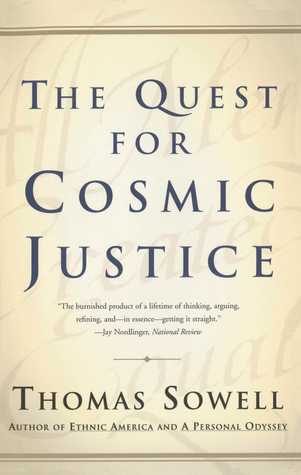
The Quest for Cosmic Justice cover
Archivist's Choice

The Quest for Cosmic Justice

Thomas Sowell (1999)

Genre

Politics / History / Economics / Philosophy

Reading Time

240 min

Key Themes

See below

Track Your Reading

Sign in to track this book

Sowell shows how seeking an ill-defined 'cosmic justice' undermines true equality and freedom, slowly eroding the foundations of the American Revolution through well-intentioned but flawed social ideas.

Core Idea

Thomas Sowell explains that 'cosmic justice' – the goal of correcting all perceived historical and societal imbalances through government action and redistribution to achieve equal results – is a dangerous and pointless utopian effort. He contrasts this with traditional justice, which focuses on fair rules, individual responsibility, and equal opportunity. Sowell argues that pursuing cosmic justice leads to less individual liberty, economic inefficiency, more arbitrary power, and new injustices. He criticizes the belief that societal outcomes can be centrally planned and points out the negative, unforeseen effects of such actions throughout history, politics, and economics.
Reading time
240 min
Difficulty
Medium
✓ Read this if...
You are interested in a rigorous critique of social engineering, affirmative action, and government intervention aimed at equalizing outcomes, or if you appreciate analyses from a free-market, individual-liberty perspective.
✗ Skip this if...
You believe that government intervention is the primary means to correct historical injustices and achieve social equality, or you prefer less confrontational analyses of social policy.

Core idea

The central argument and framework that powers the entire book.

Thomas Sowell explains that 'cosmic justice' – the goal of correcting all perceived historical and societal imbalances through government action and redistribution to achieve equal results – is a dangerous and pointless utopian effort. He contrasts this with traditional justice, which focuses on fair rules, individual responsibility, and equal opportunity. Sowell argues that pursuing cosmic justice leads to less individual liberty, economic inefficiency, more arbitrary power, and new injustices. He criticizes the belief that societal outcomes can be centrally planned and points out the negative, unforeseen effects of such actions throughout history, politics, and economics.

At a glance

Reading time

240 min

Difficulty

Medium

Read this if...

You are interested in a rigorous critique of social engineering, affirmative action, and government intervention aimed at equalizing outcomes, or if you appreciate analyses from a free-market, individual-liberty perspective.

Skip this if...

You believe that government intervention is the primary means to correct historical injustices and achieve social equality, or you prefer less confrontational analyses of social policy.

Key Takeaways

1

Cosmic vs. Traditional Justice

The dangerous pursuit of an idealized outcome over established rules.

Quote

The quest for 'cosmic justice' is the pursuit of an ideal state of affairs where everyone is equally well-off, or where disparities are rectified by some central authority, rather than justice being the adherence to rules of conduct in a process.

Sowell separates 'traditional justice' from 'cosmic justice.' Traditional justice, from Western legal traditions, focuses on fair processes and rules, ensuring impartial treatment under the law. It is about 'fair play.' Cosmic justice, in contrast, tries to correct all historical and societal imbalances, aiming for a specific, set outcome of equality. This often involves a central authority reallocating resources or opportunities to achieve a 'just' distribution, regardless of individual merit or effort. Sowell argues that this shift ...

Supporting evidence

Sowell frequently references historical legal systems and philosophical traditions that emphasize procedural justice, contrasting them with modern progressive movements that prioritize redistributive or compensatory 'cosmic' justice.

Apply this

Before advocating for a policy, critically assess whether its primary aim is to ensure fair processes or to engineer specific societal outcomes. Prioritize policies that uphold universal rules and individual accountability over those that seek to rectify perceived historical injustices through differential treatment.


procedural-justicedistributive-justicesocial-engineering
2

The Tyranny of Social Visions

Ideological frameworks blind adherents to real-world consequences.

Quote

The vision is not a hypothesis to be tested but a truth to be proclaimed.

Sowell states that many who support cosmic justice are driven by strong 'social visions' – broad, often utopian, frameworks for how society should be structured. These visions are not testable ideas but deeply held beliefs that shape how all evidence is interpreted. When policies based on their vision have negative results, supporters often ignore the evidence, blame outside factors, or strengthen their commitment to the vision, rather than questioning its basic ideas. This rigid thinking prevents self-correction and keeps harmful pol...

Supporting evidence

Sowell dissects various historical examples where ideological commitments (e.g., certain forms of socialism or racial quotas) persisted despite clear evidence of their detrimental effects on economic productivity, social cohesion, or individual liberty.

Apply this

Cultivate intellectual humility and an empirical mindset. Be wary of any ideology that claims to have all the answers or dismisses contradictory evidence out of hand. Prioritize observable outcomes and data over abstract theoretical purity when evaluating policies.

ideologyconfirmation-biasunintended-consequences
3

Equality of Opportunity vs. Outcome

Confusing these concepts erodes individual freedom and meritocracy.

Quote

Equality of opportunity is not merely different from equality of outcome; it is in fact, often in conflict with it.

Sowell carefully distinguishes between equal opportunity and equal outcome, arguing that the modern pursuit of 'cosmic justice' blurs and ultimately prioritizes the latter. Equal opportunity means individuals face the same rules and have access to the same starting points, free from discrimination. It emphasizes fair competition. Equal outcome, however, demands that everyone finishes in the same place, regardless of effort, talent, or choices. Trying to achieve equal outcomes requires actions that violate equal opportunity – such as q...

Supporting evidence

Sowell points to affirmative action policies and wealth redistribution schemes, arguing that while they aim for more 'equal' outcomes, they necessarily create unequal opportunities or treatments based on group identity rather than individual merit.

Apply this

Advocate for policies that remove barriers and ensure fair competition for all individuals, rather than policies that predetermine or manipulate results. Focus on empowering individuals to succeed through their own efforts within a just framework, not on guaranteeing specific achievements.

affirmative-actionmeritocracyredistribution
4

The Illusion of 'Solving' Disparities

Many societal differences are natural, not necessarily injustices to be corrected.

Quote

The fact that people are not equally distributed in all occupations, incomes, or educational institutions is not, by itself, evidence of injustice, but often a reflection of myriad factors, many of them voluntary.

A main idea of cosmic justice is that any group difference in outcomes (income, job representation, academic achievement) must result from systemic injustice, discrimination, or oppression, requiring immediate correction. Sowell challenges this idea, arguing that such differences often come from diverse individual choices, preferences, talents, geography, age, and cultural factors. To blame all differences on 'injustice' ignores the complex, natural nature of human societies. Trying to 'solve' these natural differences through social ...

Supporting evidence

Sowell cites examples of various ethnic and cultural groups excelling in specific fields (e.g., Chinese in laundries, Jews in intellectual pursuits, Japanese in gardening) not due to discrimination, but often due to cultural capital, historical circumstances, or voluntary preferences. He also notes age differences in income distribution.

Apply this

Approach societal disparities with a nuanced, data-driven perspective. Resist the knee-jerk assumption that all group differences are evidence of injustice. Focus on removing genuine barriers to individual advancement rather than attempting to equalize outcomes across groups.

group-disparitiessocial-engineeringcultural-capital
5

The Erosion of Freedom

The pursuit of cosmic justice inevitably expands state power at the expense of individual liberty.

Quote

The more the state takes on the role of correcting cosmic injustices, the more it must take on powers that erode the freedom of individuals.

Sowell argues that achieving cosmic justice requires an ever-growing government. To reallocate resources, enforce quotas, or manage societal outcomes, the government must gain more control over individual lives, choices, and property. This growth of state power conflicts with individual liberty, property rights, and freedom of association. As the state intervenes more to 'correct' perceived injustices, it reduces individual autonomy, changing citizens from free agents into subjects whose lives are increasingly controlled by central pl...

Supporting evidence

Sowell points to the growth of regulatory bodies, the expansion of eminent domain, and the increasing complexity of tax codes as examples of governmental expansion driven by the desire to achieve specific social outcomes, often at the expense of individual economic and personal freedoms.

Apply this

Be vigilant about proposals that grant greater power to the state, especially those justified by the need to 'level the playing field' or 'correct historical wrongs.' Prioritize policies that protect individual rights and limit governmental overreach, even if they don't promise immediate, idealized social outcomes.

state-powerindividual-libertyproperty-rightscollectivism
6

The Dangers of Utopianism

Idealized visions ignore human nature and lead to real-world suffering.

Quote

The tragic vision of the human condition is that man is inherently flawed, and that progress is painstakingly achieved and often reversible. The unconstrained vision sees man as perfectible and social problems as solvable by reason.

Sowell implies that his earlier work on 'Visions of Justice' (specifically the 'unconstrained' versus 'constrained' visions) shows that the quest for cosmic justice comes from an unrestrained, utopian view of human nature and society. This view assumes that humans can be perfectly shaped and improved, and that all societal problems are simply 'design flaws' fixable by rational planning. This ignores human limitations and imperfections, as well as the complexities of spontaneous social order. When reality does not match the utopian pla...

Supporting evidence

Sowell often alludes to the failures of centrally planned economies and social experiments throughout history (e.g., various communist regimes) that, despite noble intentions, resulted in widespread deprivation and loss of freedom due to their utopian assumptions.

Apply this

Adopt a 'constrained' vision of human nature, acknowledging inherent limitations and trade-offs. Be deeply skeptical of any grand scheme promising to solve all societal problems through radical restructuring. Prioritize incremental improvements and respect for evolved institutions over revolutionary change.

utopianismhuman-natureconstrained-visionunconstrained-vision
7

The Intellectual Arrogance of 'Experts'

Central planners overestimate their ability to manage complex societies.

Quote

The greatest danger of all is that the quest for cosmic justice allows the intellectual to become the self-appointed guardian of society, with powers that no individual should possess.

Sowell criticizes the intellectual arrogance in the quest for cosmic justice. The belief that a small group of 'enlightened' individuals or experts can identify, diagnose, and 'fix' all societal injustices implies an almost god-like level of knowledge. This overlooks Hayek's idea of dispersed knowledge – that the vast, complex, and changing information needed to coordinate a society is held by millions of individuals, not by any central planner. When 'experts' try to plan for cosmic justice centrally, they make decisions based on inco...

Supporting evidence

Sowell frequently contrasts the efficiency of market economies (where knowledge is decentralized and prices convey information) with the inefficiencies and failures of centrally planned economies, which rely on the limited knowledge of a few decision-makers.

Apply this

Be skeptical of 'expert' panels or government agencies that claim to have the unique ability to solve complex social problems. Prioritize decentralized decision-making, market mechanisms, and individual agency as more effective ways to manage societal complexity.

hayekdispersed-knowledgecentral-planningintellectual-hubris
8

Quiet Repeal of the American Revolution

The shift to cosmic justice undermines foundational principles of liberty.

Quote

The American Revolution was about limiting government power to protect individual liberty. The quest for cosmic justice expands government power to achieve collective outcomes, effectively repealing those founding principles.

Sowell sees the quest for cosmic justice as a gradual undoing of the core principles of the United States. The American Revolution aimed to establish a government with limited powers, protecting individual rights and freedoms. It focused on procedural justice – ensuring fair rules and due process. The shift toward cosmic justice, however, demands an ever-growing, interventionist state that actively shapes societal outcomes, thus dismantling the checks and balances, individual liberties, and property rights central to the revolutionary...

Supporting evidence

Sowell implicitly references the U.S. Constitution, the Bill of Rights, and the writings of the Founding Fathers, contrasting their emphasis on limited government and individual rights with modern trends towards expansive government programs and judicial activism aimed at achieving social equity.

Apply this

Actively defend constitutional principles of limited government, individual rights, and property rights. Educate others on the historical context and foundational intent of American governance, resisting attempts to redefine justice in ways that undermine these bedrock principles.

american-revolutionlimited-governmentconstitutionalismfounding-principles
9

The Moral Hazard of Blame

Attributing all disparities to 'injustice' discourages individual responsibility.

Quote

When success and failure are routinely attributed to external forces beyond an individual's control, the incentive for self-improvement and personal responsibility diminishes.

Sowell argues that a significant moral problem arises from the cosmic justice framework's tendency to blame external factors for all negative outcomes. If every difference or personal difficulty is seen as a systemic injustice, the incentive for individuals to take responsibility for their own choices and self-improvement decreases. This creates a culture where personal agency is minimized, and individuals are encouraged to seek solutions from external authorities rather than striving for self-reliance. While real injustices exist and...

Supporting evidence

Sowell critiques social welfare policies that, in his view, have inadvertently fostered dependency by reducing the consequences of certain choices, and discusses how academic theories of 'systemic oppression' can inadvertently disincentivize individual striving.

Apply this

Foster a culture that balances acknowledging genuine systemic barriers with emphasizing individual responsibility, effort, and self-improvement. Support policies that empower individuals to overcome challenges through their own actions and choices, rather than solely relying on external interventions.

moral-hazardindividual-responsibilityvictimhood-cultureself-reliance
10

Process Over Intent

Well-intentioned policies often lead to disastrous, unforeseen consequences.

Quote

The road to hell is paved with good intentions.

Sowell repeatedly stresses that a policy's intentions, no matter how noble, are less important than its actual results. Supporters of cosmic justice often justify their actions by pointing to their good goals – reducing poverty, promoting equality, eliminating discrimination. However, Sowell shows that policies designed for these ends often produce unexpected and negative outcomes that worsen the very problems they aimed to solve, or create new ones. This highlights the importance of careful study of policy effects, rather than just a...

Supporting evidence

Sowell frequently cites examples like minimum wage laws (intended to help the poor, but often leading to job losses for the least skilled), rent control (intended to help tenants, but leading to housing shortages and dilapidation), and various foreign aid programs with counterproductive results.

Apply this

Always evaluate policies based on their demonstrated outcomes, not just their stated intentions. Be wary of appeals to emotion or moral righteousness that bypass rigorous analysis of practical effects. Demand data and evidence of effectiveness before endorsing new interventions.

unintended-consequencespolicy-evaluationempirical-analysisgood-intentions

Critical analysis

Notable Quotes

The great tragedy of the twentieth century was not that so many millions of people were killed, but that so many millions more were made to believe that they were living in a just society.

Critiquing the moral relativism and self-deception in totalitarian regimes.

Cosmic justice is not merely a different kind of justice. It is a quest for a different kind of universe.

Introducing the central theme of the book, distinguishing cosmic justice from traditional justice.

There are no solutions, only trade-offs.

Arguing that social policy often involves difficult choices rather than perfect fixes.

The vision of cosmic justice is inherently intoxicating because it promises to transcend the painful limitations of the real world.

Explaining the appeal of the concept of cosmic justice despite its impracticality.

Facts do not speak for themselves. They are spoken for by people.

Emphasizing the role of interpretation and bias in presenting data and arguments.

What is called 'social justice' today is often an attempt to override the consequences of individual choices, rather than to ensure equal opportunities.

Distinguishing between 'social justice' and 'equal opportunity'.

Much of the social history of the twentieth century has been a history of attempts to impose cosmic justice, often with catastrophic results.

Connecting the pursuit of cosmic justice to historical events and their negative outcomes.

The word 'fair' is one of the most dangerous words in the English language, because it is so often used to justify unfairness.

Critiquing the subjective and manipulative use of the term 'fair' in political discourse.

Freedom has been defined in many ways, but in economics it means freedom of choice, and that is a freedom that is often denied in the name of cosmic justice.

Discussing the conflict between economic freedom and the pursuit of cosmic justice.

Equality of opportunity is not equality of results.

A fundamental distinction made throughout the book, highlighting the difference between starting points and outcomes.

The greatest danger to freedom is not the bad choices of the individual, but the good intentions of the powerful.

Warning against the unintended negative consequences of well-meaning government intervention.

People who talk about 'social justice' often mean that they want to transfer wealth from those who have it to those who don't, without regard to how either group came to be in their respective positions.

Defining the practical implications of many 'social justice' movements.

The more you hear about 'solutions' to social problems, the more likely it is that you are hearing about proposals that will create new problems.

Skepticism towards grand, simplistic solutions to complex societal issues.

When people speak of 'society' having a responsibility to do this or that, they are usually referring to the government having a responsibility.

Clarifying the often-interchangeable use of 'society' and 'government' in political discourse.

Quiz

Test Your Knowledge

Ready to see how well you understood this book? Take our interactive quiz with 10 questions.

10
Questions
~5
Minutes
?
Best Score

Key Questions (FAQ)

Cosmic justice, in Sowell's view, refers to the idea of rectifying all historical and systemic inequalities to achieve a perfectly 'just' outcome for individuals or groups, often through government intervention. It contrasts with traditional or 'process' justice, which focuses on fair rules and procedures.

About the author