BookBrief
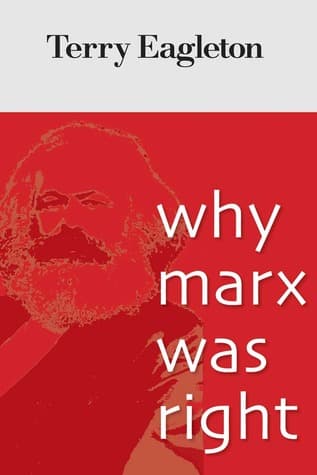
Why Marx Was Right cover
Archivist's Choice

Why Marx Was Right

Terry Eagleton (2011)

Genre

Politics / History / Economics / Philosophy

Reading Time

240 min

Key Themes

See below

Track Your Reading

Sign in to track this book

Terry Eagleton, with his signature wit, dissects ten common myths about Marxism, showing its lasting relevance and frequent misrepresentation in today's capitalist world.

Core Idea

Terry Eagleton argues that many criticisms of Marxism come from common misunderstandings, not from a true look at Marx's ideas. He debunks ten widespread criticisms, demonstrating that Marx's analysis of capitalism's contradictions, its tendency toward crisis, and its capacity for exploitation and alienation remains relevant. Eagleton believes Marxism offers a strong and necessary critique of modern society, pointing to a more just and democratic future beyond capitalism's limits, without suggesting a simple utopia or totalitarian state.
Reading time
240 min
Difficulty
Medium
✓ Read this if...
You are curious about what Marxism actually entails beyond common stereotypes, or you want a concise, intellectual defense of Marx's core ideas and their continued relevance in the 21st century.
✗ Skip this if...
You are looking for an introductory text to Marxist theory from scratch, or you are completely closed off to re-evaluating any aspect of Marxist thought, or you prefer purely historical accounts without contemporary political arguments.

Core idea

The central argument and framework that powers the entire book.

Terry Eagleton argues that many criticisms of Marxism come from common misunderstandings, not from a true look at Marx's ideas. He debunks ten widespread criticisms, demonstrating that Marx's analysis of capitalism's contradictions, its tendency toward crisis, and its capacity for exploitation and alienation remains relevant. Eagleton believes Marxism offers a strong and necessary critique of modern society, pointing to a more just and democratic future beyond capitalism's limits, without suggesting a simple utopia or totalitarian state.

At a glance

Reading time

240 min

Difficulty

Medium

Read this if...

You are curious about what Marxism actually entails beyond common stereotypes, or you want a concise, intellectual defense of Marx's core ideas and their continued relevance in the 21st century.

Skip this if...

You are looking for an introductory text to Marxist theory from scratch, or you are completely closed off to re-evaluating any aspect of Marxist thought, or you prefer purely historical accounts without contemporary political arguments.

Key Takeaways

1

Marxism is Not Totalitarianism

Distinguishing Marx's vision from Stalinist atrocities.

Quote

Marxism is a critique of capitalism, not a blueprint for a utopian society, and certainly not an endorsement of Stalinist totalitarianism.

One common criticism against Marxism is its supposed link to totalitarian regimes like the Soviet Union and Maoist China. Eagleton refutes this, arguing that these historical examples distort Marx's original thought, rather than being its logical result. Marx envisioned a classless society achieved through worker emancipation, stressing democratic control and individual growth, not a centralized, authoritarian state. The atrocities committed by these regimes came from specific historical, economic, and political conditions, often mark...

Supporting evidence

Eagleton highlights that Marx's writings explicitly condemn censorship and advocate for freedom of the press, contrasting sharply with the repressive nature of Stalinist states. He also points out that many of these 'Marxist' states arose in predominantly agrarian societies, a context Marx never anticipated for a socialist revolution, which he believed would emerge from advanced capitalism.

Apply this

When evaluating political ideologies, differentiate between the foundational theories and their historical implementations. Avoid guilt-by-association fallacies, and critically examine the specific conditions that lead to authoritarian outcomes, rather than attributing them solely to the ideology itself. Understand that a theory's misapplication does not inherently invalidate its core tenets.


totalitarianismstalinismauthoritarianismhistorical-materialism
2

Beyond Economic Determinism

Marx's nuanced view of base and superstructure.

Quote

Marxists do not believe that everything is reducible to economics. They believe that economics is ultimately determinant in the last instance, but that the 'last instance' may never arrive.

Another common error is that Marxism reduces all human activity, culture, politics, and thought to mere reflections of economic forces. Eagleton clarifies that while Marx saw the 'economic base' (modes of production) as fundamental, he never argued for a simple, one-way determinism where the 'superstructure' (law, politics, religion, art, philosophy) is just a passive mirror. Instead, he understood the relationship as complex and interactive. The superstructure can influence the base, within certain limits. Cultural practices, politic...

Supporting evidence

Eagleton cites Engels's later clarifications on historical materialism, which acknowledged that the superstructure can react back upon the economic base. He also points to Marx's own engagement with classical literature and philosophy, demonstrating a deep appreciation for culture beyond its economic utility.

Apply this

When analyzing social phenomena, avoid simplistic cause-and-effect explanations. Recognize that multiple factors — economic, cultural, political, and ideological — interact in complex ways. Understand that 'ultimate determination' does not mean 'sole determination' or 'immediate determination.' Seek out the interplay and feedback loops between different societal components.

economic-determinismbase-superstructurehistorical-materialismdialectics
3

Capitalism's Internal Contradictions

The inherent instability and self-destructive tendencies of the capitalist system.

Quote

The very forces that capitalism unleashes, the productive powers it generates, are precisely what threaten to bring it down.

Eagleton argues that Marx's most lasting insights are in his analysis of capitalism's inherent contradictions and its tendency toward crisis. Capitalism, driven by the pursuit of profit, constantly changes its production methods, creating immense wealth but also poverty, inequality, and instability. The system requires constant expansion, leading to boom-and-bust cycles, overproduction, and financial crises. The very mechanisms that make capitalism dynamic—competition, technology, globalization—also create problems by producing a vast...

Supporting evidence

Eagleton points to the 2008 financial crisis as a stark contemporary example of capitalism's inherent instability and its tendency towards self-destruction through speculative bubbles and unregulated markets, mirroring Marx's predictions of escalating crises.

Apply this

Critically analyze economic news and policies, looking beyond superficial explanations for crises. Understand that economic downturns are not merely 'glitches' but often stem from fundamental structural issues within capitalism itself, such as the drive for profit over social need, and the inherent conflict between capital and labor. Consider the long-term implications of economic policies on wealth distribution and social stability.

capitalismcrisis-theoryalienationclass-struggle
4

The End of History is Not Here

Marx's rejection of historical determinism and teleology.

Quote

Marx did not believe in an inevitable, pre-ordained march of history towards a socialist utopia. He saw history as open-ended, shaped by human struggle and contingency.

Contrary to popular belief, Marx was not a simple historical determinist who believed in an inevitable, linear progression toward communism. Eagleton stresses that Marx saw history as a process driven by class struggle and human action, not by some mystical, pre-ordained fate. While he identified certain trends and contradictions in historical development, he never suggested that socialism was a guaranteed outcome. The future, for Marx, depended on human action, political organization, and the conscious efforts of the working class. T...

Supporting evidence

Eagleton highlights Marx's emphasis on revolutionary practice and the need for class consciousness, demonstrating that societal change requires active human intervention, not passive waiting for an inevitable future. He also references Marx's writings on various historical possibilities and the role of chance.

Apply this

Reject fatalistic views of history and recognize the power of collective action to shape the future. Understand that social change is not automatic but requires conscious effort, organization, and struggle. Avoid assuming that current political or economic systems are permanent or 'the end of history.' Actively engage in shaping societal outcomes.

historical-determinismteleologyhuman-agencyclass-struggledialectical-materialism
5

Ethics and Justice in Marx

Uncovering the moral core behind Marx's critique of capitalism.

Quote

Marx's work is saturated with a passionate sense of moral outrage at the injustices and inhumanity of capitalism.

Despite the common idea that Marx was purely a 'scientific' analyst without ethical concerns, Eagleton argues that Marx's entire project is based on a strong moral vision and a commitment to justice. His critique of capitalism comes not just from its economic inefficiencies but, more importantly, from its dehumanizing effects: alienation, exploitation, and the denial of human potential. Marx condemned capitalism for reducing people to instruments of profit, for breaking up communities, and for stifling creativity and self-realization....

Supporting evidence

Eagleton points to Marx's early writings on alienation, particularly in the *Economic and Philosophic Manuscripts of 1844*, which vividly describe the psychological and spiritual damage inflicted by capitalist labor. He also references Marx's consistent condemnation of poverty and inequality.

Apply this

When evaluating economic and political systems, look beyond purely quantitative metrics (like GDP) to consider their ethical implications and impact on human dignity, well-being, and social justice. Recognize that a truly just society requires addressing systemic exploitation and alienation, not just providing welfare. Connect economic analysis with a moral framework.

alienationexploitationjusticeethicshuman-flourishing
6

The Revolutionary Potential of the Proletariat

Why Marx saw the working class as the agent of transformative change.

Quote

The working class, by virtue of its very position within capitalism, is the only class capable of universal emancipation, for its liberation entails the liberation of all.

Marx's focus on the proletariat as the agent of revolutionary change is often misunderstood as a romantic idealization. Eagleton clarifies that this was not based on moral superiority, but on a careful analysis of the working class's unique position within capitalism. The proletariat, without ownership of the means of production and forced to sell its labor, has no interest in maintaining the capitalist system. Also, its collective nature, brought together in factories and workplaces, offers the potential for organized resistance and ...

Supporting evidence

Eagleton refers to Marx's analysis in *The Communist Manifesto*, which identifies the proletariat as the only truly revolutionary class under capitalism due to its lack of private property and its collective experience of exploitation, making it a universal class.

Apply this

Understand that social change often originates from those most directly impacted by systemic injustices. Look for collective movements and organized labor as potential drivers of significant societal transformation. Recognize that true liberation for one group often requires dismantling structures that oppress all, even if indirectly.

proletariatclass-strugglerevolutionemancipationclass-consciousness
7

Beyond Utopia: A Practical Critique

Marx's realism contrasted with utopian socialist visions.

Quote

Marx was no utopian dreamer. His critique of capitalism was rooted in a materialist understanding of history and a practical assessment of existing social forces.

Many dismiss Marxism as an impractical, utopian fantasy. Eagleton argues the opposite: Marx criticized utopian socialism, which he saw as detached from the real conditions of class struggle and historical development. Unlike utopian socialists who proposed ideal societies from scratch, Marx sought to understand the inherent dynamics of capitalism and identify the real-world forces that could lead to its transformation. His vision of communism was not a detailed plan for a perfect society, but rather the 'real movement which abolishes ...

Supporting evidence

Eagleton contrasts Marx's approach with that of utopian socialists like Robert Owen or Charles Fourier, who designed elaborate, self-contained communities. Marx, in contrast, focused on analyzing the existing capitalist mode of production and the class relations it generated.

Apply this

When envisioning societal change, ground your ideas in a realistic assessment of current material conditions, power structures, and existing social forces. Avoid designing abstract 'perfect' systems without considering the practical steps and agents of change. Understand that radical transformation often emerges from the contradictions of the present, not from external ideals.

utopian-socialismscientific-socialismmaterialismrealpolitikpraxis
8

The Relevance of Alienation

How capitalism detaches us from our labor, products, species-being, and each other.

Quote

Alienation is not just a psychological state, but a fundamental structural feature of capitalist production, where human activity becomes an alien power over us.

Marx's concept of alienation remains relevant today. Eagleton explains how capitalism alienates individuals from four key aspects: the product of their labor (they don't own or control what they make), the act of labor itself (work becomes a means to an end, not fulfilling), their human nature (their creative, social essence is suppressed), and from other human beings (competition replaces cooperation). In modern society, this appears as meaningless jobs, consumerism as a substitute for real fulfillment, increasing social isolation de...

Supporting evidence

Eagleton directly references Marx's detailed analysis of alienation in the *Economic and Philosophic Manuscripts of 1844*. He implicitly connects this to modern phenomena like precarious work, the rise of mental health issues linked to job dissatisfaction, and the increasing sense of disconnect in consumer-driven societies.

Apply this

Reflect on how your work and consumption habits contribute to or mitigate alienation. Advocate for workplaces that prioritize worker autonomy, creativity, and meaningful contribution. Critically evaluate societal structures that commodify human activity and promote isolation. Seek out ways to reconnect with your creative essence and foster genuine community.

alienationcommodificationexploitationspecies-beinglabor
9

Socialism as Radical Democracy

Marx's vision for a truly democratic and self-governing society.

Quote

For Marx, socialism was not about state ownership of everything, but about the radical democratization of production and social life.

A common misrepresentation of Marxism is that it advocates for a single, centralized state that controls all aspects of life. Eagleton counters this, arguing that Marx's vision of socialism (and communism) was about expanding democracy beyond politics into economic and social areas. He envisioned a society where the means of production are collectively owned and democratically managed by the workers, leading to true self-governance. This is far from state bureaucracy; it is about empowering individuals and communities to collectively ...

Supporting evidence

Eagleton points to Marx's analysis of the Paris Commune, which he lauded as a model of workers' self-governance and direct democracy, rather than a centralized state apparatus. He also emphasizes Marx's critique of bureaucracy and the state as an oppressive force.

Apply this

Challenge definitions of democracy that are limited to electoral politics. Consider how democratic principles can be extended to economic decision-making, workplace governance, and community control over resources. Advocate for decentralized, participatory forms of organization rather than centralized, bureaucratic ones. Recognize that true self-determination requires economic as well as political freedom.

democracysocialismcommunismstate-witheringparis-commune
10

Marx's Enduring Critique of Capitalism

Why Marx's analysis of capitalism remains vital today.

Quote

The relevance of Marx is not that he offered a perfect solution, but that he provided the most profound and devastating critique of the system we still inhabit.

Ultimately, Eagleton's main point is that Marx's lasting legacy lies in his critique of capitalism, a system whose fundamental dynamics and contradictions he accurately diagnosed. Even if one disagrees with his proposed solutions, his analysis of exploitation, alienation, class struggle, and capitalism's instability remains a powerful way to understand global challenges today. From financial crises and widening inequality to environmental destruction driven by endless growth, many modern problems resonate with Marx's insights. Eagleto...

Supporting evidence

Eagleton frequently references the ongoing relevance of Marx's predictions regarding globalization, financial crises, and the concentration of wealth, demonstrating how these modern phenomena validate aspects of his critique.

Apply this

Engage with Marx's ideas not as dogma, but as a critical tool for analyzing contemporary society. Use his framework to question dominant narratives about economics, politics, and social progress. Even if you don't fully embrace Marxism, recognize its value in exposing the structural inequalities and systemic problems within capitalism, fostering a more nuanced and critical perspective on the world.

capitalism-critiqueclass-struggleexploitationalienationcontemporary-relevance

Critical analysis

Notable Quotes

Marxism, by contrast, is a critique of capitalism, not a model for some future society.

Explaining the nature of Marxist thought as analytical rather than prescriptive.

The true measure of all wealth is the disposable time of society.

Discussing the alienation of labor and the potential for human flourishing beyond commodity production.

Capitalism will not be overthrown by a mass of starving workers with nothing to lose but their chains.

Challenging a common misinterpretation of Marx's prediction regarding revolution.

Marxism is not a theory of inevitable historical progress.

Addressing the deterministic critique often leveled against historical materialism.

Freedom, for Marx, is not the absence of constraint, but the capacity for self-realisation.

Defining Marx's nuanced understanding of freedom in contrast to liberal individualism.

Socialism is not about abolishing private property tout court, but about abolishing private ownership of the means of production.

Clarifying a key distinction often misunderstood in socialist theory.

The point is not just to interpret the world, but to change it.

Emphasizing Marx's commitment to practical action and transformation.

It is not consciousness that determines life, but life that determines consciousness.

Introducing the materialist conception of history and its implications for understanding human thought.

The greatest revolutions are not those that change the government, but those that change the way people think.

Highlighting the profound societal shifts envisioned by Marx beyond mere political coups.

Capitalism, for Marx, is a system that constantly revolutionizes its own means of production.

Describing the inherent dynamism and instability of capitalist economies.

The ruling ideas of each age have ever been the ideas of its ruling class.

Explaining the ideological power of dominant social classes.

Marx thought that capitalism would eventually run out of steam, not because it was inefficient, but because it was too efficient.

Presenting Marx's unique critique of capitalism's productive capacity leading to crises.

Marxism is not just about poverty; it's about power.

Broadening the scope of Marxist analysis beyond economic deprivation to include social and political domination.

The state is not a neutral arbiter but an instrument of class rule.

Outlining Marx's view on the role and function of the state in class society.

Quiz

Test Your Knowledge

Ready to see how well you understood this book? Take our interactive quiz with 10 questions.

10
Questions
~5
Minutes
?
Best Score

Key Questions (FAQ)

Terry Eagleton argues that the historical examples often cited as Marxist tyrannies are gross distortions of Marx's original thought. He contends that Marx himself was a fierce critic of state power and that these regimes arose from specific historical circumstances and interpretations, rather than being an inherent outcome of Marxist theory.

About the author