“Midway upon the journey of our life I found myself within a forest dark, for the straightforward pathway had been lost.”
— The opening lines of the Inferno, where Dante realizes he has strayed from the righteous path.


Dante Alighieri (1823)
Genre
Fantasy / Spirituality / Philosophy
Reading Time
970 min
Key Themes
See below
Sign in to track this book
Explore sin, repentance, and divine love with Dante's classic poem, guided by expert insights.
At the start of the Divine Comedy, on Good Friday evening in 1300, Dante Alighieri is lost and scared in a dark wood, which represents spiritual confusion and sin. He tries to climb a sunny hill but is blocked by three fierce beasts: a leopard (lust/fraud), a lion (pride/violence), and a she-wolf (greed). These drive him back into the shadows. As he loses hope, a figure appears, identifying himself as the Roman poet Virgil, Dante's literary hero. Virgil explains that Beatrice, Dante's love, sent him from Heaven to guide Dante through the afterlife to salvation. However, Virgil warns that he cannot enter Paradise himself because he is a pagan.
Virgil leads Dante to the Gates of Hell, which bear the chilling warning, 'Abandon all hope, ye who enter here.' Inside, they first find the Ante-Inferno, where the 'neutrals' – those who lived without good or evil – are endlessly stung by wasps and flies, chasing a meaningless banner. They then cross the Acheron River, ferried by Charon, into Limbo, the first circle of Hell. Here, Dante sees unbaptized infants and virtuous pagans, including famous philosophers, poets, and heroes like Homer, Socrates, Plato, and Virgil. Their punishment is not physical pain but eternal longing and sorrow, as they live without hope of ever knowing God.
Going deeper into Hell, Dante and Virgil meet Minos, the judge who assigns souls to their circle by coiling his tail. In the second circle, the lustful are swept forever by a strong whirlwind, unable to rest, as seen with Francesca da Rimini and Paolo Malatesta. The third circle punishes the gluttonous, who lie in freezing mud under a constant, dirty rain, guarded by the three-headed dog Cerberus. The fourth circle holds the greedy and the wasteful, who endlessly push huge weights against each other. Finally, in the fifth circle, the wrathful furiously attack each other in the muddy Styx River, while the sullen lie submerged beneath it, gurgling their sorrow.
The journey continues to the fiery walls of the City of Dis, the capital of lower Hell, guarded by fallen angels who initially refuse them entry. Medusa and the Furies threaten them, but a heavenly messenger intervenes, opening the gates. Inside the sixth circle, Dante sees the heretics, mostly Epicureans, trapped in fiery tombs. Here, he speaks with Farinata degli Uberti, a Ghibelline leader, and Cavalcante de' Cavalcanti, father of Dante's friend Guido. This circle marks the divide between sins of lack of control (upper Hell) and sins of malice (lower Hell), which are punished more severely and are considered more serious offenses against God and reason.
Beyond the City of Dis, the seventh circle is for violence. It has three rings. The first ring, the Phlegethon, is a river of boiling blood where those violent against neighbors (tyrants, murderers) are submerged to different levels, guarded by centaurs who shoot arrows at those who try to rise. The second ring is the Wood of Suicides, where those violent against themselves (suicides) become twisted trees, their leaves eaten by Harpies, and their bodies can only speak when a branch is broken. The third ring punishes those violent against God, nature, and art (blasphemers, sodomites, usurers) under a constant rain of fire on a burning plain.
Dante and Virgil ride on the back of the monster Geryon, a creature representing fraud, down into Malebolge ('Evil Pouches'), the eighth circle of Hell. This circle has ten concentric ditches, or 'bolge,' each punishing a different type of ordinary fraud. They see panderers and seducers (whipped by demons), flatterers (in excrement), simoniacs (head-down in holes with fiery feet), sorcerers and false prophets (heads twisted backward), barrators (in boiling tar, guarded by demons), hypocrites (wearing heavy leaden cloaks), thieves (attacked by snakes and changing forms), fraudulent counselors (in flames), sowers of discord (mutilated), and finally, falsifiers (with horrible diseases).
The ninth and final circle of Hell, Cocytus, is a large, frozen lake, divided into four concentric rings, each punishing a different level of treachery. Caina holds those who betrayed kin (frozen up to their necks). Antenora contains those who betrayed their country (frozen up to their heads). Ptolomea traps those who betrayed guests (frozen with only their faces exposed, tears freezing their eyes shut). Finally, Judecca punishes those who betrayed their masters (completely submerged in ice, twisted). At the very center of Hell, trapped in the ice, is Lucifer, the ultimate betrayer, a three-headed monster chewing on Brutus, Cassius, and Judas Iscariot. Dante and Virgil climb down Lucifer's hairy body, pass the center of the Earth, and emerge on the other side.
After leaving Hell, Dante and Virgil arrive on the shores of Mount Purgatory, an island mountain rising from the southern hemisphere. Cato of Utica, the guardian of Purgatory, purifies them. In the Ante-Purgatory, they meet souls who delayed repentance or died violently, who must wait before starting their climb. This includes the excommunicated, negligent rulers, and those who repented at the last moment. They see an angelic boat bringing new souls to the mountain and learn about Purgatory as a place of hope and temporary suffering, a stark contrast to the eternal despair of Hell.
Dante and Virgil climb the seven terraces of Mount Purgatory, each for one of the seven deadly sins, in reverse order of severity from Hell. On each terrace, souls do specific penances to cleanse their sin. They see the proud carrying heavy stones, the envious with their eyes sewn shut, the wrathful in acrid smoke, the lazy running endlessly, the greedy lying face down, the gluttonous starved by tempting trees, and the lustful walking through purifying flames. On each terrace, Dante is marked with a 'P' (for *peccatum*, sin), which an angel erases as he purges that sin, leading to his complete purification.
Having climbed all seven terraces and cleansed of all sin, Dante reaches the Earthly Paradise (Garden of Eden) at the top of Mount Purgatory. Here, he meets Matilda, a mysterious woman who guides him through the ideal landscape. A grand procession, representing the history of the Church, unfolds before him. At its peak, Beatrice descends from a cloud-borne chariot, radiant and majestic. Her appearance marks a key moment: Virgil, having finished his role as the guide of reason, quietly leaves, unable to enter Paradise. Beatrice, representing divine revelation and grace, now guides Dante, leading him toward the ultimate vision of God.
Beatrice leads Dante through the nine concentric celestial spheres of Paradise, each linked to a planet or star and home to different categories of the blessed. In the Moon, they meet souls who broke vows. In Mercury, those who sought honor. In Venus, the lovers. In the Sun, the wise theologians and philosophers. In Mars, the warriors of faith. In Jupiter, the just rulers. In Saturn, the contemplatives. In the Fixed Stars, they see the triumph of Christ and Mary and are questioned on faith, hope, and charity by Saints Peter, James, and John. Each sphere offers Dante a growing understanding of divine order and love, preparing him for the ultimate vision.
Beatrice brings Dante to the Primum Mobile, the ninth and outermost sphere, which moves all lower spheres. Beyond this, they ascend to the Empyrean, the unmoving, non-material heaven that is where God and all the blessed souls live. Here, Beatrice changes into her glorious form, then yields her place to Saint Bernard of Clairvaux, who will guide Dante to the final vision. Dante sees the vast assembly of the blessed arranged as a celestial rose, each petal a soul, bathed in eternal light. He recognizes many figures, including Mary, Adam, and other saints, all united in perfect harmony and love.
Guided by Saint Bernard, Dante's vision becomes clearer, allowing him to see the mystery of the Holy Trinity. He sees three distinct circles of light, representing the Father, Son, and Holy Spirit, yet unified as one. He struggles to understand how human and divine natures are united in Christ within this divine essence. In a sudden flash of insight, given by divine grace, his mind is illuminated, and he finally grasps the unity of all creation within divine love. His will and desire are now aligned with God's, and the poem ends with this ineffable, transcendent moment of understanding and perfect peace, his journey complete.
La Vita Nuova begins with Dante, at age nine, meeting Beatrice Portinari for the first time. Even then, her beauty and grace deeply affect him, imprinting her image on his soul and awakening love within him. Nine years later, at eighteen, he meets her again. Beatrice greets him with a nod, which fills him with such joy that he goes to his room and dreams of Love holding Beatrice in his arms, feeding her Dante's burning heart. This second meeting solidifies his devotion, and he begins to write poetry for her, keeping his love secret by pretending interest in other 'screen ladies' to deflect attention from Beatrice.
Dante's pure, spiritual love for Beatrice deepens, expressed through his sonnets and canzoni. However, his earthly joy is shattered by Beatrice's early death. He describes her passing with great sorrow, lamenting the loss of such a virtuous and beautiful soul. His grief is so strong that he withdraws from society, consumed by his pain. During this time, he writes some of his most moving poetry, reflecting on her perfection and his despair. He eventually finds comfort in the idea that Beatrice is now in Heaven, a blessed soul, and he decides to write about her in a way no woman has ever been written about before, leading to the grand vision of the Divine Comedy.
The Protagonist
From a lost, sinful man, Dante transforms into a purified soul capable of witnessing the Beatific Vision, achieving spiritual enlightenment and understanding.
The Supporting
Serves as a steadfast mentor, guiding Dante to the limits of human reason before gracefully yielding to divine revelation.
The Supporting
From an earthly beloved, Beatrice transforms into a celestial guide, embodying divine wisdom and leading Dante to the ultimate vision of God.
The Antagonist
Remains eternally static, a symbol of ultimate, unrepentant evil, serving as a fixed point for Dante's passage out of Hell.
The Supporting
Appears briefly as a gatekeeper, fulfilling his eternal role without personal development.
The Supporting
Functions as a fixed element of Hell's judicial system, without a personal arc.
The Mentioned
Serves as a poignant example of the consequences of lust, eliciting Dante's profound pity.
The Supporting
Remains a steadfast guardian, embodying the principles of freedom and virtue that initiate the purgatorial journey.
The Supporting
Guides Dante through the final stage of mystical contemplation, facilitating the Beatific Vision.
The Divine Comedy is built on divine justice, showing how every sin gets a fitting punishment (contrapasso) in Hell, and every virtue is rewarded in Paradise. Punishments in Hell are not random; they mirror the sin, often by reversal or comparison, like the lustful swept by winds (lacked control in life) or hypocrites wearing beautiful but heavy leaden cloaks (outward appearance vs. inner burden). Purgatory also reflects justice, as souls willingly do penance to cleanse their sin. In Paradise, justice appears as perfect harmony and varying degrees of blessedness, showing how souls can receive God's light. Dante's journey teaches him this complex and perfect justice.
“'Justice moved my high maker; divine power made me, / The highest wisdom, and the primal love.'”
Dante's trip through the afterlife is a journey of personal and spiritual redemption. He starts as a lost and sinful man in the dark wood, symbolizing spiritual error. Through meeting various souls, seeing sin and virtue, and understanding divine order, he changes deeply. In Hell, he faces sin and learns to tell the difference between pity for suffering and condemnation of sin. In Purgatory, he actively cleanses his own sins, shown by the 'P' marks on his forehead, which are slowly erased. By the time he reaches Paradise, he is purified and can experience the ultimate divine vision, representing a soul's complete spiritual rebirth. This journey mirrors the Christian path to salvation.
“'And then he led me out to see the stars again.'”
Love drives the entire cosmos and Dante's journey. Beatrice's love for Dante, and her help from the Virgin Mary, starts his journey, showing divine grace. The structure of Paradise itself is ruled by divine love, which moves the stars and unites all creation. In Hell, the lack or distortion of love leads to damnation; for example, the lustful, driven by carnal love, suffer forever. In Purgatory, souls are motivated by a pure love of God to do penance. Ultimately, the Beatific Vision is an experience of pure, unadulterated divine love, which aligns Dante's will with God's. 'La Vita Nuova' specifically explores how human, courtly love can transform, raising Dante to spiritual thought, hinting at his later divine love for Beatrice.
“'The Love that moves the sun and the other stars.'”
This theme is central to Dante's guidance through the afterlife. Virgil, representing human reason and classical philosophy, is an essential guide through the moral and intellectual complexities of Hell and Purgatory. He can explain sin and the path to purification. However, Virgil's journey ends at the edge of the Earthly Paradise, as reason alone cannot grasp divine mysteries or lead to salvation. Beatrice, embodying divine revelation, theology, and grace, takes over to guide Dante through Paradise. Her guidance goes beyond logical explanation, leading Dante to direct spiritual experience and the ultimate vision of God, showing that faith and divine insight are needed to fully understand the divine.
“'As far as reason sees, I can tell you; / Beyond that, only faith can teach you.'”
Dante uses the journey through the afterlife to criticize the political and moral corruption of his time in Italy, especially Florence, and the Church. He places many real-life figures, including popes, politicians, and Florentine citizens, in Hell for their sins (e.g., simony, treachery, greed). He laments the civil strife, misuse of power by secular rulers, and moral decay within the papacy. Purgatory also includes figures who repented late, highlighting the human tendency toward neglect. Through these condemnations and observations, Dante argues for a pure Church and a unified, just Holy Roman Empire as the ideal political structure, believing these would lead to a more righteous society.
“'Ah, Florence, you may well be pleased with this digression / That strikes not at yourself, thanks to your people!'”
The principle of divine justice where the punishment fits the sin by analogy or inversion.
Contrapasso is the foundational principle of divine justice in Dante's Hell. It dictates that the punishment of a soul should either mirror the sin committed, or be its direct opposite. For example, the lustful are endlessly tossed by winds because in life they were swept away by their passions. The gluttonous lie in filthy slush, symbolizing their excessive and disgusting consumption. The sowers of discord are perpetually mutilated, their bodies split open just as they split society. This device serves to underscore the perfect, rational, and often ironic nature of God's justice, making the consequences of sin immediately comprehensible and vivid to Dante and the reader.
The use of characters, events, and settings to represent abstract ideas or moral qualities.
The entire Divine Comedy is a multi-layered allegory. Dante's journey is not just a literal trip through the afterlife, but an allegorical representation of the soul's journey from sin (the Dark Wood) through purification (Purgatory) to salvation (Paradise). Characters like Virgil (human reason), Beatrice (divine grace/revelation), and the three beasts (lust, pride, avarice) are all allegorical figures. The settings themselves, from the circles of Hell to the terraces of Purgatory and the spheres of Heaven, allegorically represent different moral states and theological truths. This device allows Dante to explore complex philosophical, theological, and moral concepts through a vivid narrative.
A character who leads the protagonist through a perilous or unknown realm, providing knowledge and protection.
The use of guide figures is crucial to Dante's journey. Virgil, as the embodiment of human reason and classical wisdom, guides Dante through the dangers and moral complexities of Hell and Purgatory. He explains the nature of sin, the structure of the afterlife, and protects Dante from demonic threats. Beatrice, representing divine revelation and grace, takes over in Paradise, leading Dante through the celestial spheres and towards the Beatific Vision, providing theological insights. Finally, Saint Bernard, symbolizing mystical contemplation, prepares Dante for his ultimate encounter with God. These guides are essential for Dante's understanding and survival, reflecting the necessity of different forms of guidance for spiritual enlightenment.
The pervasive use of specific numbers to convey theological and structural meaning.
Dante employs numerical symbolism extensively, most notably with the number three and its multiples. The Divine Comedy is divided into three canticles (Inferno, Purgatorio, Paradiso). Each canticle has 33 cantos (plus an introductory canto in Inferno, making 100 total). Hell has nine circles, Purgatory has seven terraces plus Ante-Purgatory and the Earthly Paradise (totaling nine divisions), and Heaven has nine spheres plus the Empyrean. This reflects the Holy Trinity (Father, Son, Holy Spirit) and the perfection associated with the number nine (three times three). This structural symbolism reinforces the theological framework of the poem and its divine order, creating a sense of balance and cosmic design.
Appeals to divine inspiration or classical muses to assist in the daunting task of poetic creation.
Dante frequently invokes the Muses or other divine powers at crucial points in his narrative, particularly when describing particularly challenging or sublime scenes. For example, he calls upon the Muses at the beginning of Inferno, and later in Purgatorio and Paradiso, he invokes Apollo or other celestial lights. This device serves multiple purposes: it acknowledges the monumental difficulty of portraying such transcendent experiences, it positions Dante within the classical poetic tradition, and it emphasizes that his poetic endeavor requires divine assistance to accurately represent the truths he witnesses. It also highlights the sacred nature of his subject matter, differentiating it from purely human artistic creation.
“Midway upon the journey of our life I found myself within a forest dark, for the straightforward pathway had been lost.”
— The opening lines of the Inferno, where Dante realizes he has strayed from the righteous path.
“Abandon all hope, ye who enter here.”
— The inscription above the gate of Hell, warning those who pass through.
“The darkest places in hell are reserved for those who maintain their neutrality in times of moral crisis.”
— Dante's observation about the punishment for the 'neutrals' or 'opportunists' in the Ante-Inferno.
“Love, that in gentle heart is quickly born, seized him for the fair form that was ta'en from me; and the manner still afflicts me.”
— Francesca da Rimini recounts her tragic love affair with Paolo, leading to their damnation in the circle of Lust.
“There is no greater sorrow than to recall happiness in a time of misery.”
— Francesca da Rimini's famous line, expressing her pain when asked to recount her past joy.
“Consider your origin; you were not made to live as brutes, but to follow virtue and knowledge.”
— Ulysses's speech to his crew, urging them to sail beyond the known world in pursuit of knowledge, leading to their demise.
“From a little spark may burst a mighty flame.”
— A proverb-like statement found in the Paradiso, emphasizing the potential of small beginnings.
“The more a thing is perfect, the more it feels pleasure and pain.”
— A philosophical observation in Paradiso, linking perfection to the capacity for intense experience.
“His will is our peace.”
— Piccarda Donati's explanation in Paradiso of why she is content with her assigned place in Heaven, despite not fulfilling her earthly vows.
“And the will that stirs the sun and other stars.”
— The final line of the Paradiso, and the entire Divine Comedy, referring to the Love of God.
“The path to paradise begins in hell.”
— An overarching theme of the Divine Comedy, where Dante must journey through Hell and Purgatory to reach Heaven.
“O human race, born to fly upward, why are you cast down at every little wind?”
— An observation in Purgatorio, lamenting humanity's tendency to be easily swayed from its higher purpose.
“To get to the other side, you must first go through the dark.”
— A metaphorical summary of Dante's journey through the underworld to reach salvation.
“Beauty awakens the soul to act.”
— A general philosophical idea expressed in the Paradiso, linking beauty to spiritual and moral action.
Ready to see how well you understood this book? Take our interactive quiz with 10 questions.
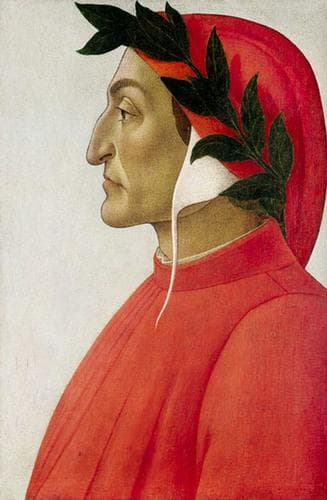
Dante Alighieri, most likely baptized Durante di Alighiero degli Alighieri and often referred to as Dante, was an Italian poet, writer and philosopher. His Divine Comedy, originally called Comedìa and later christened Divina by Giovanni Boccaccio, is widely considered one of the most important poems of the Middle Ages and the greatest literary work in the Italian language.







