BookBrief
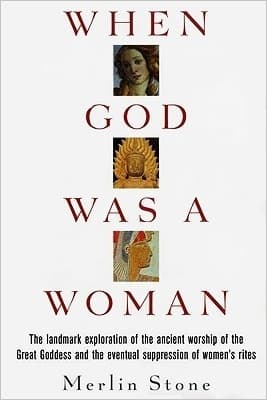
When God Was a Woman cover
Archivist's Choice

When God Was a Woman

Merlin Stone (1976)

Genre

History / Spirituality

Reading Time

270 min

Key Themes

See below

Track Your Reading

Sign in to track this book

This book unearths millennia of suppressed history, revealing the forgotten era of Goddess worship, a world where female divinity was central and women held positions of power before patriarchal religions changed things.

Core Idea

Merlin Stone's "When God Was a Woman" reconstructs a pre-patriarchal history where the Divine Feminine, called the Goddess, was the main deity in many ancient cultures. Stone says evidence for this matrifocal era, which included female lineage, sacred sexuality, and women's respected roles, has been hidden and twisted by later patriarchal religions and history. By examining ancient myths, archaeological finds, and language patterns, the book aims to show the intentional removal of the Goddess and the later negative portrayal of women. It says that understanding this lost history helps us understand the roots of gender inequality and reclaim a part of human heritage.
Reading time
270 min
Difficulty
Medium
✓ Read this if...
You are interested in the historical role of goddesses, the origins of patriarchy, or alternative interpretations of ancient history and mythology.
✗ Skip this if...
You prefer mainstream historical narratives exclusively or are uncomfortable with critical analyses of established religious histories.

Core idea

The central argument and framework that powers the entire book.

Merlin Stone's "When God Was a Woman" reconstructs a pre-patriarchal history where the Divine Feminine, called the Goddess, was the main deity in many ancient cultures. Stone says evidence for this matrifocal era, which included female lineage, sacred sexuality, and women's respected roles, has been hidden and twisted by later patriarchal religions and history. By examining ancient myths, archaeological finds, and language patterns, the book aims to show the intentional removal of the Goddess and the later negative portrayal of women. It says that understanding this lost history helps us understand the roots of gender inequality and reclaim a part of human heritage.

At a glance

Reading time

270 min

Difficulty

Medium

Read this if...

You are interested in the historical role of goddesses, the origins of patriarchy, or alternative interpretations of ancient history and mythology.

Skip this if...

You prefer mainstream historical narratives exclusively or are uncomfortable with critical analyses of established religious histories.

Key Takeaways

1

The Primacy of the Goddess

Before patriarchal religions, a widespread Goddess-worshipping culture revered female divinity and principles.

Quote

The religion of the Goddess was based upon the worship of the female as the giver and sustainer of life, and it was the primary religion of the ancient world.

Merlin Stone argues that a dominant, widespread religion focused on the worship of a Great Goddess existed before and alongside the early patriarchal religions. This was not just a local group but a common belief system across the ancient Near East, Europe, and parts of Africa. The Goddess was honored in different ways as the creator, the source of fertility, wisdom, and justice. This focus on female divinity naturally raised the status of women in society, as they were seen as direct reflections of the sacred. The book questions the ...

Supporting evidence

Stone cites numerous archaeological findings, including thousands of female figurines from Neolithic sites across Europe and the Near East (e.g., Catal Huyuk, Vinca culture), and ancient texts/myths that depict a powerful female creator or supreme deity (e.g., Sumerian Inanna, Egyptian Isis, Anatolian Cybele).

Apply this

Re-evaluate historical narratives of religion and gender roles, understanding that the subjugation of women is not an inherent or 'natural' state but a historical construct tied to specific religious and social shifts.


goddess-worshipmatriarchal-societiesneolithic-religion
2

Societal Reflection of Divine Feminine

In Goddess cultures, women held prominent roles in leadership, priesthood, and societal structures, reflecting the divine feminine.

Quote

In societies where the Goddess was worshipped, women often held positions of power and reverence, serving as priestesses, queens, and tribal leaders.

The book suggests a direct link between respecting a female deity and the higher status of women in society. In these Goddess-centered cultures, women were not just in domestic roles. They actively participated in and often led religious, political, and economic life. Stone points to many female priestesses who interpreted divine will, healed, and taught. She also mentions historical and mythical accounts of queens and matriarchs who had significant power. This society, where women's authority was recognized and celebrated, contrasts ...

Supporting evidence

Stone discusses the role of priestesses in ancient temples (e.g., those dedicated to Ishtar in Mesopotamia or the Oracle of Delphi), as well as archaeological evidence of female burial sites indicating high status and the existence of 'matrilineal' inheritance patterns in some early societies.

Apply this

Recognize that gender equality and female leadership are not modern inventions but have historical precedents, offering a powerful counter-narrative to patriarchal historical interpretations.

female-leadershippriestesshoodmatrilineal-societies
3

The Sacredness of Female Sexuality

Goddess religions celebrated female sexuality, fertility, and the birthing process as sacred, not as sources of sin or shame.

Quote

The creative power of the female was revered, and her sexuality was seen as sacred, a direct manifestation of the divine life-giving force.

Stone makes a key difference between Goddess religions and later patriarchal systems regarding how female sexuality was viewed. In Goddess worship, the female body, its ability to reproduce, and sexual expression were sacred and divine. They were directly connected to the earth's fertility and the cosmic creative power. There was no idea of 'original sin' linked to female sexuality; instead, it was a source of power and respect. Birth was seen as a miracle, and menstruation was often connected to lunar cycles and spiritual insight. Th...

Supporting evidence

Stone references ancient fertility cults, the widespread use of vulva symbols in ancient art, and myths where goddesses engage in sexual acts as part of creation or renewal (e.g., Inanna's sacred marriage rites).

Apply this

Challenge contemporary attitudes towards female sexuality and the female body that are rooted in shame or control, by understanding their historical origins in patriarchal shifts rather than inherent truths.

sacred-sexualityfertility-cultsbody-positivity
4

The Eradication of the Goddess

The rise of patriarchal invaders led to the violent suppression and systematic demonization of Goddess religions.

Quote

The overthrow of the Goddess was not a peaceful transition, but a violent conquest, resulting in the systematic destruction of her temples and the demonization of her worshipers.

Stone argues that the end of Goddess worship was not a natural process. Instead, it was a deliberate and often violent action by invading patriarchal tribes (like Indo-Europeans, Semites). These groups, with their male gods and warrior gods, actively suppressed the existing Goddess cultures. This included destroying temples, defiling sacred sites, rewriting myths to lessen or demonize female deities, and subjugating women. The book describes this cultural clash as a violent fight for control. It resulted in the systematic removal of a...

Supporting evidence

Stone points to archaeological layers showing destruction and replacement of Goddess shrines with male-deity temples, the shift in mythology where goddesses are defeated or raped by male gods (e.g., Marduk vs. Tiamat), and historical accounts of invasions and conquests.

Apply this

Understand how power dynamics and conquest shape religious narratives and societal structures, and how history is often written by the victors to legitimize their dominance.

patriarchal-invasionreligious-persecutionmyth-reinterpretation
5

Myth as Historical Record

Ancient myths, often dismissed as mere fiction, contain encoded historical accounts of cultural shifts and conflicts.

Quote

Myths are not merely fanciful tales, but often contain veiled records of actual historical events, cultural transformations, and conflicts between differing belief systems.

Stone says that ancient myths, epics, and religious stories should be studied not just for their spiritual or symbolic meaning, but also as veiled historical documents. She argues that stories of gods fighting goddesses, or heroes conquering monstrous female figures, often represent actual historical conflicts: the clash between patriarchal invaders and established Goddess-worshipping societies. By understanding these myths, Stone finds evidence of the violent overthrow of matriarchal systems and the later negative portrayal of the Gr...

Supporting evidence

Stone re-examines myths like the Greek Gorgon Medusa (interpreted as a powerful Libyan Goddess demonized by patriarchal heroes) or the slaying of the dragon Tiamat by Marduk (representing the triumph of Babylonian patriarchy over an earlier Goddess cult).

Apply this

Approach ancient texts and folklore with a critical eye, seeking deeper historical and sociological meanings beyond surface-level interpretations, especially regarding gender dynamics.

myth-analysishistorical-mythologycultural-memory
6

The Demonization of Women

The suppression of the Goddess religion directly led to the systematic demonization and subjugation of women.

Quote

As the Goddess was dethroned and demonized, so too were women, whose status plummeted from revered to reviled.

A main argument of the book is that the decline of the Goddess was directly linked to the decline in women's status. Once the divine feminine was suppressed and replaced by male deities, women, who had been seen as reflections of the sacred, became associated with sin, temptation, and inferiority. Stone explains how priestesses were called witches, sacred sexual rites were called prostitution, and the act of female creation (childbirth) lost its divine meaning. This change in ideas gave religious justification for patriarchal control....

Supporting evidence

Stone traces the origins of concepts like 'original sin' and the portrayal of women as 'temptresses' in Judeo-Christian traditions back to the demonization of earlier Goddess figures and their associated practices.

Apply this

Identify and challenge misogynistic narratives and practices in contemporary culture, recognizing their deep historical roots in the overthrow of earlier, more egalitarian systems.

misogyny-originswitch-huntspatriarchal-oppression
7

Tracing the Lost Lineage

Despite suppression, echoes of Goddess worship persisted and can be found in later religious traditions.

Quote

Even after centuries of suppression, traces and remnants of the Goddess religion can be discerned within the very traditions that sought to eradicate her.

Stone says that the removal of the Goddess was never fully successful. Despite strong efforts to erase her, parts of Goddess worship, symbols, and myths continued. They were often absorbed, reinterpreted, or combined into the new patriarchal religions. She points to figures like the Virgin Mary, who, though a mother without a divine partner, has many qualities of earlier Great Mothers. Also, some folk traditions, pagan practices, and even specific saints or rituals may carry faint reminders of the ancient reverence for the feminine di...

Supporting evidence

Stone discusses the veneration of the Virgin Mary, arguing she inherited many attributes of earlier Goddesses like Isis or Cybele. She also references pre-Christian pagan survivals in European folklore and certain local cults.

Apply this

Explore the hidden layers of religious and cultural practices, seeking out the influences and survivals of pre-patriarchal belief systems to gain a richer understanding of cultural evolution.

religious-syncretismpagan-survivalsvirgin-mary-cult
8

The Importance of Female Lineage

Matrilineal inheritance and descent were significant in Goddess cultures, emphasizing the mother's role in identity.

Quote

In many Goddess-worshipping societies, lineage was traced through the mother, reflecting her central role in the family and community.

Merlin Stone highlights matrilineal descent as a key feature of many Goddess-revering societies. In these systems, identity, inheritance, and social status passed through the mother's line, not the father's. This structure naturally made women more important within the family and wider community, as their motherhood was the clear link to lineage. This differs sharply from patriarchal patrilineal systems, where fatherhood (often uncertain) became most important and women's roles were reduced. The shift from matrilineal to patrilineal s...

Supporting evidence

Stone refers to ancient Cretan culture and certain early Semitic groups where matrilineal practices are evidenced, and discusses how the concept of 'fatherhood' itself evolved and gained importance with patriarchal shifts.

Apply this

Consider how different systems of descent impact gender roles and power dynamics within families and society, and how historical shifts in these systems have shaped contemporary social structures.

matrilineal-descentfamily-structuregender-identity
9

Reclaiming Lost History

Understanding the Goddess era is crucial for a complete and equitable understanding of human history and spirituality.

Quote

To truly understand our past, and to envision a more equitable future, we must reclaim and acknowledge the long-suppressed history of the Goddess.

The book is a call to action. It says that recovering the history of Goddess worship is not just an academic task. It is a vital step towards a more complete and fair understanding of human history and spirituality. By knowing about these ancient cultures and their suppression, we can better understand the roots of gender inequality, religious intolerance, and societal power structures. Stone implies that recognizing this 'lost' period allows us to rethink current ideas and offers other ways for spiritual and social organization that ...

Supporting evidence

The entire book's methodology—synthesizing archaeology, mythology, and historical texts—serves as evidence for the possibility and necessity of reclaiming this history.

Apply this

Engage critically with mainstream historical narratives and seek out marginalized histories, particularly those concerning women and non-dominant spiritual traditions, to foster a more nuanced worldview.

revisionist-historyfeminist-archaeologyspiritual-reclamation

Critical analysis

Notable Quotes

The image of the Goddess was not a symbol of a female deity who was worshipped in place of a male god; she was the symbol of the unity of all life in nature.

Explaining the role of the Goddess in ancient matriarchal societies.

For thousands of years, before the advent of patriarchal religions, the female deity was revered as the primary creative force in the universe.

Historical overview of pre-patriarchal spirituality.

The suppression of the Goddess was not a natural evolution of religious thought but a deliberate political act.

Discussing the transition from matriarchal to patriarchal societies.

In the ancient world, the female principle was seen as the source of all life, wisdom, and regeneration.

Describing the spiritual beliefs of early civilizations.

The worship of the Goddess was intimately connected with the cycles of nature, agriculture, and the human body.

Linking ancient spirituality to natural and bodily rhythms.

Patriarchal religions systematically erased the memory of the Goddess, rewriting history to place male deities at the center.

Analyzing the historical revisionism by patriarchal systems.

The female deity was often depicted as a serpent, symbolizing wisdom, healing, and the life force.

Explaining symbolic representations of the Goddess.

Ancient societies that revered the Goddess tended to be more egalitarian and peaceful.

Comparing social structures in matriarchal and patriarchal eras.

The concept of a male god as the sole creator is a relatively recent development in human history.

Challenging the notion of male-dominated creation myths.

Rituals honoring the Goddess often involved dance, music, and communal celebration, emphasizing joy and connection.

Describing the practices of Goddess worship.

The decline of the Goddess coincided with the rise of militaristic, hierarchical societies.

Connecting spiritual shifts with social and political changes.

Rediscovering the Goddess tradition offers a way to reconnect with a more holistic and life-affirming spirituality.

Advocating for the relevance of ancient beliefs in modern times.

The female deity was not just a mother figure but also a warrior, healer, and wise crone.

Highlighting the multifaceted nature of the Goddess.

Archaeological evidence from sites like Çatalhöyük and Malta reveals widespread worship of the Goddess across ancient cultures.

Citing historical and archaeological support for the book's thesis.

Quiz

Test Your Knowledge

Ready to see how well you understood this book? Take our interactive quiz with 10 questions.

10
Questions
~5
Minutes
?
Best Score

Key Questions (FAQ)

The book argues that ancient societies worshipped a female deity (the Goddess) in a matriarchal or matrilineal system, where women held significant social and religious power. It traces how this system declined with the rise of patriarchal religions like Judaism and Christianity, leading to diminished status for women.

About the author