BookBrief
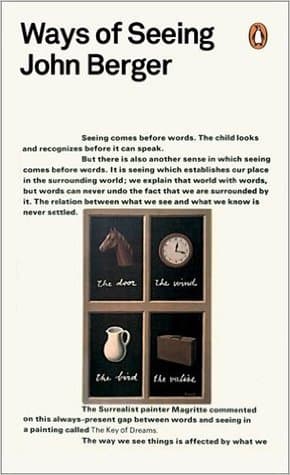
Ways of Seeing cover
Archivist's Choice

Ways of Seeing

John Berger (1972)

Genre

History / Creativity / Philosophy

Reading Time

180 min

Key Themes

See below

Track Your Reading

Sign in to track this book

John Berger's "Ways of Seeing" changes how we see art by showing the historical and social forces that shape our view, making us question the power dynamics in every image.

Core Idea

John Berger's "Ways of Seeing" argues that how we see art, and the world, is not natural but learned, shaped by power structures, ownership, and an image's historical context. He criticizes traditional art history for making art seem mysterious, which hides its ideological roles and how it has been used to support social hierarchies, especially through the male gaze and treating women as commodities. Berger believes that understanding these ways of seeing helps us take back images from their common meanings. This allows us to see art not as a timeless truth but as a political act tied to specific social and economic realities. The book asks readers to break down the messages in visual culture, from old paintings to modern ads, to achieve a more free and critical way of seeing.
Reading time
180 min
Difficulty
Medium
✓ Read this if...
You are interested in critical theory, art history, media studies, or want to fundamentally question how you perceive images and their socio-political implications.
✗ Skip this if...
You prefer a purely aesthetic or uncritical appreciation of art, or are looking for a traditional art history text focused on biographical details and stylistic evolution.

Core idea

The central argument and framework that powers the entire book.

John Berger's "Ways of Seeing" argues that how we see art, and the world, is not natural but learned, shaped by power structures, ownership, and an image's historical context. He criticizes traditional art history for making art seem mysterious, which hides its ideological roles and how it has been used to support social hierarchies, especially through the male gaze and treating women as commodities. Berger believes that understanding these ways of seeing helps us take back images from their common meanings. This allows us to see art not as a timeless truth but as a political act tied to specific social and economic realities. The book asks readers to break down the messages in visual culture, from old paintings to modern ads, to achieve a more free and critical way of seeing.

At a glance

Reading time

180 min

Difficulty

Medium

Read this if...

You are interested in critical theory, art history, media studies, or want to fundamentally question how you perceive images and their socio-political implications.

Skip this if...

You prefer a purely aesthetic or uncritical appreciation of art, or are looking for a traditional art history text focused on biographical details and stylistic evolution.

Key Takeaways

1

The Fallacy of Originality

Mechanical reproduction fundamentally alters how we perceive and value art.

Quote

The uniqueness of the original object resides in the fact that it has been there. This is no longer so. Its uniqueness has been destroyed. Its value as a cult object has been destroyed. Its value as a commodity has been increased.

Berger says that mechanical reproduction (photography, printing, film) changed art forever. Before, an artwork's meaning was tied to its physical presence in one place and time. Seeing it was a unique experience. Reproduction, though, takes the image out of its original setting, making it common and easy to access. This makes art more democratic, but it also takes away the 'original's' special quality and cult value. The 'original' becomes a relic; its authenticity now comes from its physical history, not its unique visual impact, whi...

Supporting evidence

Berger illustrates this by comparing the experience of seeing a painting in a church or private collection (where its meaning was tied to ritual or ownership) versus seeing a photograph of the same painting in a book or on a postcard. The latter allows for a different, often more analytical, engagement but divorces the image from its original, intended impact.

Apply this

When encountering art, especially famous works, consider how much of your perception is shaped by reproductions you've seen versus the actual physical object. Challenge the inherent reverence for the 'original' and analyze how its meaning changes across different mediums and contexts.


mechanical-reproductionaura-of-artcult-valueauthenticity
2

The Gaze of Ownership

European oil painting often depicts objects and people as possessions, reflecting the values of capitalism and patriarchy.

Quote

Oil painting did to appearances what capital did to social relations. It reduced everything to the equality of objects.

Berger argues that European oil painting, especially from the 16th century on, is closely linked to the rise of capitalism and the focus on private property. These paintings often show wealth: land, fancy clothes, animals, and even people (in portraits of landowners or merchants). The way objects are painted, with their textures and light, makes them seem desirable and ownable. This 'gaze of ownership' includes women, who are often shown as objects for the male viewer to admire and possess, supporting male power structures. Oil paint'...

Supporting evidence

Berger analyzes genre paintings and portraits where the subjects are surrounded by their possessions (e.g., a merchant with his ledgers, a landowner with his estate in the background). He also points to nudes, arguing that they are often painted for a male spectator, presenting the woman's body as an object of desire and possession, rather than an active subject.

Apply this

When viewing historical European oil paintings, consciously question what the painting is 'selling' or celebrating. Look beyond the aesthetic beauty to discern the underlying values of wealth, status, and possession that are being depicted and reinforced, especially concerning the portrayal of women and landscapes.

oil-painting-and-capitalismpossessive-gazepatriarchal-artcommodity-aesthetics
3

The Spectator's Role

The meaning of an image is not inherent but constructed by the viewer and its context.

Quote

The way we see things is affected by what we know and what we believe.

Berger questions the idea of objective viewing. He says that seeing is not passive but an active process shaped by our experiences, culture, beliefs, and the ideas around an image. An image's meaning changes with each new person who sees it and each new place it is in. This means there is no single, set meaning for an artwork. Instead, viewers bring their own 'ways of seeing' to the image, and the image, in turn, interacts with and sometimes challenges those existing frameworks. This interaction means art is never still; it always tal...

Supporting evidence

Berger discusses how the same image, when placed in an art gallery, an advertisement, or a political poster, acquires entirely different meanings and provokes different responses. He also notes how a painting's meaning shifted historically, for instance, a religious altarpiece viewed by a medieval worshiper versus a modern secular art critic.

Apply this

Actively reflect on your own biases and assumptions when encountering new images or artworks. Consider the context in which you are seeing the image and how that context might be influencing your interpretation. Engage in critical dialogue about different interpretations, recognizing the subjectivity inherent in all viewing.

viewer-interpretationcontextual-meaningsubjectivity-of-artideological-framing
4

Publicity as Pseudo-Glamour

Advertising creates anxiety and offers escapism through the promise of a better, future self.

Quote

Publicity is about the future. It proposes to each of us that we transform ourselves, or our lives, by buying something more.

Berger looks at modern advertising, saying it does not just sell products but sells a vision of a future, better self. It uses hidden dissatisfaction, creating an image of glamour and desirability that is always just out of reach. The advertised product then seems like the key to this perfect future. This process creates envy and worry in the viewer, as they are always reminded of what they lack. The 'glamour' of advertising is not in the product itself but is a made-up fantasy of a better life that buying promises. It is a cycle: the...

Supporting evidence

Berger contrasts traditional portraiture, which affirmed the present status of the sitter, with modern advertising, which always points to a future state. He analyzes advertisements that show people experiencing joy, success, or beauty *after* consuming a product, rather than simply depicting the product itself.

Apply this

Become a critical consumer of advertising. Instead of passively absorbing its messages, analyze what anxieties it is trying to exploit and what future fantasy it is attempting to sell. Recognize that the 'glamour' is a manufactured illusion, not an inherent quality of the product or attainable through mere purchase.

advertising-critiqueconsumerismmanufactured-desireglamour-illusion
5

The Nude vs. the Naked

In Western art, the female nude is often a spectacle for the male gaze, distinct from genuine nakedness.

Quote

Men act and women appear. Men look at women. Women watch themselves being looked at.

Berger makes a clear difference between being 'naked' and being 'nude.' Nakedness means being oneself without clothes, a state of openness and self-awareness. Nudity, especially in Western art, is often a performance, a pose for an outside viewer—historically, the male viewer. The 'nude' woman in painting is rarely shown as she is, but as an object of desire and show, her pose and expression often fitting beauty standards and submission set by a male-dominated art world. This turns the woman into a passive object, existing for the ple...

Supporting evidence

Berger examines numerous examples of classical and Renaissance nudes, highlighting how their poses (reclining, averted gaze, self-conscious gestures) are designed to invite and cater to a male viewer. He contrasts this with genuine moments of nakedness, which are less common in art and often carry a different, more vulnerable emotional weight.

Apply this

When viewing artworks depicting nude figures, especially women, question whose gaze the painting is catering to. Consider if the figure is presented as a subject with agency or as an object for visual consumption. Seek out and appreciate art that portrays nakedness as a state of being rather than a posed spectacle.

male-gazeart-and-genderobjectificationfeminist-art-critique
6

Mystification in Art Criticism

Specialized art criticism often obscures rather than illuminates, maintaining an elite status for art.

Quote

The art of the past no longer exists as it once did. Its authority is in question. In a world of mechanical reproduction, the meaning of a work of art is no longer fixed.

Berger criticizes much traditional art history and criticism, which he says often uses language that is too complex and obscure. This 'mystification' keeps art as the special area of a few—the critics and experts—instead of making it available to more people. By focusing on unclear historical facts, symbolic meanings, or technical terms, critics often separate the viewer from a direct, emotional, and critical experience with the artwork. This approach supports the idea that art needs special knowledge to be understood, keeping its eli...

Supporting evidence

Berger frequently parodies or critiques examples of highbrow art criticism that use convoluted language to describe simple observations or to assign profound, yet ultimately irrelevant, meanings to artworks, thereby alienating the common viewer.

Apply this

Approach art criticism with a healthy skepticism. Prioritize your own direct engagement and emotional response to an artwork. If a piece of criticism feels deliberately obscure or exclusionary, question its purpose and whether it genuinely enhances your understanding or merely asserts academic authority.

art-criticism-critiqueelitism-in-artdemystificationaccessible-art
7

History as a Tool for the Present

Our understanding of the past is constantly reinterpreted through the lens of contemporary concerns.

Quote

The past is not for us a land of fixed laws and unchanging truths. It is a living, changing landscape.

Berger states that history, especially art history, is not a neutral telling of facts but an active creation influenced by current ideas and power structures. We do not just 'find' the past; we constantly rethink it, choosing and stressing parts that fit our current concerns and values. This means that the meaning and importance of historical artworks are not fixed but change over time. Those in power often control the story of the past, using it to justify their current authority or worldview. Recognizing this changing nature of hist...

Supporting evidence

Berger discusses how certain artworks or periods are championed at different times, reflecting contemporary political or social agendas. He implies that the 'greatness' of certain masters is often a construct maintained by institutions to uphold a particular cultural narrative.

Apply this

When engaging with historical art or accounts, question whose perspective is being presented and whose voices might be absent. Consider how current societal values might be shaping the interpretation of the past. Actively seek out diverse perspectives and alternative histories to gain a more nuanced understanding.

reinterpretation-of-historypower-and-historycultural-narrativepresentism
8

Art as Political Act

Seeing is inherently political; art can either reinforce or challenge dominant ideologies.

Quote

Every image embodies a way of seeing. Even a photograph. For photographs are not, as is often assumed, a mechanical record. They are a construction.

For Berger, no art is outside of politics. Every image, whether a painting, photo, or ad, is made within a specific social and ideological context. By existing, it either supports or challenges that context. The 'way of seeing' in an image shows the power structures and values of its creators and viewers. Art can be a tool of oppression, supporting stereotypes and common stories (as seen in the male gaze or possessive oil paintings), or it can be a tool of freedom, challenging established norms and offering other views. Seeing this po...

Supporting evidence

Berger's entire book is a testament to this, as he consistently links artistic conventions (like the depiction of women, wealth, or landscapes) to broader political and economic systems. He implicitly champions art that questions the status quo.

Apply this

When encountering any visual media, go beyond aesthetic appreciation to consider its political implications. Ask: Whose interests does this image serve? What power dynamics does it reinforce or challenge? How does it shape my understanding of the world and my place within it?

art-and-politicsideology-in-artcritical-viewingchallenging-power
9

Memory and the Image

Images shape our collective and individual memories, often replacing direct experience.

Quote

We only see what we look at. To look is an act of choice. To look is to choose and so to appropriate.

Berger suggests that images do not just record history; they actively build our memory of it. With many reproductions, our memory of an event or artwork is often shaped by images rather than direct experience. This can lead to a 'image-memory,' where the reproduction itself becomes more powerful than the original event or object. This has big effects on how we understand the past and our connection to it. When an image is everywhere, it can overwrite or simplify complex realities, shaping a shared memory that may not match real experi...

Supporting evidence

Berger implicitly touches on this when discussing how reproductions of famous paintings replace the experience of the original. He also highlights how photographs, by isolating a moment, fundamentally change our memory of continuous time.

Apply this

Be aware of how images (especially photographs and media clips) might be shaping your memory and understanding of events. Actively seek out diverse perspectives and original sources where possible, rather than relying solely on mediated imagery. Reflect on how your personal memories are influenced by the images you've consumed.

image-memorymediated-experiencecollective-memoryvisual-culture
10

The Freedom of Seeing

By understanding how images work, we can reclaim our power to interpret and resist manipulation.

Quote

The camera isolated images from the flow of time and space, but it did not thereby make them timeless. On the contrary, it gave them, by virtue of their isolation, a new and more urgent contemporaneity.

Despite his criticisms, Berger's main goal is to empower people. By showing how images (especially in advertising and traditional art) manipulate perception, support power structures, and shape our understanding, he gives the viewer tools for critical engagement. This awareness lets us move from passively consuming to actively interpreting. It frees us from the 'mystification' of experts and the tempting promises of advertising. It lets us see images not as neutral reflections of reality, but as made-up stories. This critical awarenes...

Supporting evidence

The entire structure of 'Ways of Seeing' serves as evidence, meticulously breaking down the illusions and biases inherent in visual culture, thus providing the reader with a framework for independent critical thought.

Apply this

Continuously practice critical viewing in all aspects of your life. Question sources, contexts, and underlying messages in every image you encounter. Share these insights with others to foster a collective, liberated way of seeing and interpreting the world around us.

critical-consciousnessvisual-literacyempowerment-through-artresistance-to-manipulation

Critical analysis

Notable Quotes

Seeing comes before words. The child looks and recognizes before it can speak.

Opening line of the book, establishing the primacy of visual perception.

The relation between what we see and what we know is never settled.

Discussing how our understanding influences our visual interpretation.

Men act and women appear. Men look at women. Women watch themselves being looked at.

Analysis of gender dynamics in European oil painting and advertising.

The past is never there waiting to be discovered, to be recognized for exactly what it is.

Critiquing traditional art history's treatment of the past as objective.

Publicity is, in essence, nostalgia. It has to sell the past to the future.

Comparing advertising imagery to traditional oil painting.

Oil painting did to appearances what capital did to social relations. It reduced everything to the equality of objects.

Connecting artistic technique to economic systems and property.

A woman's presence expresses her own attitude to herself, and defines what can and cannot be done to her.

Further exploration of female representation in visual culture.

The camera isolated momentary appearances and in so doing destroyed the idea that images were timeless.

Discussing photography's impact on perception of time and art.

The art of the past is being mystified because a privileged minority is striving to invent a history which can retrospectively justify the role of the ruling classes.

Critique of traditional art institutions and their narratives.

What you see is what you get.

Simple statement about the immediacy of visual experience (often paraphrased in culture).

The way we see things is affected by what we know or what we believe.

Explaining how cultural context shapes visual interpretation.

Images were first made to conjure up the appearances of something that was absent.

Reflecting on the original magical or religious purpose of images.

The meaning of an image is changed according to what one sees immediately beside it or what comes immediately after it.

Discussing how context alters interpretation, especially in reproduced images.

The spectator-buyer is meant to envy herself as she will become if she buys the product. She is meant to imagine herself transformed by the product into an object of envy for others.

Analyzing the psychological mechanisms of advertising imagery.

Quiz

Test Your Knowledge

Ready to see how well you understood this book? Take our interactive quiz with 10 questions.

10
Questions
~5
Minutes
?
Best Score

Key Questions (FAQ)

'Ways of Seeing' is a groundbreaking book that explores how we perceive and interpret visual art, challenging traditional art criticism by examining the social, political, and cultural contexts that shape our viewing. Based on a BBC television series, it argues that our understanding of images is influenced by factors like gender, class, and history, rather than being purely aesthetic.

About the author