BookBrief
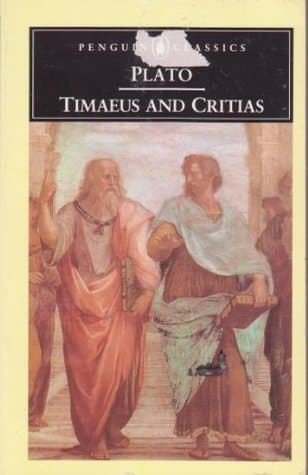
Timaeus and Critias cover
Archivist's Choice

Timaeus and Critias

Plato (2018)

Genre

History / Science / Philosophy

Reading Time

180 min

Key Themes

See below

Track Your Reading

Sign in to track this book

Plato's Timaeus and Critias explores the creation of the cosmos, the divine origin of humans, and the advanced civilization of Atlantis through ancient Greek philosophical dialogues.

Core Idea

Plato's Timaeus and Critias present a comprehensive cosmology and a historical-allegorical narrative. They describe the universe's creation, humanity's origins, and the ideal state, contrasting it with a warning about a powerful, corrupt empire. Timaeus details a good Demiurge organizing pre-existing chaos into a rational, mathematical cosmos. It establishes the four elements, the human soul's divine origin, and the body's design. Critias then applies these ideas to human society through the story of ancient Athens and the advanced but morally failing Atlantis. This serves as a political story, showing how civilizations rise and fall based on their adherence to divine order and virtue versus their surrender to pride and materialism.
Reading time
180 min
Difficulty
Hard
✓ Read this if...
You are interested in ancient Greek cosmology, metaphysics, political philosophy, or the origins of the Atlantis myth, and are comfortable with dense philosophical arguments presented through extensive mythological narrative.
✗ Skip this if...
You are looking for a straightforward historical account, a modern scientific explanation of the universe, or a light, easy read without significant philosophical or allegorical interpretation.

Core idea

The central argument and framework that powers the entire book.

Plato's Timaeus and Critias present a comprehensive cosmology and a historical-allegorical narrative. They describe the universe's creation, humanity's origins, and the ideal state, contrasting it with a warning about a powerful, corrupt empire. Timaeus details a good Demiurge organizing pre-existing chaos into a rational, mathematical cosmos. It establishes the four elements, the human soul's divine origin, and the body's design. Critias then applies these ideas to human society through the story of ancient Athens and the advanced but morally failing Atlantis. This serves as a political story, showing how civilizations rise and fall based on their adherence to divine order and virtue versus their surrender to pride and materialism.

At a glance

Reading time

180 min

Difficulty

Hard

Read this if...

You are interested in ancient Greek cosmology, metaphysics, political philosophy, or the origins of the Atlantis myth, and are comfortable with dense philosophical arguments presented through extensive mythological narrative.

Skip this if...

You are looking for a straightforward historical account, a modern scientific explanation of the universe, or a light, easy read without significant philosophical or allegorical interpretation.

Key Takeaways

1

The Demiurge's Ordered Cosmos

The universe is a divine creation, ordered by an intelligent craftsman.

Quote

For the world came into being as a living creature endowed with soul and intelligence by the providence of God.

Plato, through Timaeus, proposes a universe of deliberate design, not random chance. The 'Demiurge' (divine craftsman) is the intelligent cause, shaping the cosmos from existing chaos, guided by eternal Forms. This Demiurge is good and desires the best for creation, making the world as perfect and beautiful as possible. The universe is a living, intelligent being, a single, visible god, containing all other living things. This view gives the cosmos inherent purpose and intelligibility, suggesting its structure reflects a divine ration...

Supporting evidence

The detailed description of the Demiurge's creation of the world-soul and the physical body of the universe, using mathematical proportions and geometric shapes (especially triangles for the elements).

Apply this

Approach the natural world not just as a collection of phenomena, but as a system with underlying order and purpose, seeking the rational principles that govern its existence. This encourages a holistic and philosophical approach to science.
demiurgeteleologyworld-soulforms
2

The Four Elements and Geometric Foundations

All matter is composed of earth, air, fire, and water, derived from fundamental geometric solids.

Quote

God made the body of the universe to consist of fire and earth, and between these two He put air and water, and arranged them in a proportion...

Plato offers a sophisticated, though speculative, ancient theory of matter. He states that the four classical elements—earth, air, fire, and water—are not fundamental but are built from specific regular polyhedra: the tetrahedron (fire), octahedron (air), icosahedron (water), and cube (earth). These 'Platonic solids' are themselves made from two types of basic triangles. This geometric reductionism tries to explain matter's properties and transformations through the shapes and arrangements of these microscopic particles. It is an ambi...

Supporting evidence

The detailed explanation of how the five regular polyhedra correspond to the elements, and how their faces (triangles) allow for the transformation of one element into another (e.g., water breaking down into fire and air).

Apply this

Recognize the historical importance of seeking fundamental, mathematical principles to explain physical reality, even if the specific models are later superseded. It encourages looking beyond surface appearances to underlying structures.

platonic-solidselementsgeometric-atomismphysical-theory
3

The Soul's Divine Origin and Embodiment

The human soul is immortal and divinely composed, temporarily housed in a mortal body.

Quote

The soul which is the elder and ruler, and the body which is the younger and subject, were made by God in the beginning.

Plato presents a dualistic view of human nature. The immortal, rational soul is a direct creation of the Demiurge, made of the same mixture as the World-Soul, though diluted. This divine soul is then placed in a mortal physical form, causing a constant tension between the higher rational faculties and the lower appetitive and spirited parts of the soul, which are linked to the body. The soul's pre-existence and its eventual return to the stars (or reincarnation) after death emphasize its inherent superiority and divine origin. This fr...

Supporting evidence

The account of the Demiurge mixing the substance of the World-Soul to create individual souls, assigning them to stars, and then placing them in bodies, along with the description of the three parts of the soul (rational in the head, spirited in the chest, appetitive in the belly).

Apply this

Cultivate the rational part of your soul through philosophy and contemplation, recognizing its capacity for understanding eternal truths. Strive for harmony between your rational and emotional impulses, viewing the body as a temporary vessel.

souldualismimmortalityreason
4

Atlantis: A Moral Fable of Hubris

The story of Atlantis serves as a cautionary tale against imperial ambition and moral decay.

Quote

But when the divine portion began to fade away, and became diluted too often with the mortal admixture, and the human nature got the upper hand, they then began to behave unseemly...

The tale of Atlantis, introduced in Timaeus and expanded in Critias, is a moral allegory. Critias describes an advanced, powerful island civilization, founded by Poseidon's divine offspring, initially showing virtue and wisdom. However, as the divine bloodline thinned, the Atlanteans became consumed by greed, imperial ambition, and pride, attempting to conquer Athens. Their eventual destruction by earthquakes and floods serves as a warning about the results of moral decay and overreaching power. Plato uses this vivid narrative to cont...

Supporting evidence

Critias's detailed description of Atlantis's geography, engineering (concentric rings, canals), wealth, military power, and the gradual moral decline leading to Zeus's judgment.

Apply this

Reflect on the dangers of unchecked power and wealth, and the importance of maintaining moral integrity in both personal and societal governance. Prioritize virtue and justice over material gain and conquest.

atlantishubrismoral-decaypolitical-philosophy
5

The Ideal State vs. Corrupt Empire

Ancient Athens represents a virtuous, just society, contrasting with Atlantis's imperial overreach.

Quote

Our city, which you have just described, is a city of justice, and she will be a worthy antagonist of your Atlanteans.

Plato uses the legend of ancient Athens and Atlantis to show a contrast between two types of civilization. The Athens described is an idealized version, embodying philosophical virtues, martial skill in defense, and a just political structure focused on the common good, not conquest. It is the opposite of Atlantis, which, despite its material and technological superiority, ultimately falls because of its pursuit of dominance and its moral corruption. This narrative allows Plato to explore his theories on the ideal state, emphasizing t...

Supporting evidence

The vivid description of ancient Athens's simple, virtuous lifestyle, its military discipline, and its successful defense against the Atlantean invasion, all rooted in its adherence to divine law.

Apply this

Advocate for and strive to build societies founded on principles of justice, moderation, and communal well-being, rather than succumbing to the temptations of imperial expansion or material excess. Prioritize ethical governance.

ideal-stateathensjusticevirtue
6

Myth as a Vehicle for Truth

Plato employs mythical narratives to convey complex philosophical and scientific truths.

Quote

For we are speaking of what is like the truth, and not of the truth itself.

Plato's Timaeus and Critias contain narratives that blend myth, history, and philosophy. The creation story of the Demiurge, the geometric construction of elements, and the tale of Atlantis are presented with a specificity that suggests factual claims, yet Plato often calls them 'likely stories' or 'noble lies.' This approach shows Plato's understanding that some truths, especially about the cosmos's origins or deep moral lessons, might be best understood through compelling narratives rather than purely logical explanations. Myth serv...

Supporting evidence

The explicit framing of Timaeus's account of creation as a 'likely story' (eikos muthos) and Critias's assertion that the Atlantis story is 'true history' passed down from Solon, despite its fantastic elements.

Apply this

Recognize that different forms of discourse (storytelling, metaphor, scientific explanation) can all contribute to understanding. Be open to narratives that convey deeper truths, even if their literal historicity is debatable.

mythoslogospedagogyallegory
7

The Interconnectedness of Cosmos and Man

Humanity is a microcosm reflecting the macrocosm of the universe.

Quote

And the other gods, when they had received from him the immortal principle of the soul, in imitation of their sire, fashioned the mortal body...

Plato details how the human body and soul are structured to imitate the universe and the World-Soul. The human head, for example, is a sphere, reflecting the spherical cosmos, and holds the rational soul. The circulatory system and organs are explained with analogies to cosmic movements and elemental interactions. This 'microcosm-macrocosm' analogy suggests a deep, inherent connection between individual humans and the entire universe. Understanding the cosmos, therefore, becomes a way to understand oneself, and vice-versa. It implies ...

Supporting evidence

The detailed physiological descriptions, such as the brain as the seat of reason, the heart as the seat of courage, and the liver as the seat of appetite, and how these correspond to the parts and functions of the universe.

Apply this

Seek to understand the natural laws and patterns of the universe, recognizing that these external principles often mirror internal human experiences and structures. Strive for inner harmony as a reflection of cosmic order.

microcosmmacrocosmanalogycosmology
8

The Primacy of Sight in Knowledge

Vision is the most important sense, leading to philosophy and understanding of the divine.

Quote

And the sight of the day and night, and the months and the courses of the stars, have given us philosophy, and thence the greatest good of which our nature is capable.

Plato, through Timaeus, elevates the sense of sight above all others, not just for practical use but for its deep philosophical implications. The ability to observe the ordered movements of celestial bodies—the sun, moon, and stars—is the main reason for the development of philosophy, mathematics, and our understanding of time and causality. By observing this cosmic order, humans are led to consider the divine intelligence that arranged it. This consideration, in turn, helps us order our own souls and seek wisdom. It suggests that eng...

Supporting evidence

The specific passage attributing the origin of philosophy, mathematics, and the concept of time to the observation of celestial motions through sight.

Apply this

Cultivate a sense of wonder and careful observation of the natural world, particularly celestial phenomena. Use these observations as a springboard for philosophical inquiry and reflection on the underlying order of existence.

sightphilosophyastronomycontemplation
9

The Purpose of Disease and Remedy

Illness arises from imbalance, and health is restored through harmony and moderation.

Quote

Now, the nature of all things, animate as well as inanimate, has been so framed by the Demiurge as to maintain a due proportion of all its parts.

Plato offers a theory of disease, attributing illness to imbalances—whether of the elements in the body, the humors, or the parts of the soul. Mental illnesses, for instance, arise from the disproportionate growth of the spirited or appetitive parts of the soul over the rational part, often worsened by a poorly formed body or inadequate education. Health, both physical and mental, lies in restoring harmony and proportion. This holistic view emphasizes moderation in all things and the connection between physical well-being, mental stat...

Supporting evidence

The detailed explanations of various diseases, their causes (e.g., excess of fire leading to fevers, misalignments of the bone marrow), and the remedies, often involving diet, exercise, and intellectual pursuits.

Apply this

Adopt a holistic approach to health, recognizing that physical, mental, and spiritual well-being are intertwined. Strive for balance and moderation in diet, exercise, and intellectual engagement to maintain harmony.

diseaseharmonymoderationholistic-health
10

The Incompleteness of Human Knowledge

While striving for truth, humans must acknowledge the limits of their understanding.

Quote

But to discover the Father and Maker of all this universe is indeed a work of difficulty, and when found, it is impossible to speak of him to all.

Plato, despite presenting a grand cosmic narrative, includes a crucial epistemological humility within Timaeus. He often reminds the audience that these are 'likely stories' or 'probable accounts,' acknowledging human reason's limits when trying to grasp ultimate truths about creation and divine nature. The Demiurge, though described, remains somewhat elusive, and his ultimate motivations are only inferred from his creation's goodness. This recognition of incompleteness is a strength, encouraging ongoing inquiry and a cautious approac...

Supporting evidence

The repeated use of phrases like 'likely story' (eikos muthos) and 'probable account' throughout Timaeus when discussing the origins of the universe and elements.

Apply this

Cultivate intellectual humility, recognizing that even the most advanced theories are provisional. Remain open to new information and perspectives, and be wary of absolute certainty when dealing with complex, ultimate questions.

epistemologyhumilitytruthmystery

Critical analysis

Notable Quotes

For that which is generated must be generated by a cause; for nothing can be generated without a cause.

Timaeus explaining the necessity of a cause for the creation of the cosmos.

Now, that which is apprehended by intelligence and reason is always in the same state; but that which is conceived by opinion with the help of sensation and without reason, is always in a process of becoming and perishing and never really is.

Timaeus distinguishing between the eternal Forms and the changing physical world.

God desired that all things should be good and nothing bad, so far as this was attainable.

Timaeus describing the benevolent intention of the Demiurge in creating the universe.

For the world has been framed in the likeness of that which is apprehended by reason and mind and is unchangeable, and must therefore itself be beautiful.

Timaeus asserting the beauty and order of the cosmos as a reflection of its divine model.

Time, then, and the heaven came into being at the same instant in order that, having been created together, if they were ever to be dissolved, they might be dissolved together.

Timaeus explaining the co-creation of time with the physical universe.

The eye is the best organ of sense, and its use is to give us sight.

Timaeus discussing the purpose and function of the eye as part of human creation.

For a city is well ordered if it has good laws, and is not without order if it has bad ones.

Critias recalling Solon's wisdom about the importance of laws for a city's order.

For as there are many and various races of animals, so are there many and various forms of human life.

Critias reflecting on the diversity of human societies and their origins.

Now the earth, when it was created, was the fairest of all things that were made.

Timaeus describing the initial beauty and perfection of the Earth in its creation.

And the cause of this creation was the goodness of God.

Timaeus reiterating the primary motivation behind the Demiurge's act of creation.

The soul is older than the body.

Timaeus discussing the pre-existence and priority of the soul over the physical body.

For that which is created cannot be eternal, unless it has a divine will to preserve it.

Timaeus explaining that created things are inherently perishable without divine intervention.

And the land of Attica, in which this city of Athens is situated, was in those days much more productive than it is now.

Critias describing the ancient, more fertile state of Attica before geological changes.

We must not, therefore, suppose that there are two heavens, but only one, and that unique.

Timaeus arguing for the uniqueness and singularity of the cosmos.

Quiz

Test Your Knowledge

Ready to see how well you understood this book? Take our interactive quiz with 10 questions.

10
Questions
~5
Minutes
?
Best Score

Key Questions (FAQ)

Plato's Timaeus provides a comprehensive account of the cosmos, exploring the origins of the universe, life, and humanity. It describes a world composed of four elements—earth, air, fire, and water—and outlines both physical laws and metaphysical principles.

About the author

Plato

Biography coming soon.