“The gods made us for war, and we are good at it.”
— Early in the narrative, reflecting on Spartan identity.

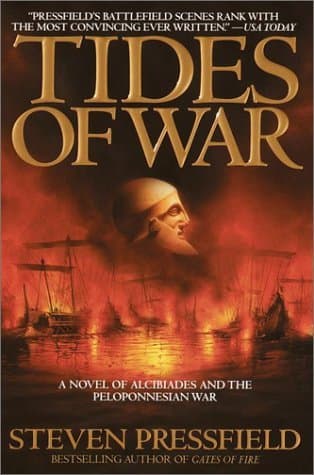
Steven Pressfield (2000)
Genre
History / Fantasy / Historical Fiction
Reading Time
900 min
Key Themes
See below
Sign in to track this book
Through the eyes of his conflicted bodyguard, witness the rise and fall of Alcibiades, Athens' golden son and greatest general, as his brilliance and arrogance ignite a war that reshapes ancient Greece and ultimately consumes him.
Theramenes, a seasoned soldier and former bodyguard to the legendary Athenian general Alcibiades, is imprisoned and awaiting execution in Spartan-occupied Athens. He is an old man, weary from years of war and political intrigue, haunted by his former master. As he awaits his fate, Theramenes decides to chronicle his life, particularly his intertwined destiny with Alcibiades, from their early days in Athens through the decades of the Peloponnesian War. His narrative is driven by a mix of admiration, resentment, and a desire to understand the man who shaped his life and the fate of Greece. He begins his account with the volatile political climate of Athens before the war, setting the stage for Alcibiades' rise.
Theramenes recounts the early life of Alcibiades, a scion of one of Athens' noblest families, a student of Pericles and Socrates. From a young age, Alcibiades had unparalleled charisma, intellect, and physical beauty, making him the darling of Athens. He excelled in athletics, philosophy, and oratory, quickly rising in Athenian society. However, his brilliance was matched by arrogance, extravagance, and a disregard for conventional morality. Theramenes describes incidents that highlight Alcibiades' tendency to provoke and offend, even as he charmed the masses. These early displays of arrogance foreshadow the tragic trajectory of his career and the divisions he would sow within Athens.
As the Peloponnesian War rages, Alcibiades becomes a prominent voice in Athenian politics, advocating for an ambitious expedition to conquer Sicily. Despite warnings from more cautious generals like Nicias, Alcibiades' persuasive rhetoric and the promise of immense wealth and power sway the Athenian assembly. He is appointed one of the expedition's commanders, to the excitement and trepidation of the city. Theramenes details the immense preparations and initial enthusiasm surrounding the fleet's departure. However, just before the fleet sails, a sacrilege occurs — the defacing of the herms (religious statues) — and Alcibiades is implicated. This incident, fueled by political enemies, marks the beginning of his downfall.
While commanding the Athenian fleet en route to Sicily, Alcibiades is recalled to Athens to face charges of sacrilege and impiety related to the herms incident and alleged mockery of the Eleusinian Mysteries. Fearing a politically motivated trial and certain condemnation, Alcibiades makes the decision to flee. Rather than return to Athens, he defects to Sparta, Athens' mortal enemy. Theramenes vividly describes the shock and outrage in Athens at this betrayal, and its impact on the war. Alcibiades, now an advisor to the Spartans, uses his knowledge of Athenian strategy and weaknesses to inflict damage on his former city, including advising them to fortify Decelea, a strategic blow to Athens.
Alcibiades quickly proves invaluable to the Spartans, providing strategic advice that leads to Spartan victories against Athens. He helps them secure alliances and exploit Athenian vulnerabilities. However, his flamboyant lifestyle, perceived arrogance, and alleged seduction of the Spartan king Agis's wife alienate many conservative Spartans. Fearing for his life, Alcibiades again changes allegiances, seeking refuge with the Persian satrap Tissaphernes. Theramenes recounts Alcibiades' ability to adapt to new environments and manipulate powerful figures. He advises Tissaphernes on how to play Athens and Sparta against each other, prolonging the war and weakening both Greek powers, all while subtly working to secure his own return to Athens.
Through negotiations and political maneuvering, Alcibiades secures his recall to Athens. He promises the Athenians Persian support if they adopt an oligarchic government, a promise he later breaks. Upon his return, he is entrusted with command of the Athenian fleet. Theramenes details Alcibiades' naval strategies, leading Athens to victories at Cynossema, Abydos, and Cyzicus, where he defeats the Spartan fleet. These victories revitalize Athenian morale and temporarily shift the tide of the war. Alcibiades is hailed as a savior, his past transgressions seemingly forgiven in the euphoria of victory, and he makes a triumphant return to Athens.
Despite his triumphs, Alcibiades' political enemies in Athens remain powerful. Following a minor naval defeat at Notium, where Alcibiades had left his fleet in the command of his subordinate Antiochus against his own orders, his political opponents use the opportunity to undermine him. They exaggerate the defeat and accuse him of negligence and ambition. Theramenes describes the swift shift in public opinion, fueled by lingering distrust and envy. Alcibiades, rather than facing another trial, again chooses exile, withdrawing to his estates in the Thracian Chersonese. This second banishment effectively ends his direct command in the Peloponnesian War, leaving Athens vulnerable.
With Alcibiades sidelined, Athens struggles to regain its military advantage. Theramenes recounts the grim reality of the war's final stages, highlighting the rise of the cunning Spartan general Lysander. Lysander, with Persian support, systematically dismantles Athens' remaining naval power. The decisive battle of Aegospotami, where Lysander ambushes and destroys the Athenian fleet, is the final, catastrophic blow. Athens, starved and besieged, is forced to surrender, its walls torn down, and its democracy replaced by the Spartan-backed oligarchy of the Thirty Tyrants. Theramenes, now a prominent figure among the Thirty, is complicit in the city's subjugation and the subsequent reign of terror.
Theramenes, initially a leading member of the Spartan-imposed Thirty Tyrants, becomes disillusioned and horrified by their brutal rule. The Thirty, led by Critias, unleash a reign of terror, executing thousands of Athenian citizens, confiscating property, and dismantling democratic institutions. Theramenes attempts to moderate their excesses and advocates for a more inclusive government, earning him the enmity of Critias. Theramenes' internal conflict between self-preservation and a lingering sense of justice is a central theme. Ultimately, his opposition leads to his own arrest and forced suicide, a poignant moment described by him from his prison cell as he reflects on his own complicity and fate.
Meanwhile, Alcibiades, living in exile in Phrygia under the protection of the Persian satrap Pharnabazus, continues to be a figure of fear and suspicion for both Spartans and Athenians. He is seen as a threat who could always return to influence events. Theramenes, reflecting on his own impending death, recounts the circumstances of Alcibiades' assassination. The Spartans, particularly Lysander, fearing Alcibiades' capacity for disruption, pressure Pharnabazus to eliminate him. Alcibiades' home is set ablaze, and when he attempts to fight his way out, he is cut down by Persian archers. Theramenes, who was present at various points in Alcibiades' life, implies his own indirect role in the events leading to his former master's death, closing the circle of their intertwined destinies.
The Narrator/Supporting
Theramenes begins as a loyal, if critical, follower, rises to power through morally ambiguous choices, and ultimately finds a tragic redemption in his principled opposition to the Thirty Tyrants.
The Protagonist
Alcibiades rises as Athens' golden boy, falls into exile and betrays his city, returns to glory, and ultimately dies a hunted man, a victim of his own unchecked ambition and the shifting tides of war and politics.
The Antagonist
Critias rises to absolute power as the leader of the Thirty Tyrants, only to fall as the democratic resistance eventually triumphs, though his direct demise is not detailed by Theramenes.
The Supporting/Mentioned
Socrates' arc is largely static within this narrative, serving as a foundational figure whose influence is acknowledged but ultimately rejected by his ambitious student.
The Supporting
Nicias, a respected but ultimately outmaneuvered general, faces a tragic end as his warnings are unheeded and he leads a doomed expedition.
The Antagonist
Lysander rises to become the architect of Sparta's victory over Athens and ensures the final elimination of Alcibiades, consolidating Spartan power.
The Supporting
Tissaphernes' arc remains largely consistent as a manipulative foreign power broker, constantly seeking to exploit Greek divisions for Persian gain.
The novel illustrates how unchecked ambition and the pursuit of power corrupt even the most brilliant individuals. Alcibiades, blessed with extraordinary talents, repeatedly succumbs to his own arrogance, betraying his city, changing allegiances, and alienating everyone around him. His desire for glory and control leads him to make reckless decisions, such as advocating for the Sicilian Expedition, which proves catastrophic for Athens. Similarly, the Thirty Tyrants, initially seizing power with promises of order, quickly become a brutal dictatorship, driven by their own lust for control and the desire to eliminate opposition, as seen in Critias's ruthless purging of Athenian citizens.
““Power, once tasted, is a drug. And Alcibiades, my master, was a connoisseur of its most potent vintage.””
Loyalty is a fluid and often conditional concept in 'Tides of War'. Alcibiades betrays Athens twice, first by defecting to Sparta and then by aligning with Persia, driven by self-preservation and ambition. Conversely, Theramenes grapples with his own shifting loyalties, serving Alcibiades, then the Thirty Tyrants, before ultimately betraying the latter due to moral conviction. The constant shifts in alliances, both personal and political, show how precarious trust is in wartime. The narrative questions whether true loyalty can exist in a world where survival often dictates allegiance, and ambition frequently overrides principle.
““In war, a man's loyalty is to himself first, then to his coin, and only then, perhaps, to his city.””
The novel explores the tension between human free will and predetermined fate, a common theme in Greek tragedy. Alcibiades' character, with his flaws and repeated errors in judgment, seems destined for a tragic end, echoing the ancient Greek belief in a hero's downfall due to arrogance. Despite his abilities, he cannot escape the consequences of his actions or the machinations of his enemies. Theramenes, reflecting from his prison cell, often muses on the 'tides of war' and the forces beyond individual control that sweep people into certain destinies, suggesting that while individuals make choices, the grander sweep of history often dictates their ultimate outcomes.
““We are but corks upon the ocean, tossed by currents we cannot see, much less command.””
The Peloponnesian War is not merely a backdrop but a central character, showing its devastating impact on Athens and its people. Theramenes' narrative details the gradual erosion of Athenian democracy, the moral compromises forced upon its citizens, and the human cost of decades of conflict. The once-proud city, famed for its democracy and culture, descends into political infighting, tyranny, and subjugation. The war strips away Athens' glory, leaving behind a city ravaged by famine, plague, and internal strife, highlighting the destructive power of prolonged conflict on a society and its ideals.
““Athens, in her arrogance, believed herself invincible. The war taught her otherwise, and the lesson was paid in blood and tears.””
Alcibiades embodies the magnetic, yet dangerous, power of charisma. He can sway entire assemblies, inspire armies to victory, and charm his way out of impossible situations. However, the novel also shows that charisma alone is not enough for sustained, ethical leadership. His personal magnetism often masks a lack of consistent moral compass and long-term vision beyond his own self-aggrandizement. In contrast, figures like Nicias represent a more traditional, cautious form of leadership, while Critias demonstrates the terrifying efficacy of ruthless, tyrannical control. The story explores how a leader's personality shapes the fate of a nation, for better or worse.
““He could make men believe anything, even the lies they knew were false. That was his gift, and his curse.””
The story is told from the perspective of Theramenes, looking back on events from his prison cell.
This device allows for a deeply personal and subjective account of the Peloponnesian War and Alcibiades' life. Theramenes' unique position as both Alcibiades' intimate associate and eventual critic, coupled with his own involvement in the war's later stages, provides a complex and often morally ambiguous viewpoint. His impending execution lends a sense of urgency and finality to his reflections, shaping his interpretations of events and characters, particularly Alcibiades, whom he simultaneously admires and resents. The retrospective nature also allows for foreshadowing and commentary on the ultimate outcomes of the historical events.
Alcibiades embodies the classical Greek tragic hero, brilliant but undone by his own flaws.
Alcibiades perfectly fits the mold of a tragic hero. He possesses extraordinary qualities – intelligence, charisma, military genius – that elevate him above ordinary men. However, his fatal flaws (hamartia) are his immense hubris, excessive ambition, and lack of self-control. These flaws lead directly to his downfall, including his repeated exiles, betrayals, and ultimately, his assassination. His trajectory evokes pity and fear, as the audience witnesses a truly gifted individual brought low by his own character, a common theme in ancient Greek drama that Pressfield deliberately employs to frame Alcibiades' story.
The narrator knows the outcome of events, creating tension and pathos for the reader.
Since Theramenes is narrating from his death cell, he often alludes to future events or the ultimate consequences of actions being described. This creates dramatic irony, as the reader is aware of the tragedy that awaits Athens and many of its key figures, even as Theramenes recounts moments of triumph or hope. For instance, when Alcibiades triumphs after his return to Athens, Theramenes' commentary often hints at the fleeting nature of this glory, deepening the sense of impending doom and making the moments of success more poignant and fragile.
Theramenes acts as an anti-hero, morally ambiguous but ultimately seeking a form of redemption.
Theramenes serves as an anti-hero. He is not conventionally virtuous, having made many morally questionable choices throughout his life, including his complicity with the Thirty Tyrants. He is a survivor, pragmatic and cynical, often putting self-preservation first. However, his narrative journey involves a gradual awakening of conscience, leading him to oppose the brutality of Critias and accept his own tragic fate. His flawed nature makes him a more relatable and complex character, and his eventual stand against tyranny provides a nuanced form of heroism, distinct from the grand, but ultimately destructive, heroism of Alcibiades.
“The gods made us for war, and we are good at it.”
— Early in the narrative, reflecting on Spartan identity.
“Fear is a weapon, and the Spartans wield it masterfully.”
— Xenophon observing the psychological impact of Spartan warriors.
“A man who runs from battle is a dead man walking.”
— A harsh Spartan proverb about cowardice.
“The greatest glory is to die for your city, in the front rank, facing the enemy.”
— A core tenet of Spartan philosophy, often repeated.
“We did not choose this life. It chose us.”
— A Spartan reflecting on the inescapable demands of their society.
“The shield is more important than the spear, for it saves the man who carries it, and the man beside him.”
— Highlighting the importance of the phalanx and mutual protection.
“Better to suffer a thousand deaths in training than one in battle.”
— Emphasizing the brutal and constant training of Spartan warriors.
“The sea does not care for our plans or our gods.”
— A character reflecting on the indifferent power of nature during a naval campaign.
“Honor is not given; it is taken, by blood and sweat.”
— A Spartan's view on how true honor is earned.
“Even the mightiest city can fall, if its people lose their will.”
— A commentary on the importance of morale and unity.
“A good general knows not only how to fight, but when not to fight.”
— A strategic insight into military leadership.
“The gods play with men as children play with toys.”
— Xenophon's cynical observation on human fate and divine intervention.
“Freedom is a heavy burden, but slavery is heavier still.”
— A reflection on the cost of liberty versus subjugation.
“We are not born for ourselves, but for our city.”
— A fundamental principle of Spartan communal life and sacrifice.
Ready to see how well you understood this book? Take our interactive quiz with 10 questions.

Biography coming soon.

Michael S. Heiser
4.5

Winston S. Churchill
4.5

Will Durant
4.4

Sigurd F. Olson
4.4
Thomas Sowell
4.4

Emmanuel Guibert
4.3

W.E.B. Du Bois
4.3

Joseph Campbell
4.3