BookBrief
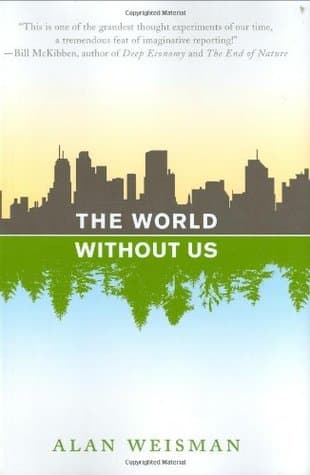
The World Without Us cover
Archivist's Choice

The World Without Us

Alan Weisman (2007)

Genre

History / Science

Reading Time

6-8 hours

Key Themes

See below

Track Your Reading

Sign in to track this book

Explore a post-human Earth where New York's subways flood, cities become forests, and our most lasting legacies are plastic, bronze, and radio waves.

Core Idea

Alan Weisman's "The World Without Us" is a thought experiment about Earth's future if humans disappeared instantly. It details the quick decay of human structures and nature's fast return, showing that most of our physical legacy would crumble surprisingly quickly. The book suggests that while buildings and technology would largely vanish within centuries, materials like plastics, radioactive waste, and reshaped landscapes would last for millennia, leaving a distinct, often microscopic, mark of our brief time on Earth.
Reading time
6-8 hours
Difficulty
Medium
✓ Read this if...
You are fascinated by environmental science, post-apocalyptic scenarios, the resilience of nature, or the long-term impact of human civilization on the planet.
✗ Skip this if...
You prefer books focused on human solutions to environmental problems, or find the idea of humanity's disappearance unsettling rather than thought-provoking.

Core idea

The central argument and framework that powers the entire book.

Alan Weisman's "The World Without Us" is a thought experiment about Earth's future if humans disappeared instantly. It details the quick decay of human structures and nature's fast return, showing that most of our physical legacy would crumble surprisingly quickly. The book suggests that while buildings and technology would largely vanish within centuries, materials like plastics, radioactive waste, and reshaped landscapes would last for millennia, leaving a distinct, often microscopic, mark of our brief time on Earth.

At a glance

Reading time

6-8 hours

Difficulty

Medium

Read this if...

You are fascinated by environmental science, post-apocalyptic scenarios, the resilience of nature, or the long-term impact of human civilization on the planet.

Skip this if...

You prefer books focused on human solutions to environmental problems, or find the idea of humanity's disappearance unsettling rather than thought-provoking.

Key Takeaways

1

Nature's Rapid Reclamation

Without human intervention, the natural world quickly reclaims its territory, often in surprising ways.

Quote

Days after humans disappear, floods in New York's subways would start eroding the city's foundations, and how, as the world's cities crumble, asphalt jungles would give way to real ones.

Weisman vividly shows the immediate and dramatic effect of human absence. Instead of slow decay, many of our built environments would face rapid collapse and ecological takeover. New York City, for instance, would be especially vulnerable because its subway system acts as a giant drainage basin. Without constant pumping, the tunnels would flood, weakening street foundations and causing widespread sinkholes. Plants would quickly grow in cracks in pavement and buildings, speeding up their breakdown. This shows nature's strong drive to f...

Supporting evidence

The rapid flooding of New York City's subway system and the subsequent erosion of its foundations; the growth of vegetation through cracks in concrete and asphalt, accelerating structural collapse.

Apply this

Consider designing infrastructure with ecological resilience in mind, understanding that maintenance is a continuous battle against natural forces. Support urban rewilding projects that allow nature to integrate more seamlessly with human spaces.
ecological-successionurban-decayrewilding
2

The Immortal Remnants

While much of our world would vanish, certain materials and structures are destined for geological immortality.

Quote

Plastic, bronze sculpture, radio waves, and some man-made molecules may be our most lasting gifts to the universe.

Not everything we create would simply vanish. Weisman explores the materials and artifacts that would last for millennia, acting as a 'fossil record' of our civilization. Plastics, because of their chemical stability and resistance to breakdown, would remain in vast amounts, forming a distinct geological layer. Bronze sculptures, especially those made with high-quality alloys, would resist corrosion for hundreds of thousands of years. Even our radio waves, though weakening, would continue to travel into space, a faint, expanding bubbl...

Supporting evidence

The persistence of plastics in landfills and oceans; the longevity of bronze statues; the continuous propagation of radio waves into space.

Apply this

Prioritize the development of biodegradable alternatives for common plastics. Be mindful of the enduring legacy of materials we create, seeking to minimize those that become persistent pollutants and maximize those that offer lasting cultural or scientific value.

anthropocenegeological-recordmaterial-science
3

The DMZ's Unexpected Sanctuary

Areas devoid of human presence, even under duress, can become thriving ecological havens.

Quote

The Korean DMZ, a landscape pockmarked by land mines and artillery shells, has become one of the most pristine wildlife sanctuaries on Earth.

The Korean Demilitarized Zone (DMZ) is a powerful, real-world example of nature's resilience. Despite being a heavily fortified and dangerous border, the absence of civilian human activity for decades has allowed it to become an accidental ecological haven. Rare species, including the Amur leopard and the red-crowned crane, thrive there, protected by the very conflict that created the zone. This shows that even extreme human actions, when they lead to long-term human exclusion, can accidentally create conditions for biodiversity to fl...

Supporting evidence

The flourishing of rare and endangered species like the Amur leopard and red-crowned crane within the Korean DMZ, a result of human exclusion despite its military nature.

Apply this

Explore the potential for creating 'no-go' zones or rewilding areas where human access is strictly limited, allowing ecosystems to recover naturally. Advocate for the protection of existing wilderness areas from human encroachment.

biodiversity-hotspotconservation-biologywilderness-preservation
4

The Indelible Scars

Some human impacts are so profound they would endure for geological epochs, even without us.

Quote

As he shows which human devastations are indelible, and which examples of our highest art and culture would endure longest...

While nature reclaims much, Weisman does not avoid the truly lasting scars we have made. Deep-mined tunnels, particularly those for nuclear waste, are designed to last for hundreds of thousands of years. The vast amounts of industrial chemicals and persistent pollutants, like PCBs and dioxins, would seep into soil and water for millennia. Even the landscape itself, reshaped by strip mining or massive earthmoving projects, would bear our mark for geological ages. This sobering part of the book confronts the true scale of our long-term ...

Supporting evidence

The long-term persistence of nuclear waste repositories; the enduring contamination from persistent organic pollutants (POPs); the geological-scale reshaping of landscapes by mining.

Apply this

Invest in 'cradle-to-grave' accountability for industrial processes and waste. Prioritize clean energy sources to minimize the creation of long-lived pollutants. Support research into bioremediation for existing contaminated sites.

nuclear-wasteenvironmental-legacydeep-time
5

The Fragility of Our Infrastructure

Complex human systems are surprisingly dependent on constant maintenance and would rapidly fail without it.

Quote

Without constant human maintenance, our massive infrastructure would collapse and finally vanish without human presence.

The book details how our modern world, from power grids to water treatment plants, relies on constant human oversight. Without us, the lights would go out almost immediately, followed by the breakdown of complex machinery due to lack of lubrication, rust, and simple wear and tear. Dams would fail, bridges would corrode, and chemical plants would become environmental hazards. This shows a basic weakness in our highly engineered world: its dependence on continuous human effort. It is a sharp reminder that 'progress' often comes with an ...

Supporting evidence

The immediate failure of power grids; the rapid deterioration of bridges and dams due to lack of maintenance; the breakdown of cooling systems in nuclear power plants.

Apply this

Design infrastructure with greater redundancy and passive safety features. Encourage local, resilient systems that are less dependent on vast, interconnected networks. Emphasize preventative maintenance in existing systems.

infrastructure-resiliencesystems-thinkingtechnological-dependency
6

The Plastic Age's Geological Signature

Our ubiquitous plastic waste will form a defining, immortal layer in Earth's future geological record.

Quote

How plastic...may be our most lasting gifts to the universe.

Weisman highlights plastic not just as a pollutant, but as a future geological marker. Unlike organic materials, most plastics resist breakdown very well. They would remain in landfills, ocean gyres, and even buried sediments for hundreds of thousands to millions of years. This 'plastiglomerate' layer, a mix of plastic fragments, sediment, and organic matter, would be a clear and unmistakable sign of the Anthropocene epoch for future paleontologists. The sheer volume and durability of plastic make it a uniquely lasting artifact of hum...

Supporting evidence

The formation of 'plastiglomerates' (plastic-rock conglomerates) found in various coastal environments; the vast accumulation of microplastics in oceans and sediments.

Apply this

Implement aggressive policies for plastic reduction, reuse, and recycling. Invest in research for truly biodegradable plastics that break down into harmless components. Support initiatives to clean up existing plastic pollution.

plastiglomerateanthropocene-markersplastic-pollution
7

The Resilience of Wildness

Ecosystems, when given the chance, exhibit an astonishing capacity for recovery and flourishing.

Quote

As the world's cities crumble, asphalt jungles would give way to real ones. It describes the distinct ways that organic and chemically treated farms would revert to wild, how billions more birds would flourish...

Beyond the collapse of human structures, Weisman describes a strong ecological recovery. Forests would reclaim farmland, rivers would run cleaner, and animal populations, free from human hunting and habitat destruction, would rebound greatly. The book compares the slower recovery of chemically treated farms with the fast return to wildness of organic ones, showing different ways for ecosystems to heal. This optimistic contrast shows the inherent resilience of life on Earth. It suggests that while our impact is huge, the planet itself ...

Supporting evidence

The rapid rewilding of organic farmlands compared to chemically treated ones; the potential flourishing of bird populations due to reduced hunting and habitat loss; the re-establishment of predator-prey dynamics.

Apply this

Support sustainable agriculture practices that minimize chemical inputs. Advocate for the creation of wildlife corridors and protected areas. Educate on the importance of rewilding initiatives to restore ecological balance.

ecological-restorationbiodiversity-recoverynatural-regeneration
8

The Lasting Echoes of Our Culture

Certain forms of human expression, particularly those in durable materials, could outlast our physical presence.

Quote

Which examples of our highest art and culture would endure longest...

Weisman explores which parts of our culture might last the longest. Beyond bronze sculptures, he considers the longevity of petroglyphs, carefully made stone monuments, and even certain types of literature preserved on archival-quality paper in protected places. While much of our digital record would disappear with power, the physical forms of our creativity, especially those made to last, could become humanity's last whispers. This raises interesting questions about what we choose to preserve and why, and what future, non-human intel...

Supporting evidence

The enduring nature of ancient Egyptian pyramids and Roman aqueducts; the potential longevity of carefully stored archival documents; the resilience of bronze statues.

Apply this

Support the preservation of cultural heritage through durable materials and secure storage. Invest in public art and monuments that are designed for long-term endurance. Consider the material longevity of information storage.

cultural-heritagearchival-sciencelegacy-building
9

The Paradox of Chernobyl

Even catastrophic human-made disasters can, through human absence, become unexpected havens for wildlife.

Quote

From places already devoid of humans (a last fragment of primeval European forest; the Korean DMZ; Chernobyl), Weisman reveals Earth's tremendous capacity for self-healing.

Chernobyl's Exclusion Zone offers another compelling, if stark, example of nature's resilience. Despite the lingering, dangerous radiation levels, the absence of human activity — farming, hunting, logging, and development — has allowed wildlife to flourish. Populations of wolves, elk, wild boar, and rare birds have rebounded, adapting to the contaminated environment. This suggests that for many species, the direct impact of human presence (habitat destruction, hunting) is often more harmful than even severe environmental contamination...

Supporting evidence

The documented increase in wildlife populations (wolves, elk, wild boar) within the Chernobyl Exclusion Zone despite high radiation levels.

Apply this

Recognize that human presence itself, regardless of specific technologies, has a profound ecological footprint. Consider the potential for 'passive' conservation through human exclusion, even in degraded areas, as a powerful tool for ecological recovery.

radioecologyexclusion-zoneecological-adaptation
10

A Radical Solution: Less of Us

The book subtly argues that a sustainable future might require a conscious reduction in human numbers and impact.

Quote

Weisman's narrative ultimately drives toward a radical but persuasive solution that needn't depend on our demise.

While imagining a world without us, Weisman implicitly, and then explicitly, suggests that the ultimate answer to our environmental crisis is not our disappearance, but a significant reduction in our ecological footprint, which often relates to population. The lessons from the DMZ and Chernobyl — where nature thrives precisely because humans are absent — hint at a future where fewer humans, or humans living with far less impact, could allow the planet to heal. This is not a call for humanity's end, but a radical re-evaluation of our s...

Supporting evidence

The repeated examples of ecological recovery in areas devoid of human presence (DMZ, Chernobyl, urban ruins); the discussion of population control and sustainable living as alternatives to environmental collapse.

Apply this

Support family planning initiatives and education worldwide. Advocate for policies that incentivize sustainable consumption and smaller ecological footprints. Engage in discussions about optimal human population levels for planetary health.

population-sustainabilityecological-footprintdegrowth

Critical analysis

Notable Quotes

The very things we create to save us from nature—our cities, our industries, our agriculture—are the very things that are most vulnerable to the absence of our constant attention.

Reflecting on the fragility of human infrastructure without maintenance.

The planet will be fine. It's the people who are going to have problems.

A scientist's blunt assessment of environmental concerns.

Perhaps the greatest legacy of humanity, if we were to vanish, would be the layer of plastic that would remain in the geological record for millions of years.

Discussing the enduring impact of plastic pollution.

Without us, the air would clear in a few years, the rivers in a few decades, and the oceans in a few centuries. But some things, like radioactive waste, would persist for millennia.

Illustrating varying timescales for environmental recovery.

The greatest danger to the environment is not the existence of humans, but our unsustainable activities.

Highlighting the distinction between human presence and human behavior.

Nature, given half a chance, is a great restorer.

Observing the resilience and regenerative power of nature.

Our cities, monuments to our ingenuity, would become monuments to our absence.

Imagining the fate of urban centers without human inhabitants.

The animals would return to the wild places we once called our own, reclaiming them with an instinctual ease that mocks our elaborate claims of ownership.

Considering how wildlife would reclaim abandoned human spaces.

The question isn't whether the Earth can survive without us, but whether we can survive on it.

Framing the core question of human survival in relation to planetary health.

Even our most durable creations, like the Pyramids, would eventually succumb to the slow, relentless forces of erosion and biological encroachment.

Discussing the long-term fate of even the most robust human structures.

The most visible sign of our passing would be the sudden silence.

Pondering the immediate sensory impact of human disappearance.

Our greatest fear is not that we will destroy the planet, but that the planet will destroy us.

Exploring the underlying anxieties about humanity's place in the natural world.

In the end, the Earth will simply shrug off humanity like a bad case of fleas.

A vivid metaphor for the planet's ultimate indifference to human existence.

The future, without us, is not a void, but a vibrant, complex tapestry of life that continues, oblivious to our former presence.

Emphasizing the ongoing vitality of the natural world in humanity's absence.

Quiz

Test Your Knowledge

Ready to see how well you understood this book? Take our interactive quiz with 10 questions.

10
Questions
~5
Minutes
?
Best Score

Key Questions (FAQ)

Within days, our massive infrastructure would begin to collapse, with subways flooding and buildings eroding. Over time, cities would crumble, and nature would reclaim these spaces, turning asphalt jungles back into real ones.

About the author

Alan Weisman

Alan Weisman is an American non-fiction author best known for his seminal work, "The World Without Us." This book, a New York Times bestseller and a finalist for the National Book Critics Circle Award, explores the hypothetical impact of humanity's disappearance on the planet. Weisman's writing often delves into complex environmental and scientific themes with a compelling narrative style.