BookBrief
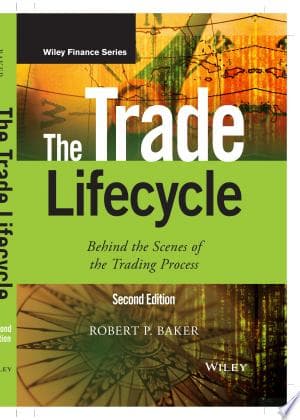
The Trade Lifecycle cover
Archivist's Choice

The Trade Lifecycle

Robert P. Baker (2015)

Genre

Finance

Reading Time

12 Minutes

Key Themes

See below

Track Your Reading

Sign in to track this book

Core Idea

The Trade Lifecycle by Robert P. Baker provides a comprehensive, step-by-step examination of the entire process a financial trade undergoes, from its initial decision and execution to its final settlement and reconciliation. The book demystifies the complex operational workflows, various participants, and critical technologies involved in ensuring a trade is accurately and efficiently processed across different asset classes. It emphasizes the interconnectedness of front, middle, and back-office functions, highlighting how each stage contributes to risk management, regulatory compliance, and overall market integrity.
Difficulty
Medium

Core idea

The central argument and framework that powers the entire book.

The Trade Lifecycle by Robert P. Baker provides a comprehensive, step-by-step examination of the entire process a financial trade undergoes, from its initial decision and execution to its final settlement and reconciliation. The book demystifies the complex operational workflows, various participants, and critical technologies involved in ensuring a trade is accurately and efficiently processed across different asset classes. It emphasizes the interconnectedness of front, middle, and back-office functions, highlighting how each stage contributes to risk management, regulatory compliance, and overall market integrity.

At a glance

Difficulty

Medium

Key Takeaways

1

The Trade Lifecycle as an Organizational Spine

Understanding how a trade's journey connects every department within a financial institution.

Quote

Every person working in a bank is highly connected to the lifecycle of a trade. It is the glue by which all departments are bound, and the aggregated success or failure of each trade determines the entire organization's survival.

Baker's main idea is that the trade lifecycle is not just a back-office function. It is the fundamental link for all operations within a financial firm. From the first sales pitch to the final settlement, each trade stage directly affects and relies on various departments: front office for execution, middle office for risk management, back office for settlement, legal for documentation, IT for infrastructure, and compliance for regulations. This connection means that problems at any point can spread through the whole organization. Thi...

Supporting evidence

The book's overarching structure and repeated emphasis on the 'glue' metaphor for departmental connection.

Apply this

Financial professionals should cultivate a cross-functional understanding of trade processing, moving beyond siloed perspectives to anticipate downstream impacts and foster inter-departmental collaboration. This includes understanding the data flows and handoffs between teams.


2

Deconstructing Trade Components and Their Risks

Breaking down complex trades into their fundamental parts to identify inherent risks and cashflows.

Quote

The Trade Lifecycle catalogues and details the various types of trades, including the inherent cashflows and risk exposures of each.

Baker offers a method for breaking down any trade, no matter how complex, into its basic parts: instrument type, notional amount, tenor, payment schedules, and underlying assets. This detailed breakdown is important because each part creates specific cashflow patterns and risk exposures. For example, an FX exotic trade might involve multiple currencies, complex option features, and non-standard settlement dates. Each element contributes to market, credit, and operational risks. By understanding these parts, firms can accurately model ...

Supporting evidence

The book's detailed analysis of various trade types and their inherent characteristics, like FX exotics and commodity counterparty risk.

Apply this

Analysts and risk managers should adopt a modular approach to trade analysis, identifying and isolating each component to assess its individual contribution to overall risk and cashflow profiles. This facilitates more precise risk mitigation strategies.

3

The Post-Crisis Thrust on Risk Control

How the 2008 financial crisis reshaped the focus on trade processing, settlement, and risk management.

Quote

Trade processing and settlement combined with control of risk has been thrust into the limelight with the recent near collapse of the global financial market.

The book stresses that the 2008 global financial crisis was a sharp wake-up call. It greatly raised the importance of strong trade processing, careful settlement, and full risk control. Before the crisis, many firms did not fully grasp the system-wide risks in complex, unclear trades and inefficient post-trade operations. The crisis revealed weaknesses in counterparty risk management, collateralization, and the large number of uncleared derivatives. Because of this, regulators set stricter rules, demanding more transparency, standard ...

Supporting evidence

The book's acknowledgment of the 2008 crisis as a catalyst for renewed focus on trade processing and risk.

Apply this

Financial institutions must continuously review and enhance their post-trade infrastructure and risk frameworks, ensuring they meet evolving regulatory standards and address lessons learned from past crises. This involves investing in technology and skilled personnel.

4

The Evolving Role of Information Technology

IT's critical and expanding influence in enabling efficient and compliant trade processing.

Quote

This comprehensive guide includes major new coverage of... the role of information technology.

A major update in this edition is the increased focus on information technology. This reflects its essential role in modern finance. Baker shows how IT supports every part of the trade lifecycle, from automated trade capture and real-time risk calculations to electronic settlement and regulatory reporting. The large number and complexity of trades, along with the need for speed and accuracy, make manual processes impossible. IT systems help with straight-through processing (STP), reduce operational errors, improve data quality, and pr...

Supporting evidence

The explicit mention of 'major new coverage' on IT, indicating its growing importance since the first edition.

Apply this

Firms should prioritize strategic IT investments in areas like automation, data analytics, and cloud infrastructure to optimize trade processing, minimize manual intervention, and ensure regulatory compliance. Collaboration between business and IT teams is paramount.

5

Credit Valuation Adjustment (CVA) in Focus

Understanding the complex measure of counterparty credit risk and its impact on derivatives valuation.

Quote

This comprehensive guide includes major new coverage of... credit valuation adjustment.

The inclusion of Credit Valuation Adjustment (CVA) as a new topic shows its growing importance in derivatives trading. Baker explains CVA as the market value of counterparty credit risk. It is a deduction from the fair value of a derivative portfolio to account for the chance of a counterparty defaulting. This concept became vital after the crisis as firms realized they needed to price in counterparty risk directly, instead of assuming risk-free transactions. Calculating CVA is very complex, involving probability models, exposure simu...

Supporting evidence

Specific mention of 'credit valuation adjustment' as a new coverage area.

Apply this

Derivatives traders and risk managers must integrate CVA into their pricing and risk models, understanding its drivers and sensitivities. This requires sophisticated analytical tools and robust data for accurate calculation and management.

6

The Spectrum of Risks: Beyond Market Risk

A comprehensive view of legal, operational, liquidity, credit, and market risks inherent in trades.

Quote

You will become familiar with the full extent of legal, operational, liquidity, credit, and market risks to which it is exposed.

While market risk often gets the most attention, Baker broadens the scope of risk. He argues that a trade faces a much wider range of dangers. Legal risks come from contracts, documentation, and regulatory changes (e.g., global derivatives initiatives). Operational risks result from human error, system failures, or process breakdowns (e.g., equity settlement issues). Liquidity risk concerns the ability to meet cashflow obligations or close positions without major price impact. Credit risk, as discussed with CVA, addresses counterparty...

Supporting evidence

The explicit enumeration of 'legal, operational, liquidity, credit, and market risks' as areas of focus.

Apply this

Risk management strategies should extend beyond traditional market risk to encompass a multi-dimensional view, integrating assessments of legal, operational, and liquidity exposures into every stage of trade planning and execution. This calls for diversified risk expertise.

7

Case Studies: Bridging Theory and Practice

Real-world examples illustrate the practical application of trade lifecycle principles and risk management.

Quote

Case studies of real projects cover topics like FX exotics, commodity counterparty risk, equity settlement, bond management, and global derivatives initiatives.

A strength of Baker's approach is the inclusion of practical case studies. These examples cover areas such as FX exotics, commodity counterparty risk, equity settlement, bond management, and global derivatives initiatives. They connect theoretical ideas to real-world application. For instance, a case study on equity settlement might detail the complexities of matching, confirmation, and reconciliation across different countries, showing potential operational problems. An example of bond management could illustrate how interest rate ch...

Supporting evidence

The explicit mention of specific case study topics.

Apply this

Readers should actively engage with the case studies, analyzing the problems presented and considering alternative solutions. This practice helps develop critical thinking skills necessary for navigating real-world financial challenges and applying theoretical knowledge.

8

From Preconception to Maturity: Tracking the Trade

Following a trade's journey through its entire lifecycle, from initiation to expiration.

Quote

By reading this, you’ll dissect a trade into its component parts, track it from preconception to maturity, and learn how it affects each business function of a financial institution.

The book carefully maps the entire path of a trade. It starts from its initial idea or client request, through execution, confirmation, settlement, and finally to its maturity or expiration. This chronological approach is key to understanding a trade's dynamic nature and its changing impact. At each stage, new risks appear, different departments get involved, and various data points are generated. For example, a trade started by the front office moves to the middle office for risk validation, then to the back office for settlement ins...

Supporting evidence

The stated goal of tracking a trade 'from preconception to maturity.'

Apply this

Professionals should develop a 'lifecycle mindset,' understanding the sequential steps and interdependencies of every trade they encounter. This helps in anticipating future requirements, managing expectations, and identifying potential issues before they escalate.

9

Profit and Risk: The Inseparable Twins

Understanding that every trade's potential for profit is inherently tied to its associated risks.

Quote

Drive profit and manage risk with expert guidance on trade processing... This book provides thorough, practical guidance toward processing the trade, and the risks and rewards it entails.

Baker consistently reinforces the idea that profit and risk are two sides of the same coin in finance. They are inseparable and must be managed at the same time. No trade makes a profit without taking on some risk, and managing risk well is essential for lasting profitability. The book argues against a purely revenue-driven approach. It favors a balanced perspective where potential rewards are always weighed against the risks. This involves not just identifying risks but also quantifying them, hedging when needed, and understanding th...

Supporting evidence

The book's explicit goal to 'drive profit and manage risk' and its mention of 'risks and rewards.'

Apply this

Decision-makers should always evaluate trades through a risk-adjusted return lens, ensuring that expected profits adequately compensate for the level of risk undertaken. This means integrating risk metrics into all performance evaluations and strategic planning.

10

The Foundational Nature of Trade Processing

Trade processing as a core, fundamental aspect of finance for all professionals.

Quote

This book provides thorough, practical guidance toward processing the trade... to help you build a strong background in this fundamental aspect of finance.

Baker consistently presents trade processing as a fundamental aspect of finance, not a niche specialty. This is a crucial point for anyone working or hoping to work in the financial industry. No matter one's specific role—be it sales, trading, risk, compliance, IT, or operations—a strong understanding of how trades are executed, confirmed, settled, and managed is essential. The book's comprehensive nature, covering everything from product types to regulatory impacts, highlights this basic importance. It suggests that mastering the tra...

Supporting evidence

The repeated use of 'fundamental aspect of finance' and the book's comprehensive scope.

Apply this

All finance professionals, regardless of their specific department, should prioritize building a solid understanding of the trade lifecycle. This foundational knowledge enhances communication, problem-solving, and strategic thinking across the organization.

Critical analysis

Notable Quotes

Quiz

Test Your Knowledge

Ready to see how well you understood this book? Take our interactive quiz with 10 questions.

10
Questions
~5
Minutes
?
Best Score

Key Questions (FAQ)

The trade lifecycle refers to the entire process a financial trade goes through, from its inception and execution to its settlement and maturity. It encompasses all the steps and activities involved in managing a trade's risks and operational processes.

About the author