“If you can make something better and cheaper, you can sell it.”
— Rufus explains his basic business idea to his friend Kate.

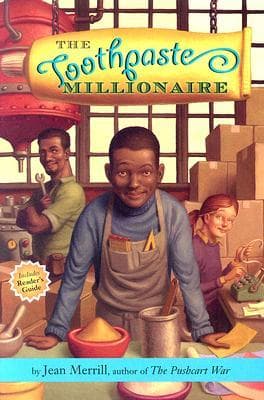
Jean Merrill (1972)
Genre
Economics / Children's / Historical Fiction / Young Adult
Reading Time
90 min
Key Themes
See below
Sign in to track this book
In 1960s Cleveland, a sixth-grader's quest to save on toothpaste unexpectedly becomes a million-dollar empire, showing that ingenuity and basic math can conquer the market.
The story opens in 1960s Cleveland, Ohio, with sixth-grader Rufus Mayflower, who wants to save money. After his father buys him an expensive tube of toothpaste, Rufus calculates the cost per ounce and finds it too high. He tells his friend Kate MacKinstrey that he can make a gallon of toothpaste for the same price as one store-bought tube. Kate, practical and good with numbers, at first doubts him but is interested. Their first attempt involves mixing baking soda, salt, and red food coloring in the Mayflower kitchen, creating a gritty, unpalatable concoction. Despite the initial failure, Rufus keeps going, seeing it as a learning experience and the first step in his ambitious, money-saving project.
Rufus and Kate start experimenting to improve their toothpaste formula. They research ingredients, focusing on cost and function. Kate carefully tracks their expenses and ingredient ratios, using her math skills to optimize the formula. They try combinations of baking soda, salt, peppermint oil, and a bit of chalk for texture, often using household items for measurements. Their goal is to make a toothpaste that is cheap, effective, and pleasant to use. The kitchen becomes their lab, filled with trial-and-error batches, some successful, many not, but each step brings them closer to a marketable product.
Once Rufus and Kate finalize an acceptable formula — a minty, slightly gritty paste packaged in small plastic bags — they decide to sell it. They calculate their production costs, including ingredients and packaging, and set a competitive price. Their first customers are their classmates. Rufus, with his entrepreneurial spirit, handles sales and marketing, while Kate manages production and finances. They quickly realize demand is greater than their small kitchen operation can handle, leading them to consider more efficient production methods and more raw materials. This initial success confirms their efforts and fuels their ambition.
To meet growing demand, Rufus and Kate set up a production line in Rufus's basement. They enlist other classmates, hiring them to mix ingredients, fill containers, and package the toothpaste. This introduces them to managing labor, inventory, and quality control. They improvise equipment, using a cement mixer for large batches and a modified cake decorator for filling tubes. Kate, with her organizational skills, creates a system for tracking production and sales, ensuring efficiency and profitability. The basement factory becomes a busy place, transforming their small project into an amateur manufacturing operation.
As their production scales up, Rufus and Kate face challenges in getting raw materials. They can no longer rely on small grocery store purchases for baking soda, salt, and peppermint oil. They learn about wholesale suppliers and buying in bulk to reduce costs. This means contacting different distributors, comparing prices, and negotiating deals, which is a learning experience. They also consider storage for larger quantities of ingredients. These logistical hurdles make them think like real business owners, understanding a reliable and cost-effective supply chain is important to maintain profit margins.
The success of Rufus's toothpaste, now called 'Mayflower Toothpaste,' starts to get attention, both good and bad. Local drugstores and established toothpaste companies begin to notice the disruption their product is causing. Rufus and Kate learn about competition and the need for marketing. They use word-of-mouth, school announcements, and local newspaper ads to promote their product. They emphasize the low cost and quality of their toothpaste, appealing to consumers looking for an affordable alternative. This period shows their growing understanding of market dynamics and consumer behavior.
With demand surging, Rufus and Kate realize they need to expand their distribution. They start selling their toothpaste to other schools and small shops in different neighborhoods. This involves recruiting more classmates as distributors, teaching them about sales, and managing delivery. They even consider using bicycles for local deliveries. This expansion phase introduces them to managing a wider sales network, ensuring consistent product quality across different locations, and collecting payments. Their initial small operation is rapidly becoming a regional company.
As the business grows, Rufus and Kate face more adult challenges. They need a bank account to manage their increasing revenue and expenses. They learn about opening a business account and the importance of financial records. They also encounter questions about business permits and regulations, prompting them to seek advice from adults, including Rufus's father and a local lawyer. These experiences expose them to the legal and financial frameworks governing businesses, teaching them about responsibility, compliance, and the importance of professional advice. They are no longer just kids making toothpaste; they are running a legitimate, youth-led company.
Through hard work, shrewd calculations, and a strong product, Mayflower Toothpaste becomes successful. Rufus and Kate, now in eighth grade, have built a thriving company from scratch. They have streamlined production, established a robust distribution network, and maintained a loyal customer base because of their affordable and effective product. The story ends with Rufus realizing his dream, and more: the business's profits reach the million-dollar mark, making Rufus Mayflower a millionaire. This achievement shows their entrepreneurial spirit, mathematical skill, and determination, proving that even kids can build a successful business with the right approach.
At the end of the story, Rufus and Kate reflect on their journey from a simple idea to a million-dollar business. They discuss the lessons learned about economics, business management, marketing, and the value of hard work. While Rufus has achieved financial success, the experience has also been an educational one for both of them. They consider what's next for Mayflower Toothpaste and their own futures, hinting at potential for continued innovation and entrepreneurship. The story closes with the satisfaction of their achievement and the enduring friendship that supported their success.
The Protagonist
Rufus transforms from a thrifty kid with a simple idea into a savvy young entrepreneur who successfully builds a million-dollar business.
The Supporting
Kate develops from a supportive friend into an indispensable business manager, honing her organizational and financial skills.
The Supporting
He moves from mild amusement and skepticism to genuine pride and helpfulness as he witnesses his son's entrepreneurial success.
The Supporting
Her role remains largely consistent as a supportive mother, providing the space and tolerance for the initial business experiments.
The Mentioned
Not a character with an arc, but his business's struggle illustrates the competitive impact of Mayflower Toothpaste.
The Supporting
He shifts from disinterest to considering stocking Rufus's product, reflecting the growing legitimacy of the business.
The Supporting
His arc is limited, serving primarily to illustrate the concept of hiring and managing labor.
The main theme is entrepreneurship, as Rufus and Kate, wanting to save money, create a successful business from scratch. The book details their journey from an idea to a million-dollar company, showing the challenges and triumphs of starting a business. It highlights identifying a market need (affordable toothpaste), developing a product, managing production, marketing, and distribution. Their innovative approach to cost-cutting and problem-solving is a core aspect, showing how creativity can lead to success.
“What makes it so expensive? Rufus asked. 'It's the stuff they put in it,' said Kate. 'The stuff that makes it taste good and makes it foam up.' 'Well,' said Rufus, 'I bet I could make a gallon of toothpaste for the price of one tube.'”
Mathematics and basic economic principles are throughout the story, as essential tools for Rufus and Kate's success. Kate uses math for calculating ingredient costs, profit margins, scaling recipes, and managing inventory. The story illustrates concepts like cost-per-unit, wholesale vs. retail pricing, supply and demand, labor costs, and economies of scale in an accessible way. The characters constantly solve real-world math problems to ensure the profitability and efficiency of their business, showing the practical use of these subjects.
“Kate worked out the figures. 'If we sell it for twenty cents a bag, we'll make ten cents profit on each bag.'”
Rufus and Kate show resourcefulness in overcoming obstacles. From improvising a cement mixer as a large-scale mixing device to finding bulk suppliers for ingredients, they creatively solve problems in production, finance, and distribution. Their ability to adapt, experiment, and find unconventional solutions to business challenges is a recurring idea. This theme emphasizes that success often comes from thinking outside the box and making the most of available resources, even when resources are limited.
“Rufus found an old cement mixer in his backyard. 'This will do for mixing,' he said. 'We can make big batches now!'”
The friendship between Rufus and Kate is fundamental to their success. Rufus provides the vision and salesmanship, while Kate offers the analytical skills and organizational ability. Their complementary strengths highlight the power of collaboration in achieving a common goal. They support each other through failures and celebrate successes, showing that teamwork and mutual respect are important in any endeavor, especially a challenging business venture. Their partnership is more effective than either could have been alone.
“'We make a good team,' said Kate. 'You have the ideas, and I have the numbers.'”
The book shows how a simple idea — making cheaper toothpaste — can become a significant company. It shows that great businesses don't always start with complex innovations but often with a straightforward solution to an everyday problem. Rufus's initial desire to save money on a basic household item sparks events that lead to a million-dollar company, emphasizing that observation, initiative, and persistence can transform a small concept into something monumental.
“It all started with a simple question: Why was toothpaste so expensive?”
The story is structured around identifying a problem and systematically solving it.
The entire plot is driven by Rufus's initial problem: store-bought toothpaste is too expensive. The subsequent events detail the step-by-step process of solving this problem by creating an alternative product. Each challenge encountered – from formulating the recipe to scaling production and distribution – is presented as a problem that Rufus and Kate must analyze and overcome, providing a clear, engaging, and educational narrative arc for young readers. This device effectively demonstrates the practical application of critical thinking and entrepreneurial skills.
Actual math calculations are woven into the dialogue and narrative.
Instead of abstract math problems, the book presents real-world calculations that the characters must perform to advance their business. Kate frequently calculates costs, profits, ingredient ratios, and production efficiency. This device makes mathematics tangible and relevant, showing its direct application in business and daily life. It helps young readers understand the importance of math beyond the classroom, demonstrating how it directly impacts the success or failure of an enterprise.
The story is told through the eyes of Kate MacKinstrey.
The entire story is narrated by Kate MacKinstrey, Rufus's best friend and business partner. This narrative choice provides a grounded, analytical, and often slightly skeptical perspective on Rufus's grand ideas. Kate's voice allows for the integration of mathematical details and practical considerations in a natural way, as she is the one tracking the numbers and organizing the logistics. Her perspective offers a balanced view, highlighting both Rufus's ambition and the meticulous planning required for success, and makes the economic concepts more accessible.
The gallon represents the initial, seemingly impossible, goal.
The initial bet of making a 'gallon of toothpaste for the price of one tube' serves as a powerful symbolic goal. It represents Rufus's ambitious vision and the challenge he sets for himself. As the story progresses, the 'gallon' evolves from a literal measurement into a symbol of their growing success and profitability. By the end, they make not just a gallon, but enough to earn a million dollars, demonstrating how a small, specific goal can lead to much larger achievements and the realization of unexpected potential.
“If you can make something better and cheaper, you can sell it.”
— Rufus explains his basic business idea to his friend Kate.
“A million dollars isn't a million dollars until you've earned it.”
— Rufus reflects on the ambitious goal hinted in the title.
“Why pay for fancy packaging when what's inside matters most?”
— Rufus criticizes wasteful spending in the toothpaste industry.
“We started in my basement, with a recipe and a dream.”
— Rufus recounts the humble beginnings of his toothpaste business.
“Sometimes the best ideas come from asking simple questions.”
— Kate encourages Rufus's curiosity about everyday products.
“Big companies forget that kids can be smart about money too.”
— Rufus challenges assumptions about age and business acumen.
“It's not just about making money; it's about making sense.”
— Rufus defends his focus on efficiency and fairness.
“Every tube we sell proves that good things don't have to cost a lot.”
— Rufus emphasizes the value proposition of his toothpaste.
“Friends make the best business partners when they believe in the idea.”
— Rufus acknowledges Kate's support in their venture.
“A little math and a lot of grit can change everything.”
— Rufus summarizes the key ingredients to his success.
“Why should toothpaste be a luxury? It's a necessity.”
— Rufus argues for affordable dental care products.
“Our biggest competition was our own doubt, not the other brands.”
— Rufus reflects on overcoming internal challenges.
“You don't need a factory to start; you just need to start.”
— Rufus advises on taking initiative with limited resources.
“In business, every penny saved is a penny earned for something better.”
— Rufus discusses cost-saving strategies in production.
“The real treasure wasn't the money, but what we learned along the way.”
— Rufus shares a lesson from his entrepreneurial journey.
Ready to see how well you understood this book? Take our interactive quiz with 10 questions.

Biography coming soon.

Jackie Wang
4.7
Thomas Sowell
4.4

Paul Anthony Samuelson
4.4
Thomas Sowell
4.4
Hans Rosling
4.4
Dave Ramsey
4.3
Palagummi Sainath
4.3
George Reisman
4.3