BookBrief
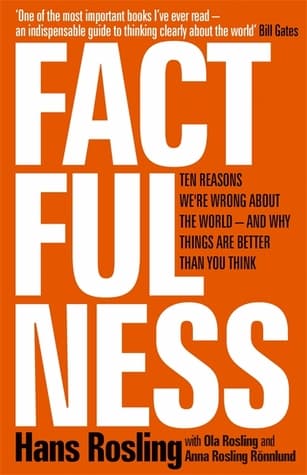
Factfulness: Ten Reasons We're Wrong About the World – and Why Things Are Better Than You Think cover
Archivist's Choice

Factfulness: Ten Reasons We're Wrong About the World – and Why Things Are Better Than You Think

Hans Rosling (2018)

Genre

Business / History / Economics / Science / Philosophy

Reading Time

12 Minutes

Key Themes

See below

Track Your Reading

Sign in to track this book

Hans Rosling shows how ten common human instincts distort our view of global progress, urging us to use data for a clearer, less anxious understanding of the world.

Core Idea

Factfulness argues that our worldview is often distorted by cognitive biases and outdated information, leading us to believe the world is much worse than it actually is. Hans Rosling, through data-driven insights, demonstrates that humanity has made significant progress in various metrics like health, education, and poverty reduction. The book introduces ten instincts (e.g., the gap instinct, the negativity instinct, the fear instinct) that prevent us from seeing these improvements and provides a framework for understanding the world based on facts and data, rather than emotion and anecdote, to foster a more accurate and hopeful perspective.
Difficulty
Easy

Core idea

The central argument and framework that powers the entire book.

Factfulness argues that our worldview is often distorted by cognitive biases and outdated information, leading us to believe the world is much worse than it actually is. Hans Rosling, through data-driven insights, demonstrates that humanity has made significant progress in various metrics like health, education, and poverty reduction. The book introduces ten instincts (e.g., the gap instinct, the negativity instinct, the fear instinct) that prevent us from seeing these improvements and provides a framework for understanding the world based on facts and data, rather than emotion and anecdote, to foster a more accurate and hopeful perspective.

At a glance

Difficulty

Easy

Key Takeaways

1

The Ignorance Instinct

Most people are systematically wrong about global trends, often performing worse than random chance.

Quote

The ape is better than the human. This is because the ape is choosing randomly and about one-third of the time it is right. The humans are systematically wrong.

Rosling begins by showing that most people, even highly educated ones, consistently answer global statistics questions worse than if they guessed randomly. This 'ignorance instinct' isn't about being unintelligent, but about holding an outdated view of the world. He uses simple multiple-choice questions about global facts (like the percentage of people in extreme poverty or girls finishing primary school). The pattern of wrong answers, often leaning towards a more negative world view, shows a basic gap between what we think and what i...

Supporting evidence

Rosling's 'ignorance test' administered to thousands of people, including Nobel laureates, showing a consistent pattern of incorrect answers on basic global statistics.

Apply this

Before forming opinions on global issues, test your factual knowledge. Be skeptical of your initial negative assumptions and actively seek out current, data-driven information.

2

The Gap Instinct

The world isn't neatly divided into 'developed' and 'developing'; most people live in the middle.

Quote

The gap instinct makes us divide all sorts of things into two distinct groups, with an imagined gap in between.

Rosling explains that our minds tend to create simple divisions, making an artificial 'gap' between two extremes, such as rich and poor, or developed and developing. He introduces four income levels, showing that most of the world's population lives in Levels 2 and 3—the 'middle'—not in extreme poverty (Level 1) or extreme wealth (Level 4). This challenges the old idea of a clear split between 'us' and 'them,' showing how billions have moved out of deep poverty. Understanding these levels shows a continuous path of progress, where sma...

Supporting evidence

Rosling's four-level income model, illustrating how the majority of the world's population falls into the middle-income levels (Level 2 and 3), not the extremes of Level 1 or 4.

Apply this

When encountering binary classifications, look for the majority in the middle. Seek out nuanced data that shows a spectrum of progress rather than just two opposing groups.

3

The Negativity Instinct

Our tendency to notice and remember bad news distorts our perception of overall progress.

Quote

The negativity instinct makes us believe that things are getting worse, even when they are not.

This is one of the book's best ideas, explaining why people believe the world is getting worse even with much evidence of global improvement. Rosling blames this on several things: remembering the past as better than it was, journalists reporting mostly bad news, and our natural tendency to focus more on negative events. He notes that 'bad news is much more newsworthy than good news,' which creates a biased media picture. While acknowledging real problems, he stresses that progress can happen at the same time as new challenges, and on...

Supporting evidence

Analysis of media reporting biases towards negative events and the psychological phenomenon of negativity bias, where people remember bad experiences more vividly than good ones.

Apply this

Actively seek out positive trends and improvements. Be aware that 'bad news' often represents isolated incidents or ongoing challenges, not necessarily a reversal of overall progress. Ask: 'Is this trend getting better or worse?'

4

The Straight Line Instinct

Assuming trends will continue indefinitely in a straight line often leads to incorrect predictions.

Quote

The straight line instinct makes us assume that a line on a graph that shows a trend will just continue straight and never bend.

Rosling criticizes the common mistake of assuming current trends will continue forever, especially regarding population growth. While the global population is growing, the rate of growth is slowing, and estimates show it will likely reach about 10-11 billion by the end of the century. He uses a child's growth curve—fast at first, then leveling off—to show that few things continue in a straight line. This instinct causes unnecessary worry about resource shortages or overpopulation, ignoring factors like falling birth rates as societies...

Supporting evidence

Population growth projections from the UN and other demographic institutions, showing a slowdown in growth rate and an eventual plateau, rather than a continuous straight-line increase.

Apply this

When seeing a linear trend, consider other possible curve shapes (S-curve, hump, plateau) and the underlying factors that might cause a change in direction. Question exponential growth assumptions.

5

The Fear Instinct

Fear distorts our judgment and makes us perceive risks as greater than they are.

Quote

The fear instinct makes us pay more attention to scary things. When we are afraid, we do not see clearly.

Rosling points out how fear, often made worse by media, activates an old survival response that bypasses rational thought. This instinct makes us overstate rare but dramatic risks (like plane crashes, shark attacks, or terrorism) while understating common, everyday ones (like heart disease or car accidents). He provides data showing that many perceived threats are statistically less dangerous than our instincts suggest. While fear can be irrational, it also protects us. However, Rosling's point is that uncontrolled fear stops us fro...

Supporting evidence

Statistical comparisons of actual risks (e.g., deaths from natural disasters vs. preventable diseases) demonstrating a disconnect between perceived and actual danger.

Apply this

When feeling fearful, pause and check the facts. Compare the perceived risk with statistical data. Focus your energy on addressing the largest, most common risks, not just the most dramatic ones.

6

The Size Instinct

Isolated numbers can be misleading; always compare them to a larger context or baseline.

Quote

The size instinct makes us misjudge the importance of a single number. Always compare!

This instinct makes us misunderstand isolated figures without proper context. A large number can sound alarming, but its importance can only be understood when compared to a total, a rate, or another relevant baseline. For example, 10,000 deaths from a disease sounds terrible, but if it's out of 10 billion people, it's very different from if it's out of 100,000. Rosling shows how a seemingly huge number of refugees, when compared to the total population of a receiving country, might be a manageable percentage. This is a basic lesson i...

Supporting evidence

Examples of large numbers (e.g., aid money, casualties) being presented without context, and then re-evaluated by comparing them to total budgets, populations, or historical rates.

Apply this

Whenever you encounter a number, ask: 'Compared to what?' Seek out rates, percentages, and comparisons over time or against relevant baselines to understand its true significance.

7

The Generalization Instinct

Categorizing without nuance leads to stereotypes and prevents understanding of individual variation.

Quote

The generalization instinct makes us incorrectly assume that everything within a category is similar.

This instinct is related to the Gap Instinct, but it focuses on the idea that all members of a category are the same. Rosling warns against generalizing from a few examples or assuming that a group (e.g., 'the poor,' 'Westerners') is uniform. He stresses looking for differences within groups and similarities across groups. For instance, not all 'poor people' live the same way; their experiences vary greatly across the four income levels. This instinct leads to stereotyping and prevents an accurate understanding of complex situations. ...

Supporting evidence

Stories of cultural differences within seemingly homogenous groups, and common stereotypes (e.g., 'lazy Africans') debunked by showing diverse realities and individual agency.

Apply this

Question categories. Look for variations within groups and similarities across different groups. Be wary of broad generalizations and seek out specific examples and data.

8

The Destiny Instinct

The idea that certain cultures or nations are inherently unchanging prevents recognition of progress.

Quote

The destiny instinct makes us assume that innate characteristics determine the destinies of people, countries, religions, or cultures.

Rosling questions the idea that the future of cultures, religions, or countries is set and unchangeable. This 'destiny instinct' leads to the belief that 'they've always been that way and always will be,' ignoring ongoing change and progress. He uses examples like the big shifts in birth rates and life expectancy in countries like Bangladesh, once thought to be hopelessly poor and traditional, to show that societies are not static. This instinct is especially harmful because it discourages action and fosters helplessness, keeping us f...

Supporting evidence

The rapid demographic and social changes in countries like Bangladesh, illustrating how societies can transform significantly within a few generations, defying 'destiny' assumptions.

Apply this

Recognize that societies and cultures are dynamic, not static. Look for examples of past change and be open to the possibility of future transformation. Challenge fatalistic views.

9

The Single Perspective Instinct

Relying on a single explanation or solution for complex problems is dangerous.

Quote

The single perspective instinct makes us look for simple explanations and solutions. This is dangerous.

This instinct leads us to believe there's one simple cause or solution for complex global issues. Experts, activists, or politicians often fall into this trap, promoting their specific area of knowledge as the ultimate answer. Rosling argues that complex problems need a 'tool-kit' of approaches, not just one. He encourages looking at problems from many angles and considering different viewpoints. For example, improving health isn't just about medicine; it's also about sanitation, education, economic development, and political stabilit...

Supporting evidence

Examples where a single 'solution' (e.g., only providing aid, or only promoting free markets) failed because it ignored other contributing factors to a problem.

Apply this

Be wary of simple solutions to complex problems. Seek out multiple perspectives, consider different disciplines, and understand that most issues have many interconnected causes.

10

The Urgency Instinct

Impulsive decision-making under perceived urgency can lead to poor choices.

Quote

The urgency instinct makes us want to take immediate action in the face of perceived danger.

The final instinct, the 'urgency instinct,' is a call to action but also a warning. Rosling agrees that some problems (like climate change or pandemics) are urgent, but he cautions against panicking and making hasty decisions. When we feel urgency, our critical thinking can shut down, causing us to overreact, ignore data, or embrace extreme solutions. He advises taking a deep breath, insisting on data, being careful of predictions, and taking small, steady steps. This is a crucial balance: recognizing true urgency without giving in ...

Supporting evidence

Historical examples of panicked responses to crises leading to ineffective or harmful policies, contrasted with measured, data-driven approaches that yielded better outcomes.

Apply this

When feeling urgent, pause and take a deep breath. Insist on data, consider the potential side effects of immediate action, and differentiate between true urgency and false alarms.

Critical analysis

Notable Quotes

Key Questions (FAQ)

Factfulness is about understanding the world through data and facts, rather than relying on outdated or emotionally driven perceptions. It reveals ten common human instincts that distort our view of global trends, showing why things are often better than we think.

About the author