BookBrief
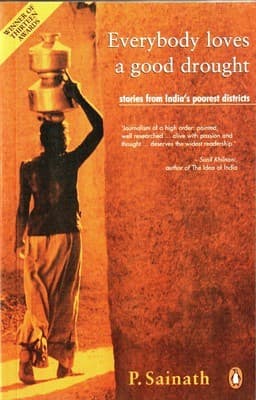
Everybody Loves a Good Drought cover
Archivist's Choice

Everybody Loves a Good Drought

Palagummi Sainath (2025)

Genre

Politics / History / Economics

Reading Time

10-12 hours

Key Themes

See below

Track Your Reading

Sign in to track this book

Through vivid, on-the-ground reporting, Sainath exposes the absurdities and failures of India's development policies, revealing the human cost behind the statistics of poverty and displacement.

Core Idea

Palagummi Sainath's "Everybody Loves a Good Drought" exposes the failures, corruption, and human cost behind India's recurring droughts and rural poverty. He argues these are not just natural events but often man-made disasters made worse by policy neglect, statistical manipulation, and media indifference. The book shows how a 'drought industry' profits from suffering, diverting aid and resources while the rural poor, especially women and marginalized communities, face official apathy and economic exploitation. Sainath believes official stories and economic data often hide the harsh realities on the ground, calling for human-focused reporting and policy-making.
Reading time
10-12 hours
Difficulty
Medium
✓ Read this if...
You want a deep, unflinching, and empathetic look into the realities of rural poverty, the politics of development, and the human cost of systemic failures in India. Essential for understanding grassroots socio-economic issues.
✗ Skip this if...
You are looking for a light read or prefer theoretical economic analyses over detailed, often grim, on-the-ground reportage.

Core idea

The central argument and framework that powers the entire book.

Palagummi Sainath's "Everybody Loves a Good Drought" exposes the failures, corruption, and human cost behind India's recurring droughts and rural poverty. He argues these are not just natural events but often man-made disasters made worse by policy neglect, statistical manipulation, and media indifference. The book shows how a 'drought industry' profits from suffering, diverting aid and resources while the rural poor, especially women and marginalized communities, face official apathy and economic exploitation. Sainath believes official stories and economic data often hide the harsh realities on the ground, calling for human-focused reporting and policy-making.

At a glance

Reading time

10-12 hours

Difficulty

Medium

Read this if...

You want a deep, unflinching, and empathetic look into the realities of rural poverty, the politics of development, and the human cost of systemic failures in India. Essential for understanding grassroots socio-economic issues.

Skip this if...

You are looking for a light read or prefer theoretical economic analyses over detailed, often grim, on-the-ground reportage.

Key Takeaways

1

The Drought Industry

How scarcity becomes a perverse opportunity for the powerful.

Quote

Everybody loves a good drought. The officials, the politicians, the contractors, the journalists. It's an industry.

Sainath exposes the 'drought industry,' a system where natural disasters are not just endured but often used for personal and political gain. Drought becomes a profitable opportunity for bureaucrats, politicians, contractors, and even media, who profit from relief funds, dubious projects, and sensational reporting. This creates an incentive to keep, rather than fix, the scarcity, as aid depends on the crisis continuing. The book argues that this corruption diverts resources, perpetuates poverty, and harms genuine efforts to build resi...

Supporting evidence

Sainath details how relief funds are siphoned off through inflated project costs, phantom beneficiaries, and substandard work, particularly in regions like Kalahandi, often deemed 'perennially drought-stricken' despite potential for irrigation.

Apply this

When evaluating disaster relief or development aid, critically question the transparency and accountability mechanisms. Advocate for direct, community-managed solutions rather than top-down, contractor-driven projects.


corruptiondisaster-capitalismpoverty-industry
2

Statistics vs. Humanity

The dehumanizing effect of reducing poverty to mere numbers.

Quote

The poor in India are, too often, reduced to statistics. In the dry language of development reports and economic projections, the true misery gets overlooked.

Sainath's main argument is that poverty, when seen only through statistics, loses its human face. The large numbers — millions in poverty, millions displaced, millions suffering from disease — become an abstraction that lets policymakers and the public distance themselves from the reality of suffering. By focusing on individual stories and struggles, Sainath forces the reader to confront the personal tragedies behind the data. This approach shows how official reports often hide systemic failures and the human cost of development polic...

Supporting evidence

The book opens with an explicit critique of how official reports focus on aggregate numbers (312 million below poverty line, 26 million displaced, 13 million with TB) without conveying the individual stories of survival and struggle that define these statistics.

Apply this

Seek out and amplify individual narratives within broader social issues to foster empathy and a deeper understanding. Challenge the reliance on purely quantitative metrics when assessing human well-being and policy impact.

dehumanizationstatistical-biasqualitative-research
3

The Irony of 'Development'

How projects meant to alleviate poverty often exacerbate it.

Quote

What passes for 'development' often means destruction for those at the bottom, displacement for the weak, and enrichment for the powerful.

Sainath shows the paradox of 'development' in India. Large projects, meant for national progress and poverty reduction, often lead to the displacement, impoverishment, and marginalization of vulnerable communities. Dam constructions, industrial zones, and infrastructure projects, while boosting GDP, often uproot millions, destroy traditional livelihoods, and offer inadequate compensation. This 'development-induced displacement' is a systemic feature, disproportionately affecting tribal populations, farmers, and the landless. The book ...

Supporting evidence

Sainath documents numerous cases of large dam projects and industrial zones displacing entire villages, leading to loss of land, culture, and traditional occupations, with promises of rehabilitation rarely fulfilled.

Apply this

Scrutinize 'development' projects for their true impact on local communities and ecosystems. Support initiatives that prioritize community-led development and sustainable practices over large-scale, disruptive interventions.

development-induced-displacementsustainable-developmenttrickle-down-economics
4

The Media's Blind Spot

Why mainstream media often ignores or misrepresents rural poverty.

Quote

The poor are invisible to the national press, unless they are dying in spectacular ways, or being photographed for a 'development tourism' piece.

Sainath critiques the Indian media's failure to adequately cover rural poverty and distress. He argues that mainstream journalism is largely urban-focused, obsessed with political spectacles and economic growth stories, and largely indifferent to the chronic issues plaguing rural India. When rural poverty is covered, it is often through 'disaster porn' — sensationalizing extreme suffering without exploring root causes — or as 'development tourism,' superficial reports that gloss over complexities. This media neglect makes the poor inv...

Supporting evidence

Sainath frequently points out the lack of rural correspondents for major newspapers, the focus on urban crime and politics, and the superficiality of 'special reports' on poverty, often published during crises and quickly forgotten.

Apply this

Actively seek out alternative and independent media sources that prioritize in-depth reporting on marginalized communities. Support journalism that goes beyond sensationalism to explore systemic issues.

media-biasrural-journalismagenda-setting
5

The Resilience of the Poor

Despite systemic failures, marginalized communities demonstrate extraordinary coping mechanisms.

Quote

The poor are not just victims; they are survivors, innovators, and often the most resourceful people you will ever meet.

Amidst the grim realities of poverty and exploitation, Sainath highlights the resilience, ingenuity, and dignity of the marginalized. Far from being passive recipients of aid or helpless victims, the poor in his accounts are active, using diverse and often clever strategies to survive and cope with systemic neglect. This includes social support networks, traditional knowledge, and innovative, though often risky, livelihood strategies. Sainath challenges the condescending view of the poor as lacking agency, instead revealing their stre...

Supporting evidence

Sainath recounts stories of villagers pooling meager resources, developing unique water conservation methods using local materials, and maintaining strong community bonds in the face of governmental neglect.

Apply this

When engaging with marginalized communities, prioritize listening to their solutions and supporting their existing coping mechanisms. Recognize and value indigenous knowledge and community-led initiatives.

community-resilienceindigenous-knowledgehuman-agency
6

The Politics of Water

Access to water is a fundamental right, yet often a tool of control and corruption.

Quote

Water, the most basic necessity, becomes a commodity, a political weapon, and a source of vast corruption in drought-prone regions.

Sainath focuses on the critical role of water, or its absence, in shaping the lives of the rural poor. He reveals how water scarcity is not always natural but often a result of mismanagement, corrupt practices, and political neglect. Irrigation projects are left unfinished, water resources are diverted to powerful agricultural lobbies or urban centers, and the poor must trek miles for water. This creates a cycle of dependency, ill-health, and lost productivity. Control over water resources becomes a tool for political patronage and ec...

Supporting evidence

Sainath details the failure of numerous government irrigation projects, the diversion of river water to cash crops of wealthy farmers, and the plight of women who walk dozens of kilometers daily to fetch drinking water.

Apply this

Advocate for equitable water distribution policies and community-managed water resources. Support initiatives that focus on sustainable water harvesting and conservation at the local level.

water-scarcityenvironmental-justiceresource-politics
7

Debt and Despair

The crushing cycle of debt trapping farmers in a spiral of poverty.

Quote

For too many farmers, the harvest is not a time of celebration, but a moment of reckoning with debts that will only grow.

The book exposes the widespread and devastating impact of debt on rural farming communities, especially with erratic monsoons and fluctuating market prices. Farmers, often smallholders or landless laborers, are forced to take loans from moneylenders at high interest rates, or from banks with complex repayment terms. A single crop failure, illness, or family event can plunge them into an inescapable debt trap, leading to asset forfeiture, forced labor, and, in tragic cases, suicide. Sainath shows how this debt crisis is made worse by g...

Supporting evidence

Sainath documents numerous instances of farmer suicides directly linked to overwhelming debt, particularly in regions where cash crops failed or market prices collapsed, leaving them unable to repay loans.

Apply this

Support microfinance initiatives and cooperative credit societies that offer fair lending practices to small farmers. Advocate for government policies that provide debt relief and insurance for agricultural losses.

agrarian-crisisfarmer-suicidesmicrofinance
8

The Invisible Labor of Women

Women bear a disproportionate burden of poverty and neglect.

Quote

In the struggle for survival, it is often the women who carry the heaviest load, unseen and unacknowledged.

Sainath consistently highlights the unique and often unseen burdens carried by women in rural India. Beyond their traditional roles, women are often responsible for fetching water and fuel from increasingly distant sources, managing household finances with meager resources, caring for the sick, and working in arduous, low-wage jobs. They are often the first to sacrifice their own nutrition and education for their families. Despite their immense contributions to household and community survival, their labor is largely unrecognized, und...

Supporting evidence

Sainath's reports frequently feature women walking dozens of kilometers for water, working in fields for minimal wages, and bearing the brunt of family crises, all while maintaining household responsibilities.

Apply this

Support programs that empower rural women through education, skill development, and access to resources. Advocate for policies that recognize and value women's unpaid labor and ensure their participation in decision-making.

gender-inequalitywomen-in-povertyunpaid-labor
9

The Power of the Personal Narrative

Individual stories are more impactful than abstract data.

Quote

To understand poverty, you must look into the eyes of a starving child, not just at a graph of malnutrition rates.

Sainath's journalistic method is an example of how individual storytelling can illuminate complex systemic issues. By immersing himself in the lives of the rural poor, he transforms abstract concepts like poverty, drought, and displacement into tangible, emotionally resonant experiences. Each chapter introduces readers to specific individuals, families, and villages, detailing their struggles, hopes, and daily realities. This human-centered approach not only makes the book compelling but also serves a critical political function: it f...

Supporting evidence

The entire book is structured around individual stories, such as the farmer who lost his land, the woman who walks miles for water, or the children suffering from preventable diseases, rather than just presenting aggregate data.

Apply this

When trying to advocate for social change, prioritize sharing personal stories and testimonials to build empathy and connection. Engage directly with affected communities to understand their perspectives.

narrative-journalismempathyhuman-centered-design
10

The Call for Accountability

Poverty is a political choice, demanding systemic change and responsibility.

Quote

Poverty is not an accident. It is a man-made condition, a political choice, and it demands political solutions and accountability.

Ultimately, Sainath's work is a strong indictment of the systemic failures and lack of accountability among India's political elite, bureaucracy, and even media. He shows that the widespread poverty and suffering he documents are not inevitable results of natural calamities or overpopulation, but rather the direct result of deliberate policy choices, corruption, and an indifference to the plight of the marginalized. The book calls for greater transparency, democratic participation, and a fundamental shift in priorities to genuinely ad...

Supporting evidence

Sainath consistently links the suffering of the poor to specific government policies, unfulfilled promises, diverted funds, and the impunity of corrupt officials and politicians.

Apply this

Actively demand accountability from elected officials and public institutions. Support grassroots movements that advocate for policy changes and challenge corruption. Vote based on candidates' commitment to social justice and poverty alleviation.

political-accountabilitysystemic-changesocial-justice

Critical analysis

Notable Quotes

The poor are not a vote bank; they are a currency bank.

Sainath's observation on how political parties view and use the poor during elections.

Development is not about building dams; it's about building people.

Critique of large-scale infrastructure projects that often displace and marginalize local populations.

In India, you can be poor, but you cannot be invisible.

Highlighting the constant visibility and often spectacle surrounding poverty in India, particularly for media and politicians.

For every problem, there is a simple solution. And it is always wrong.

Sainath's take on simplistic policy approaches to complex issues like rural distress.

The biggest tragedy is not that people are dying of hunger, but that we have stopped being shocked by it.

Reflecting on the desensitization of society to widespread suffering and poverty.

Drought is not a natural calamity. It is a man-made disaster.

Sainath argues that water scarcity and famine are often results of mismanagement and policy failures, not just natural phenomena.

The official statistics on poverty are often as dry as the land they describe.

Critique of government data and its disconnect from the lived realities of the poor.

Journalism's job is not to be liked, but to be true.

Sainath's philosophy on the role of investigative journalism in uncovering uncomfortable truths.

The rich get richer, and the poor get poorer, and the middle class gets to watch it all on cable TV.

A cynical observation on growing economic disparity and the detachment of the middle class.

When the government builds a road, it's not for the villagers; it's for the contractors.

Highlighting corruption and vested interests in infrastructure projects.

The most effective way to help the poor is to stop making them poorer.

A direct and critical statement on policies that often exacerbate poverty.

Sometimes, the biggest stories are found not in the headlines, but in the footnotes.

Emphasizing the importance of deep, grassroots reporting over superficial mainstream news.

The ultimate test of a moral society is the way it treats its children.

Sainath often reported on the plight of children in poverty-stricken regions.

The tragedy of the commons is really the tragedy of the common person.

A reinterpretation of the economic concept, linking resource depletion to its direct impact on ordinary people.

Quiz

Test Your Knowledge

Ready to see how well you understood this book? Take our interactive quiz with 10 questions.

10
Questions
~5
Minutes
?
Best Score

Key Questions (FAQ)

Palagummi Sainath's 'Everybody Loves a Good Drought' delves into the human realities of poverty in rural India, moving beyond statistics to tell the stories of individuals affected by drought, displacement, and disease. It exposes the often-misguided development efforts and the resilience of the poor.

About the author