BookBrief
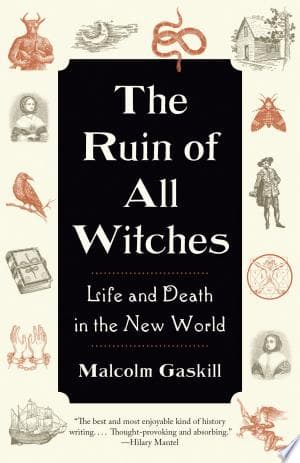
The Ruin of All Witches cover
Archivist's Choice

The Ruin of All Witches

Malcolm Gaskill (2024)

Genre

History / Spirituality

Reading Time

420 min

Key Themes

See below

Track Your Reading

Sign in to track this book

In Puritan New England, a community's fear and suspicion lead to the tragic downfall of a young couple accused of witchcraft.

Core Idea

Malcolm Gaskill's "The Ruin of All Witches" reconstructs a devastating 17th-century witch trial in Puritan New England. It shows how religious devotion, community worry, and a strong belief in Satan could quickly break down social order and ruin individual lives. The book argues that accusations and confessions were not just simple superstition but complex expressions of a worldview where spiritual problems, social differences, and perceived evil forces combined. This made a good reputation fragile and being different dangerous. By examining original documents, Gaskill shows how a community's struggles and its firm belief in divine will and demonic action created an environment ready for suspicion. This allowed witchcraft accusations to grow, turning personal arguments and unexplained troubles into proof of a satanic plot. The result was a tragic injustice driven by fear, religious fervor, and the misuse of perceived suffering against those labeled 'other.'
Reading time
420 min
Difficulty
Medium
✓ Read this if...
You are fascinated by the psychological and sociological underpinnings of historical witch trials, want a deep dive into Puritan culture and legal processes, or seek to understand how fear and religious belief can distort justice.
✗ Skip this if...
You prefer broad surveys of witch trials over a single, detailed case study, or are not interested in the nuances of 17th-century religious and legal thought.

Core idea

The central argument and framework that powers the entire book.

Malcolm Gaskill's "The Ruin of All Witches" reconstructs a devastating 17th-century witch trial in Puritan New England. It shows how religious devotion, community worry, and a strong belief in Satan could quickly break down social order and ruin individual lives. The book argues that accusations and confessions were not just simple superstition but complex expressions of a worldview where spiritual problems, social differences, and perceived evil forces combined. This made a good reputation fragile and being different dangerous.

By examining original documents, Gaskill shows how a community's struggles and its firm belief in divine will and demonic action created an environment ready for suspicion. This allowed witchcraft accusations to grow, turning personal arguments and unexplained troubles into proof of a satanic plot. The result was a tragic injustice driven by fear, religious fervor, and the misuse of perceived suffering against those labeled 'other.'

At a glance

Reading time

420 min

Difficulty

Medium

Read this if...

You are fascinated by the psychological and sociological underpinnings of historical witch trials, want a deep dive into Puritan culture and legal processes, or seek to understand how fear and religious belief can distort justice.

Skip this if...

You prefer broad surveys of witch trials over a single, detailed case study, or are not interested in the nuances of 17th-century religious and legal thought.

Key Takeaways

1

The Weight of Puritan Piety

How rigid religious dogma fueled suspicion and fear in early New England.

Quote

Lives were steeped in the divine and the diabolic, in omens, curses and enchantments.

Puritan New England was a society deeply shaped by its theology. Every misfortune, from spoiled food to sick children, could be seen as divine judgment or, more ominously, as the Devil's work. This widespread belief system meant that 'peculiar things' were not random accidents but signs that needed interpretation. The constant pressure to prove one's piety and the fear of God's anger, along with the ever-present threat of the Devil, made the community very sensitive to anything outside the norm. This deep spiritual anxiety set the sta...

Supporting evidence

The narrative details how spoiled food, ailing livestock, and personal afflictions were immediately attributed to spiritual causes rather than natural explanations, reflecting the Puritan belief in a world constantly intervened upon by God and Satan.

Apply this

Recognize how deeply held belief systems, especially those with strong moral or spiritual components, can shape collective perception and response to crisis. Be wary of systems that encourage attributing complex problems to single, often external, malevolent forces.

puritanismreligious-extremismsupernatural-beliefsocial-anxiety
2

The Spiral of Suspicion

Minor grievances and community tensions escalated into accusations of witchcraft.

Quote

The community becomes tangled in a web of distrust, resentment and denunciation.

Witchcraft accusations rarely appeared out of nowhere. Instead, they often grew in communities already stressed by internal conflicts, small jealousies, and old resentments. The Springfield story in 1651 shows this: 'peculiar things' began to happen, but it was the existing 'web of distrust' that allowed these events to be used as weapons. A bad harvest, a property disagreement, or a personal insult could, in the right (or wrong) situation, be reinterpreted as evidence of evil magic. The book illustrates how these seemingly ordinary s...

Supporting evidence

The book describes a community already experiencing 'tensions' and 'resentments' before the specific accusations, implying that these pre-existing social fractures contributed to the readiness to believe in and act upon witchcraft rumors.

Apply this

Understand that societal scapegoating often arises from unresolved internal conflicts and anxieties. Actively address community grievances and foster open communication to prevent minor issues from escalating into destructive blame games.

scapegoatingcommunity-dynamicssocial-tensioncollective-hysteria
3

The Fragility of Reputation

How easily a person's standing could crumble under the weight of suspicion.

Quote

The finger of suspicion soon falls on a young couple... the prickly brickmaker, Hugh Parsons, and his troubled wife, Mary.

In a close-knit Puritan community, one's reputation was extremely important, a fragile thing built on perceived piety, conformity, and social standing. The moment suspicion fell, even on individuals like Hugh and Mary Parsons who might have already been somewhat marginalized or 'troubled,' their entire social structure began to break down. It was not just about legal guilt or innocence; it was about public opinion, which, once damaged, was almost impossible to fix. The book suggests that the Parsons' existing traits – Hugh's 'prickly'...

Supporting evidence

The specific naming of Hugh as 'prickly' and Mary as 'troubled' suggests that their existing social profiles made them susceptible to being identified as witches when the community sought an explanation for its misfortunes.

Apply this

Reflect on how quickly reputations can be damaged by rumor and how pre-existing biases can make individuals targets. Advocate for due process and critical thinking, rather than allowing character flaws or social awkwardness to become evidence of malice.

reputation-managementsocial-stigmavulnerabilitygossip
4

The Power of the Unseen

Dreams, visions, and omens held significant sway over Puritan minds.

Quote

Disturbing dreams and visions proliferate... lives were steeped in the divine and the diabolic, in omens, curses and enchantments.

For the Puritans, the line between the physical and spiritual world was thin. Dreams were not just subconscious thoughts but potential messages from God or the Devil. Visions were not hallucinations but divine or demonic appearances. This belief system meant that subjective experiences, often caused by stress, illness, or psychological distress, were given objective, often terrifying, interpretations. The book highlights how these 'disturbing dreams and visions' directly increased the growing paranoia, providing 'evidence' that evil s...

Supporting evidence

The text explicitly mentions 'disturbing dreams and visions proliferate,' and that people's lives were 'steeped in omens, curses and enchantments,' indicating the profound impact these subjective experiences had on their perception of reality and the unfolding events.

Apply this

Recognize the powerful influence of belief systems on how individuals interpret subjective experiences. In modern contexts, differentiate between genuine psychological distress and external malevolence, and seek evidence-based explanations rather than supernatural ones.

superstitionpsychological-projectioncollective-hallucinationdream-interpretation
5

Beyond Simple Superstition

Witch hunts were complex phenomena rooted in social, political, and theological anxieties.

Quote

Captures an entire society caught in agonized transition between superstition and enlightenment, tradition and innovation.

Gaskill challenges simple views of witch hunts as just products of ignorant superstition. Instead, he presents them as very complex events resulting from several factors: the strict religious framework of Puritanism, the social pressures of a new colony, economic worries, political power struggles, and psychological vulnerabilities. The 'agonized transition' describes a society dealing with big changes, where old explanations (like witchcraft) clashed with new rational thought. The book suggests that the witch hunt was a symptom of a ...

Supporting evidence

The description of the book combining 'history, anthropology, sociology, politics, theology and psychology' and portraying a society in 'agonized transition' highlights the multifaceted nature of the witch hunt's origins.

Apply this

Avoid reductionist explanations for complex historical or social phenomena. Always look for the interplay of multiple factors – economic, political, social, psychological, and cultural – when analyzing societal crises.

historical-analysissocietal-changecultural-anxietyinterdisciplinary-study
6

The Weaponization of Affliction

Illness and suffering became powerful tools in the machinery of accusation.

Quote

People suffer convulsions as if possessed by demons. Children sicken and die.

In a world without modern medicine or understanding of disease, illness was often blamed on spiritual causes. When 'people suffer convulsions as if possessed by demons' or 'children sicken and die,' these real and tragic afflictions were not seen as medical issues but as direct attacks from the Devil, carried out by human agents – witches. This meant that the suffering of individuals, especially children, became strong 'evidence' in witchcraft trials, fueling the community's hysteria and making the accusations seem legitimate. The boo...

Supporting evidence

The specific mention of 'convulsions as if possessed by demons' and 'children sicken and die' directly links physical suffering to the belief in demonic possession and witchcraft, making these afflictions central to the unfolding accusations.

Apply this

Be critically aware of how real suffering can be misinterpreted or manipulated to serve other agendas. Prioritize accurate diagnosis and compassionate care, and challenge interpretations that attribute complex human suffering to simplistic, externalized evil.

medical-historydemonologyvictimizationsocial-manipulation
7

The Peril of the 'Other'

Those who deviated from societal norms were often the first to be targeted.

Quote

A woman is seen wading through the swamp like a lost soul.

While not explicitly named as a target, the image of 'a woman ... wading through the swamp like a lost soul' suggests deviance and isolation. Witchcraft accusations often affected those who were already marginalized, eccentric, or non-conformist in their communities. Women, the elderly, the poor, or those with unusual personalities or behaviors were often the first to be suspected. The book, by featuring such figures, implicitly shows how societal anxieties were projected onto those who did not fit the strict rules of Puritan conformi...

Supporting evidence

The evocative image of 'a woman... wading through the swamp like a lost soul' subtly points to individuals who might be seen as outsiders or unusual, making them vulnerable to suspicion in a paranoid community.

Apply this

Challenge the tendency to demonize or ostracize those who are different or marginalized. Actively promote inclusion and empathy, recognizing that 'othering' often paves the way for injustice.

marginalizationconformitysocial-exclusionxenophobia
8

The Enduring Legacy of Fear

The events of 1651 reveal timeless lessons about human vulnerability to fear and scapegoating.

Quote

Thought-provoking and absorbing.

While set in a specific historical context, the lessons from 'The Ruin of All Witches' are relevant far beyond 17th-century New England. The book, as Hilary Mantel notes, is 'thought-provoking' because it reveals how easily humans fall prey to fear, the destructive power of collective paranoia, and how readily societies can turn on their own when facing unexplained challenges. The ways suspicion, denunciation, and the search for external enemies are not unique to witch hunts; they are patterns that appear throughout history in various...

Supporting evidence

Hilary Mantel's praise highlights the book's enduring relevance and its ability to provoke thought beyond its specific historical setting, suggesting its universal themes.

Apply this

Actively study historical instances of mass hysteria and persecution to develop critical thinking skills and recognize early warning signs of similar societal breakdowns. Promote empathy, critical inquiry, and a commitment to justice in your community.

historical-lessonsmoral-paniccollective-memorysocial-justice

Critical analysis

Notable Quotes

The witch was a terrible inversion of the ideal woman, a figure of perversion and destruction, an enemy within.

Describing the societal perception of witches in early modern England.

To understand the witch-hunt is to understand not just the accuser and accused, but the entire fabric of belief and anxiety that bound them.

Gaskill's overarching thesis on the complexity of witch trials.

Magic was not a separate realm, but an integral part of everyday life, a way of understanding and influencing a world full of unseen forces.

Explaining the pervasive nature of magical thinking in the period.

The devil was not just a theological concept but a tangible presence, actively recruiting souls and disrupting the divine order.

Discussing the role of the devil in early modern demonology and fear.

Confession, whether coerced or genuine, was the linchpin of the witch trial, validating the accusers and solidifying the narrative of evil.

Analyzing the importance and impact of confessions in judicial processes.

The landscape itself was imbued with meaning, a stage upon which spiritual battles were fought and supernatural encounters took place.

Exploring the connection between environment and spiritual belief.

Poverty, sickness, and misfortune were not random occurrences but often interpreted as the malevolent work of witches.

Highlighting how personal suffering was attributed to witchcraft.

The witch-hunt was a collective drama, enacted by communities struggling to make sense of a world undergoing profound and unsettling changes.

Framing witch trials as a community response to societal upheaval.

The body of the accused witch was often seen as a site of transgression, marked by unusual features or 'witch's marks'.

Discussing the physical examination of accused witches.

Children, both as victims and accusers, played a surprisingly significant and often terrifying role in the unfolding of witch trials.

Examining the involvement of children in witch accusations.

The 'ruin' in the title refers not just to individual witches, but to the broader societal and spiritual fabric that was torn apart by these events.

Explaining the deeper meaning behind the book's title.

Justice, in these cases, was a labyrinth of suspicion, fear, and deeply held beliefs, rather than a clear path to truth.

Critiquing the nature of justice during witch trials.

The legacy of the witch-hunt continues to haunt us, a stark reminder of the dangers of mass hysteria and the demonization of the 'other'.

Reflecting on the enduring relevance of witch trials.

While we may never fully grasp the inner world of the accused, we can strive to understand the external pressures and beliefs that shaped their fate.

Gaskill's approach to historical empathy and understanding.

Quiz

Test Your Knowledge

Ready to see how well you understood this book? Take our interactive quiz with 10 questions.

10
Questions
~5
Minutes
?
Best Score

Key Questions (FAQ)

The book tells the gripping story of a family tragedy in Puritan New England, specifically in Springfield, Massachusetts in 1651, focusing on the witch-hunting accusations against Hugh and Mary Parsons amidst a community steeped in suspicion and fear. It explores the historical, social, and spiritual dimensions of this period.

About the author