BookBrief
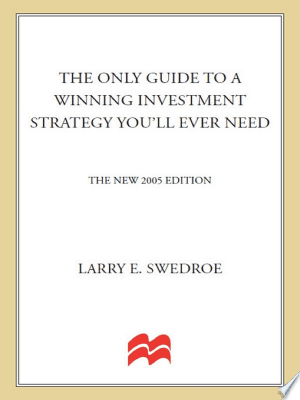
The Only Guide to a Winning Investment Strategy You'll Ever Need cover
Archivist's Choice

The Only Guide to a Winning Investment Strategy You'll Ever Need

Larry E. Swedroe (2005)

Genre

Finance

Reading Time

240 min

Key Themes

See below

Track Your Reading

Sign in to track this book

Build lasting wealth by mastering passive investing and avoiding active stock picking, using Swedroe's principles for a strong, diverse portfolio.

Core Idea

This book argues that most individual investors and even professional money managers cannot consistently beat the market because it is efficient. Instead of picking stocks or timing the market, investors should use a disciplined, passive strategy. This means focusing on broad diversification, low-cost index funds, and understanding the five proven factors of return. The main idea is that a careful, systematic way to build and maintain a portfolio, rather than active speculation, is the most reliable way to accumulate wealth over time.
Reading time
240 min
Difficulty
Medium
✓ Read this if...
You are an individual investor seeking a research-backed, evidence-based approach to long-term portfolio construction, or if you are skeptical of active management and market timing.
✗ Skip this if...
You believe you can consistently beat the market through stock picking, market timing, or an active management strategy, or if you are looking for get-rich-quick schemes.

Core idea

The central argument and framework that powers the entire book.

This book argues that most individual investors and even professional money managers cannot consistently beat the market because it is efficient. Instead of picking stocks or timing the market, investors should use a disciplined, passive strategy. This means focusing on broad diversification, low-cost index funds, and understanding the five proven factors of return. The main idea is that a careful, systematic way to build and maintain a portfolio, rather than active speculation, is the most reliable way to accumulate wealth over time.

At a glance

Reading time

240 min

Difficulty

Medium

Read this if...

You are an individual investor seeking a research-backed, evidence-based approach to long-term portfolio construction, or if you are skeptical of active management and market timing.

Skip this if...

You believe you can consistently beat the market through stock picking, market timing, or an active management strategy, or if you are looking for get-rich-quick schemes.

Key Takeaways

1

Embrace Market Efficiency

The market already prices in all available information, making 'beating' it a statistical anomaly.

Quote

The market is remarkably efficient, meaning asset prices reflect all publicly available information almost instantly.

Swedroe's main argument uses the concept of market efficiency, specifically the semi-strong form. This theory says that current stock prices reflect all public information. Because of this, active managers find it very hard to consistently beat the market after fees and taxes, as new information quickly changes prices. This does not mean markets are perfect, but that the combined intelligence of millions of participants makes sustained outperformance by stock-picking a zero-sum game before costs, and a negative-sum game after costs. U...

Supporting evidence

Numerous academic studies, including those by Eugene Fama (a Nobel laureate), demonstrating that active managers, as a group, fail to beat their benchmarks over long periods, especially after fees.

Apply this

Accept that trying to pick individual stocks or actively time the market is a low-probability endeavor. Instead, focus on capturing market returns rather than attempting to outsmart the market.

market-efficiencysemi-strong-efficiencyalpha
2

Passive Investing Triumphs

Index funds and ETFs consistently outperform most actively managed funds due to lower costs and diversified exposure.

Quote

The evidence is overwhelming: passive index funds and ETFs are the most effective way for the vast majority of investors to achieve their financial goals.

Swedroe strongly supports passive investing, mainly through low-cost index funds and Exchange Traded Funds (ETFs). The main benefit is their low expense ratios. Active funds have high costs from research, trading, and management fees, which reduce returns. Passive funds, by simply tracking an index, have minimal overhead. Over decades, this small difference in fees grows significantly, letting passive investors keep a larger share of market returns. Also, passive funds naturally offer broad diversification, reducing specific risks fro...

Supporting evidence

SPIVA (S&P Dow Jones Indices Versus Active) reports consistently show that a significant majority of active funds underperform their respective benchmarks over 3, 5, 10, and 15-year periods. Swedroe also highlights the compounding effect of even small fee differences over long investment horizons.

Apply this

Build your portfolio primarily with broad-market, low-cost index funds or ETFs that track major indices like the S&P 500, total stock market, and total bond market. Prioritize funds with the lowest expense ratios.

index-fundsetfspassive-investingexpense-ratio
3

The Power of Diversification

Spread your investments across different asset classes, geographies, and market segments to mitigate risk.

Quote

Diversification is the only free lunch in investing. It allows you to reduce risk without sacrificing expected returns.

Modern Portfolio Theory (MPT), created by Harry Markowitz, is a core part of Swedroe's strategy. It says investors should look at how assets move together, not just individual asset risk and return. By combining assets that do not correlate perfectly, investors can build a portfolio with a higher expected return for a certain risk, or lower risk for a certain expected return. Swedroe expands this beyond just stocks and bonds to include international equities, real estate, and other asset classes. This ensures exposure to many sources ...

Supporting evidence

Markowitz's Nobel Prize-winning work on Modern Portfolio Theory. The historical data showing that different asset classes perform well at different times, highlighting the benefit of not having all your eggs in one basket.

Apply this

Construct a globally diversified portfolio using low-cost funds. Include domestic and international equities (developed and emerging markets), fixed income (various maturities and credit qualities), and potentially real estate or commodities. Rebalance periodically to maintain your target allocation.

diversificationmodern-portfolio-theoryasset-allocationrisk-mitigation
4

Focus on the Five Factors of Return

Expected returns are driven by factors beyond just the broad market, offering opportunities for 'smarter' passive exposure.

Quote

While broad market indexes capture much of the market's return, academic research has identified specific factors that explain a significant portion of long-term expected returns.

Beyond just tracking the total market, Swedroe discusses specific 'factors' that academic research (especially by Fama and French) shows drive long-term returns. These include the market risk premium (stocks over cash), size (small-cap stocks doing better than large-cap), value (value stocks doing better than growth stocks), profitability, and investment (companies with careful investment policies doing better than those with aggressive ones). By leaning a portfolio towards these factors through specific index funds (e.g., small-cap v...

Supporting evidence

The Fama-French three-factor model (market, size, value) and subsequent extensions (profitability, investment) which show these factors explain a large portion of cross-sectional stock returns.

Apply this

Consider allocating a portion of your equity portfolio to factor-based index funds or ETFs that target small-cap and value stocks, in addition to broad market exposure. Understand that these tilts come with their own periods of underperformance.

factor-investingfama-frenchvalue-premiumsize-premiumprofitability-premium
5

Control What You Can Control

Focus on fees, taxes, and your own behavior, as these are the true determinants of long-term investment success.

Quote

You cannot control the market, but you can control your costs, your taxes, and your behavior. These are the levers of investment success.

Swedroe emphasizes that investors should focus on what they can control, not on market fluctuations they cannot control. The three main controllable elements are investment costs (expense ratios, trading fees), taxes (tax-efficient fund placement, tax-loss harvesting), and investor behavior (avoiding emotional decisions, sticking to a plan). High fees reduce returns constantly, while poor tax planning can greatly cut net gains. Most importantly, emotional reactions like panic selling during downturns or chasing popular trends destroy ...

Supporting evidence

Examples of how high expense ratios compound to massive losses over decades. The documented tendency of individual investors to buy high and sell low due to emotional reactions to market news.

Apply this

Choose funds with ultra-low expense ratios. Utilize tax-advantaged accounts (401k, IRA) first, and employ tax-efficient strategies in taxable accounts. Develop a written Investment Policy Statement (IPS) to guide your decisions and prevent emotional mistakes.

investment-coststax-efficiencyinvestor-behaviorbehavioral-financeinvestment-policy-statement
6

The Perils of Active Management

Attempts to beat the market through stock picking or market timing are statistically doomed for most investors.

Quote

The vast majority of actively managed funds fail to beat their benchmarks over time, especially after accounting for their higher fees and taxes.

Swedroe spends much time disproving the idea of the active manager. He shows how the zero-sum nature of the market means that for every investor who outperforms, another must underperform. When fees and trading costs are included, the average active investor (or fund) will underperform the market. Even successful managers often owe their success more to luck than skill, and their performance rarely lasts. The book warns against believing marketing hype or the appeal of 'expert' stock pickers.

Supporting evidence

Data from studies like Dalbar's Quantitative Analysis of Investor Behavior, showing individual investors consistently underperform market averages due to poor timing decisions. Historical performance of hedge funds and actively managed mutual funds versus their benchmarks.

Apply this

Avoid actively managed mutual funds, stock-picking, and market timing. Be skeptical of financial advisors who promise to 'beat the market' or claim to have proprietary trading strategies.

active-managementmarket-timingstock-pickinghedge-fundsunderperformance
7

Portfolio Care and Maintenance

Regular rebalancing and disciplined adherence to your plan are essential for long-term success.

Quote

Building a sound portfolio is only half the battle; the other half is maintaining it with discipline and periodic adjustments.

A well-built portfolio does not need constant changes, but it also is not something you 'set and forget.' Swedroe stresses the importance of regular rebalancing. As different asset classes perform differently, your initial target allocations will change. Rebalancing means selling appreciated assets and buying depreciated ones to return to your target percentages. This strategy naturally makes you 'buy low and sell high' (compared to your original allocation) and helps manage risk by preventing too much exposure to any single asset cla...

Supporting evidence

Illustrations of how asset allocation drifts over time due to differing returns. The historical benefits of rebalancing in maintaining risk levels and potentially enhancing returns over the long term.

Apply this

Establish a rebalancing schedule (e.g., annually or when allocations drift by a certain percentage, like 5%). Stick to your pre-determined asset allocation through market ups and downs. Review your Investment Policy Statement regularly (but not too frequently) to ensure it still aligns with your goals.

rebalancingasset-allocationportfolio-maintenancedisciplineinvestment-policy-statement
8

The 15 Rules of Prudent Investing

A concise framework of actionable principles for building and maintaining a successful investment strategy.

Quote

Prudent investing is about adhering to a set of evidence-based rules, not chasing fads or relying on gut feelings.

Swedroe summarizes his philosophy into 15 clear, practical rules, acting as a full checklist for investors. These rules cover everything from understanding market efficiency and diversification benefits to controlling costs, managing taxes, and, most importantly, keeping emotional discipline. They reinforce that successful investing is a long journey, built on consistent use of proven principles rather than speculative risks. This framework is very useful for investors seeking a structured, evidence-based approach.

Supporting evidence

The culmination of all the evidence presented throughout the book, synthesized into a practical guide. Each rule is underpinned by academic research and historical market data.

Apply this

Print out and regularly review Swedroe's 15 Rules of Prudent Investing. Use them as a personal checklist to ensure your investment decisions remain aligned with a sound, long-term strategy.

prudent-investinginvestment-principlesfinancial-planninglong-term-investing
9

Understand Your Risk Tolerance

Align your portfolio's risk level with your personal capacity and willingness to take on risk.

Quote

The most effective portfolio is one you can stick with through thick and thin, and that means understanding and respecting your true risk tolerance.

A crucial, often overlooked part of investing is truly understanding one's risk tolerance. Swedroe distinguishes between the capacity for risk (how much you can afford to lose without harming your financial goals) and the willingness to take risk (your comfort with market volatility). A portfolio that is too aggressive for your comfort will likely lead to panic selling during downturns, while one that is too conservative may prevent you from reaching your goals. The book stresses the importance of an honest self-assessment to buil...

Supporting evidence

Behavioral finance research on how investors' emotions impact their decision-making during market volatility. Examples of investors abandoning sound strategies due to fear.

Apply this

Before investing, conduct a thorough self-assessment of your risk tolerance. Consider your financial goals, time horizon, income stability, and emotional reaction to hypothetical market crashes. Choose an asset allocation that genuinely allows you to sleep at night.

risk-tolerancerisk-capacityasset-allocationbehavioral-financeemotional-investing

Critical analysis

Notable Quotes

The market has a marvelous way of humbling the arrogant and rewarding the patient.

Emphasizing the long-term perspective needed for successful investing.

Diversification is the only free lunch in finance.

Highlighting the importance of spreading investments to reduce risk without sacrificing returns.

Predicting the future direction of the market is a fool's errand.

Warning against market timing and emphasizing a focus on long-term strategy.

Costs matter, and they matter a lot.

Stressing the significant impact of fees and expenses on investment returns over time.

Your most important asset is not your portfolio, but your behavior.

Underscoring the critical role of investor discipline and emotional control.

Passive investing isn't about being lazy; it's about being smart.

Defending index fund investing as a rational and effective strategy.

Risk and expected return are highly correlated, but not perfectly so.

Explaining the relationship between taking on risk and the potential for higher returns.

Focus on what you can control: your costs, your asset allocation, and your behavior.

Advising investors to concentrate on actionable elements of their strategy.

The biggest mistake investors make is allowing emotions to drive their decisions.

Pointing out the common pitfalls of emotional investing during market fluctuations.

There are no crystal balls in investing, only probabilities.

Reinforcing the idea that investing involves managing uncertainty, not certainty.

Understand your risk tolerance before you build your portfolio, not after the market crashes.

Emphasizing the importance of self-assessment and planning prior to market volatility.

Chasing past performance is a recipe for future disappointment.

Warning against the common mistake of investing based on historical returns without considering future prospects.

A well-thought-out investment plan, adhered to consistently, is your best defense.

Advocating for a systematic and disciplined approach to investing.

Quiz

Test Your Knowledge

Ready to see how well you understood this book? Take our interactive quiz with 10 questions.

10
Questions
~5
Minutes
?
Best Score

Key Questions (FAQ)

Active mutual funds aim to outperform the market by actively buying and selling securities, relying on fund managers' expertise. Passive mutual funds, in contrast, seek to replicate the performance of a specific market index, such as the S&P 500, with minimal trading.

About the author