BookBrief
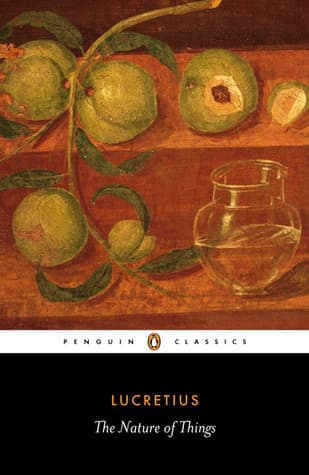
The Nature of Things cover
Archivist's Choice

The Nature of Things

Lucretius (1957)

Genre

History / Science / Philosophy

Reading Time

600 min

Key Themes

See below

Track Your Reading

Sign in to track this book

Lucretius, through his powerful verse, explains the atomic dance of the cosmos, urging people to let go of divine fear and find peace in the physical workings of existence.

Core Idea

Lucretius's "De Rerum Natura" (On the Nature of Things) explains Epicurean philosophy, stating that the universe works only through atoms and void, without gods. This view helps achieve tranquility by removing the fear of death, punishment, and gods, which Lucretius says cause human suffering. By understanding the soul's material nature, the impermanence of things, and the cycle of creation and destruction from atomic movements, people can live free from superstition and dread, focusing on simple pleasures and knowledge.
Reading time
600 min
Difficulty
Hard
✓ Read this if...
You are interested in the foundational ideas of atomic theory, ancient materialism, philosophical atheism, or wish to explore a classical perspective on achieving tranquility through understanding the physical world.
✗ Skip this if...
You prefer modern scientific explanations, are uncomfortable with a non-theistic worldview, or find ancient philosophical poetry challenging to engage with.

Core idea

The central argument and framework that powers the entire book.

Lucretius's "De Rerum Natura" (On the Nature of Things) explains Epicurean philosophy, stating that the universe works only through atoms and void, without gods. This view helps achieve tranquility by removing the fear of death, punishment, and gods, which Lucretius says cause human suffering. By understanding the soul's material nature, the impermanence of things, and the cycle of creation and destruction from atomic movements, people can live free from superstition and dread, focusing on simple pleasures and knowledge.

At a glance

Reading time

600 min

Difficulty

Hard

Read this if...

You are interested in the foundational ideas of atomic theory, ancient materialism, philosophical atheism, or wish to explore a classical perspective on achieving tranquility through understanding the physical world.

Skip this if...

You prefer modern scientific explanations, are uncomfortable with a non-theistic worldview, or find ancient philosophical poetry challenging to engage with.

Key Takeaways

1

Embrace the Void: Fear of Death is an Illusion

Our souls are mortal, and ceasing to exist is not a state of suffering.

Quote

When we exist, death is not yet present, and when death is present, then we do not exist.

Lucretius strongly argues against the fear of death, saying it comes from not understanding our nature. He says the soul, like the body, is made of atoms and is mortal. When we die, these atoms scatter, and the 'self' ends. There is no afterlife of pain or joy because no conscious being exists to feel it. Fearing death is fearing non-existence, which is illogical, as one cannot suffer from something that removes the ability to suffer. This view offers freedom, encouraging people to live fully in the present without the worry of an ima...

Supporting evidence

Lucretius elaborates on the atomic composition of the soul, describing its delicate, mobile nature, and how it is intertwined with the body but ultimately dissolves upon death. He uses analogies like a cup breaking and its contents spilling to illustrate the impermanence of the 'self'.

Apply this

Reflect on the impermanence of consciousness. When faced with existential dread, remind yourself that the cessation of existence is not a personal experience of suffering, but a return to the natural state of non-being that preceded your birth. Focus on maximizing the quality of your present life.
atomismmortalityepicureanism
2

The Universe is Mechanistic, Not Divine

Natural laws, not capricious gods, govern all phenomena.

Quote

Nothing is ever created out of nothing by divine will.

A main part of Lucretius's philosophy is rejecting divine involvement in the world. He states that the universe works by fixed, mechanical laws, driven by the constant movement and interaction of atoms. Earthquakes, storms, diseases are not signs of divine anger or favor, but predictable results of natural processes. This different view from religious explanations lets people seek understanding through observation and reason, rather than appeasement or superstition. It grounds human existence in a rational, understandable cosmos, crea...

Supporting evidence

Lucretius meticulously explains phenomena like the water cycle, the formation of mountains, and the propagation of sound through the movement and collision of atoms. He explicitly states that if gods created the world, it would be perfect, yet it is full of flaws and dangers, proving its natural origin.

Apply this

When confronted with unexplained events or misfortunes, resist the urge to attribute them to supernatural forces. Instead, seek out scientific or logical explanations. Cultivate a mindset of curiosity and rational inquiry into the causes and effects of the world around you.

materialismatheismdeterminism
3

Atomic Theory: The Building Blocks of Reality

Everything, visible and invisible, is composed of indivisible particles.

Quote

All things whatsoever are formed of atoms, and all things return to atoms.

Lucretius supports Epicurus's atomic theory, suggesting the universe has an infinite number of tiny, unbreakable, and eternal particles called atoms, moving in an infinite void. These atoms differ in shape, size, and weight, and their endless combinations and separations create everything we see, from rocks to thoughts, from the human body to the vast cosmos. This basic idea makes the world clearer, simplifying complex events into basic particles and their interactions, offering a strong way to understand the physical world centuries ...

Supporting evidence

He explains how different atomic shapes account for different properties: smooth, round atoms for liquids and gases, hooked atoms for solids. He also discusses the 'swerve' (clinamen) of atoms, allowing for randomness and preventing pure determinism.

Apply this

When considering the nature of objects or even abstract concepts, try to break them down into their fundamental components. Recognize that even the most complex systems are built from simpler, interacting parts. This perspective can foster a deeper appreciation for the underlying order of the universe.

atomismvoidmatter
4

The Nature of Sensation and Perception

Our senses receive 'films' of atoms from objects, forming our understanding of the world.

Quote

From all things whatsoever that exist, there flow forth continually and are scattered abroad images of them.

Lucretius explains sensation and perception by saying objects constantly release thin 'films' or 'images' (simulacra) of atoms. These films travel through the void and hit our sense organs, which then send this information to the mind, also made of atoms. This material explanation covers sight, hearing, smell, and touch without supernatural means. It shows the physical basis of our interaction with the outside world and our inner experiences, setting an early foundation for a scientific understanding of how we think.

Supporting evidence

He describes how these 'films' are incredibly thin and swift, allowing us to perceive distant objects almost instantly. He also touches upon how dreams are formed by these same 'films' reaching the mind during sleep, often distorted or fragmented.

Apply this

Become more aware of how your senses are constantly bombarded by external stimuli. Consider that your perception is a physical process, and therefore subject to limitations and potential distortions. Question the absolute truth of your immediate sensory experience, fostering a more critical and reflective mindset.

epicurean epistemologysimulacrasensation
5

Love and Lust: Atomic Attractions

Sexual desire and love are natural, physical urges, not divine interventions.

Quote

Love is a torment, if you allow yourself to be caught in its snares.

Lucretius examines love and sexual desire, placing them firmly in the realm of atomic interactions within the body. He sees sexual attraction as a natural, biological need for reproduction, driven by specific atomic movements and the exchange of 'seeds' between bodies. While acknowledging pleasure, he also warns against the obsessive and often painful parts of romantic love, especially the destructive jealousy and irrationality it can cause. His view encourages a balanced, rational approach to these strong emotions, supporting pleasur...

Supporting evidence

He describes the physical sensations of desire and the bodily fluids involved, all as manifestations of atomic movements. He also contrasts the pure physical pleasure of sex with the emotional turmoil and societal complications often associated with 'falling in love'.

Apply this

Recognize that strong emotional responses like attraction are rooted in biological and physical processes. Seek to enjoy companionship and intimacy without allowing obsessive thoughts or irrational jealousy to dominate. Cultivate a sense of calm and moderation in your relationships.

hedonismdesirepassion
6

The Evolution of Life and Society

Lifeforms and human civilization developed through natural selection and adaptation.

Quote

Nature by herself formed all things and nourished them, and she alone gave them increase and strength.

Lucretius foreshadows parts of evolutionary theory, describing how life on Earth began on its own from a primal soup and changed over time. He suggests that only creatures suited to their environment survived and reproduced, while unfit forms died. He extends this natural view to human society, tracing the path from primitive, solitary life to communities, language, and technology, all driven by need and cleverness, not divine guidance. This foresight highlights the power of observation and reason in understanding complex natural proc...

Supporting evidence

He discusses how early Earth conditions were fertile for life's emergence, and how various creatures, including humans, developed different abilities (e.g., speed, strength, intelligence) to ensure survival. He also details the invention of fire, shelter, and language as responses to human needs.

Apply this

Observe the natural world with an eye towards adaptation and survival. Understand that human civilization is a product of continuous innovation and problem-solving, not a static, divinely ordained state. Appreciate the incremental progress that has shaped both species and societies.

evolutionnatural selectionanthropology
7

The Cosmic Dance: Creation and Destruction

Worlds are born, thrive, and perish in an endless cycle of atomic rearrangement.

Quote

The universe is always changing, always in flux, always moving.

Lucretius presents a changing, cyclical view of the cosmos, where endless worlds constantly form and dissolve within the vast void. Our world, like all others, had a start and will have an end, not by divine judgment, but by the natural processes of atomic gathering and scattering. This cosmic view lessens human self-importance, placing our existence within a vast, impersonal, and ever-changing universe. It encourages humility and acceptance about the temporary nature of all things, from stars to civilizations.

Supporting evidence

He describes the 'birth' of our world from a swirling mass of atoms, and predicts its eventual 'death' as its constituent atoms scatter, perhaps to form new worlds elsewhere. He uses the analogy of a body decaying to illustrate the dissolution of a world.

Apply this

Cultivate a long-term perspective on events, recognizing that all things are impermanent. When faced with change or loss, remember that these are natural parts of a larger cosmic cycle. Find peace in the understanding that even destruction is a precursor to new forms and possibilities.

cosmologyentropycyclical universe
8

Achieving Tranquility Through Understanding

Freedom from fear and superstition leads to true peace of mind (ataraxia).

Quote

The greatest wealth is to live content with little.

The main goal of Lucretius's philosophy, from Epicurus, is to guide people to 'ataraxia' – a state of calm and freedom from worry. This peace of mind comes from understanding the true nature of things: removing the fear of death, seeing the mechanistic universe, and freeing oneself from worries caused by superstitious beliefs and irrational desires. By adopting a rational, materialist view, one can live a life focused on simple pleasures, friendship, and learning, free from the pains of fear and the pursuit of brief, unsatisfying desi...

Supporting evidence

Lucretius consistently links his scientific explanations to their practical benefit for human well-being. He argues that understanding the atomic nature of the soul removes the fear of death, and understanding natural phenomena removes the fear of angry gods.

Apply this

Actively challenge your fears, particularly those related to death or supernatural judgment, by engaging with rational explanations. Simplify your life by focusing on intrinsic satisfactions like knowledge, friendship, and moderation, rather than external pursuits that often lead to anxiety and dissatisfaction.

ataraxiaepicureanismhedonism
9

The Perils of Superstition and Organized Religion

Blind faith and fear of the gods are sources of immense human suffering.

Quote

So potent was religion in persuading to evil deeds.

Lucretius strongly criticizes organized religion and superstition, seeing them as major causes of human suffering and irrationality. He argues that the fear of angry gods, belief in a painful afterlife, and demands of religious rules lead to needless suffering, moral corruption, and even violence (like the sacrifice of Iphigenia). By offering a clear, natural explanation for the universe, he aims to free people from these oppressive beliefs, allowing them to live more freely, rationally, and ethically, guided by reason rather than fea...

Supporting evidence

He recounts the myth of Iphigenia, sacrificed by her father Agamemnon to appease the gods, as a stark example of religion's capacity for cruelty. He also details the psychological torment caused by the fear of divine punishment.

Apply this

Approach religious claims and supernatural explanations with a critical, questioning mind. Evaluate beliefs based on evidence and reason, rather than blind faith or tradition. Seek ethical guidance from principles of human well-being and empathy, rather than dogmatic commands.

anti-theismrationalismsuperstition
10

The Limitless Nature of the Void and Atoms

The universe is infinite in extent and contains an infinite number of atoms.

Quote

For if there were no void, all things would be solid; and if there were no bodies, all would be void.

Lucretius states that the universe is limitless, stretching infinitely in all directions, and holds an infinite supply of atoms. This endlessness is logically necessary: if the void were finite, atoms would eventually fall out; if atoms were finite, they would scatter and dissolve into the void, leaving nothing. This grand scale means there is no center, no 'edge' to the cosmos, and endless potential for new worlds and new combinations of matter. It's a humbling and expansive vision, showing the sheer vastness and constant change of e...

Supporting evidence

He uses the thought experiment of throwing a spear to the edge of the universe: if it hits something, that's not the edge; if it goes through, the void extends further. He also argues that if atoms were finite, they would have long ago dissolved into the infinite void.

Apply this

When feeling confined or overwhelmed, reflect on the infinite scale of the universe. Understand that your immediate circumstances are but a tiny part of an immeasurably vast and eternal cosmic dance. Cultivate a sense of wonder and humility in the face of such boundless existence.

infinitudevoidcosmology

Critical analysis

Notable Quotes

Nothing can be made from nothing.

Introducing the first principle of physics, that matter cannot be created.

Nature, therefore, resolves everything into its component atoms, and never reduces anything to nothing.

Explaining the conservation of matter, that things merely change form.

For the mind, which rules the whole body, is part of a man, and is fixed in a definite place, just as the hand and foot are parts of the whole body.

Describing the mind as a physical part of the body, located in the chest.

No single thing abides; but all things flow. Fragment to fragment clings; the things thus grow Until we see a whole that still is one.

Illustrating the constant change and flux of the universe, made of constantly moving atoms.

For the nature of mind and spirit is bodily.

Arguing against the idea of an immaterial soul, asserting the physical nature of thought.

For if you think that the soul is immortal, and that it can be separated from the body, you will be in great error.

Directly refuting the concept of an immortal, separable soul, a key Epicurean tenet.

How many errors have men made, how many times have they erred, in their search for the truth!

Reflecting on human fallibility and the difficulty of philosophical inquiry.

For it is sweet, when on the great sea the winds trouble the waters, to gaze from the land on the great struggles of another.

A famous opening to Book II, expressing the pleasure of observing others' troubles from a safe distance.

Thus the sum of things is ever being renewed, and mortals live by a give and take.

Describing the cyclical nature of existence and the constant exchange of matter.

No power of the gods has given us birth, nor have we been created by any divine hand.

Rejecting divine creation in favor of a natural, atomic origin for life.

The greatest wealth is to live content with little.

An Epicurean maxim on the importance of simple living and contentment.

For it is by no means in our power to choose what kind of parents we shall have, or by what laws we shall live.

Acknowledging the limits of human agency and the influence of external factors.

The world, therefore, is not governed by divine power, but by chance.

Asserting the role of chance and natural laws over divine intervention in the universe.

Terror and darkness of mind must be dispelled not by the rays of the sun, nor by the bright shafts of daylight, but by the outer view and the inner law of nature.

Advocating for reason and understanding of nature as the cure for fear and superstition.

Quiz

Test Your Knowledge

Ready to see how well you understood this book? Take our interactive quiz with 10 questions.

10
Questions
~5
Minutes
?
Best Score

Key Questions (FAQ)

'The Nature of Things' is an epic philosophical poem that explains the world through atomic theory, advocating for a life free from the fear of death and divine intervention. It combines scientific treatise with profound poetry to demonstrate that the universe operates by mechanical laws, not by gods.

About the author