“I can resist everything except temptation.”
— Algernon explaining his philosophy to Lane.


Oscar Wilde (1976)
Genre
History / Romance
Reading Time
164 min
Key Themes
See below
Sign in to track this book
In a world of mistaken identities and social artifice, two bachelors create alter egos named Ernest, leading to a tangle of romance and witty banter that reveals the absurdities of Victorian high society.
The play begins in Algernon Moncrieff's London flat, where his butler Lane serves tea. Algernon and Lane discuss marriage and music, revealing Algernon's cynical, witty outlook. His nephew, Ernest Worthing, arrives, but Algernon quickly confronts him about an inscribed cigarette case. Jack, whose real name is Jack Worthing, admits he lives a double life: in the country, he is the respectable guardian Jack, but in London, he invents a wicked younger brother named Ernest. This brother's supposed misadventures give him an excuse to visit the city. Algernon confesses to a similar deception, using an invalid friend named Bunbury to escape social obligations, a practice he calls 'Bunburying.'
Gwendolen Fairfax, Algernon's cousin and Lady Bracknell's daughter, arrives. Jack takes the opportunity to propose to her. Gwendolen, who wants to marry a man named Ernest, readily accepts, believing Jack is Ernest. However, the formidable Lady Bracknell soon appears and questions Jack rigorously about his background and financial prospects. Jack passes the financial test, but his revelation that he was found as a baby in a handbag at Victoria Station, cloakroom number 'Bags, left luggage,' by a railway official, horrifies Lady Bracknell. She declares such an origin makes him unsuitable for her daughter.
After Lady Bracknell forbids the marriage, Gwendolen reaffirms her love for Jack and promises to remain faithful, despite his unknown parents. Jack, frustrated, decides to 'kill off' his fictional brother Ernest, announcing his death from a severe chill in Paris. Meanwhile, Algernon, having learned Jack's country address and the existence of his charming ward, Cecily Cardew, decides to 'Bunbury' his way into the country. He plans to impersonate Jack's wicked brother, Ernest, to meet Cecily. Jack, unaware of Algernon's scheme, prepares to return to the country.
The scene moves to Jack's country estate in Woolton. Cecily Cardew, Jack's innocent and romantic ward, studies German with her governess, Miss Prism. Dr. Chasuble, the local rector, also visits. Cecily expresses her interest in Jack's supposedly wicked brother, Ernest. Algernon arrives, introducing himself as Ernest Worthing, to Cecily's delight. Cecily, who has long fantasized about Ernest, is immediately charmed by Algernon and his 'wicked' reputation, which she finds romantic. She quickly falls in love with him, having already written a detailed account of their imaginary courtship in her diary.
Jack returns to Woolton, dressed in mourning clothes, ready to announce his brother Ernest's death. He is shocked and furious to find Algernon already there, having convinced Cecily that he is Ernest. Jack tries to expose Algernon's deception, but Cecily is too smitten to listen. The situation becomes more complicated when Gwendolen arrives unexpectedly, having traveled to the country after hearing of Jack's whereabouts. Both women believe they are engaged to 'Ernest Worthing,' leading to a humorous confrontation as they realize they are engaged to two different men using the same name.
Gwendolen and Cecily initially connect over their shared love for 'Ernest Worthing,' only to discover the truth about Jack and Algernon's deceptions. They angrily confront the two men, who try to explain their 'Bunburying.' The women are particularly upset that neither man is actually named Ernest. After a brief but intense argument, largely about eating muffins, the women withdraw their affections. Eventually, after the men agree to be christened 'Ernest' to satisfy their fiancées, the couples reconcile. Their love proves stronger than the initial deception, though the name 'Ernest' remains a key point for both women.
Lady Bracknell unexpectedly arrives at Jack's country estate, having followed Gwendolen. She is initially pleased to find Gwendolen, but her mood sours when she discovers Algernon is engaged to Cecily. Lady Bracknell immediately questions Cecily's background and fortune. She is delighted to learn that Cecily has a substantial inheritance of one hundred and thirty thousand pounds, making her a highly desirable match. However, Jack, as Cecily's guardian, refuses to consent to the marriage unless Lady Bracknell allows him to marry Gwendolen. This creates a stalemate, as Lady Bracknell remains firm in her disapproval of Jack's unknown parentage.
During the standoff, Dr. Chasuble mentions that Miss Prism, Cecily's governess, had once written a three-volume novel. Lady Bracknell overhears this and, to everyone's surprise, recognizes Miss Prism's name. She accuses Miss Prism of having disappeared twenty-eight years ago with a baby in a perambulator, leaving a manuscript in its place. Miss Prism, flustered, admits to having confused the baby with her novel, inadvertently placing the infant in a handbag and the manuscript in the perambulator. She reveals she left the handbag in the cloakroom of Victoria Station, the same location where Jack was found.
Jack rushes to retrieve the handbag from his dressing-room, confirming it is the one Miss Prism described. The revelation that Jack is the baby Miss Prism misplaced means he is of respectable birth and Algernon's elder brother. Lady Bracknell then reveals that Jack is the son of her late sister, Mrs. Moncrieff, and General Moncrieff. Jack, consulting the Army Lists, discovers his father's Christian name was Ernest. This means Jack's real name has always been Ernest, and his fictional brother Ernest was, in fact, himself. The play concludes with Jack realizing that 'the importance of being Earnest' was a truth all along.
With Jack's true identity and noble lineage confirmed, Lady Bracknell gives her full consent to his marriage with Gwendolen. Algernon is already engaged to Cecily, and Dr. Chasuble proposes to Miss Prism, who accepts. The play ends with all three couples happily engaged. Jack, now truly Ernest, embraces Gwendolen, exclaiming that he finally understands the 'importance of being Earnest.' The characters have navigated a maze of lies and deceptions, only to arrive at a conclusion where truth, though revealed through comedic circumstances, ultimately wins, leading to happiness and the fulfillment of all romantic wishes.
The Protagonist
Jack transforms from a man living a double life to discovering his true, respectable identity and name, embracing the 'importance of being Earnest'.
The Protagonist/Supporting
Algernon moves from a life of self-indulgent 'Bunburying' to genuinely falling in love and committing to Cecily, albeit still with his characteristic wit.
The Supporting
Gwendolen's initial superficiality about names gives way to a deeper, though still name-dependent, commitment to Jack, accepting him for who he truly is (or rather, who he turns out to be).
The Supporting
Cecily's romantic fantasies are challenged by reality, but she ultimately finds love with Algernon, accepting his flaws.
The Antagonist
Lady Bracknell remains largely unchanged, her rigid social views only bending when wealth and status align with her desires, ultimately accepting Jack's marriage after his true noble parentage is revealed.
The Supporting
Miss Prism's past mistake is revealed, leading to the resolution of the plot and her own romantic engagement.
The Supporting
Dr. Chasuble's celibate life is disrupted by his affection for Miss Prism, culminating in their engagement.
The Mentioned
Lane remains a static character, serving his role as a butler.
Wilde critiques Victorian attitudes towards marriage, showing it less as a union of love and more as a social and economic arrangement. Lady Bracknell's questioning of Jack about his finances and connections, and her refusal to allow Gwendolen to marry him based on his lack of 'parents,' shows this. Both Jack and Algernon initially view marriage with a cynical detachment, using it as a means to an end or a social necessity rather than a romantic ideal. However, the play suggests that beneath the superficialities, genuine affection can still grow, even through absurd circumstances.
“An engagement should come on a young girl as a surprise, pleasant or unpleasant, as the case may be.”
This theme uses the double meaning of the word 'earnest' – both the name and the quality of being serious and sincere. The characters are obsessed with the name 'Ernest,' believing it embodies desirable traits, while engaging in elaborate deceptions. Jack and Algernon create alter egos named Ernest to escape their responsibilities, highlighting Victorian society's hypocrisy. The play makes fun of the idea that appearance (having the 'right' name) is more valued than genuine character (being earnest). The ending, where Jack discovers his real name is Ernest, ironically validates the women's superficial desires.
“In matters of grave importance, style, not sincerity, is the vital thing.”
The entire plot centers on the deceptions of 'Bunburying' and the creation of the fictional brother Ernest. Characters constantly maintain false fronts to escape social obligations or to pursue forbidden pleasures. Jack pretends to be Ernest in London, while Algernon invents Bunbury. Even the seemingly moral Miss Prism has a secret past involving a lost baby. Wilde uses these deceptions to expose the widespread hypocrisy of Victorian upper-class society, where maintaining appearances and following strict social codes often took precedence over truth and genuine morality.
“The truth is rarely pure and never simple.”
Wilde critiques the idleness, superficiality, and self-absorption of the Victorian aristocracy. Characters focus on trivial matters like cucumber sandwiches, muffins, and the 'correct' name for a husband, while serious issues are often treated lightly. Lady Bracknell's absurd questions during her interrogation of Jack, and Algernon's constant witty but meaningless pronouncements, highlight this theme. The play suggests that the upper class, free from the need to work, has become disconnected from real concerns, finding meaning only in social rituals and witty conversation.
“I never travel without my diary. One should always have something sensational to read in the train.”
Despite the satirical tone, love and romance are central to the play. All the main characters seek love, though often with very superficial or unconventional conditions. Gwendolen and Cecily are obsessed with the name Ernest, seeing it as a requirement for love. Jack and Algernon are driven by their affections, even if their methods are deceptive. The play, while mocking romantic conventions, celebrates love's power to overcome obstacles, even those created by the characters' own lies. The happy ending sees all couples united, suggesting that love, in its own peculiar way, triumphs.
“To lose one parent, Mr. Worthing, may be regarded as a misfortune; to lose both looks like carelessness.”
The invention of a fictional invalid friend to escape social obligations.
Bunburying is Algernon's term for creating a fictional persona or situation to avoid unwanted social engagements. Algernon invents 'Bunbury,' an invalid friend whose frequent relapses require Algernon to visit him in the country. Jack employs a similar device with his fictional wicked brother, Ernest. This device allows the characters to lead double lives, highlighting the hypocrisy of Victorian society and providing the central comedic engine for the plot, as the two 'Bunburyists' eventually clash.
A crucial prop that reveals Jack's true parentage.
The handbag in which Jack was found as a baby serves as the ultimate deus ex machina. Its seemingly trivial nature, combined with the detailed description of its location at Victoria Station, links Jack's unknown origins to Miss Prism's past mistake. This plot device is essential for resolving the central conflict of Jack's parentage and allowing him to marry Gwendolen. It also cleverly ties together the themes of identity, truth, and the absurd coincidences that drive the plot.
A name that becomes a catalyst for romantic obsession and identity confusion.
The name 'Ernest' is central to the play's title and its comedic misunderstandings. Both Gwendolen and Cecily are fixated on marrying a man named Ernest, believing it embodies ideal characteristics. This superficial obsession drives Jack and Algernon to adopt the name, leading to mistaken identities and farcical confrontations. The irony culminates when Jack discovers his true, birth name actually is Ernest, fulfilling the women's desires in an unexpected and humorous way, and underscoring the play's commentary on appearance versus reality.
A personal journal used to record and invent romantic fantasies.
Cecily's diary is a key plot device that reveals her romantic idealism and imagination. She meticulously records her imagined courtship with Jack's fictional brother, Ernest, anticipating Algernon's arrival and their subsequent 'romance.' The diary highlights Cecily's preference for fantasy over reality and serves as evidence of her affections, both real and imagined. It also contributes to the comedic confusion when Gwendolen believes her own engagement to 'Ernest' is being recorded, leading to a confrontation between the two women.
“I can resist everything except temptation.”
— Algernon explaining his philosophy to Lane.
“To lose one parent, Mr. Worthing, may be regarded as a misfortune; to lose both looks like carelessness.”
— Lady Bracknell interrogating Jack about his origins.
“The truth is rarely pure and never simple.”
— Algernon reflecting on honesty and deception.
“All women become like their mothers. That is their tragedy. No man does. That is his.”
— Algernon's cynical observation about gender roles.
“I never travel without my diary. One should always have something sensational to read in the train.”
— Cecily explaining her habit of writing a diary.
“Oh! I don't think I would care to catch a sensible man. I should not know what to talk to him about.”
— Gwendolen expressing her preference for less sensible men.
“The very essence of romance is uncertainty.”
— Algernon discussing the nature of romance with Jack.
“In matters of grave importance, style, not sincerity, is the vital thing.”
— Gwendolen's view on what truly matters in life.
“Gwendolen, it is a terrible thing for a man to find out suddenly that all his life he has been speaking nothing but the truth.”
— Jack realizing the irony of his 'truthful' identity.
“I am sick of not being Earnest.”
— Jack lamenting his double life and desire for authenticity.
“Few people nowadays are sufficiently sensible to their own defects to make any real change for the better.”
— Miss Prism's observation on human nature.
“The good ended happily, and the bad unhappily. That is what Fiction means.”
— Miss Prism's definition of fiction while discussing her novel.
“I hate people who are not serious about meals. It is so shallow of them.”
— Algernon expressing his strong opinion on dining.
“You can never be overdressed or overeducated.”
— Oscar Wilde's often-quoted line, embodying the play's spirit.
Ready to see how well you understood this book? Take our interactive quiz with 10 questions.
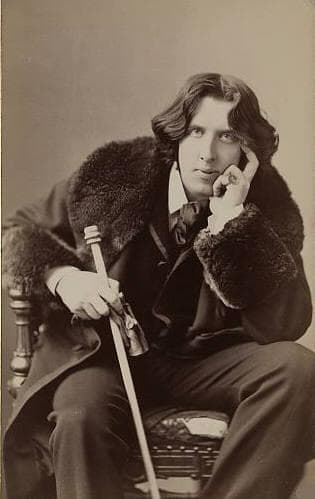
Oscar Fingal O'Fflahertie Wills Wilde was an Irish poet and playwright. After writing in different forms throughout the 1880s, he became one of the most popular playwrights in London in the early 1890s. He is best remembered for his epigrams and plays, his novel The Picture of Dorian Gray, and the circumstances of his criminal conviction for gross indecency for consensual homosexual acts in "one of the first celebrity trials", imprisonment, and early death from meningitis at the age of 46.
Michael S. Heiser
4.5
Winston S. Churchill
4.5
Will Durant
4.4
Sigurd F. Olson
4.4
Thomas Sowell
4.4
Emmanuel Guibert
4.3
W.E.B. Du Bois
4.3
Joseph Campbell
4.3