BookBrief
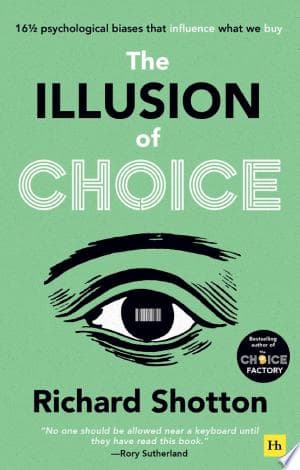
The Illusion of Choice cover
Archivist's Choice

The Illusion of Choice

Richard Shotton (2023)

Genre

Economics / Marketing

Reading Time

180 min

Key Themes

See below

Track Your Reading

Sign in to track this book

Explore 16 psychological biases that shape consumer choices and how businesses can use them to attract and keep customers.

Core Idea

Richard Shotton's "The Illusion of Choice" examines the subtle psychological biases that influence human decision-making, especially in consumer behavior and marketing. The book argues that our seemingly rational choices are often guided by environmental factors, presentation, and mental shortcuts. Shotton uses behavioral science experiments and marketing examples to show how principles like the Decoy Effect, Anchoring, Social Proof, and Framing can be used to create desire, shape perceptions, and influence purchasing, revealing the predictable irrationality behind our choices.
Reading time
180 min
Difficulty
Medium
✓ Read this if...
You are a marketer, advertiser, product designer, or anyone interested in understanding the psychological triggers behind consumer decisions and how to ethically (or unethically) influence them.
✗ Skip this if...
You are looking for a deep philosophical treatise on free will or a purely academic textbook on behavioral economics without practical marketing applications.

Core idea

The central argument and framework that powers the entire book.

Richard Shotton's "The Illusion of Choice" examines the subtle psychological biases that influence human decision-making, especially in consumer behavior and marketing. The book argues that our seemingly rational choices are often guided by environmental factors, presentation, and mental shortcuts. Shotton uses behavioral science experiments and marketing examples to show how principles like the Decoy Effect, Anchoring, Social Proof, and Framing can be used to create desire, shape perceptions, and influence purchasing, revealing the predictable irrationality behind our choices.

At a glance

Reading time

180 min

Difficulty

Medium

Read this if...

You are a marketer, advertiser, product designer, or anyone interested in understanding the psychological triggers behind consumer decisions and how to ethically (or unethically) influence them.

Skip this if...

You are looking for a deep philosophical treatise on free will or a purely academic textbook on behavioral economics without practical marketing applications.

Key Takeaways

1

The Decoy Effect: Engineering Desire

How a strategically inferior option can boost sales of a target product.

Quote

Subtle changes in the way products are positioned, promoted and marketed can radically alter how customers behave.

The Decoy Effect, or asymmetric dominance, shows that adding a third, less appealing option can guide consumers toward a specific choice among the others. The decoy does not need to seem bad; it just makes one of the other options appear better by comparison. When a new option is clearly inferior to one product but not necessarily to another, it makes the 'dominant' product more appealing. This bias is especially strong with multiple choices, subtly manipulating perceived value without devaluing any product. Businesses can use this by...

Supporting evidence

Shotton likely references classic studies like Dan Ariely's subscription experiment for The Economist, where a print-only option was introduced to make the print-and-web bundle more attractive than the web-only option.

Apply this

When presenting pricing tiers, introduce a high-priced, slightly less featured 'decoy' option to make your mid-tier offering seem like a much better value. Alternatively, when selling a premium product, offer a slightly inferior, similarly priced option to make the premium product's value stand out.
decoy-effectasymmetric-dominancechoice-architecture
2

The Power of Precision: Specificity Sells

Using exact numbers and details to enhance perceived credibility and value.

Quote

The illusion of choice identifies the 16½ most important psychological biases that everyone in business needs to be aware of today.

People trust specific claims. Vague statements like 'save a lot of money' are less convincing than 'save 17% on your energy bill.' Precise numbers, even if they seem arbitrary, make a claim feel more authentic and thorough. This bias suggests our brains interpret precise figures as the result of careful calculation and expertise, not guesswork. This applies to pricing, discounts, statistics, and even timeframes. Businesses often avoid precision for fear of being wrong, but Shotton argues that the perceived credibility gained outweighs...

Supporting evidence

Shotton would likely cite studies where precise numbers in advertising or pricing led to higher conversion rates or perceived trustworthiness compared to rounded or approximate figures.

Apply this

Instead of saying 'our customers are very satisfied,' state '92.3% of our customers report high satisfaction.' When offering a discount, use a specific percentage like 'save 17%' instead of 'save big.' For delivery times, 'delivered in 3-5 days' is better than 'delivered quickly.'

precision-biascredibilitynumerical-anchoring
3

The Peak-End Rule: Crafting Memorable Experiences

People judge an experience by its most intense point and its conclusion, not the sum of its parts.

Quote

You'll learn to take advantage of the peak-end rule, the power of precision, the wisdom of wit – and much, much more.

The Peak-End Rule, a cognitive bias identified by Daniel Kahneman, states that our memory of an experience is heavily influenced by its most intense (peak) moment and how it ends. The duration or average quality of the experience matters less. This has significant implications for customer service, product design, and marketing. Businesses should find the 'peak' moments in their customer journey and enhance them, while also ensuring a positive and memorable conclusion. A strong finish can improve a less-than-perfect journey, and an ex...

Supporting evidence

Kahneman's famous colonoscopy study, where patients preferred a longer, but less painful at the end, procedure over a shorter, more painful at the end, one.

Apply this

For a hotel, ensure the check-in is seamless (a good start), but focus resources on a memorable 'peak' experience (e.g., an unexpected upgrade, an exceptional meal) and a smooth, personalized check-out (a strong end). For a subscription service, ensure the cancellation process, if it must happen, is frictionless and polite, leaving a positive final impression.

peak-end-rulecustomer-experiencememory-bias
4

The Wisdom of Wit: Humor as a Persuasion Tool

Strategic use of humor can increase memorability, likability, and message retention.

Quote

These choices might appear to be freely made, but psychologists have shown that subtle changes in the way products are positioned, promoted and marketed can radically alter how customers behave.

Humor, when used correctly, is a powerful but often underused tool in marketing. It can cut through clutter, make a brand more relatable and human, and significantly increase the memorability of an ad or message. Wit disarms audiences, making them more receptive to the underlying message. However, the key is 'correctly' – humor must be relevant, appropriate for the audience, and not overshadow the product or service promoted. It builds connection, fostering goodwill and a sense of shared experience, which can lead to stronger brand lo...

Supporting evidence

Shotton would likely reference studies on humorous advertising campaigns and their impact on brand recall, likability, and purchase intent, contrasting them with purely informational ads.

Apply this

Integrate clever, self-aware humor into social media posts, email subject lines, or even product packaging. For example, a brand of 'healthy' snacks could use a witty tagline acknowledging the struggle to eat well, creating relatability. Avoid offensive or overly complex jokes that could alienate potential customers.

humor-in-marketinglikabilitymessage-retention
5

Framing Effects: Shaping Perceptions with Language

How presenting information in different ways can drastically alter consumer decisions.

Quote

Every day, people make hundreds of choices. Many of these are commercial.

The way information is 'framed' greatly influences how it is perceived and acted upon. Consumers react differently to '80% fat-free' versus '20% fat,' even though the objective information is identical. This bias shows that people are not purely rational decision-makers; their choices are heavily swayed by how options are presented. Marketers can use framing by emphasizing positive attributes (gain framing) or minimizing negative ones (loss framing), depending on the desired outcome. Understanding this allows businesses to craft messa...

Supporting evidence

Kahneman and Tversky's Asian Disease Problem, where the framing of survival rates versus death rates significantly altered participant choices for medical treatments.

Apply this

Instead of stating 'late fees apply,' frame it as 'save money by paying on time.' When discussing product features, focus on the benefits gained ('experience smoother performance') rather than the problems avoided ('less likely to crash'). For a warranty, emphasize 'peace of mind for five years' over 'only a 5% chance of failure.'

framing-effectcognitive-biasloss-aversion
6

Scarcity Principle: The Allure of Limited Availability

Perceived rarity or limited availability increases an item's desirability.

Quote

How much to spend on a bottle of wine? Whether to renew a subscription?

The Scarcity Principle is a strong psychological trigger: when something is perceived as scarce, its value and desirability increase. This applies to limited-time offers, limited-edition products, or exclusive access. The fear of missing out (FOMO) drives consumers to act quickly, often impulsively, to secure an item they might otherwise hesitate to buy. Shotton emphasizes that this scarcity must be genuine or credibly presented; false scarcity can backfire and damage trust. When used ethically, it creates urgency and signals high dem...

Supporting evidence

Shotton would point to examples like 'limited stock remaining' messages on e-commerce sites, 'today only' sales, or collectible items that gain value due to their restricted production.

Apply this

Implement 'only X left in stock' notifications on product pages. Run flash sales with a clear countdown timer. Offer exclusive access to a new product line for a select group of early adopters. Create limited-edition versions of popular products to generate buzz and demand.

scarcity-principlefomourgency-marketing
7

Social Proof: Following the Crowd

People are more likely to adopt beliefs or behaviors if they see others doing so.

Quote

Richard Shotton, author of the acclaimed The Choice Factory, draws on academic research, previous ad campaigns and his own original field studies.

Social proof is a basic human tendency to look to others for cues on how to think, feel, and act, especially in uncertain situations. When we see many people endorsing a product, using a service, or engaging in a particular behavior, we perceive it as more credible, desirable, and 'correct.' This bias appears through testimonials, reviews, celebrity endorsements, 'most popular' labels, and even simple crowd sizes. Businesses can use social proof by showcasing positive customer experiences, highlighting popularity, and leveraging influ...

Supporting evidence

Shotton would reference studies like Robert Cialdini's work on social proof, or examples like 'Bestseller' labels in bookstores, or restaurant queues signaling good food.

Apply this

Display customer reviews and star ratings prominently on your website. Feature testimonials from satisfied clients. Highlight the number of people who have purchased or subscribed ('Join 10,000 happy customers!'). Use 'trending' or 'most popular' indicators for products.

social-proofconformitybandwagon-effect
8

Anchoring Effect: The First Impression's Power

Initial information disproportionately influences subsequent judgments and decisions.

Quote

What shampoo to pick? How much to spend on a bottle of wine?

The Anchoring Effect describes our tendency to rely heavily on the first piece of information offered (the 'anchor') when making decisions, even if that anchor is irrelevant. This initial figure then skews our subsequent judgments. For businesses, this means that the first price shown, the initial feature presented, or even an unrelated high number can set a benchmark against which all other options are evaluated. Marketers can strategically use high anchors to make subsequent, lower prices seem more reasonable, or to frame the value ...

Supporting evidence

Tversky and Kahneman's wheel of fortune experiment, where participants' estimates of African countries in the UN were influenced by an arbitrary spin of a wheel showing a high or low number.

Apply this

When presenting pricing, always show the original, higher price (the anchor) alongside the discounted price. For a premium product, start the conversation by mentioning a competitor's even higher-priced offering. When fundraising, suggest a high donation amount first, even if you expect people to give less.

anchoring-effectprice-perceptioncognitive-bias
9

Commitment and Consistency: The Power of Small Asks

Once we make a small commitment, we're more likely to follow through with larger, consistent actions.

Quote

You simply cannot afford to miss The Illusion of Choice.

Humans need to appear consistent in their words and actions. Once we've made a public or even private commitment, however small, we feel pressure to maintain that consistency. This bias is very useful for marketers guiding customers through a sales funnel. By starting with a small, low-friction request (e.g., signing up for a newsletter, liking a post, taking a free trial), businesses can increase the likelihood of customers agreeing to larger, more significant commitments later (e.g., making a purchase, renewing a subscription). The ...

Supporting evidence

Shotton would reference Robert Cialdini's foot-in-the-door technique, where agreeing to a small request (e.g., putting a small sign in their window) significantly increased agreement to a much larger, related request (e.g., putting a large, unsightly billboard in their yard).

Apply this

Ask website visitors to subscribe to a free email list before asking them to make a purchase. Offer a free sample or a low-cost trial before pitching the full-priced product. Encourage customers to leave a short review before asking for a detailed testimonial.

commitment-consistencyfoot-in-the-doorpersuasion-techniques

Critical analysis

Notable Quotes

The greatest enemy of a good plan is the illusion of choice.

Introducing the core theme of the book, how we often feel we have more choice than we do.

When people are overwhelmed by choice, they often choose not to choose.

Discussing the paradox of choice and its impact on consumer behavior.

We are not rational actors; we are rationalizers.

Highlighting the post-hoc justification of decisions rather than purely logical decision-making.

Small nudges can lead to big changes.

Emphasizing the power of behavioral economics in influencing decisions without restricting choice.

The default option is a remarkably powerful force.

Explaining how pre-selected options significantly influence uptake rates for various services or products.

Friction is the enemy of action.

Discussing how simplifying processes and removing obstacles can increase desired behaviors.

We don't buy products; we buy better versions of ourselves.

Explaining how marketing appeals to aspirations and self-perception rather than just product features.

The best way to change behaviour is often to change the environment.

Arguing for the effectiveness of contextual changes over direct persuasion.

What is scarce is valued.

Discussing the principle of scarcity and its impact on perceived value and demand.

People are more likely to act when they feel a sense of ownership.

Explaining the endowment effect and its implications for marketing and sales.

The power of social proof is immense.

Highlighting how people are influenced by the actions and opinions of others.

We often confuse familiarity with preference.

Discussing the mere-exposure effect and its role in brand loyalty and product choice.

Emotion, not logic, is often the true driver of our decisions.

Underlining the significant role of feelings and intuition in decision-making, even if we rationalize it later.

The cost of inaction is often invisible, but no less real.

Encouraging a consideration of the opportunity costs and missed benefits of not making a change.

Humans are fundamentally lazy thinkers, seeking the path of least resistance.

Discussing cognitive effort and how people tend to avoid mentally demanding tasks.

Quiz

Test Your Knowledge

Ready to see how well you understood this book? Take our interactive quiz with 10 questions.

10
Questions
~5
Minutes
?
Best Score

Key Questions (FAQ)

'The Illusion of Choice' explores how our daily commercial decisions, from buying shampoo to renewing subscriptions, are subtly influenced by psychological biases. It reveals that what seems like free choice is often guided by how products are positioned and marketed.

About the author