“The patient is the one with the disease.”
— A core teaching for interns about who truly suffers and needs care.

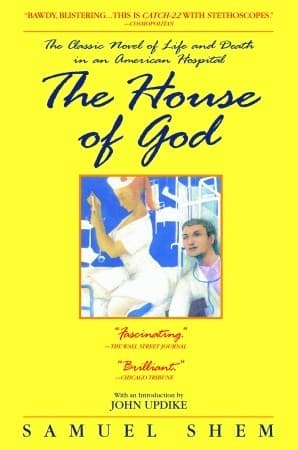
Samuel Shem (1978)
Genre
Health
Reading Time
416 pages (approx. 8-10 hours)
Key Themes
See below
Sign in to track this book
In the chaotic trenches of a hospital, six idealistic interns confront the brutal realities of medicine, love, and sanity, guided by the cynical wisdom of the Fat Man, as they fight to become doctors without losing themselves entirely.
“The patient is the one with the disease.”
— A core teaching for interns about who truly suffers and needs care.
“GOMERs don't die.”
— An ironic and cynical observation about chronically ill, elderly patients who seem to defy death despite severe conditions.
“If you don't take a temperature, you can't find a fever.”
— A sarcastic rule highlighting how medical professionals might avoid discovering problems to simplify their work.
“The delivery of medical care is a service.”
— A simple, yet profound statement about the fundamental nature of medicine often overlooked in the chaos of a teaching hospital.
“At a cardiac arrest, the first procedure is to take your own pulse.”
— A crucial rule emphasizing the importance of remaining calm and composed in high-stress medical emergencies.
“The only thing worse than a patient with no complaints is a patient with no pulse.”
— A dark humor observation on the challenges of dealing with patients who either hide their symptoms or are in critical condition.
“The intern's lot is not to reason why, but to do or die.”
— A parody of 'The Charge of the Light Brigade,' reflecting the demanding, often unquestioning nature of intern duties.
“When in doubt, cut it out.”
— A cynical surgical rule, often leading to unnecessary procedures.
“The patient is always right... until they're wrong.”
— A nuanced take on patient autonomy and the physician's responsibility to guide care.
“There are no atheists in the ICU.”
— Highlighting the profound spiritual and existential questions that arise in critical care settings.
“If you can't feel it, you can't fix it.”
— A practical, hands-on approach to diagnosis, emphasizing physical examination.
“The house of God is a place for patients, not for doctors.”
— A reminder of the true purpose of the hospital, often lost amidst the resident's own struggles.
“The only sure thing about medicine is that it changes.”
— A recognition of the evolving nature of medical knowledge and practice.
“You can always tell a medical student, but you can't tell him much.”
— A humorous jab at the perceived arrogance or overconfidence of medical students.
Ready to see how well you understood this book? Take our interactive quiz with 10 questions.

Anonymous, Alcoholics Anonymous
4.5
Mark Rippetoe
4.4
Atul Gawande
4.4
Lori Gottlieb
4.4

Bruce Lee
4.4
Napoleon Hill
4.3

James Clear
4.3

Christopher McDougall
4.3