BookBrief
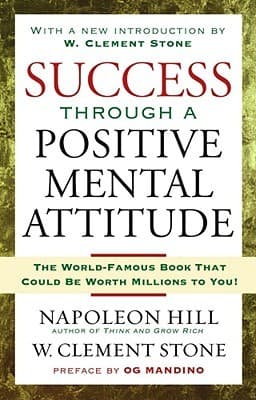
Success Through a Positive Mental Attitude cover
Archivist's Choice

Success Through a Positive Mental Attitude

Napoleon Hill (2007)

Genre

Business / Leadership / Health / Philosophy / Self-Help

Reading Time

360 min

Key Themes

See below

Track Your Reading

Sign in to track this book

Achieve a prosperous and joyful life by using your mind to attract success and repel negativity.

Core Idea

Success comes from a Positive Mental Attitude (PMA) and specific habits. This book says that with clear purpose, collaboration, faith, self-suggestion, extra effort, focused attention, learning from mistakes, saving, good health, enthusiasm, and initiative, people can reach their goals. The main idea is that a positive mind can attract desired outcomes and overcome problems, turning wishes into reality through consistent effort.
Reading time
360 min
Difficulty
Medium
✓ Read this if...
You are seeking a foundational framework for personal and professional development through mindset shifts and practical habits, and are open to a prescriptive approach to self-improvement.
✗ Skip this if...
You prefer modern, evidence-based psychological approaches or are skeptical of self-help philosophies that emphasize mental attitude as the primary driver of success without extensive empirical data.

Core idea

The central argument and framework that powers the entire book.

Success comes from a Positive Mental Attitude (PMA) and specific habits. This book says that with clear purpose, collaboration, faith, self-suggestion, extra effort, focused attention, learning from mistakes, saving, good health, enthusiasm, and initiative, people can reach their goals. The main idea is that a positive mind can attract desired outcomes and overcome problems, turning wishes into reality through consistent effort.

At a glance

Reading time

360 min

Difficulty

Medium

Read this if...

You are seeking a foundational framework for personal and professional development through mindset shifts and practical habits, and are open to a prescriptive approach to self-improvement.

Skip this if...

You prefer modern, evidence-based psychological approaches or are skeptical of self-help philosophies that emphasize mental attitude as the primary driver of success without extensive empirical data.

Key Takeaways

1

The Talisman of Your Mind

Your mental attitude is a powerful, invisible force shaping your reality.

Quote

Your mind has a secret invisible talisman. On one side is emblazoned the letters PMA (positive mental attitude) and on the other the letters NMA (negative mental attitude).

Hill and Stone say our minds have an invisible talisman, representing our main mental attitude. This talisman has two sides: Positive Mental Attitude (PMA) and Negative Mental Attitude (NMA). The authors argue that the side we show determines the experiences and opportunities we attract. PMA is a magnetic force drawing in success, health, happiness, and wealth, while NMA pushes away good outcomes, leading to a life of struggle. This is not just about being optimistic; it is about a core belief system and an active approach to life's c...

Supporting evidence

The central metaphor of the invisible talisman, introduced early in the book, serves as the foundational concept upon which all other principles are built. It's less a specific study and more a philosophical framework.

Apply this

Regularly check your dominant thoughts and feelings. When faced with a challenge, consciously choose to view it through the lens of PMA by seeking opportunities or lessons, rather than succumbing to despair or self-pity.

positive-mental-attitudenegative-mental-attitudemindsetself-talk
2

Definiteness of Purpose

Clear, specific goals are the bedrock of all achievement.

Quote

The starting point of all achievement is the definiteness of purpose.

Before any success can happen, one must have a 'definiteness of purpose.' This means more than just wishing; it is about setting a clear, detailed, and specific goal, written down and memorized. The authors say that a vague wish leads to vague results, or no results. A definite purpose acts as a guide for all actions and decisions, and it aligns the subconscious mind toward its achievement. It provides direction, focus, and a way to measure progress. Without this clarity, effort is scattered, and potential is wasted, like a ship witho...

Supporting evidence

The book frequently cites examples of highly successful individuals (though not always named, they align with Hill's work studying titans of industry) who meticulously planned and pursued their objectives with unwavering clarity, illustrating how their specific aims propelled them forward.

Apply this

Write down your primary goal with absolute clarity. Include specific details: what it is, when you want to achieve it, and what you are willing to give in return. Review this statement daily to engrain it in your subconscious.

goal-settingpurposeclarityvision
3

The Master Mind Principle

Collaborate with others to amplify your collective intelligence and power.

Quote

No two minds ever come together without thereby creating a third, invisible, intangible force which may be likened to a third mind.

The Master Mind principle is a concept for two or more people working together in harmony for a common purpose. The authors say that the synergy from such a group creates a 'third mind' – a collective intelligence much greater than its individual parts. This principle is not just about teamwork; it is about a harmonious mix of different perspectives, knowledge, and skills, where members support and inspire each other, overcome problems, and speed up progress. It uses the power of collective brainstorming, shared resources, and mutual ...

Supporting evidence

Hill's extensive research into successful individuals and corporations consistently revealed that many achieved greatness through collaboration and forming strategic alliances, drawing on the combined intellect and energy of a 'Master Mind' group.

Apply this

Identify individuals whose skills and perspectives complement your own and whose goals align with yours. Form a small, committed group to meet regularly, share ideas, and support each other in achieving your respective definite purposes.

collaborationteamworksynergycollective-intelligence
4

Applied Faith and Autosuggestion

Believe in your goals and program your subconscious mind for success.

Quote

Faith is the only known antidote for failure.

Hill and Stone state that 'faith' is not just a religious idea but a powerful mental state that, when applied to one's purpose, becomes an unstoppable force. This 'applied faith' is built through self-suggestion – repeatedly feeding positive, goal-oriented thoughts and affirmations into the subconscious mind. By consistently picturing success and affirming one's ability to achieve it, people can change their internal beliefs, overcoming self-doubt and fear. The subconscious mind, being easily influenced, then works to make these belie...

Supporting evidence

The authors explain how individuals can overcome ingrained negative thought patterns and fears by consciously and repeatedly impressing positive affirmations and visualizations upon their subconscious mind, much like how fear can be inadvertently programmed.

Apply this

Create a clear, concise affirmation statement for your definite purpose. Read it aloud with conviction multiple times a day, especially before sleep and upon waking. Visualize yourself already having achieved your goal, feeling the emotions of success.

affirmationsvisualizationsubconscious-mindbelief
5

Go the Extra Mile

Exceed expectations and provide more value than is required.

Quote

The habit of going the extra mile is the one sure way of making yourself indispensable.

The principle of 'going the extra mile' says that true success and leadership come from consistently doing more than what is expected. This habit means delivering excellent quality, offering extra service, and showing a willingness to contribute beyond what is required. The authors argue that this habit makes people stand out, making them essential and highly valued. It builds a reputation for excellence, creates trust, and naturally attracts opportunities for advancement and reward, often far beyond the initial effort. It is a key pr...

Supporting evidence

The book illustrates how individuals in various professions, from sales to management, achieved remarkable success and promotions by consistently offering more value and service than their peers, making them invaluable assets.

Apply this

In your daily tasks, identify one area where you can consistently 'go the extra mile.' It could be delivering a project ahead of schedule, offering unexpected help to a colleague, or providing an additional valuable insight in a report.

proactivityexcellenceservicevalue-creation
6

Controlled Attention

Direct your focus intentionally to achieve your desired outcomes.

Quote

You can control your attention, and thereby direct your thoughts, or you can allow your attention to be controlled by outside influences.

The ability to control one's attention is an important skill for success. This principle says that people can consciously direct their thoughts and focus toward their purpose, instead of letting their attention be scattered by distractions or negative influences. By mastering controlled attention, one can focus mental energy on problem-solving, learning, and creative thinking, improving productivity. The authors argue that an unfocused mind is open to NMA and outside pressures, while a disciplined mind, through controlled attention, u...

Supporting evidence

The book contrasts individuals who allow their minds to wander and be consumed by worries with those who deliberately focus their mental faculties on constructive endeavors, illustrating the stark difference in their achievements.

Apply this

Practice mindfulness exercises to improve your ability to focus. When working on a task, eliminate distractions and consciously bring your attention back to the task whenever your mind wanders. Set specific time blocks for focused work.

focusmindfulnessconcentrationdistraction-management
7

Learn from Adversity

Every setback contains the seed of an equivalent or greater advantage.

Quote

Every adversity, every failure, every heartache carries with it the seed of an equivalent or a greater benefit.

This principle sees adversity not as an end, but as a hidden opportunity. Hill and Stone argue that no matter how hard a setback seems, it contains a lesson or a possible advantage that can lead to greater success. The key is to keep a PMA and actively look for this 'seed of benefit.' This view encourages resilience, adaptability, and an active approach to challenges. Instead of focusing on loss or failure, people are urged to analyze the situation, learn valuable lessons, and move toward a new, possibly better path. It shows the powe...

Supporting evidence

The authors share numerous anecdotal accounts of individuals who faced significant financial ruin, personal tragedy, or business failures, only to emerge stronger and more successful by learning from their experiences and adapting their approach.

Apply this

When facing a challenge or setback, pause and reflect. Instead of immediately reacting with negativity, ask yourself: 'What is the hidden opportunity here? What can I learn from this? How can this make me stronger or redirect me to a better path?'

resiliencegrowth-mindsetovercoming-adversitylearning-from-failure
8

Habit of Saving

Financial discipline is crucial for independence and opportunity.

Quote

The habit of saving money is the best school for the development of character.

Beyond just making money, the 'habit of saving' is a basic building block for character and future opportunity. The authors say that consistent saving, even small amounts, builds discipline, foresight, and financial control. It provides a safety net for unexpected events and creates a reserve for future investments or business ventures. More importantly, it develops patience and the ability to delay gratification, traits essential for success in all areas of life. This principle highlights that financial freedom is not just about earn...

Supporting evidence

The book highlights how many self-made millionaires started with humble beginnings but meticulously saved and invested their earnings, demonstrating that consistent financial discipline, not just high income, is key to lasting wealth.

Apply this

Commit to saving a fixed percentage of your income regularly, regardless of the amount. Automate this saving so it happens before you have a chance to spend it. Track your savings to see your progress and stay motivated.

financial-disciplinefrugalityinvestmentfinancial-independence
9

Sound Health and Mental Poise

A healthy body and balanced mind are essential for sustaining success.

Quote

Sound health is one of the greatest assets you can possess.

Hill and Stone emphasize that lasting success is impossible without good physical health and mental calm. They suggest a complete approach, recognizing how the mind and body are connected. Good health provides the energy, stamina, and clear thinking needed to pursue and achieve one's purpose. Mental calm, the ability to stay balanced under pressure, prevents burnout and allows for rational decisions. The authors suggest that neglecting one's physical or mental well-being ultimately harms all other efforts toward success, emphasizing d...

Supporting evidence

The book frequently points out that even the most ambitious individuals can be derailed by poor health or emotional instability, underscoring that physical and mental well-being are prerequisites, not byproducts, of success.

Apply this

Prioritize daily habits that support your health: regular exercise, nutritious eating, sufficient sleep, and stress-reducing activities like meditation or spending time in nature. Consciously practice deep breathing or visualization to maintain mental calm in challenging situations.

well-beingstress-managementphysical-healthmental-healthbalance
10

Enthusiasm and Initiative

Passion and proactive action are infectious and attract success.

Quote

Enthusiasm is faith in action.

The authors champion enthusiasm as a vital part of success, calling it 'faith in action.' Enthusiasm is more than just excitement; it is a dynamic, contagious energy that fuels persistence, creativity, and the ability to inspire others. With initiative – the active readiness to act without being told – these qualities form a strong combination. Initiative means taking the first step, seizing opportunities, and showing leadership. Together, enthusiasm and initiative overcome inactivity, attract positive attention, and motivate others t...

Supporting evidence

The book highlights how leaders and innovators consistently display a vibrant enthusiasm for their work and a strong sense of initiative, often inspiring entire teams and movements through their infectious energy and proactive approach.

Apply this

Consciously bring enthusiasm to your daily tasks, even mundane ones, by focusing on the positive aspects or the end goal. Look for opportunities to take initiative in your work or personal life, offering solutions or starting projects without waiting for explicit direction.

motivationproactivepassionleadership

Critical analysis

Notable Quotes

What the mind can conceive and believe, it can achieve.

A foundational principle emphasized throughout the book.

Every adversity, every failure, every heartache carries with it the seed of an equivalent or greater benefit.

Discussing the importance of finding opportunity in setbacks.

Your only limitation is the one you set up in your own mind!

Highlighting the power of self-imposed limits and the mind's role in overcoming them.

The starting point of all achievement is desire.

Emphasizing the crucial role of strong, definite desire as the initial spark for success.

PMA (Positive Mental Attitude) is the right mental attitude, which is composed of the right ingredients, in the right proportions, at the right time.

Defining the core concept of a Positive Mental Attitude.

You are the master of your destiny. You can influence, direct and control your own environment. You can make your life what you want it to be.

Empowering the reader to take charge of their life and circumstances.

Action is a great restorer and builder of confidence. Inaction is not only the result, but the cause, of fear.

Advocating for taking consistent action to build self-confidence and overcome fear.

Success comes to those who become success conscious.

Illustrating the idea that one must cultivate a mindset attuned to success to achieve it.

When you are faced with a difficulty, you have two courses of action. One, to flee from it. Two, to face it and overcome it.

Presenting a choice in how to approach challenges, favoring a proactive stance.

The habit of giving more than you are paid for is a sure road to success.

A principle of 'going the extra mile' often discussed in relation to business and career advancement.

Don't wait. The time will never be just right.

Encouraging immediate action and discouraging procrastination.

No man is a success in business unless he loves his work.

Connecting passion for one's profession with ultimate business success.

To be healthy, happy, and successful, you must learn to cooperate with others.

Highlighting the importance of teamwork and collaboration for overall well-being and achievement.

Fear is a habit, a negative habit, and we must break it before it breaks us.

Addressing fear as a learned behavior that needs to be consciously overcome.

Quiz

Test Your Knowledge

Ready to see how well you understood this book? Take our interactive quiz with 10 questions.

10
Questions
~5
Minutes
?
Best Score

Key Questions (FAQ)

PMA, or Positive Mental Attitude, is presented as a fundamental principle for achieving personal success, health, happiness, and wealth. It suggests that maintaining a positive outlook naturally attracts beneficial outcomes and opportunities into one's life.

About the author