BookBrief
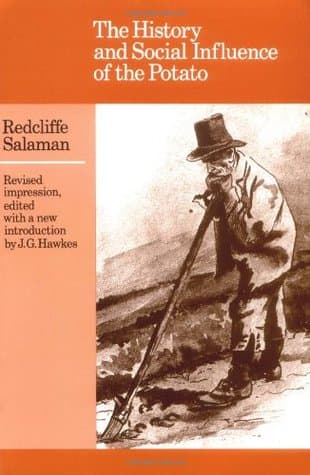
The History and Social Influence of the Potato cover
Archivist's Choice

The History and Social Influence of the Potato

Redcliffe N. Salaman (1985)

Genre

History / Science

Reading Time

1200 min

Key Themes

See below

Track Your Reading

Sign in to track this book

From the Andes to the European dinner table, discover how the humble potato reshaped civilizations, fueled population booms, and irrevocably altered the course of human history and social structure.

Core Idea

Salaman's "The History and Social Influence of the Potato" chronicles how a humble Andean tuber, initially met with European suspicion, transformed global demographics, economics, and politics. From its role in fueling population growth that enabled industrialization and urbanization to its catastrophic failure in the Irish Famine, the book argues that the potato was not merely a foodstuff but an agent of historical change, shaping human societies, agricultural practices, and national destinies across centuries and continents. It demonstrates how a single crop could be both a blessing and a curse, driving both prosperity and disaster, and fundamentally altering the course of human civilization.
Reading time
1200 min
Difficulty
Hard
✓ Read this if...
You are fascinated by how seemingly minor biological elements can exert monumental influence on human history, demography, and social structures, or if you want a comprehensive, scholarly deep dive into the global impact of a single food crop.
✗ Skip this if...
You prefer concise historical overviews, are looking for a light read, or have little interest in agricultural history, botany, or the intricate details of socio-economic shifts driven by food.

Core idea

The central argument and framework that powers the entire book.

Salaman's "The History and Social Influence of the Potato" chronicles how a humble Andean tuber, initially met with European suspicion, transformed global demographics, economics, and politics. From its role in fueling population growth that enabled industrialization and urbanization to its catastrophic failure in the Irish Famine, the book argues that the potato was not merely a foodstuff but an agent of historical change, shaping human societies, agricultural practices, and national destinies across centuries and continents. It demonstrates how a single crop could be both a blessing and a curse, driving both prosperity and disaster, and fundamentally altering the course of human civilization.

At a glance

Reading time

1200 min

Difficulty

Hard

Read this if...

You are fascinated by how seemingly minor biological elements can exert monumental influence on human history, demography, and social structures, or if you want a comprehensive, scholarly deep dive into the global impact of a single food crop.

Skip this if...

You prefer concise historical overviews, are looking for a light read, or have little interest in agricultural history, botany, or the intricate details of socio-economic shifts driven by food.

Key Takeaways

1

The Andean Cradle of Diversity

The potato's origins in the Andes reveal a rich tapestry of agricultural innovation.

Quote

The potato, far from being a simple food, emerged from millennia of sophisticated agricultural practices and selective breeding within the Andean civilizations.

The potato's journey begins not in European fields, but high in the South American Andes, where indigenous peoples like the Inca cultivated it for thousands of years. Salaman details how these civilizations developed a diversity of potato varieties, each adapted to specific microclimates and uses. This was not merely subsistence farming; it was an advanced system of agricultural engineering, including terracing, irrigation, and the development of frost-resistant varieties and preservation techniques like chuño. The genetic breadth o...

Supporting evidence

Salaman's extensive documentation of archaeological findings, botanical classifications of thousands of Andean potato varieties, and historical accounts of Inca agricultural practices, including the creation of *chuño* (freeze-dried potatoes) for long-term storage and famine prevention.

Apply this

Appreciating the potato's Andean origins encourages a more nuanced view of agricultural history, recognizing the sophisticated contributions of indigenous cultures. It also highlights the importance of genetic diversity in food systems, a critical lesson for modern agriculture facing climate change and disease.


andean-agriculturechuñogenetic-diversity
2

Skepticism and Slow Adoption in Europe

Europe's initial resistance to the potato was a blend of fear, superstition, and social inertia.

Quote

For centuries after its introduction, the potato faced a formidable barrier of suspicion and prejudice in Europe, often dismissed as food for animals or the poor, and even associated with disease.

Despite its nutritional value and high yield, the potato's adoption in Europe was slow, taking centuries to become a staple. Salaman describes the widespread skepticism rooted in its unfamiliar appearance (growing underground, unlike familiar grains), its botanical relation to poisonous nightshades, and its lack of mention in the Bible, leading to accusations of being 'the devil's apple.' Peasants feared it caused leprosy, while landowners saw no immediate profit in a crop that did not fit existing agricultural practices. This resista...

Supporting evidence

Salaman cites numerous historical decrees, medical pamphlets, and popular superstitions from 16th-18th century Europe, detailing fears that potatoes caused various diseases or were associated with witchcraft. He also references aristocratic resistance and the efforts of figures like Antoine-Augustin Parmentier to popularize it through royal endorsements.

Apply this

This takeaway offers a historical parallel to modern challenges in introducing new foods or agricultural practices, demonstrating that cultural acceptance often trumps purely rational arguments. It underscores the need for social engineering and education alongside scientific innovation.

european-resistancefood-prejudiceparmentier
3

The Catalyst for Population Growth

The potato's caloric density and ease of cultivation fueled an unprecedented demographic boom in Europe.

Quote

The ability of a small plot of land to sustain a large family on potatoes alone was a demographic game-changer, fundamentally altering the Malthusian equation.

Salaman argues that the potato was a factor in the European population explosion of the 18th and 19th centuries. Its ability to produce more calories per acre than any grain, combined with its simple cultivation, meant that smaller plots of land could sustain larger families. This agricultural change provided a cheap, abundant, and nutritious food source, significantly reducing the frequency and severity of famines. With more food, infant mortality rates dropped, and life expectancy increased, laying the groundwork for industrializati...

Supporting evidence

Salaman provides statistical data on population growth in countries like Ireland, Germany, and parts of Eastern Europe following widespread potato adoption. He contrasts the caloric yield of potatoes per acre with that of wheat or oats, demonstrating its superior efficiency in feeding dense populations.

Apply this

Understanding the potato's role in population dynamics highlights the profound impact a single agricultural innovation can have on demography and economic development. It offers insights into the historical preconditions for industrialization and urbanization.

population-boommalthusian-trapindustrial-revolution
4

The Irish Paradox: Dependence and Disaster

Ireland's extreme reliance on the potato led to both prosperity and catastrophic famine.

Quote

Nowhere else did the potato achieve such absolute dominion over the diet of a nation as in Ireland, a dependency that would ultimately prove both a blessing and a curse.

Salaman dedicates attention to Ireland, where the potato's impact was most acute and tragic. For centuries, the potato had been a godsend, allowing a rapidly growing, impoverished population to survive on small holdings, often consuming five to seven pounds per person daily. This created a unique agricultural monoculture and a deeply entrenched social structure around potato cultivation. However, this extreme dependency made Ireland uniquely vulnerable. When the potato blight (Phytophthora infestans) struck in the 1840s, the consequen...

Supporting evidence

Detailed accounts of the Irish Famine (1845-1849), including statistics on mortality, emigration, and the socio-economic conditions that made Ireland uniquely susceptible to the blight. Salaman describes the specific impact of *Phytophthora infestans* and the subsequent political failures.

Apply this

This serves as a powerful cautionary tale about the dangers of monoculture and extreme food dependency, especially in the context of political and economic vulnerability. It highlights the complex interplay of agriculture, society, and governance in shaping national destiny.

irish-faminepotato-blightmonoculture
5

Warfare and Statecraft through Spuds

Monarchs and military leaders strategically leveraged the potato to feed armies and stabilize nations.

Quote

The potato's ability to provision armies on the march and sustain besieged populations made it an invaluable, if often unheralded, weapon in the arsenal of European statecraft.

Beyond its role in feeding the general populace, Salaman reveals how the potato became a strategic asset in European geopolitics. Rulers like Frederick the Great of Prussia actively promoted potato cultivation, recognizing its potential to feed soldiers and prevent famine during wartime. Its resilience and high yield made it ideal for provisioning armies, reducing reliance on vulnerable grain supply lines, and sustaining populations during sieges or blockades. The potato's ability to grow in diverse soils and climates also offered a d...

Supporting evidence

Salaman recounts Frederick the Great's 'potato edicts' and his personal efforts to encourage peasants to grow potatoes, sometimes even planting them in royal gardens to set an example. He also details the potato's role in feeding troops during the Seven Years' War and other European conflicts.

Apply this

This takeaway illustrates the often-overlooked connection between food security and national power. It provides a historical perspective on how agricultural policy can be a tool of statecraft, relevant for contemporary discussions on food as a weapon or a tool for stability.

food-securitymilitary-provisioningfrederick-the-great
6

The Potato and Industrialization's Labor Force

Cheap potato calories fueled the growth of the urban working class, enabling the Industrial Revolution.

Quote

The potato provided the essential cheap calories that sustained the rapidly expanding industrial working class, allowing them to migrate to cities and power the factories.

Salaman argues that the potato was an unsung hero of the Industrial Revolution. As populations surged and people migrated from rural areas to urban centers, a critical challenge was feeding this new, concentrated workforce. The potato, with its high caloric yield and low cost, became the staple food that sustained these factory workers and their families. It provided the necessary energy for arduous labor, often at minimal wages, preventing widespread starvation and social unrest that might have otherwise derailed industrial progress....

Supporting evidence

Salaman connects the rise of urban populations and factory labor with the widespread adoption of the potato in industrializing regions of England, Germany, and Belgium. He analyzes dietary shifts among the working class, showing the potato's increasing prominence as a primary energy source.

Apply this

This highlights the fundamental link between food systems and economic development. It encourages us to consider the often-hidden dietary foundations that support major historical shifts like industrialization and urban growth, relevant for understanding modern supply chains and labor economics.

industrial-revolutionurbanizationlabor-force-nutrition
7

Beyond Subsistence: The Potato's Culinary Versatility

From humble staple to culinary canvas, the potato's adaptability fostered diverse food cultures.

Quote

What began as a simple, boiled subsistence food gradually transformed, through culinary innovation, into a cornerstone of diverse national cuisines across the globe.

While often lauded for its caloric contribution, Salaman also discusses the potato's culinary versatility. Once initial skepticism faded, cooks across Europe began to experiment, transforming the potato from a mere sustenance crop into an ingredient central to numerous national dishes. From French fries and German potato salad to Irish stew and Italian gnocchi, the potato adapted to local tastes and cooking methods, becoming an indispensable part of diverse food cultures. Its neutral flavor, varied textures, and ability to absorb othe...

Supporting evidence

Salaman implicitly references the emergence of various national dishes centered around the potato, though his primary focus is on its social and economic impact. He details the different ways potatoes were prepared and consumed across Europe, from simple boiling to more complex preparations, once accepted.

Apply this

This takeaway encourages an appreciation for the cultural dimensions of food and how culinary innovation can transform even the most basic ingredients. It reminds us that food is not just fuel but also a powerful marker of identity and tradition.

culinary-historyfood-culturegastronomy
8

The Enduring Power of a Humble Tuber

The potato's journey from obscure Andean root to global staple is a testament to its unparalleled resilience and utility.

Quote

Few plants have so profoundly shaped human history, population dynamics, and geopolitical landscapes as the humble potato, a testament to its extraordinary biological and social influence.

Salaman's work ultimately reveals the potato as one of the most influential crops in human history, an 'unseen architect' of modern civilization. Its journey from a diverse Andean crop to a global monoculture, then to a staple that fueled empires and populations, shows its resilience, adaptability, and nutritional efficiency. The book traces how this single tuber impacted everything from demography and warfare to industrialization and social structures. It is a powerful reminder that seemingly minor biological factors can have monumen...

Supporting evidence

The entire scope of Salaman's comprehensive historical narrative, which meticulously traces the potato's influence across continents and centuries, integrating botanical, agricultural, economic, and social evidence.

Apply this

This takeaway provides a macro-level understanding of the profound impact of agriculture on civilization. It encourages a deeper appreciation for the foods we consume and their often-hidden historical significance, fostering a more holistic view of human development.

global-stapleagricultural-historyfood-influence

Critical analysis

Notable Quotes

Few plants have had so profound an influence on the social history of man as the potato.

Opening statement emphasizing the potato's significance.

The introduction of the potato into Europe was not a single event but a gradual process, marked by both enthusiasm and suspicion.

Describing the varied reception of the potato in early modern Europe.

It was the potato, more than any other crop, that allowed for the rapid population growth in Europe from the 17th century onwards.

Highlighting the potato's role in demographic shifts.

The potato was initially viewed with suspicion due to its association with nightshades and its underground growth.

Explaining early European apprehension about the potato.

Parmentier's efforts to popularize the potato in France are a classic example of agricultural innovation driven by social necessity.

Referring to Antoine-Augustin Parmentier's advocacy for the potato.

The monoculture of the 'Lumper' potato variety in Ireland proved to be a catastrophic vulnerability.

Discussing the pre-famine agricultural practices in Ireland.

The Great Famine in Ireland stands as a stark testament to the dangers of over-reliance on a single food crop.

Reflecting on the lessons of the Irish Potato Famine.

The potato provided cheap, abundant calories, making it the bedrock of the industrial revolution's workforce.

Connecting the potato to the rise of industrialization.

While easy to grow, the potato's nutritional profile, especially its vitamin C content, was crucial for preventing scurvy.

Detailing the nutritional benefits of the potato.

The potato's journey from the Andes to global ubiquity is a remarkable tale of human ingenuity and adaptation.

Summarizing the potato's global spread.

The plant's ability to thrive in diverse climates and poor soils made it an ideal crop for marginal lands.

Explaining the potato's agricultural versatility.

The development of new potato varieties through selective breeding has been a continuous process, essential for disease resistance and yield.

Discussing ongoing efforts in potato cultivation.

Even today, the potato remains a vital food source, a testament to its enduring role in feeding the world.

Concluding remark on the potato's contemporary importance.

The potato was not merely a foodstuff; it was a catalyst for profound social and economic change across continents.

Broad statement on the potato's transformative power.

Quiz

Test Your Knowledge

Ready to see how well you understood this book? Take our interactive quiz with 10 questions.

10
Questions
~5
Minutes
?
Best Score

Key Questions (FAQ)

This scholarly classic explores how the potato has profoundly impacted social structures and economies throughout history in regions where it became a fundamental part of people's diets. It delves into its journey from origin to global staple and its far-reaching consequences.

About the author