BookBrief
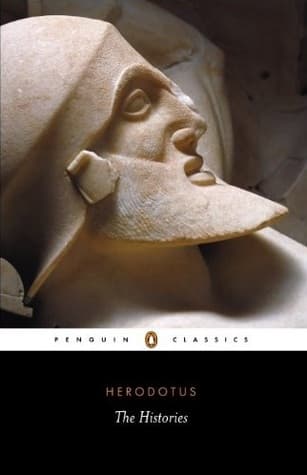
The Histories cover
Archivist's Choice

The Histories

Herodotus

Genre

History / Philosophy

Reading Time

1500-2000 min (given its length and density, this is a significant undertaking)

Key Themes

See below

Track Your Reading

Sign in to track this book

Herodotus leads readers through the ancient world, chronicling the unlikely Greek victory over the Persian Empire and sharing tales of Egyptian wonders, European lake-dwellers, and even dog-headed men.

Core Idea

Herodotus's *Histories* investigates the causes and events of the Greco-Persian Wars. It also explores human societies, the clash of civilizations, and the recurring pattern of pride leading to downfall. By collecting oral traditions, observations, and various accounts, Herodotus aimed to remember great deeds and understand what drives human conflict and imperial ambition. He shows a world where geography, culture, and leaders' moral choices shape nations' fates, ultimately arguing for freedom's power over tyranny.
Reading time
1500-2000 min (given its length and density, this is a significant undertaking)
Difficulty
Hard
✓ Read this if...
You are fascinated by ancient history, the origins of historical writing, the clash of empires, or wish to understand the cultural and political landscape that shaped classical Greece and Persia.
✗ Skip this if...
You prefer modern historical analysis with clear citations and a singular narrative voice, or find digressions and legendary accounts distracting from a linear historical progression.

Core idea

The central argument and framework that powers the entire book.

Herodotus's Histories investigates the causes and events of the Greco-Persian Wars. It also explores human societies, the clash of civilizations, and the recurring pattern of pride leading to downfall. By collecting oral traditions, observations, and various accounts, Herodotus aimed to remember great deeds and understand what drives human conflict and imperial ambition. He shows a world where geography, culture, and leaders' moral choices shape nations' fates, ultimately arguing for freedom's power over tyranny.

At a glance

Reading time

1500-2000 min (given its length and density, this is a significant undertaking)

Difficulty

Hard

Read this if...

You are fascinated by ancient history, the origins of historical writing, the clash of empires, or wish to understand the cultural and political landscape that shaped classical Greece and Persia.

Skip this if...

You prefer modern historical analysis with clear citations and a singular narrative voice, or find digressions and legendary accounts distracting from a linear historical progression.

Key Takeaways

1

The Cycle of Hubris and Nemesis

Great power often leads to overreach and inevitable downfall.

Quote

For of all the men we know, Croesus was the first to begin unjust acts against the Greeks.

Herodotus shows how pride and ambition lead to divine punishment. This is clearest in the Persian Wars, where the Achaemenid Empire's power under Darius and Xerxes drives them to seek conquest, leading to their crushing defeats by the smaller, more united Greek city-states. The story of Croesus, the rich Lydian king, is an early sign, showing that even great wealth and military strength do not guarantee protection from fate or the results of overstepping boundaries. This view of history suggests a moral universe where balance must be ...

Supporting evidence

The narrative arc of Croesus, who misinterprets the oracle and attacks Persia, leading to the destruction of his own empire. The repeated failures of Persian invasions against Greece, culminating in the defeats at Salamis and Plataea, are attributed to Xerxes' arrogance and underestimation of the Greeks.

Apply this

Leaders and nations should exercise humility and caution when wielding significant power, understanding that unchecked ambition often leads to self-destruction. Prioritize sustainable growth and diplomacy over aggressive expansion.

hubrisnemesispersian-warscroesus
2

Cultural Relativism in Antiquity

Herodotus documents diverse customs without explicit judgment, hinting at an early understanding of cultural variation.

Quote

If one were to offer men to choose out of all the customs in the world such as seemed to them the best, they would each after examination of the whole number select their own; so firmly are they persuaded that their own are far the best.

Herodotus, through his travels and research, carefully records the customs, beliefs, and social structures of various peoples, including Egyptians, Scythians, Persians, and Libyans. While he writes from a Greek viewpoint, he often describes these practices with curiosity rather than outright judgment. His famous story about Darius asking Greeks and Indians to exchange burial customs shows his understanding that what one culture finds terrible, another holds sacred. This approach, though not a modern anthropological theory, is an early...

Supporting evidence

Detailed descriptions of Egyptian embalming practices, the Scythian nomadic lifestyle and use of cannabis, Persian religious rites, and the unique dietary habits of various tribes. The story of Darius presenting Greeks and Indians with each other's funerary customs.

Apply this

Cultivate a mindset of curiosity and respect when encountering different cultures. Seek to understand the 'why' behind practices before forming judgments, recognizing that cultural norms are deeply rooted and context-dependent.

cultural-relativismethnographyancient-culturesdiversity
3

The Power of Freedom vs. Despotism

The Greek victory is framed as a triumph of free citizens over enslaved subjects.

Quote

For the Lacedaemonians are free, and yet not wholly free; for they have a master, Law, whom they fear much more than your subjects fear you.

Herodotus compares the political systems of the Greeks and Persians, showing the Greeks as free and the Persians as despotic. The Greeks, despite their internal conflicts, are shown fighting for their independence and way of life, driven by self-imposed laws rather than a monarch's arbitrary will. The Persians, in contrast, are depicted as subjects forced to fight, their large numbers a result of forced service rather than willing loyalty. This basic difference in motivation helps explain the Greek victory, suggesting that a small for...

Supporting evidence

Leonidas's Spartans at Thermopylae, willingly sacrificing themselves for Greece. The Athenian decision to abandon their city and fight at sea. The contrast between the Persian army, assembled from diverse, often unwilling, conquered peoples, and the unified, if fractious, Greek coalition.

Apply this

Recognize the inherent strength and resilience of societies where citizens are empowered and free. Foster environments where individual liberty and rule of law are valued, as these are powerful motivators for collective action and defense.

freedomdespotismspartaathenspersian-wars
4

History as Inquiry (Historia)

Herodotus establishes the foundational method of historical investigation through observation, testimony, and critical assessment.

Quote

These are the things I write about, having gathered my information by inquiry (historia) so that the deeds of men may not be forgotten...

Herodotus's title, 'Historiai' (Inquiries), points to his new approach to understanding the past. He does not just tell myths or legends; he actively seeks information from many sources: eyewitness accounts, local traditions, priestly records, and his own observations during his travels. While he sometimes includes fantastical elements (e.g., dog-headed men), he often presents conflicting accounts and lets the reader decide, or states his own doubts. This careful collection and evaluation of diverse sources, even if imperfect, marks t...

Supporting evidence

His frequent use of phrases like 'I heard,' 'the Egyptians say,' or 'I myself saw.' His discussion of conflicting stories regarding Helen of Troy's time in Egypt. His detailed descriptions of the Nile's flooding based on local inquiries and personal observation.

Apply this

Approach information with a critical, investigative mindset. Seek out multiple perspectives and primary sources. Understand that historical narratives are constructed through interpretation and evaluation of evidence, rather than simply being 'given.'

historiographyprimary-sourceshistorical-methodinquiry
5

The Unpredictability of Fate

Human plans are often thwarted by divine intervention or unforeseen circumstances.

Quote

For human prosperity never remains long in the same place.

Despite careful planning and vast resources, the most powerful figures in Herodotus's story often find their plans ruined by unpredictable fate or divine will. Xerxes' grand invasion of Greece, though well-organized, faces storms, omens, and unexpected Greek resistance. Croesus, after consulting the oracle, misinterprets its prophecy and brings ruin upon himself. This idea highlights a worldview where human actions are important but ultimately secondary to a larger, often mysterious, cosmic order. It reminds us that even the greatest ...

Supporting evidence

The storm that destroys a significant portion of Xerxes' fleet off the coast of Magnesia. The oracle's ambiguous prophecy to Croesus, leading to his downfall. The dream omens that plague Xerxes before his invasion.

Apply this

Embrace resilience and adaptability, understanding that even the best-laid plans can be disrupted by unforeseen events. Cultivate humility and avoid excessive certainty, recognizing the limits of human control over outcomes.

fatedestinydivine-interventionxernespremonition
6

The Importance of Geography

Physical landscapes profoundly influence culture, military strategy, and historical outcomes.

Quote

Egypt, to which the Greeks go to navigate, is an acquired country, and a gift of the river.

Herodotus spends much of his work describing the geography and natural features of the lands he discusses, recognizing their great impact. He details the Nile's course and its role in Egyptian civilization, Persia's dry plains, and Greece's rugged, defensible terrain. These geographical features are not just backgrounds; they determine farming practices, trade routes, military tactics, and even cultural identities. The narrow pass of Thermopylae, the straits of Salamis, and the mountainous Greek landscape are key to understanding why ...

Supporting evidence

His extensive description of the Nile's annual flooding and its impact on Egyptian agriculture and society. The strategic importance of the narrow pass at Thermopylae for the Spartan defense. The effectiveness of the Greek triremes in the confined waters of Salamis.

Apply this

When analyzing historical events or contemporary geopolitical situations, always consider the role of geography. Understand how physical landscapes influence resources, defense, communication, and cultural development.

geopoliticsenvironmental-determinismnilethermopylaesalamis
7

The Value of Oral Tradition

Despite its limitations, spoken accounts are vital for reconstructing a distant past.

Quote

My duty is to report all that is said, but I am not obliged to believe it all alike.

In a world without widespread written records, Herodotus relies heavily on oral traditions, eyewitness accounts, and stories passed down through generations. He travels widely, speaking with priests, local informants, and war veterans, gathering a rich collection of stories. While acknowledging that these accounts might contain exaggeration, bias, or outright lies, he understands their irreplaceable value for understanding events before reliable documentation. His method involves collecting these diverse stories, sometimes presenting ...

Supporting evidence

His frequent attribution of information to 'the Egyptians say,' or 'the Scythians relate.' His recounting of various legends and myths alongside more verifiable facts, often with a disclaimer about his own belief. His interviews with individuals who claim direct knowledge or inherited stories.

Apply this

Value and seek out diverse perspectives, including oral histories and marginalized voices, in historical research. Understand the inherent biases and limitations of all sources, but recognize that even 'unreliable' accounts can offer valuable insights into past perceptions and beliefs.

oral-historytestimonyancient-sourceshistorical-evidence
8

The Enduring Greek Identity

Despite internal divisions, a shared Hellenic identity emerged against a common enemy.

Quote

The Hellenic is a community of blood and language, of altars and sacrifices, of customs and manners.

Herodotus's account of the Persian Wars is not just a military history; it is a founding story for Greek identity. Before the wars, the Greek city-states often disagreed, engaging in minor disputes and even fighting among themselves. However, the threat from the Persian Empire forced them to recognize a deeper, shared Greek heritage—a common language, religion, and way of life—that went beyond their local loyalties. This unity, though fragile and temporary, was vital to their survival and created a sense of shared purpose against a fo...

Supporting evidence

The formation of the Hellenic League, despite the historical animosity between Athens and Sparta. The shared commitment to defending Greek sanctuaries and cultural sites. The contrast drawn between Greek freedom and Persian servitude.

Apply this

Recognize how shared threats or common values can forge unity among disparate groups. Understand the power of collective identity in motivating people to overcome differences and achieve common goals.

hellenic-identitygreek-city-statespersian-warsunitycultural-identity
9

The Moral Ambiguity of War

Victory is celebrated, but the costs and moral compromises of war are not ignored.

Quote

For in peace, sons bury their fathers, but in war, fathers bury their sons.

While celebrating the Greek victory, Herodotus does not avoid showing the brutality, suffering, and moral complexities of war. He details the many casualties, the destruction of cities, and the atrocities committed by both sides, though with a clear bias toward the Greeks. The narrative includes moments of Greek harshness, such as the punishment of Medizers (Greeks who sided with Persia), and the internal tensions and betrayals that threatened their unity. This complex portrayal, rather than simply glorifying war, suggests an awarenes...

Supporting evidence

The immense loss of life on both sides at Thermopylae and Plataea. The destruction of Athens by the Persians. The internal Greek debates and conflicts, such as the Athenians' treatment of their allies or the Spartans' initial reluctance to send aid.

Apply this

Approach conflicts with a clear understanding of their inevitable human cost and moral compromises. Strive for peaceful resolutions, recognizing that even victorious wars leave lasting scars and ethical dilemmas.

warfaremoral-dilemmascasualtiesancient-greece
10

The Enduring Legacy of Persia

Despite defeat, the Persian Empire's influence and grandeur are acknowledged.

Quote

There is no nation which so readily adopts foreign customs as the Persians.

Despite his clear pro-Greek stance, Herodotus presents the Persian Empire not just as a single enemy, but as a complex and powerful force with its own rich history, diverse cultures, and impressive achievements. He details their vast administration, their impressive engineering (like Xerxes' bridge across the Hellespont), their military organization, and their unique customs. He acknowledges their imperial reach and their ability to integrate diverse peoples, even through conquest. This portrayal gives the Persians dignity and complex...

Supporting evidence

Descriptions of the Persian postal system, the construction of the Hellespont bridge and the Athos canal, and the vast diversity of peoples within the Persian army. Accounts of Persian court intrigue and the character of their kings.

Apply this

When studying conflicts, strive to understand the perspective and complexities of all involved parties, not just the 'victors.' Recognize that even defeated powers can have significant cultural and historical legacies.

persian-empireachaemenid-empirexernescultural-exchangeempire

Critical analysis

Notable Quotes

For if a man were to throw the affairs of the other nations into the scales, and were allowed to choose out of all the nations of the world the most advantageous practices, he would find that each nation believes its own customs to be by far the best.

Herodotus reflecting on cultural relativism and the diversity of customs, often illustrated by the story of Darius and the Callatians/Greeks.

In peace, sons bury their fathers; in war, fathers bury their sons.

A poignant observation on the tragic consequences of war, particularly its impact on family.

Of all men's miseries, the bitterest is this: to know so much and to have power to do nothing.

Croesus lamenting his fate and the inability to alter his destiny despite his knowledge of the oracle's prophecies.

Great deeds are usually wrought at great risks.

A general observation on the nature of ambition and achievement, often preceding accounts of significant military or political undertakings.

Circumstances rule men; men do not rule circumstances.

Herodotus discussing the influence of external factors and destiny on human actions and outcomes.

The gods are just, and they are not unmindful of men's deeds.

A common theme throughout 'The Histories,' emphasizing divine justice and retribution for hubris or wrongdoing.

It is better to be envied than to be pitied.

A reflection on reputation and social standing, implying a preference for success over misfortune.

Truly, the gods are jealous of human prosperity.

Often cited in the context of hubris and the downfall of powerful figures like Croesus, who reached too great a height.

The most hateful human calamity is to have to be reminded of the past for the purpose of justifying present evils.

A statement that speaks to the manipulation of history and memory to serve current political agendas or justify wrongs.

Many things are to be seen in the world, and many things are to be heard, and many things are to be done.

Reflecting Herodotus's own insatiable curiosity and the breadth of his travels and inquiries.

And the people of Athens had grown great, and power had grown great among them.

Describing the rise of Athens and its increasing influence, often leading up to the Persian Wars.

Men's fortunes are on a wheel, which never stands still.

A metaphor for the ever-changing nature of human prosperity and adversity, suggesting a cyclical view of fate.

The noblest of all men are those who have not been corrupted by wealth.

A moral judgment on virtue and the corrupting influence of material possessions, a recurring theme when discussing rulers and their character.

Quiz

Test Your Knowledge

Ready to see how well you understood this book? Take our interactive quiz with 10 questions.

10
Questions
~5
Minutes
?
Best Score

Key Questions (FAQ)

'The Histories' primarily chronicles the origins and events of the Greco-Persian Wars, detailing how a coalition of Greek city-states resisted and ultimately repelled the vast Persian Empire. Beyond the war itself, Herodotus includes extensive cultural, geographical, and historical digressions about various peoples and lands.

About the author