BookBrief
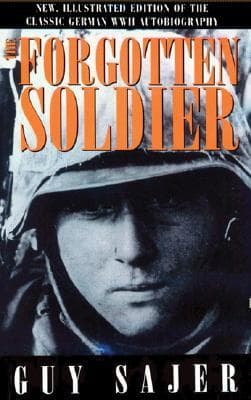
The Forgotten Soldier cover
Archivist's Choice

The Forgotten Soldier

Guy Sajer (1971)

Genre

Biography / Memoir / History

Reading Time

10-12 hours

Key Themes

See below

Track Your Reading

Sign in to track this book

Guy Sajer's memoir takes readers from the naive thrill of adventure to the brutal fight for survival as a teenage German soldier on the Eastern Front, against the relentless Soviet forces and unforgiving elements.

Core Idea

Guy Sajer's "The Forgotten Soldier" is a raw memoir that removes any romantic view of warfare, especially on the Eastern Front. It shows how the individual soldier, without ideology or grand purpose, struggles just to survive against a harsh landscape and enemy. The book details the psychological and physical breakdown of German infantrymen. It illustrates how constant danger, extreme conditions, and combat turn ordinary men into automatons driven by instinct. Their only goals are the next moment of peace and the fragile bonds of friendship formed through shared suffering.
Reading time
10-12 hours
Difficulty
Medium
✓ Read this if...
You want an unvarnished, first-person account of the Eastern Front from the German perspective, focusing on the sheer brutality and psychological toll of infantry combat.
✗ Skip this if...
You are looking for a strategic overview of WWII, a politically motivated analysis, or a narrative that romanticizes military service.

Core idea

The central argument and framework that powers the entire book.

Guy Sajer's "The Forgotten Soldier" is a raw memoir that removes any romantic view of warfare, especially on the Eastern Front. It shows how the individual soldier, without ideology or grand purpose, struggles just to survive against a harsh landscape and enemy. The book details the psychological and physical breakdown of German infantrymen. It illustrates how constant danger, extreme conditions, and combat turn ordinary men into automatons driven by instinct. Their only goals are the next moment of peace and the fragile bonds of friendship formed through shared suffering.

At a glance

Reading time

10-12 hours

Difficulty

Medium

Read this if...

You want an unvarnished, first-person account of the Eastern Front from the German perspective, focusing on the sheer brutality and psychological toll of infantry combat.

Skip this if...

You are looking for a strategic overview of WWII, a politically motivated analysis, or a narrative that romanticizes military service.

Key Takeaways

1

The Illusion of Glory

War's initial allure quickly gives way to brutal, dehumanizing reality.

Quote

War is a matter of life or death, a road either to safety or to ruin. Hence it is a subject of inquiry which can on no account be neglected.

Sajer's memoir shows how appealing early war propaganda and the initial romantic view of military service were, especially for a young man. He volunteers, drawn by adventure and duty, believing his cause is right. But this idealism quickly breaks under the harsh realities of the Eastern Front. The initial excitement of joining the Wehrmacht and the camaraderie soon turn into a desperate daily fight for survival. The 'glory' of war, seen in recruitment posters and early victories, is replaced by constant death threats, starvation, and ...

Supporting evidence

Sajer's initial enthusiasm upon volunteering and joining the Gross Deutschland Division, contrasted with his later descriptions of the relentless suffering and psychological breakdown of his comrades, and his own increasing detachment.

Apply this

Reflect on how easily narratives of 'glory' or 'necessity' can mask the true costs of conflict. Seek out diverse perspectives, especially from those directly impacted, before forming opinions on military engagements.


war-propagandadisillusionmentmilitary-psychology
2

The Eastern Front's Unrelenting Cruelty

The sheer scale of suffering and the indifference of nature defined the German-Soviet conflict.

Quote

The cold was a living thing, a predator that gnawed at our bones and stole our will.

Sajer's book is a raw depiction of the Eastern Front as a place of unmatched brutality. Unlike other fronts, the German-Soviet war had extreme ideological hatred, a scorched-earth strategy, and environmental extremes that caused as much damage as the enemy. Sajer emphasizes the ever-present cold, the vast, unforgiving landscapes, and the constant threat of starvation and disease, which added to the horrors of combat. The sheer number of casualties and the merciless fighting created an environment where human life had little value. Sur...

Supporting evidence

Detailed descriptions of frostbite, the endless marches through snow and mud, the scarcity of food, and the overwhelming power of Soviet artillery and human wave attacks, particularly during the retreats from Kursk and Kharkov.

Apply this

Understand the unique historical context and extreme conditions of the Eastern Front, recognizing it as distinct from other WWII theaters in its intensity and human cost. Appreciate the resilience of those who endured such conditions.

eastern-frontworld-war-iimilitary-historysurvival
3

Dehumanization as a Survival Mechanism

To endure, soldiers shed their humanity, becoming instruments of war and survival.

Quote

We were no longer men, but beasts, driven by instinct and fear.

One of the most impactful parts of Sajer's memoir is the slow dehumanization soldiers experienced. Constant exposure to death, the need to kill, and extreme hardship forced men to lose their moral sense and empathy. Sajer describes how he and his comrades lost their individuality, becoming mere parts of a war machine, focused only on immediate survival. Brutal acts, both towards the enemy and sometimes each other, became normal. This dehumanization was not a choice but a psychological need, a defense against overwhelming horror, allow...

Supporting evidence

Sajer's accounts of his own changing perceptions, his increasing indifference to death, and the brutal treatment of prisoners or civilians, which he describes with a chilling, detached tone reflecting his psychological state.

Apply this

Consider the psychological toll of war beyond physical injury. Recognize how extreme environments can warp human behavior and morality, and the importance of understanding these processes in post-conflict rehabilitation.

psychological-traumadehumanizationmilitary-ethicscoping-mechanisms
4

The Arbitrariness of Death

Survival on the front was less about skill and more about sheer, brutal luck.

Quote

Death was everywhere, a constant companion, and its hand was often dealt by chance.

Sajer repeatedly highlights the random nature of death on the Eastern Front. In the chaos of battle, men died from stray bullets, unseen artillery shells, or even friendly fire, with no clear pattern or fairness. Skill, bravery, or fear often mattered little when a mortar round landed exactly in one's foxhole. This randomness created a deep sense of fatalism among soldiers. They lived knowing their time could be up at any moment, leading them to focus on immediate survival and detach from the future. This lack of control over one's fa...

Supporting evidence

Numerous anecdotes where comrades are killed suddenly and without warning, often in absurd or mundane circumstances, while others survive seemingly impossible odds, reinforcing the idea of 'luck' as the primary determinant of survival.

Apply this

Challenge narratives that overemphasize individual heroism or skill in combat, recognizing the significant role of chance and external factors. This perspective fosters empathy for all involved, regardless of their 'performance' in battle.

fatalismcombat-psychologyrandomnessmortality
5

Camaraderie as a Double-Edged Sword

Bonds forged in hell provided solace but amplified the pain of loss.

Quote

The only thing that kept us human was each other, and losing a comrade was like losing a part of yourself.

Amid the desolation, Sajer vividly portrays the deep bonds of friendship that formed among soldiers. These relationships, born from shared suffering and mutual reliance, were often the only source of comfort and meaning. Soldiers depended on each other for physical survival, psychological support, and a brief sense of humanity. However, this intense connection came with a terrible cost. Every comrade's death was a personal blow, deeply felt in an environment where grief was a luxury no one could afford. The constant loss wore away at ...

Supporting evidence

Sajer's detailed descriptions of shared jokes, small acts of kindness, and the collective mourning (or suppression of mourning) for fallen friends, contrasting with the increasing emotional distance he observes in himself and others.

Apply this

Understand the complex role of social bonds in extreme environments. Recognize that while human connection is vital, it also creates vulnerabilities, especially in situations of pervasive loss and trauma.

camaraderietrauma-bondinggriefsocial-support
6

The War's Psychological Scars

The mental wounds of combat proved more enduring than the physical ones.

Quote

The war never really ended for us; it lived on inside our heads, a constant echo.

While Sajer recounts many physical injuries, his memoir ultimately shows war's devastating psychological toll. He describes the slow loss of sanity, the start of hallucinations, the crushing weight of fear, and the deep sense of detachment that fills soldiers' experiences. Constant stress, sleep deprivation, and exposure to extreme violence fundamentally change their minds, leaving them with invisible wounds much harder to heal than any physical ailment. Sajer's own fragmented memories and his struggles after the war show that for man...

Supporting evidence

Sajer's vivid descriptions of his own mental state, including moments of hallucination, panic attacks, and the pervasive feeling of unreality, especially towards the end of the war when his division is constantly retreating and disintegrating.

Apply this

Advocate for comprehensive mental health support for veterans, recognizing that psychological trauma is a legitimate and often debilitating consequence of combat. Challenge stigmas surrounding mental health in military contexts.

PTSDcombat-stressmental-healthveteran-support
7

The German Soldier's Perspective

A rare, intimate look at the Eastern Front from the 'enemy's' side.

Quote

We were fighting for our lives, not for an ideology we barely understood.

What makes 'The Forgotten Soldier' unique and valuable is its German perspective on the Eastern Front. Sajer, a Frenchman serving in the Wehrmacht, offers a rare, non-ideological account of the conflict. His story focuses almost entirely on the common soldier's raw experience — the fight for survival, the friendship, the fear, and the brutal conditions — rather than political reasons or grand strategy. This perspective helps readers understand the universal human experience of war, even when fought on the 'wrong' side of history. It h...

Supporting evidence

Sajer's consistent focus on the day-to-day realities of soldiering, his lack of engagement with Nazi ideology, and his emotional responses to the suffering of his comrades, regardless of their nationality, as well as the initial excitement of joining the Wehrmacht.

Apply this

Seek out diverse historical narratives, even those from 'unpopular' perspectives, to gain a more complete and nuanced understanding of historical events. Differentiate between individual experiences and the ideologies they may have been forced to serve.

historical-perspectivegerman-wehrmachteastern-front-historymemoir-analysis
8

War as an Absurdist Nightmare

The logical order of life dissolves into a chaotic, senseless struggle.

Quote

Logic had no place here; only the absurd ruled.

Sajer's depiction of war often leans towards the absurd. Constant shifting front lines, illogical orders, senseless deaths, and massive destruction create an environment where reason and meaning break down. Soldiers are caught in a relentless, seemingly pointless cycle of advance and retreat, killing and being killed, driven by forces they do not understand or control. This pervasive absurdity strips war of any heroic or glorious meaning, presenting it instead as a chaotic, terrifying, and ultimately pointless effort that consumes hum...

Supporting evidence

Episodes where soldiers are sent on futile missions, witness bizarre or contradictory events, or where the landscape itself becomes a surreal, nightmarish tableau of destruction and death, such as the burned villages and endless rubble.

Apply this

Question the justifications for war and critically examine narratives that attempt to rationalize or glorify conflict. Recognize that the lived experience of war is often one of profound disorder and lack of meaning.

absurdismmeaninglessnessanti-war-literatureexistentialism
9

The Enduring Power of Memory

Even fragmented, traumatic memories shape and haunt the survivor.

Quote

The past is never dead. It's not even past.

Sajer himself admits his memories are fragmented and sometimes unreliable, acknowledging that trauma can twist and hide the past. Yet, this struggle to recall and articulate the horrors he saw gives the memoir its raw power. The act of remembering, even imperfectly, is a vital, though painful, process for the survivor. These lasting memories, whether clear or hazy, continue to shape his post-war identity, showing that the war experience is not something one simply 'gets over.' The book itself tries to deal with these permanent marks, ...

Supporting evidence

Sajer's frequent prefacing of events with phrases like 'if my memory serves me right' or 'it seems to me,' highlighting the subjective and fragmented nature of his recollections, yet still providing profound detail and emotional resonance.

Apply this

Appreciate the power and fragility of memory, especially in the context of trauma. Understand that historical accounts, particularly memoirs, offer subjective truths that are valuable in their own right, even if not strictly objective.

memory-and-traumamemoir-writinghistorical-memorypost-war-identity
10

The Unbearable Weight of the Infantryman

The foot soldier bears the ultimate burden of war, often without understanding its purpose.

Quote

We were the forgotten, the ones who did the dying, while the generals moved their pins on maps.

Sajer's memoir strongly argues for the unique and often unacknowledged burden of the infantryman. Far from strategic decisions or grand narratives, the foot soldier faces the most direct and brutal consequences of conflict. They are the ones who confront the enemy directly, who march for endless miles, who starve, freeze, and die anonymously. Sajer emphasizes the physical exhaustion, constant fear, and psychological breakdown that is the infantryman's lot. His account removes any romantic notions of combat, showing it as a relentless,...

Supporting evidence

Sajer's detailed descriptions of the physical demands of marching, carrying heavy equipment, digging foxholes, and enduring direct enemy fire, contrasted with his complete lack of insight into the broader strategic objectives or political aims of the war.

Apply this

Cultivate a profound respect for the sacrifices and experiences of infantry soldiers in any conflict. Recognize the immense physical and psychological demands placed upon them, and the often thankless nature of their role.

infantry-experiencegrunt-lifemilitary-burdensoldier's-perspective

Critical analysis

Notable Quotes

War is a matter of enduring.

A general reflection on the nature of warfare as experienced by the common soldier.

I was a soldier. I had no other identity, no other hope, no other thought.

Sajer's immersion into the soldier's life, losing his individual identity.

The feeling of cold was a constant companion, a dull ache that never left.

Describing the pervasive and debilitating cold of the Eastern Front.

Death was everywhere, a familiar face, sometimes a friend, sometimes an enemy.

The constant presence of death on the battlefield, blurring its meaning.

We were fighting for nothing, against nothing, just fighting.

A sense of futility and meaninglessness in the endless battles.

The fear, it was not just of dying, but of living in such a way.

Highlighting the psychological toll and the dread of continued existence in combat.

There were no heroes, only survivors.

Sajer's cynical view of heroism, replaced by the grim reality of survival.

The silence was sometimes more terrifying than the noise.

The eerie and suspenseful moments between battles, filled with anticipation.

We clung to each other, not out of friendship, but out of necessity, like drowning men.

The desperate bond formed between soldiers, driven by shared peril.

Memory is a strange thing. It can save you or destroy you.

Reflecting on the power of memory after the war, both as a comfort and a torment.

The earth was soaked with blood, so much blood that it seemed to belong to the earth itself.

A vivid description of the scale of death and destruction on the battlefield.

We were rats, scurrying in the ruins of a collapsing world.

Sajer's dehumanizing self-perception amidst the chaos and destruction.

Even hope became a burden, because it meant there was something to lose.

The psychological state where even positive emotions become a source of pain.

The war had taken everything, even the memory of who I once was.

The profound and lasting impact of war on Sajer's sense of self and past.

Quiz

Test Your Knowledge

Ready to see how well you understood this book? Take our interactive quiz with 10 questions.

10
Questions
~5
Minutes
?
Best Score

Key Questions (FAQ)

'The Forgotten Soldier' is a powerful memoir by Guy Sajer, detailing his experiences as a teenage German soldier on the Eastern Front during World War II. It vividly portrays the brutal realities of combat, the extreme conditions, and the desperate struggle for survival against the Soviet forces.

About the author