BookBrief
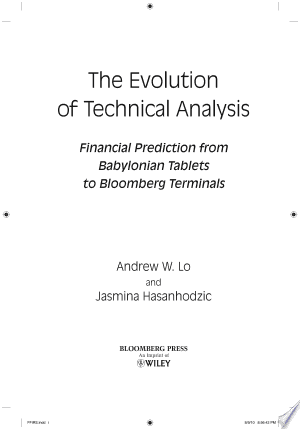
The Evolution of Technical Analysis cover
Archivist's Choice

The Evolution of Technical Analysis

Andrew W. Lo (2010)

Genre

Finance

Reading Time

480 min

Key Themes

See below

Track Your Reading

Sign in to track this book

Andrew Lo's book tracks technical analysis from ancient Babylonian clay tablets to modern Bloomberg terminals, showing its long effort to understand human psychology and predict financial trends.

Core Idea

Andrew Lo's "The Evolution of Technical Analysis" explores the history and theory of technical analysis. He argues that its continued use over millennia, despite academic doubt, points to a logic rooted in human psychology and how markets work. The book suggests that technical analysis is not pseudoscience but an adaptive way to recognize patterns, developed in response to market problems and the human need to find order in complex systems. It aims to connect traditional technical traders with modern financial academics by re-evaluating its effectiveness through behavioral finance and adaptive markets. Lo suggests its value comes from understanding market dynamics and participant behavior, not just prediction.
Reading time
480 min
Difficulty
Hard
✓ Read this if...
You are a finance professional, academic, or serious investor interested in a rigorous, historical, and interdisciplinary examination of technical analysis, moving beyond anecdotal evidence to explore its scientific and psychological foundations.
✗ Skip this if...
You are looking for a practical 'how-to' guide for applying technical analysis or a quick read on basic chart patterns. This book is academic and theoretical, not a trading manual.

Core idea

The central argument and framework that powers the entire book.

Andrew Lo's "The Evolution of Technical Analysis" explores the history and theory of technical analysis. He argues that its continued use over millennia, despite academic doubt, points to a logic rooted in human psychology and how markets work. The book suggests that technical analysis is not pseudoscience but an adaptive way to recognize patterns, developed in response to market problems and the human need to find order in complex systems. It aims to connect traditional technical traders with modern financial academics by re-evaluating its effectiveness through behavioral finance and adaptive markets. Lo suggests its value comes from understanding market dynamics and participant behavior, not just prediction.

At a glance

Reading time

480 min

Difficulty

Hard

Read this if...

You are a finance professional, academic, or serious investor interested in a rigorous, historical, and interdisciplinary examination of technical analysis, moving beyond anecdotal evidence to explore its scientific and psychological foundations.

Skip this if...

You are looking for a practical 'how-to' guide for applying technical analysis or a quick read on basic chart patterns. This book is academic and theoretical, not a trading manual.

Key Takeaways

1

Ancient Roots, Modern Relevance

Technical analysis isn't a modern invention; its principles echo through millennia.

Quote

The charting of past stock prices for the purpose of identifying trends, patterns, strength, and cycles within market data has allowed traders to make informed investment decisions based in logic, rather than on luck.

Technical analysis, often seen as a modern pseudoscience, has a surprisingly long history. Lo carefully tracks its origins to ancient civilizations, showing that the human desire to find patterns and predict outcomes from past data is not new. From Babylonian clay tablets recording prices to early Japanese rice traders, the basic ideas of watching supply and demand, finding trends, and using visuals to make decisions have been consistently applied. This history gives the practice important credibility, showing that while tools and mar...

Supporting evidence

Babylonian cuneiform tablets recording commodity prices, early Japanese rice trading records, and Dutch tulip mania charts.

Apply this

Approach market analysis with a historical perspective, recognizing that current market behaviors often mirror patterns observed in ancient markets. Don't dismiss 'old' methods outright; they often contain fundamental truths.


historical-market-analysispattern-recognitionmarket-psychology
2

East Meets West: Divergent Paths, Convergent Goals

Distinct cultural approaches to market analysis ultimately sought the same predictive edge.

Quote

The book compares and contrasts the Eastern practices of China and Japan to Western methods.

Lo points out the interesting differences and eventual similarities between Eastern and Western technical analysis. In the East, especially Japan, people like Munehisa Homma developed complex systems, such as candlestick charting for rice futures as early as the 18th century. These systems focused on patterns and market psychology and were often intuitive and visual. At the same time, in the West, pioneers like Charles Dow developed theories based on market averages and trends, focusing on the economic reasons and 'smart money' moveme...

Supporting evidence

Munehisa Homma's development of candlestick charting for Japanese rice markets vs. Charles Dow's work on the Dow Theory and market averages in the late 19th/early 20th century.

Apply this

Explore diverse technical analysis techniques from different cultures (e.g., Japanese candlesticks alongside Western chart patterns) to broaden your analytical toolkit and gain a more holistic market perspective.

candlestick-chartsdow-theorycultural-market-approaches
3

Pioneers and Their Enduring Legacies

Key figures laid the groundwork for modern technical analysis, shaping its core tenets.

Quote

The book details the contributions of pioneers such as Charles Dow, Munehisa Homma, Humphrey B. Neill, and William D. Gann.

The book highlights the influential thinkers who created the core ideas of technical analysis. Munehisa Homma’s systematic approach to rice trading, which led to candlestick patterns, gave a visual language for market sentiment. Charles Dow, through his observations of market averages, established the idea of trends and market phases, which became the foundation of Dow Theory. Humphrey B. Neill explored the psychological aspects of crowd behavior, linking market action to human emotion. William D. Gann, with his mix of geometry, astro...

Supporting evidence

Specific contributions of Munehisa Homma (candlesticks), Charles Dow (Dow Theory, market averages), Humphrey B. Neill (mass psychology), and William D. Gann (geometric and time cycles).

Apply this

Study the original works of these pioneers to understand the fundamental principles behind common indicators and patterns. Don't just apply techniques; understand their historical and theoretical underpinnings.

munehisa-hommacharles-dowwilliam-gannhumphrey-neill
4

The Psychological Undercurrent

Market movements are deeply intertwined with collective human emotions and biases.

Quote

Whether driven by mass psychology, fear or greed of investors, the forces of supply and demand, or a combination, technical analysis has flourished for thousands of years.

Lo suggests that much of technical analysis's lasting appeal and effectiveness comes from its ability to show and use market psychology. Price patterns are not just random; they often show collective fear, greed, hope, and despair among market participants. The book suggests that technical analysis, by finding repeated patterns, is essentially finding repeated behavioral biases and emotional responses in the market crowd. This view connects 'charting' and 'behavioral finance,' suggesting that technical analysts were, in a way, doing a...

Supporting evidence

Examples of market bubbles and crashes throughout history (e.g., Dutch tulip mania, 1929 crash), where collective irrationality drove prices beyond fundamental value, creating observable patterns.

Apply this

When analyzing charts, consider the underlying psychological state of the market. Is fear driving a sharp sell-off? Is greed fueling an unsustainable rally? Use this insight to anticipate potential turning points or accelerations.

behavioral-financemarket-sentimentcrowd-psychologyfear-greed
5

The Perpetual Debate: Science vs. Art

Technical analysis navigates a complex space between rigorous methodology and intuitive interpretation.

Quote

The Evolution of Technical Analysis explores the fascinating history of technical analysis, tracing where technical analysts failed, how they succeeded, and what it all means for today's traders and investors.

Lo's historical review indirectly highlights the ongoing question in technical analysis: is it a science with measurable rules, or an art form that needs intuition and experience? Early practitioners often combined observation with some subjective interpretation. While modern technical analysis increasingly uses quantitative methods and algorithms, the 'art' of reading charts—finding subtle patterns, understanding context, and weighing conflicting signals—remains important. The book shows cases where strict application failed and wher...

Supporting evidence

The contrast between William D. Gann's highly geometric and mathematical (yet often mystical) approaches and the more observational, pattern-based methods of early chartists.

Apply this

Develop a systematic approach to technical analysis, but also cultivate the 'art' of chart reading through extensive practice and observation. Don't become a slave to indicators; learn to read the underlying price action.

quantitative-analysischart-interpretationmarket-intuition
6

Adaptation to New Technologies

Technical analysis has constantly evolved, leveraging new tools from paper charts to Bloomberg terminals.

Quote

Financial Prediction from Babylonian Tablets to Bloomberg Terminals.

A key lesson from Lo's work is how well technical analysis adapts to different technologies. From drawing charts by hand on graph paper to the rise of computers and advanced software, the core ideas have remained, simply finding new, more efficient, and powerful ways to be expressed. The shift from physical charts to digital screens, and the ability to process large amounts of data with algorithms, has made technical analysis more accessible and allowed for more complex pattern recognition and testing. This development shows that tech...

Supporting evidence

The progression from hand-drawn charts in the early 20th century to the use of computers for calculating indicators (e.g., moving averages) in the late 20th century, and finally to real-time data feeds and algorithmic trading platforms.

Apply this

Stay updated with new technological advancements in charting software and analytical tools. Understand how these tools can enhance your ability to apply technical analysis, but always remember the underlying principles.

algorithmic-tradingdata-visualizationfintechhistorical-data
7

The Efficient Market Hypothesis Challenge

Technical analysis implicitly, and often explicitly, challenges the notion of perfectly efficient markets.

Quote

traders to make informed investment decisions based in logic, rather than on luck.

Lo's exploration of technical analysis naturally challenges the Efficient Market Hypothesis (EMH), which states that all available information is already in asset prices, making consistent outperformance through technical means impossible. The very existence and long history of technical analysis suggest that markets are not always perfectly efficient, or at least not efficient in a way that prevents using behavioral biases and patterns. If markets were truly random, technical analysis would have no basis. The fact that it has 'flouri...

Supporting evidence

The book's focus on identifying trends and patterns directly contradicts the 'random walk' theory central to the EMH. The success stories of technical analysts, even if anecdotal, provide counter-evidence.

Apply this

Acknowledge the EMH but don't let it paralyze your analytical efforts. Understand that market inefficiencies, often driven by human psychology, can create opportunities that technical analysis aims to capture.

efficient-market-hypothesismarket-inefficienciesrandom-walk-theoryalpha-generation
8

The Quest for Logic, Not Luck

Technical analysis offers a structured framework to make decisions, reducing reliance on chance.

Quote

traders to make informed investment decisions based in logic, rather than on luck.

Ultimately, the lasting appeal of technical analysis, as Lo shows, comes from the human desire to create order from chaos and make decisions based on 'logic, rather than on luck.' In the unpredictable world of financial markets, technical analysis provides a framework, a set of rules and observations, that allows traders to build a consistent decision-making process. Even if not always perfectly predictive, it offers a systematic way to manage risk, find possible entry/exit points, and understand market context. This structured approa...

Supporting evidence

The development of specific trading systems and rules by pioneers, designed to be repeatable and objective, rather than purely discretionary or emotional.

Apply this

Develop a clear, rules-based trading plan using technical analysis. Define your entry, exit, and risk management criteria before entering a trade. This systematic approach reduces emotional bias and promotes consistency.

risk-managementtrading-strategydecision-making-frameworksystematic-trading
9

Beyond Prediction: Understanding Market Dynamics

Technical analysis offers a lens to comprehend market forces, not just forecast prices.

Quote

identifying trends, patterns, strength, and cycles within market data.

While often seen as a prediction tool, Lo's historical account suggests that technical analysis's deeper value is in helping traders understand the underlying forces of supply and demand, the changes in market sentiment, and the strength (or weakness) of trends. It's not just about guessing where the price will go, but understanding why it might go there, or why it's currently acting in a certain way. By finding trends, patterns, and cycles, technical analysis provides a framework for understanding a market's 'health,' its momentum,...

Supporting evidence

The use of indicators like volume to gauge the 'strength' of a trend, or support/resistance levels to identify areas where supply and demand are likely to clash.

Apply this

Use technical analysis not just for entry/exit signals, but also to gain a broader understanding of the market's current state, momentum, and potential inflection points. Combine it with fundamental analysis for a holistic view.

supply-demand-analysismarket-momentumsupport-resistancemarket-structure

Critical analysis

Notable Quotes

The efficient markets hypothesis is the most important idea in the history of finance.

Highlighting the foundational importance of EMH, even while discussing its limitations.

Technical analysis, at its core, is the study of collective human behavior.

Defining technical analysis not just as chart patterns, but as a reflection of human psychology.

Markets are not always efficient, nor are they always irrational; they are adaptive.

Introducing the adaptive markets hypothesis as a more nuanced view than strict EMH or behavioral finance.

The profits of technical analysis are not guaranteed, but its insights into human nature are undeniable.

Acknowledging the practical challenges of profiting from technical analysis while validating its psychological underpinnings.

Pattern recognition is a fundamental aspect of human intelligence, and it is natural to apply it to financial markets.

Explaining the intuitive appeal of technical analysis from a cognitive perspective.

The history of technical analysis is a history of trial and error, of successes and failures, but always of learning.

Reflecting on the evolutionary nature of technical analysis as a discipline.

Risk is not just about volatility; it's about the probability of losing money, and how much.

Expanding the definition of risk beyond traditional statistical measures.

The market is a complex adaptive system, constantly evolving and adapting to new information and new participants.

Applying complex systems theory to financial markets, emphasizing dynamic change.

Technical analysis should not be dismissed out of hand; rather, it should be subjected to rigorous scientific scrutiny.

Advocating for a scientific approach to evaluating technical analysis, moving beyond dogma.

The real challenge is not just identifying patterns, but understanding why they occur and whether they are likely to persist.

Moving beyond superficial pattern recognition to deeper causal understanding.

Evolutionary forces shape not only biological systems but also financial markets and the strategies employed within them.

Drawing parallels between biological evolution and the evolution of market strategies and participants.

Behavioral biases are not necessarily irrational, but rather heuristics that have been adaptive in certain environments.

Reinterpreting behavioral biases as potentially adaptive responses, linking to the adaptive markets hypothesis.

The future of finance lies in integrating insights from diverse disciplines, from psychology to computer science to evolutionary biology.

Projecting an interdisciplinary future for financial research and understanding.

Technical analysis, properly understood, is not a magic bullet, but a tool for understanding market dynamics and human behavior.

Setting realistic expectations for technical analysis while affirming its analytical value.

Quiz

Test Your Knowledge

Ready to see how well you understood this book? Take our interactive quiz with 10 questions.

10
Questions
~5
Minutes
?
Best Score

Key Questions (FAQ)

Technical analysis involves charting past stock prices to identify trends, patterns, and cycles within market data for investment decisions. This book traces its evolution from ancient practices, such as those found on Babylonian tablets, to modern Bloomberg terminals, highlighting its consistent presence despite varying degrees of acceptance by the financial establishment.

About the author

Andrew W. Lo

Andrew W. Lo is the Charles E. and Susan T. Harris Professor of Finance at the MIT Sloan School of Management. A leading figure in quantitative finance, his research spans asset pricing, risk management, and behavioral finance. Lo is the author of "The Evolution of Technical Analysis: Financial Forecasting Technologies Since the Renaissance," which explores the historical development of technical analysis tools and methodologies.