BookBrief
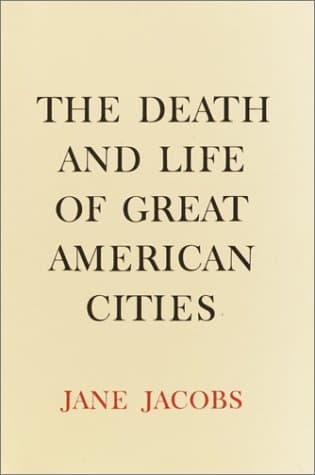
The Death and Life of Great American Cities cover
Archivist's Choice

The Death and Life of Great American Cities

Jane Jacobs (1961)

Genre

History

Reading Time

1200 min

Key Themes

See below

Track Your Reading

Sign in to track this book

Jane Jacobs's work challenges mid-20th-century urban planning, showing how diverse city life, not top-down design, creates safe, healthy neighborhoods.

Core Idea

Jane Jacobs argues that typical 20th-century urban planning, with its large renewal projects, single-use zones, and car-focused design, harms cities. She believes successful cities grow from complex, unplanned interactions at a human scale, mostly on streets and sidewalks. Jacobs values the wisdom in old city areas, highlighting the importance of mixed-use buildings, short blocks, older structures, and many people and activities. Her main point defends the unplanned, diverse, and pedestrian-friendly city against modern urban planning's destructive logic.
Reading time
1200 min
Difficulty
Hard
✓ Read this if...
You are an urban planner, architect, city resident, or anyone interested in understanding the fundamental elements that make cities livable, safe, and economically dynamic, beyond conventional top-down design.
✗ Skip this if...
You are looking for a quick, casual read on urban design or prefer books that offer simple, prescriptive solutions rather than a deep, critical analysis of urban theory and practice.

Core idea

The central argument and framework that powers the entire book.

Jane Jacobs argues that typical 20th-century urban planning, with its large renewal projects, single-use zones, and car-focused design, harms cities. She believes successful cities grow from complex, unplanned interactions at a human scale, mostly on streets and sidewalks. Jacobs values the wisdom in old city areas, highlighting the importance of mixed-use buildings, short blocks, older structures, and many people and activities. Her main point defends the unplanned, diverse, and pedestrian-friendly city against modern urban planning's destructive logic.

At a glance

Reading time

1200 min

Difficulty

Hard

Read this if...

You are an urban planner, architect, city resident, or anyone interested in understanding the fundamental elements that make cities livable, safe, and economically dynamic, beyond conventional top-down design.

Skip this if...

You are looking for a quick, casual read on urban design or prefer books that offer simple, prescriptive solutions rather than a deep, critical analysis of urban theory and practice.

Key Takeaways

1

The Sidewalk Ballet

Informal public surveillance is the bedrock of urban safety and community.

Quote

The public peace of cities is not kept primarily by the police, necessary as police are, but by an intricate, almost unconscious, network of voluntary controls and standards among the people themselves, and enforced by the people themselves.

Jacobs says that the real protectors of city safety are the people who live, work, and watch the streets every day. This 'sidewalk ballet' is a complex, informal system of constant public observation where many eyes on the street—from shopkeepers to residents—prevent crime and create security. This steady, casual observation makes a self-regulating environment, more effective than police patrols alone. It builds trust and a shared sense of ownership over public spaces, making them welcoming and safe for everyone. Without this natural ...

Supporting evidence

Jacobs illustrates this through observations of her own Greenwich Village neighborhood, contrasting its safety with the desolation and crime in areas designed with 'superblocks' and isolated towers, where no one had a vested interest in watching the street.

Apply this

When planning new developments or revitalizing existing ones, prioritize mixed-use buildings with ground-floor activity, numerous entrances and windows facing the street, and a high density of residents and businesses to ensure a constant flow of 'eyes on the street.'

eyes-on-the-streetinformal-social-controlmixed-use-development
2

Diversity is Destiny

Cities thrive on a complex intermingling of primary uses, buildings, and people.

Quote

Cities are an immense laboratory of trial and error, failure and success, in city building and city design.

For Jacobs, a city's energy depends on its diversity, not just of people, but of its physical layout and economic activities. She lists four main things that create strong diversity: enough people, mixed main uses (housing, business, culture), a mix of old and new buildings, and small blocks. These parts create many activities all day and night, ensuring constant foot traffic and economic connections. Areas with only one function, like residential suburbs or single-use business districts, are weak and cannot create the necessary compl...

Supporting evidence

Jacobs contrasts the vibrant, diverse streets of pre-urban renewal Greenwich Village with the sterile, single-use public housing projects or isolated cultural centers that urban planners favored, which often became ghost towns after business hours.

Apply this

Advocate for zoning policies that encourage mixed-use development, protect historic buildings alongside new construction, and resist large-scale, single-purpose developments. Prioritize small, walkable blocks to maximize street-level activity and interaction.

mixed-use-zoningurban-diversitysmall-blocks
3

The Perils of 'Cataclysmic Money'

Large-scale, top-down urban renewal often destroys more than it creates.

Quote

The only way to plan a city is to plan for its growth and change, not for its static perfection.

Jacobs strongly criticizes mid-20th-century urban renewal projects, which she called 'cataclysmic money' interventions. These projects, often with large government funding, aimed to clear 'slums' and replace them with grand, often sterile, new developments. However, this top-down method consistently ignored the existing social structure and economic systems of neighborhoods. By tearing down older, often affordable buildings and moving communities, these projects destroyed valuable social connections, local economies, and the diversity...

Supporting evidence

Jacobs frequently cites the failure of the 'slum clearance' projects in cities like New York, particularly the demolition of thriving neighborhoods in favor of projects like the Lower Manhattan Expressway or large public housing towers that quickly deteriorated.

Apply this

Prioritize incremental, community-led development and renovation over large-scale demolition and rebuilding. Empower local residents and small businesses in planning processes, and focus on preserving existing urban fabric rather than wholesale replacement.

urban-renewalgentrificationtop-down-planning
4

Neighborhoods as Self-Governing Organisms

Successful neighborhoods are complex, self-organizing systems, not simple administrative units.

Quote

A city is not a tree, but a collection of many diverse and overlapping systems.

Jacobs argues that a true neighborhood is more than a geographical area or an administrative district. It is a social organism, a self-governing unit with its own internal workings, informal leaders, and shared duties. These 'self-governing' parts come from residents' daily interactions and shared interests, creating a sense of group identity and action. When neighborhoods are too big, too uniform, or lack the necessary social infrastructure (like local shops and public spaces), they lose this natural ability to organize themselves an...

Supporting evidence

Jacobs discusses how neighborhoods in her Greenwich Village were able to mobilize against Robert Moses's grand development schemes, demonstrating their inherent social cohesion and capacity for collective action, in contrast to areas lacking such internal organization.

Apply this

Foster local leadership and community organizations. Design public spaces that encourage casual interaction and shared ownership. Avoid creating overly large or homogenous neighborhoods that dilute social cohesion. Support local businesses and institutions that serve as neighborhood anchors.

community-organizingsocial-capitalurban-ecology
5

The Curse of Border Vacuums

Clear-cut borders and mono-functional zones create dead spaces that undermine urban vitality.

Quote

The more successfully a city mingles everyday diversity of uses and users in its everyday streets, the more successfully, by extension, its people are enabled to mingle in person.

Jacobs criticizes modern planning that created separate zones for different functions (e.g., housing, industry, business) and defined city areas with clear, often impassable borders like highways or large parks. These 'border vacuums' block movement and interaction, creating dead zones that lack activity, observation, and economic exchange. Instead of connecting, they break up the city, isolating neighborhoods and stopping the spontaneous interactions important for city life. A healthy city, in contrast, has unclear, permeable borders...

Supporting evidence

Jacobs points to the isolating effect of major expressways cutting through cities, or the vast, unpopulated stretches of parks and institutional campuses that create barriers between once-connected neighborhoods, leading to a decline in activity and safety on their borders.

Apply this

Prioritize permeable urban edges, integrate parks and institutions into the urban fabric with active frontages, and avoid designing large, single-use developments that create their own internal borders. Encourage development that bridges existing divides rather than reinforcing them.

urban-fragmentationpermeabilityzoning-reform
6

Short Blocks, Long Lives

Small blocks are essential for maximizing street connectivity and pedestrian activity.

Quote

Intricate minglings of different kinds of uses in cities are not a form of chaos. On the contrary, they represent a complex and highly developed form of order.

Jacobs supports the small city block as a basic unit for city energy. Shorter blocks mean more intersections, more corner properties, and more chances for people to choose different routes, leading to more street activity. This increased connection encourages walking, supports local businesses by increasing foot traffic, and helps create 'eyes on the street.' On the other hand, large blocks, often favored by modern planners, create long, boring street sections with fewer points of interest and fewer chances for spontaneous interaction...

Supporting evidence

Jacobs contrasts the vibrant pedestrian life and numerous local businesses found on the short blocks of older, traditional city districts with the desolate, car-oriented streets surrounding the large-scale, superblock developments of urban renewal.

Apply this

When designing new areas or redeveloping existing ones, prioritize a fine-grained street network with short blocks. Avoid consolidating parcels into superblocks. Emphasize pedestrian-friendly design and connectivity at every intersection.

walkabilitystreet-gridpedestrian-friendly-design
7

The Inefficiency of Efficiency

Attempting to sterilize cities for 'efficiency' destroys their inherent, complex efficiency.

Quote

To think of a city as a work of art is to miss the point. A city is a problem in organic growth, in which the parts must be in a living relation to the whole.

Jacobs challenges the modern planning idea that aimed to make cities 'efficient' by separating functions, creating grand, uniform designs, and prioritizing car traffic. She argues that this top-down, rational method is inefficient because it ignores cities' actual, natural efficiency. The 'inefficiency' of messy, diverse, older neighborhoods—with their varied building ages, mixed uses, and small businesses—is actually their biggest strength. This complexity allows for flexibility, new ideas, and a strong local economy that sterile, pl...

Supporting evidence

Jacobs critiques the 'Radiant City' ideals of Le Corbusier and the grand visions of Robert Moses, whose attempts to impose order and efficiency often resulted in the destruction of existing, functioning communities and the creation of new problems, such as increased crime and economic stagnation.

Apply this

Resist the urge to over-simplify urban areas or impose grand, uniform designs. Instead, foster conditions that allow for organic growth, adaptation, and the complex interplay of diverse uses. Embrace the 'messiness' that often accompanies true urban vitality.

modernist-planning-critiqueorganic-urbanismle-corbusier
8

The Wisdom of the Mundane

Seemingly ordinary urban elements play crucial, often overlooked, roles in city life.

Quote

The street is a place of continuous interaction, not just between people but between the people and the physical environment.

Jacobs shows how ordinary, often overlooked parts of city life—like apartment windows, street vendors, small shops, and even funeral homes—are not just decoration but are vital to a healthy city. Apartment windows, for example, are 'eyes on the street,' helping with safety. Small, independent shops provide essential services, support local economies, and act as community gathering spots. Funeral homes, despite their purpose, add to the mixed-use fabric and the constant presence of people on the street. These seemingly common elements ...

Supporting evidence

Jacobs discusses the role of local shopkeepers in her own neighborhood, who knew residents by name and acted as informal guardians of the street, and the often-dismissed value of older, varied buildings that provide affordable spaces for such small-scale enterprises.

Apply this

Support local, independent businesses through policy and patronage. Protect older, smaller buildings that provide affordable commercial and residential spaces. Encourage a fine-grained mix of uses, including those often deemed 'undesirable' by traditional zoning, to ensure a continuous presence and diversity of activity.

street-lifelocal-economyurban-fabric
9

Cities as 'Problems in Organized Complexity'

Understanding cities requires a scientific approach that embraces their inherent complexity, not simplification.

Quote

A city cannot be a work of art, but it can be a work of living art.

Jacobs redefines how we should study cities. She argues that cities are not 'simple problems' that can be solved with grand, overall plans, nor are they 'disorganized complexity' (chaos). Instead, they are 'problems in organized complexity,' intricate systems with many interacting parts and emerging qualities. This means that good urban planning needs observation, testing, and an understanding of how small, local interactions contribute to bigger system behavior. Planners must move past simple ideas and embrace the messy, dynamic real...

Supporting evidence

Jacobs's entire methodology is based on direct observation of how cities actually function, rather than relying on theoretical models or statistical aggregates, contrasting her approach with the prevailing 'scientific' planning methods of her time that often led to disastrous outcomes.

Apply this

Adopt an iterative, experimental approach to urban development, continuously observing and learning from the city's responses. Prioritize small-scale interventions that can be easily adjusted. Engage in participatory planning that taps into the local knowledge of residents and businesses.

systems-thinkingurban-complexityemergent-properties
10

The Genius of Place

Authentic urban character emerges from unique local conditions, not universal formulas.

Quote

The look of things, in cities, is not a matter of aesthetics in the sense of a detached, visual art. It is a matter of function.

Jacobs suggests that the 'genius of place'—a city or neighborhood's unique character and identity—cannot be made or forced through universal design rules. Instead, it grows naturally from the specific historical, social, economic, and physical conditions of that location. Attempts to use standard solutions or abstract beauty ideals often result in generic environments that lack character and function. Real city beauty and effectiveness come from designs that are deeply connected to their context, responding to a place's particular nee...

Supporting evidence

Jacobs consistently contrasts the unique, evolving character of older, organically developed neighborhoods with the generic, often sterile, and ultimately failed attempts to create 'ideal cities' or 'neighborhood units' that looked the same everywhere.

Apply this

Before any intervention, thoroughly understand the unique history, social dynamics, and economic conditions of a place. Prioritize context-sensitive design that respects existing urban fabric and local character. Empower local communities to define what makes their place special and how it should evolve.

place-makinglocal-charactercontextual-design

Critical analysis

Notable Quotes

Cities have the capability of providing something for everybody, only because, and only when, they are created by everybody.

Opening statement on the nature of cities.

There is a quality even meaner than outright ugliness or disorder, and this is the dishonest mask of pretended order, achieved by ignoring or suppressing the real order that is struggling to assert itself, much as the clean and orderly graveyard ignores the messy problems of the living.

Critique of overly rigid, top-down urban renewal projects.

The trust of a city street is formed over time from many, many little public sidewalk contacts.

Explaining how social capital and safety develop on city streets.

Gridiron street plans, for all their bland orderliness, are not intrinsically bad. They simply require more thought and design for their use than they commonly get.

Discussing the merits and drawbacks of common street layouts.

Dull, inert cities, it is true, do contain the seeds of their own destruction and have always done so. But at present, in the United States, they are widely, cheerfully, and extravagantly sowing whole fields of destruction with urban renewal programs.

Criticizing the destructive nature of contemporary urban renewal.

The point of cities is city living, and the point of city living is to be able to make use of the great range of choices and opportunities that only cities can offer.

Defining the essential purpose and value of cities.

To think of a city as a great, intricate ballet in which the individual dancers and ensembles all play their parts, improvising and adapting as they go, is to begin to understand its complexity and beauty.

Using an analogy to describe the dynamic nature of city life.

The ballet of the good city sidewalk never repeats itself from one day to the next, any more than a continually re-forming galaxy repeats itself.

Emphasizing the ever-changing, organic nature of vibrant city streets.

Intricate minglings of different uses in cities are not a form of chaos. On the contrary, they represent a complex and highly developed form of order.

Arguing against the perception of mixed-use areas as chaotic.

Under the seeming disorder of the old city, wherever the old city has a real life, there is in fact a marvelous intricate order, which is for the most part an order of movement and change.

Further elaborating on the hidden order in seemingly chaotic urban environments.

Lowly, unpurposeful and random as they appear, sidewalk contacts are the small change from which a city's wealth of public life must grow.

Highlighting the importance of informal social interactions on sidewalks.

The public peace—the sidewalk safety—of cities is not kept primarily by the police, necessary as police are. It is kept primarily by an intricate, almost unconscious, network of voluntary controls and standards among the people themselves, and enforced by the people themselves.

Arguing for the role of informal social controls in maintaining street safety.

The simple fact is that the absence of a variety of uses, and of the people they bring with them, is the absence of effective eyes on the street.

Explaining why single-use districts often lack safety and vitality.

To generate exuberant diversity in a city's streets and districts requires the presence of four conditions. These are: (1) mixed primary uses, (2) small blocks, (3) aged buildings, and (4) density.

Outlining the key conditions for creating vibrant, diverse urban areas.

Quiz

Test Your Knowledge

Ready to see how well you understood this book? Take our interactive quiz with 10 questions.

10
Questions
~5
Minutes
?
Best Score

Key Questions (FAQ)

Jane Jacobs's 'The Death and Life of Great American Cities' is a seminal work that critiques 20th-century urban planning, arguing against top-down approaches and advocating for vibrant, diverse, and human-scaled cities. It explores what makes urban neighborhoods thrive, focusing on safety, community, and economic vitality.

About the author