BookBrief
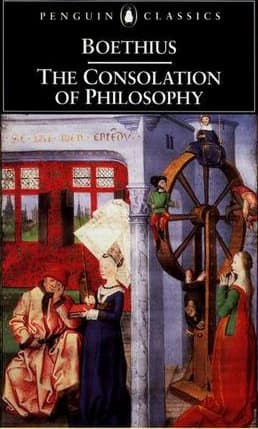
The Consolation of Philosophy cover
Archivist's Choice

The Consolation of Philosophy

Boethius (1964)

Genre

History / Spirituality / Philosophy

Reading Time

240 min

Key Themes

See below

Track Your Reading

Sign in to track this book

From a prison cell, facing execution, Boethius talks with Lady Philosophy, who, through prose and verse, reveals the nature of happiness, fortune, and divine will, changing his despair into understanding.

Core Idea

Written from prison while awaiting execution, Boethius's "The Consolation of Philosophy" is a dialogue that addresses the problem of evil and suffering. In a conversation with Lady Philosophy, Boethius explores the nature of fortune, the ultimate good, divine will, and human free will. The main argument is that true happiness and good are not found in external circumstances or material wealth, but in an internal connection with divine reason and virtue, which leads to God, the highest good. Even when facing great personal hardship, philosophical thought offers comfort and a way to understand the benevolent order of the cosmos. The book shows that worldly goods do not bring lasting happiness, demonstrating their temporary nature and the indifferent turning of Fortune's wheel. It reconciles the apparent injustice of suffering with the existence of an all-knowing and all-powerful God, arguing that what seems like evil or misfortune from a human view is, in the larger plan of divine will, always directed toward a greater good. By understanding this, people can move past their suffering, finding true freedom and power in virtue and the pursuit of divine wisdom.
Reading time
240 min
Difficulty
Medium
✓ Read this if...
You are grappling with suffering, injustice, or the meaning of life, and seek a classical philosophical perspective on finding solace and understanding in adversity. Also, if you are interested in the historical bridge between classical philosophy and early Christian thought.
✗ Skip this if...
You prefer modern, secular philosophy, or are looking for a light, easily digestible read without dense theological and metaphysical arguments.

Core idea

The central argument and framework that powers the entire book.

Written from prison while awaiting execution, Boethius's "The Consolation of Philosophy" is a dialogue that addresses the problem of evil and suffering. In a conversation with Lady Philosophy, Boethius explores the nature of fortune, the ultimate good, divine will, and human free will. The main argument is that true happiness and good are not found in external circumstances or material wealth, but in an internal connection with divine reason and virtue, which leads to God, the highest good. Even when facing great personal hardship, philosophical thought offers comfort and a way to understand the benevolent order of the cosmos.

The book shows that worldly goods do not bring lasting happiness, demonstrating their temporary nature and the indifferent turning of Fortune's wheel. It reconciles the apparent injustice of suffering with the existence of an all-knowing and all-powerful God, arguing that what seems like evil or misfortune from a human view is, in the larger plan of divine will, always directed toward a greater good. By understanding this, people can move past their suffering, finding true freedom and power in virtue and the pursuit of divine wisdom.

At a glance

Reading time

240 min

Difficulty

Medium

Read this if...

You are grappling with suffering, injustice, or the meaning of life, and seek a classical philosophical perspective on finding solace and understanding in adversity. Also, if you are interested in the historical bridge between classical philosophy and early Christian thought.

Skip this if...

You prefer modern, secular philosophy, or are looking for a light, easily digestible read without dense theological and metaphysical arguments.

Key Takeaways

1

Fortune's Wheel Turns Indifferently

True happiness cannot be found in external goods, which are inherently fleeting.

Quote

If you are striving for true wealth, you must look not for what is possessed but for what can be neither lost nor taken away.

Boethius, through Lady Philosophy, argues that seeking external things like wealth, power, fame, and pleasure is pointless. These are gifts from Fortune, an arbitrary and changeable force, and thus temporary. To base one's happiness on them means setting oneself up for suffering when they are lost. True happiness, she says, must be an internal state, independent of external changes. The mistake is in giving lasting value to what is only temporary. By understanding Fortune's indifference and the impermanence of its gifts, one can detac...

Supporting evidence

Lady Philosophy's initial argument against Boethius's despair over his lost wealth, status, and freedom, where she meticulously deconstructs the inherent flaws and limitations of each external good, demonstrating how they fail to provide lasting satisfaction or security.

Apply this

Cultivate an internal locus of control by regularly reflecting on what truly brings lasting contentment versus what merely provides fleeting gratification. Practice gratitude for what you have, but recognize its impermanence, fostering a detachment from material possessions and external validation.

external-goodsfortune's-wheelimpermanence
2

Suffering as a Catalyst for Wisdom

Adversity, while painful, can strip away illusions and reveal deeper truths.

Quote

Adversity has the effect of eliciting talents which in prosperous circumstances would have lain dormant.

Boethius's own imprisonment and upcoming execution are the catalysts for his philosophical awakening. Lady Philosophy states that suffering, rather than being only punishment, can be a powerful teacher. Prosperity often makes people complacent and hides the true nature of reality, making them dependent on external comforts and superficial relationships. Hardship, conversely, forces one to face basic questions, reevaluate values, and tell true friends from temporary companions. It is in deep despair that Boethius must turn inward and s...

Supporting evidence

Boethius's personal narrative throughout the book, detailing his fall from grace and the subsequent introspection that leads him to question the very foundations of his previous happiness. Lady Philosophy consistently reframes his misfortune as an opportunity for spiritual growth.

Apply this

When facing personal setbacks or suffering, consciously seek the lessons within the experience. Journal about the challenges, identifying illusions that have been shattered and new perspectives gained. View difficult periods as opportunities for growth and self-discovery rather than mere punishment.

adversitysufferingwisdomintrospection
3

The Supremacy of Divine Providence

An ordered universe is governed by a benevolent, all-knowing God, even if it appears chaotic.

Quote

There is, then, a rudder by which the universe is governed, and it is God's goodness.

A main idea of Boethius's consolation is the firm belief in a divine, providential order governing the universe. Lady Philosophy carefully argues against the idea of a chaotic or malevolent cosmos, stating that all events, even those that seem unjust or cruel, ultimately serve a higher, benevolent purpose within God's plan. This divine will, she explains, is not a tyrannical force but an expression of supreme goodness that guides everything toward its proper end. Understanding this order provides great comfort, as it means no sufferin...

Supporting evidence

Lady Philosophy's extended explanation of providence and fate, distinguishing between God's eternal, unified plan (providence) and the temporal, unfolding sequence of events (fate). She uses analogies of a skilled craftsman or a ship's rudder to illustrate God's guiding hand.

Apply this

When confronted with seemingly random or unjust events, try to reframe them within a larger, purposeful context. Cultivate faith in an underlying order, even if its immediate manifestation is unclear. This isn't passive acceptance but a trust in a benevolent, overarching structure.

divine-providencefatecosmic-orderbenevolence
4

True Good is God Itself

Ultimate happiness and the highest good are found in union with the divine.

Quote

Since God is the highest good, and since everything that is good is good because it participates in God, it follows that everything good is God.

Building on the concept of divine will, Lady Philosophy leads Boethius to realize that the highest good, which all beings naturally seek, is the same as God. All good things in the world—wealth, power, pleasure, fame—are simply imperfect reflections or parts of this ultimate good. When pursued alone, they lead to dissatisfaction. True and perfect happiness, therefore, can only be achieved by aligning oneself with, and ultimately participating in, the divine essence. This is not merely a theological point but a philosophical one: the v...

Supporting evidence

The philosophical argument where Lady Philosophy systematically demonstrates that all lesser goods, when pursued to their logical conclusion, ultimately lead back to a singular, perfect good, which she identifies as God. This is a crucial step in Boethius's intellectual journey.

Apply this

Reflect on your deepest desires and motivations. Are you pursuing fragmented 'goods' or seeking the ultimate source from which all good flows? Engage in practices that foster spiritual connection or philosophical contemplation of ultimate truths, redirecting your internal compass towards the highest good.

supreme-gooddivine-essenceultimate-happinessteleology
5

The Problem of Evil Reconciled

Evil is not a substantive force but a privation of good, lacking true being.

Quote

Evil is nothing. It has no being. For if it had being, it could not be evil.

One of the most complex philosophical challenges for Boethius is reconciling the existence of evil and the prosperity of the wicked with a benevolent, all-powerful God. Lady Philosophy resolves this by arguing that evil is not a positive entity or a force with its own power, but rather a lack or absence of good. Just as darkness is the absence of light, evil is the absence of goodness, and therefore lacks true being or substance. The wicked, by straying from the good, lessen their own being and power, ultimately becoming less than hum...

Supporting evidence

Lady Philosophy's detailed explanation of evil as a 'privation of good' (privatio boni), a concept that would become highly influential in medieval theology. She argues that the wicked are actually weaker and more miserable than the just, even if they appear powerful.

Apply this

Instead of focusing on battling 'evil' as an external force, focus on cultivating and increasing 'good' within yourself and your sphere of influence. Recognize that destructive behaviors often stem from a lack or distortion of good, rather than an inherent 'badness' of being.

problem-of-evilprivation-of-goodmetaphysics-of-evilgoodness
6

True Power Lies in Virtue

The virtuous are always powerful, and the wicked are always weak.

Quote

For the good are always powerful, and the wicked always weak.

This seemingly surprising claim is a core principle of Boethius's consolation. Lady Philosophy states that true power is not found in external authority, wealth, or physical strength, but in moral integrity and virtue. The wicked, despite their apparent dominance, are fundamentally weak because they lack self-control, are slaves to their passions, and are constantly driven by endless desires. Their actions, being deviations from the good, are ultimately ineffective in achieving true happiness or lasting success. Conversely, the virtuo...

Supporting evidence

Lady Philosophy's argument that the wicked, even if they achieve worldly success, are effectively 'punished' by their own vices and their separation from the good. She also points out that the wicked cannot truly achieve what they desire, as their desires are misdirected.

Apply this

Focus on cultivating inner virtues like justice, temperance, prudence, and fortitude. Recognize that genuine influence and resilience come from moral strength and integrity, not from external trappings of power. Prioritize character development over the pursuit of status.

virtuemoral-strengthinner-powerwickedness
7

Fate and Free Will Reconciled

God's foreknowledge does not negate human freedom; it is a different mode of knowing.

Quote

For the present moment, if you consider it, is known to God not as a future event but as a present one.

Perhaps the most complex philosophical problem Boethius addresses is reconciling divine foreknowledge with human free will. If God knows all future events, including our choices, are our choices truly free, or are they predetermined? Lady Philosophy offers a brilliant solution: God's knowledge is not temporal like human knowledge. God exists outside of time, in an eternal present. Therefore, God 'sees' all events—past, present, and future—as simultaneously happening in His eternal present. His foreknowledge is not a cause of our actio...

Supporting evidence

Lady Philosophy's detailed analogy of God's eternal perspective being like looking down from a high peak and seeing all travelers on a road simultaneously, whereas a traveler on the road only sees what is immediately before and behind them. This illustrates the difference between temporal and eternal cognition.

Apply this

Embrace personal responsibility for your choices, understanding that your actions are genuinely free, even within a divinely ordered universe. Don't use divine foreknowledge as an excuse for inaction or moral complacency. Act with awareness that your choices have real consequences.

free-willdivine-foreknowledgeeternitytemporal-knowledgedeterminism
8

The Soul's Return to Its Source

Philosophy guides the soul back to its divine origin, offering ultimate peace.

Quote

Philosophy is the medicine of the soul.

The entire dialogue is a therapeutic process, with Lady Philosophy acting as a doctor for Boethius's struggling soul. His initial despair comes from forgetting his true nature and the divine order. Through logic, poetic verse, and compassionate guidance, Philosophy systematically clears his mind of false beliefs and worldly attachments. The ultimate goal is to restore his spiritual health, allowing his soul to remember its inherent connection to the divine good. This return to the source is not just intellectual agreement but a deep e...

Supporting evidence

The entire structure of the book, which progresses from Boethius's initial lament and 'illness' to his gradual recovery and enlightenment through Lady Philosophy's teachings, culminating in his acceptance and understanding of his situation.

Apply this

Engage in regular philosophical inquiry and self-reflection as a form of 'soul medicine.' Actively question your assumptions, confront your fears, and seek intellectual and spiritual growth to align your inner self with higher truths and find profound inner peace.

soul's-journeyenlightenmentspiritual-healingself-discoverydivine-union

Critical analysis

Notable Quotes

If then you look upon the things of this world, considering them as they are, you will see that they are nothing.

Lady Philosophy's argument against the allure of worldly goods.

All fortune is good fortune; for it either provides a discipline, or a remedy for a disease.

Lady Philosophy's reframing of adversity.

For every man's fortune is in his own hands.

Lady Philosophy empowering Boethius to take control of his fate.

For what else is it to fly from good but to follow evil?

Lady Philosophy discussing the nature of good and evil.

No one is so completely happy that he is not afflicted by some anxiety.

Boethius reflecting on the imperfections of even the most fortunate lives.

For reason is the only thing that distinguishes man from beast.

Lady Philosophy emphasizing the unique human capacity for reason.

The greatest part of man's happiness consists in a good conscience.

Lady Philosophy linking inner peace to moral integrity.

For if there is a God, whence come evils? If there is not a God, whence come goods?

Boethius grappling with the problem of evil.

What is it, then, that can truly be said to be good? That which is in itself good, and for its own sake good.

Lady Philosophy defining true good as distinct from worldly goods.

For what is more unhappy than a man who has lost his liberty?

Boethius lamenting his imprisonment.

For nothing is more wretched than a man who has ceased to be himself.

Lady Philosophy warning against losing one's identity and principles in adversity.

For the whole course of human life is a perpetual struggle between reason and passion.

Lady Philosophy describing the internal conflict within humans.

There is nothing that can hinder the omnipotence of God.

Lady Philosophy asserting divine power and providence.

No man is so wise as to be free from all error.

Lady Philosophy acknowledging human fallibility.

For what is more precious than time?

Boethius reflecting on the fleeting nature of life.

Quiz

Test Your Knowledge

Ready to see how well you understood this book? Take our interactive quiz with 10 questions.

10
Questions
~5
Minutes
?
Best Score

Key Questions (FAQ)

'The Consolation of Philosophy' is a philosophical dialogue written by Boethius while imprisoned and awaiting execution. It explores themes of fortune, happiness, good and evil, fate, and free will through a conversation between Boethius and Lady Philosophy.

About the author

Boethius

Anicius Manlius Severinus Boethius was a Roman senator and philosopher active in the early 6th century CE. He is best known for his seminal work, 'The Consolation of Philosophy,' written while imprisoned. This philosophical text explores themes of fate, free will, and divine providence, and has profoundly influenced Western thought for centuries.