BookBrief
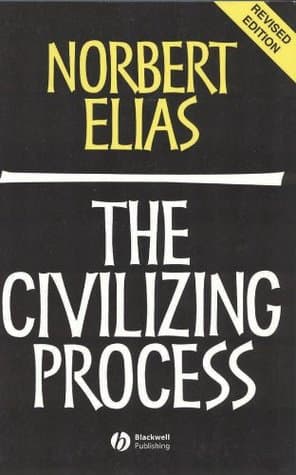
The Civilizing Process cover
Archivist's Choice

The Civilizing Process

Norbert Elias

Genre

History / Philosophy

Reading Time

1500 min

Key Themes

See below

Track Your Reading

Sign in to track this book

Norbert Elias shows how the state's power monopoly in Western Europe changed personal manners and individual minds, shaping the 'civilized' self from the late Middle Ages onward.

Core Idea

Norbert Elias's 'The Civilizing Process' argues that the modern state's growth, especially its control over force and taxes, directly connects to major changes in individual thinking, manners, and emotional control. Over centuries, outside social rules, driven by more complex and connected societies, became internal self-control. This led to more shame, disgust, and foresight, and less impulsive or violent behavior. This process is not a straight path of progress or a moral judgment, but an unplanned, long-term social and psychological change in human actions and feelings, caused by evolving connections between people.
Reading time
1500 min
Difficulty
Hard
✓ Read this if...
You are interested in the long-term historical development of manners, psychological structures, and the relationship between state formation and individual behavior, or how social structures shape human emotions and conduct.
✗ Skip this if...
You prefer a quick read, are looking for a prescriptive self-help book, or dislike dense, academic historical sociology that spans centuries and integrates multiple disciplines.

Core idea

The central argument and framework that powers the entire book.

Norbert Elias's 'The Civilizing Process' argues that the modern state's growth, especially its control over force and taxes, directly connects to major changes in individual thinking, manners, and emotional control. Over centuries, outside social rules, driven by more complex and connected societies, became internal self-control. This led to more shame, disgust, and foresight, and less impulsive or violent behavior. This process is not a straight path of progress or a moral judgment, but an unplanned, long-term social and psychological change in human actions and feelings, caused by evolving connections between people.

At a glance

Reading time

1500 min

Difficulty

Hard

Read this if...

You are interested in the long-term historical development of manners, psychological structures, and the relationship between state formation and individual behavior, or how social structures shape human emotions and conduct.

Skip this if...

You prefer a quick read, are looking for a prescriptive self-help book, or dislike dense, academic historical sociology that spans centuries and integrates multiple disciplines.

Key Takeaways

1

The State's Monopolization of Violence

How centralized power pacified society from within.

Quote

The monopolization of physical violence by the state is the basis for the pacification of society and the development of more complex and refined social behaviors.

Elias argues that the main cause of the civilizing process is the state's slow control over physical violence. In earlier, less organized societies, individuals and small groups often used violence to solve problems or show power. As states gained power, they gradually disarmed private individuals and took sole control of legal force (police, army, courts). This removed the constant threat of personal violence, forcing people to develop self-restraint and find peaceful ways to resolve conflicts. The state's external control became an ...

Supporting evidence

Elias traces the historical development of state formation in Europe, particularly focusing on France, showing how feudal lords gradually lost their right to private warfare and how central authorities increasingly asserted control over the instruments of violence.

Apply this

Reflect on how modern legal systems and police forces, despite their imperfections, are a foundational element for daily social peace, enabling everything from commerce to complex social gatherings without constant fear of physical assault. Appreciate the often-unseen infrastructure of state-backed peace.
state-formationmonopoly-of-violencepacification
2

Internalizing External Constraints

From societal pressure to self-control: the birth of conscience.

Quote

What had previously been an external constraint, exerted by others, became increasingly an internal constraint, exerted by the individual upon himself.

The civilizing process is about people internalizing social rules. At first, society's rules (like table manners or not spitting in public) were enforced by immediate outside pressure, shame, or punishment. Over generations, these behaviors became part of one's personality and self-image, not just rules to follow. People began to feel 'shame' or 'disgust' internally, even without someone watching, when they broke these rules. This change from outside control to internal self-control (what Freud called the superego) is important. It cr...

Supporting evidence

Elias meticulously analyzes etiquette books from different historical periods, showing how explicit rules for behavior (e.g., 'do not pick your nose at the table') gradually disappear from later editions, not because the behavior stopped, but because it became so deeply ingrained and 'unthinkable' that it no longer needed explicit instruction.

Apply this

Observe your own automatic reactions of disgust or embarrassment to certain behaviors (e.g., belching loudly in public). These are not innate but are deeply internalized social norms. Consider how this 'automatic' self-regulation frees up cognitive resources for more complex thought and interaction.

internalizationself-controlsocial-normssuperego
3

The 'Civilized' Body and Affects

How emotions and bodily functions became privatized and refined.

Quote

The entire process is one of a continuous transformation of spontaneous drives into controlled dispositions.

Elias shows how the civilizing process changed the human body and how emotions are shown. Behaviors once considered normal and public—like urinating, defecating, spitting, or strong emotional outbursts—slowly became private, hidden, or highly controlled. This was not just about 'good manners' but showed a deeper shift in what caused shame and disgust. The body, once more public, became increasingly private, requiring careful control over its functions and emotions. This increased control over impulses and emotions is a key part of the...

Supporting evidence

Elias provides numerous examples from medieval and Renaissance etiquette manuals, showing how advice on bodily functions (e.g., 'do not blow your nose on the tablecloth') and emotional restraint (e.g., warnings against excessive laughter or crying) became increasingly stringent and detailed over centuries.

Apply this

Pay attention to the subtle social cues and unspoken rules regarding bodily functions and emotional expression in different social settings (e.g., a formal dinner vs. a sporting event). Notice how you instinctively regulate your own body and emotions to fit the context, demonstrating centuries of internalized civilizing pressure.

affect-controlbodily-functionsshame-thresholdprivatization
4

The Interdependence of Individuals

Complex social webs necessitate greater foresight and self-restraint.

Quote

The more people are bound to each other in a complex web of actions, the more they are forced to adjust their conduct to each other.

As societies grew more complex and connected, individuals became more involved in complicated social networks. Unlike simpler, more isolated communities, where direct revenge or immediate satisfaction might be possible, the highly connected nature of court society (and later, industrial society) meant that one's actions had far-reaching effects on others and, ultimately, on oneself. This required more foresight, planning, and self-restraint. Impulsive behavior became harmful to one's social standing and survival within these complex '...

Supporting evidence

Elias highlights the development of court society in France, where nobles, stripped of their military power, became dependent on the king and each other for status and resources. This forced them into a complex game of social maneuvering, requiring immense self-control and strategic behavior.

Apply this

Consider how your daily life involves constant calibration of your behavior based on anticipation of others' reactions (e.g., driving in traffic, collaborating on a project, navigating social media). This constant 'reading' and 'adjusting' is a direct legacy of increased social interdependence.

figurationinterdependencesocial-networksforesight
5

The Pressure from Above and Below

Civilizing influences spread through social emulation and differentiation.

Quote

The standards of 'good society' filter down, while the lower strata, in turn, exert pressure on the upper strata to continually refine their own behavior.

The civilizing process is not a linear, top-down imposition but a dynamic social movement driven by both imitation and distinction. Initially, the norms of the upper classes (e.g., court nobles) served as a model for lower classes who wanted to advance. As the 'new' upper-middle classes adopted these manners, the original upper classes felt they needed to further refine their own behavior to keep their social difference. This continuous cycle of imitation from 'below' and distinction from 'above' creates constant pressure for refineme...

Supporting evidence

Elias charts the adoption of courtly manners by the rising bourgeoisie and the subsequent development of new, more subtle forms of distinction by the aristocracy, such as a greater emphasis on 'naturalness' and 'effortless' refinement.

Apply this

Observe how trends in fashion, language, or social etiquette originate in certain groups and then spread, often leading the original group to adopt new styles to re-establish their distinctiveness. Think of 'slang' that becomes mainstream, prompting new slang to emerge.

social-emulationdifferentiationstatus-competitionmanners
6

Beyond Rationality: The Unintended Process

Civilization as an emergent, not consciously planned, phenomenon.

Quote

The 'civilizing process' is not, as it were, the result of a rational plan; it is a long-term structural change in human societies, a figuration of intertwined individual processes.

A key insight from Elias is that the civilizing process is largely an unplanned, emerging phenomenon, not the result of conscious rational planning by individuals or groups. No one 'decided' to become more civilized; instead, the changing dynamics of state formation, social connection, and status competition created pressures that, over centuries, gradually reshaped human behavior and personality. It's a 'process without a subject,' meaning there is no single designer. This challenges views of history that assume a conscious drive tow...

Supporting evidence

Elias repeatedly emphasizes that the changes in manners and emotional control were not decreed by monarchs or philosophers but arose organically from the changing structure of society, particularly the interdependencies within court society.

Apply this

When observing large-scale social trends (e.g., shifts in public discourse, changing work habits), consider how many of these are not the result of deliberate policy but rather the aggregate effect of countless individual decisions and interactions, often driven by underlying structural changes.

unintended-consequencesemergent-propertiesfiguration-theoryprocess-sociology
7

The Retreat of 'Spontaneity'

The cost of civilization: a loss of immediate, uninhibited expression.

Quote

The greater the degree of civilization, the more rigidly are spontaneity and the direct discharge of affects constrained.

While Elias describes the civilizing process as a neutral, factual observation, he acknowledges its potential downsides. A significant 'cost' of increased civilization is the gradual suppression and retreat of immediate, unrestrained spontaneity and emotional expression. As individuals internalize more self-control, they become less able to act purely on impulse or show raw emotions without restraint. This can lead to a feeling of emotional restriction, a sense of constantly being 'on guard' or performing. The 'civilized' person often...

Supporting evidence

Elias contrasts the more direct and public expressions of joy, grief, or anger in medieval society (as depicted in chronicles and art) with the increasingly muted and private emotional displays of later periods, particularly within courtly and bourgeois societies.

Apply this

Reflect on moments when you feel the tension between your true feelings and what is socially acceptable to express. Consider how much emotional labor is involved in maintaining a 'civilized' demeanor in various professional or formal social settings.

emotional-repressionspontaneityaffect-regulationpsychological-cost
8

The Shifting Threshold of Shame and Disgust

What was once acceptable becomes abhorrent over time.

Quote

The boundary of what is shameful moves further and further back, until it finally encloses a very large part of what was once perfectly normal.

A main mechanism of the civilizing process is the continuous shift in what causes shame and disgust. Behaviors once openly performed and considered normal—such as eating with hands, spitting indoors, or public displays of strong emotion—gradually become sources of intense embarrassment and revulsion. This shift is not random; it is closely tied to the increasing demands for self-control and the privatization of bodily functions driven by societal complexity and interdependence. As the 'civilized' standard rises, more aspects of human ...

Supporting evidence

Elias presents numerous examples from historical etiquette manuals, showing how explicit warnings against behaviors like blowing one's nose into one's hand or urinating in public spaces gradually disappear, indicating that these acts had become so deeply shameful as to be unthinkable, even for children.

Apply this

Consider how your own 'disgust reflex' operates. What behaviors immediately trigger a strong negative emotional response in you? Recognize that many of these are learned and culturally specific, representing the culmination of centuries of civilizing pressure.

shame-thresholddisgust-responseprivatization-of-bodysocial-sensibilities
9

Civilization is Not a Value Judgment

A neutral, sociological description of social change, not moral progress.

Quote

The term 'civilization' is used here in a value-free, sociological sense, to describe a specific type of social development, not to imply moral superiority.

Crucially, Elias insists that 'The Civilizing Process' is not a moral judgment or an endorsement of progress in a normative sense. He uses 'civilization' as a descriptive, sociological term to describe a specific, long-term structural change in societies and personality structures. It describes how Western societies changed, not whether those changes were inherently 'good' or 'bad.' This neutrality is important to his analysis, allowing him to examine the process without bias, including its psychological costs (like suppressed spo...

Supporting evidence

Throughout the book, Elias meticulously avoids using 'civilized' as an adjective of praise, instead focusing on outlining the empirical shifts in behavior, affect control, and social organization across different eras without imposing a teleological or moral framework.

Apply this

When analyzing social change, strive to separate descriptive observation from normative judgment. Recognize that many historical developments, while having profound impacts, are complex and contain both positive and negative aspects, rather than being purely 'progress' or 'decline.'

value-neutralitysociological-descriptionhistorical-processanti-teleological
10

The 'Civilizing Process' is Ongoing

Societal and psychological transformations continue to unfold.

Quote

The process is not concluded. It continues, though its manifestations change with the changing structure of society.

Elias emphasizes that the civilizing process is not a historical endpoint but an ongoing dynamic. While the initial phase of state formation and the establishment of basic emotional controls mostly happened in earlier centuries, the pressures and mechanisms of civilization continue to operate in modern society. New technologies, global connections, and changing social structures constantly bring new demands for self-regulation and new forms of social control. The specific ways 'civilized' behavior appears evolve, but the underlying dy...

Supporting evidence

Although Elias's primary focus is on early modern Europe, his theoretical framework implicitly suggests how modern phenomena like digital etiquette, globalized social norms, or new forms of emotional intelligence (e.g., managing online personas) can be understood as continuations of the civilizing process.

Apply this

Consider how new technologies (e.g., social media, remote work) create new demands for self-control, etiquette, and emotional regulation. How have your own behaviors and expectations shifted in response to these modern 'civilizing' pressures?

ongoing-processmodern-civilizationdigital-etiquettesocial-evolution

Critical analysis

Notable Quotes

The 'civilizing process' is a specific transformation of human behaviour and personality structure, which occurs in the context of the transformation of human societies.

Introducing the central concept of the book.

The advance of civilization is not a planned, rational act of humanity, but a blind, unplanned process of societal transformation.

Discussing the unintentional nature of civilizational development.

The threshold of shame and embarrassment shifts in the course of history.

Highlighting the historical variability of emotional regulation and social norms.

The more stable, extensive, and effective the central political authority, the more stable, extensive, and effective the monopoly of physical force and taxation.

Linking state formation to the monopolization of violence and fiscal power.

The court society, as a particular social figuration, played a crucial role in shaping the specific forms of civilized behavior.

Emphasizing the influence of courtly life on manners and self-control.

The increasing differentiation of functions within society leads to an increasing interdependence of individuals.

Explaining how societal complexity fosters greater reliance among people.

The control of affects, the curbing of spontaneous impulses, the refinement of manners—these are hallmarks of the civilizing process.

Summarizing key aspects of the civilizing transformation.

The individual's 'second nature' of self-restraint and foresight becomes increasingly indispensable for social survival.

Describing how internalized norms become crucial for functioning in complex societies.

The development of a more extensive and stable state apparatus goes hand in hand with a corresponding transformation of the individual personality structure.

Connecting macro-level state development with micro-level psychological changes.

The changing social standards of what is considered 'private' and 'public' reflect the ongoing civilizing dynamic.

Illustrating how the boundaries of privacy evolve with societal change.

The shift from external compulsion to self-compulsion is a central feature of the civilizing process.

Highlighting the internalization of societal constraints.

The increasing pacification of social life is a long-term trend, though punctuated by reversals and violence.

Acknowledging the overall trajectory towards less overt violence, while noting exceptions.

The process of civilization is not a linear march of progress, but a complex, often contradictory, movement of human societies.

Cautioning against a simplistic view of historical development.

The growing network of interdependencies binds people together in a more complex and inescapable web, forcing greater self-control.

Explaining how increased social ties necessitate more disciplined behavior.

Quiz

Test Your Knowledge

Ready to see how well you understood this book? Take our interactive quiz with 10 questions.

10
Questions
~5
Minutes
?
Best Score

Key Questions (FAQ)

'The Civilizing Process' argues that changes in manners, behavior, and personality in Western Europe since the late Middle Ages are intrinsically linked to the formation of states and the monopolization of power. As societies became more complex and interdependent, individuals were increasingly compelled to exercise self-restraint and regulate their affects.

About the author