BookBrief
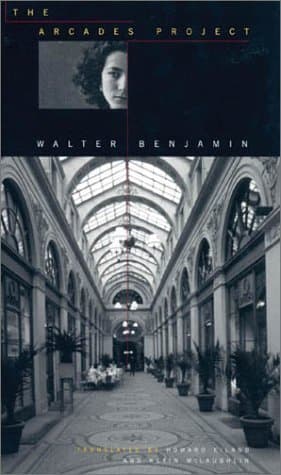
The Arcades Project cover
Archivist's Choice

The Arcades Project

Walter Benjamin (2004)

Genre

History / Creativity / Philosophy

Reading Time

Thousands of minutes (likely weeks or months)

Key Themes

See below

Track Your Reading

Sign in to track this book

Walter Benjamin's 'The Arcades Project' explores how 19th-century Parisian arcades reveal the commodification of objects and the hidden 'true history' beneath the surface of bourgeois progress.

Core Idea

Walter Benjamin's 'The Arcades Project' is a large, unfinished work that creates a materialist history of 19th-century Paris. It does this not through a regular story, but through a collection of quotes, observations, and fragments. Benjamin argues that old buildings, goods, and cultural elements from the Second Empire, especially the Parisian arcades, hold the dream-like images and unconscious desires of modern times. By looking at these old things, he aims to expose the false ideas of 'progress' and show the hidden, often violent, past of the 20th century. The project uses a unique way of philosophical study, based on gathering and arranging historical bits, to explain the deeper parts of capitalism, city life, and how the past and present connect.
Reading time
Thousands of minutes (likely weeks or months)
Difficulty
Hard
✓ Read this if...
You are a serious scholar of critical theory, urban studies, philosophy, or literary criticism and are prepared for a challenging, non-linear engagement with one of the 20th century's most influential thinkers. Essential for understanding Benjamin's unique methodology and his profound insights into modernity, capitalism, and history.
✗ Skip this if...
You are looking for a conventional, narrative-driven history book, an easy introduction to Benjamin's thought, or a quick read. This book is dense, fragmented, and demands significant intellectual effort and patience.

Core idea

The central argument and framework that powers the entire book.

Walter Benjamin's 'The Arcades Project' is a large, unfinished work that creates a materialist history of 19th-century Paris. It does this not through a regular story, but through a collection of quotes, observations, and fragments. Benjamin argues that old buildings, goods, and cultural elements from the Second Empire, especially the Parisian arcades, hold the dream-like images and unconscious desires of modern times. By looking at these old things, he aims to expose the false ideas of 'progress' and show the hidden, often violent, past of the 20th century. The project uses a unique way of philosophical study, based on gathering and arranging historical bits, to explain the deeper parts of capitalism, city life, and how the past and present connect.

At a glance

Reading time

Thousands of minutes (likely weeks or months)

Difficulty

Hard

Read this if...

You are a serious scholar of critical theory, urban studies, philosophy, or literary criticism and are prepared for a challenging, non-linear engagement with one of the 20th century's most influential thinkers. Essential for understanding Benjamin's unique methodology and his profound insights into modernity, capitalism, and history.

Skip this if...

You are looking for a conventional, narrative-driven history book, an easy introduction to Benjamin's thought, or a quick read. This book is dense, fragmented, and demands significant intellectual effort and patience.

Key Takeaways

1

The Ruin as Revelation

Unfinished fragments can reveal more profound truths than polished complete works.

Quote

To great writers, finished works weigh lighter than those fragments on which they labor their entire lives.

Benjamin's Arcades Project shows this idea. It is a massive, intentionally fragmented work, a 'monumental ruin' that uses incompleteness as its form. He believed that the smooth, linear stories of traditional history and philosophy often hide more than they show, giving a false sense of order. In contrast, the fragment, the montage, and the collection of different observations allow for a more honest look at the messy, conflicting reality of experience and history. The real insights often lie between the fragments, in the reader's a...

Supporting evidence

The entire structure of *The Arcades Project*, a collection of thousands of notes, quotations, and reflections categorized into thirty-six rubrics like 'Fashion,' 'Boredom,' and 'Dream City,' rather than a continuous narrative.

Apply this

Embrace the process of exploration and research as valuable in itself, even if it doesn't lead to a perfectly polished product. Allow for ambiguity and contradiction in your understanding of complex subjects, as these often hold deeper truths than simplistic narratives. Value the 'behind-the-scenes' work as much as the final output.
fragmentationanti-systemic-thoughtprocess-over-product
2

The Commodity as Historical Lens

Consumer goods and commercial spaces are crucial sites for understanding the commodification of modern life and history.

Quote

His central preoccupation is what he calls the commodification of things—a process in which he locates the decisive shift to the modern age.

Benjamin argues that turning things into commodities is not just an economic process but a deep cultural and historical one. The Parisian arcades, with their bright displays of goods, were not just stores but stages where the dreams, desires, and worries of 19th-century middle-class society played out. By carefully looking at how objects were made, shown, and bought, Benjamin reveals the hidden beliefs and power structures within everyday life. He sees the commodity as a 'petrified dream,' a frozen image of shared fantasy and historic...

Supporting evidence

Benjamin's extensive analysis of specific commodities within the arcades, from fashion items and advertisements to architectural elements, demonstrating how these 'things' reflect and shape the consciousness of an era.

Apply this

Pay critical attention to the objects you consume and the spaces you inhabit. Consider what stories they tell about your society, your values, and your historical moment. Practice 'reading' advertisements and product designs for their underlying cultural messages, not just their surface appeal.

commodified-culturematerial-culture-studiesconsumerism-critique
3

Unmasking 'Progress'

The dominant narrative of historical progress is an ideological construct that suppresses alternative histories.

Quote

The Arcades Project is Benjamin's effort to represent and to critique the bourgeois experience of nineteenth-century history, and, in so doing, to liberate the suppressed 'true history' that underlay the ideological mask.

Benjamin was very doubtful of the 19th-century middle-class idea of steady, unavoidable progress. He saw it as a dangerous belief that excused social inequalities and hid the repeating, cyclical, and often disastrous parts of history. For Benjamin, 'progress' was a capitalist myth meant to keep things as they were. His project aimed to 'blast open' this continuous view of history, revealing the 'true history' of the oppressed, the forgotten, and the marginalized that lies beneath the triumphant stories. He wanted to wake society from ...

Supporting evidence

Benjamin's 'Theory of Progress' rubric, where he dissects the philosophical underpinnings and societal implications of this concept, contrasting it with his own dialectical understanding of history.

Apply this

Question dominant narratives of history and societal advancement. Seek out marginalized voices and alternative perspectives to understand how history is constructed and what agendas it might serve. Recognize that 'progress' can often be a euphemism for capitalist expansion or technological advancement that doesn't necessarily benefit all.

critique-of-progresshistorical-materialismideology-critique
4

The Dream City

Modern cities, particularly their commercial spaces, function as collective dreamscapes, both alluring and deceptive.

Quote

In the bustling, cluttered arcades, street and interior merge and historical time is broken up into kaleidoscopic distractions and displays of ephemera.

For Benjamin, 19th-century Paris, especially its arcades, was a 'dream city' where the lines between reality and fantasy blurred. These places were designed to charm, to create desire, and to offer an escape from daily life. However, this dream state was also a kind of shared sleep, a distraction from the harsh realities of capitalist exploitation. The city, through its buildings, advertisements, and goods, shows a collective unconscious, a 'wish-image' of society's desires and its unresolved conflicts. Understanding the city as a dre...

Supporting evidence

The rubric 'Dream City' where Benjamin explores the psychological and sociological dimensions of urban architecture and commercial displays, seeing them as manifestations of collective unconscious desires and anxieties.

Apply this

Analyze urban environments as psychological landscapes. Consider how architecture, public spaces, and commercial districts influence your mood, desires, and sense of reality. Be aware of how cities are designed to create specific emotional responses and consumption patterns.

urban-studiescollective-unconsciouspsychogeography
5

The Flâneur's Gaze

The detached, observant stroller offers a unique perspective for critiquing modern urban life.

Quote

The street and the interior merge... Here, at a distance from what is normally meant by 'progress,' Benjamin finds the lost time(s) embedded in the spaces of things.

The flâneur, the relaxed, watchful wanderer of the Parisian streets and arcades, is a key figure in Benjamin's project. This person shows a particular way of seeing and understanding the modern city. Unlike the busy worker or the focused shopper, the flâneur moves with a casual detachment, allowing for chance encounters and a critical look at city life. This detached view lets the flâneur see the hidden connections, the layers of history, and the underlying social dynamics that are invisible to those caught in the fast pace of modern ...

Supporting evidence

Benjamin's extensive reflections on the figure of the flâneur, particularly in relation to Baudelaire's poetry and the anonymity and spectacle of the modern city.

Apply this

Practice mindful walking and observation in your own city. Take time to simply wander without a specific destination, paying attention to details, people, and the interplay of public and private spaces. Cultivate a 'flâneur's eye' to notice the overlooked and the revealing aspects of your environment.

flânerieurban-observationcritical-seeing
6

The Authority of Montage

Juxtaposition and fragmentation can create new meanings and disrupt conventional understanding.

Quote

Benjamin presents a montage of quotations from, and reflections on, hundreds of published sources, arranging them in thirty-six categories...

Benjamin's method in The Arcades Project is mainly montage. He connects different fragments—quotes, observations, historical facts, philosophical thoughts—without clear transitions or an overall story. This technique is not random; it is a deliberate plan to resist linear thinking and to force unexpected connections. By putting seemingly unrelated items side-by-side, Benjamin aims to create 'dialectical images'—sudden flashes of understanding that show the conflicting nature of historical events. The meaning comes from the tension a...

Supporting evidence

The very form of *The Arcades Project*, a colossal collection of categorized but often non-sequential notes and quotations, functioning as a literary collage.

Apply this

Experiment with juxtaposing different ideas, images, or texts to generate new insights. Don't be afraid to break down complex subjects into their constituent parts and then reassemble them in novel ways. Recognize that meaning can arise from the gaps and tensions between elements, not just their smooth integration.

montage-techniquedialectical-imagenon-linear-thinking
7

Photography as Historical Witness

Photography captures the ephemeral and reveals the forgotten aspects of history.

Quote

His central preoccupation is what he calls the commodification of things—a process in which he locates the decisive shift to the modern age.

Benjamin saw photography as a groundbreaking medium, not just for its ability to copy reality, but for its power to show the 'optical unconscious'—details and parts of the world that the naked eye misses. In the context of the arcades, photographs captured the changing fashions, the forgotten faces, and the evolving city, preserving moments that would otherwise disappear. He believed that photographs, especially early ones, had an 'aura' that linked them to their historical moment, offering a unique way to access the past. While also ...

Supporting evidence

The rubric 'Photography' where Benjamin delves into the history and theory of photography, discussing its impact on perception, art, and historical memory, often referencing early photographic processes and portraits.

Apply this

Approach photographs, especially historical ones, not just as simple records but as complex historical artifacts. Look beyond the obvious subject to the background details, the expressions, and the overall composition for clues about the time and culture they represent. Consider how photography shapes our memory and understanding of events.

photography-theoryaura-of-arthistorical-memory
8

Boredom's Revelation

Boredom, often dismissed, can be a fertile ground for critical insight and historical awareness.

Quote

The Arcades Project (in German, Das Passagen-Werk) is a monumental ruin, meticulously constructed over the course of thirteen years—'the theater,' as Benjamin called it, 'of all my struggles and all my ideas.'

Benjamin gives a significant section to 'Boredom,' raising it from just a negative state to a potentially important one. In a society increasingly driven by distractions and buying, boredom can be a rare chance for self-reflection and a resistance to the constant demands of capitalist display. For Benjamin, true boredom is not just doing nothing but a state of heightened awareness, a slow, deep breath that lets one see the true nature of time and the subtle details of existence. In this state, the 'aura' of things might show itself, a...

Supporting evidence

The detailed 'Boredom' rubric, where Benjamin explores the psychological and social dimensions of boredom in 19th-century urban life, linking it to the experience of time and the perception of the new.

Apply this

Allow for moments of genuine boredom in your daily life, resisting the urge to constantly fill every moment with stimulation. Use these periods for reflection, observation, or simply allowing your mind to wander. Recognize that profound insights can emerge from these quiet, unstimulated states, offering a counterpoint to the always-on culture.

philosophy-of-boredommindful-livinganti-distraction
9

The Ephemeral and the Eternal

Understanding history requires recognizing the interplay between fleeting trends and enduring structures.

Quote

In the bustling, cluttered arcades, street and interior merge and historical time is broken up into kaleidoscopic distractions and displays of ephemera. Here, at a distance from what is normally meant by 'progress,' Benjamin finds the lost time(s) embedded in the spaces of things.

The arcades were places of the temporary—fashion, advertisements, passing trends. Yet, for Benjamin, these short-lived events were not merely superficial. They were precisely where deeper, more lasting historical forces and structures revealed themselves. He looked for 'the lost time(s) embedded in the spaces of things,' suggesting that the seemingly unimportant objects and experiences of the present contain echoes of the past and hints of the future. By carefully analyzing the temporary, Benjamin aims to uncover the 'ur-phenomena' of...

Supporting evidence

Benjamin's detailed examination of specific fashion trends, advertising campaigns, and architectural details within the arcades, showing how these transient elements reveal deeper societal shifts and psychological states.

Apply this

Don't dismiss contemporary trends or popular culture as merely superficial. Analyze them for what they reveal about current societal values, anxieties, and aspirations. Look for recurring patterns and underlying structures that connect present-day ephemera to historical precedents and future possibilities.

ephemeralityhistorical-continuitycultural-analysis

Critical analysis

Notable Quotes

The collector is the true inhabitant of the arcades.

Describing the figure of the collector and his relationship to the material culture of the 19th century.

To discover the new in the old, that is the essence of my endeavor.

Reflecting on his methodological approach to historical analysis and the reinterpretation of past phenomena.

Fashion is the eternal recurrence of the new.

Examining the cyclical nature of fashion and its role in reflecting and shaping societal changes.

The street is the dwelling place of the collective.

Highlighting the street as a crucial public space where collective life and experiences unfold.

History is in every respect a construction.

Emphasizing the constructed nature of historical narratives, rather than a mere recounting of facts.

Not to find one's way in a city is nothing to be ashamed of. Not to find one's way in a city, however, takes some training.

Discussing the flâneur's deliberate disorientation and engagement with the urban environment.

The dream of the nineteenth century was to be rid of the past.

Analyzing the forward-looking, yet often repressed, desires of the 19th century in relation to its own history.

Architecture, fashion, and advertising are the three forms in which the phantasmagoria of the new urban landscape manifests itself.

Identifying key cultural forms that embody the illusory and captivating aspects of modern city life.

The true picture of the past flits by. The past can be seized only as an image which flashes up at the instant when it can be recognized and is never seen again.

Explaining the concept of the 'dialectical image' and the fleeting nature of historical truth.

The commodity is a fetish, the commodity is a dream object.

Exploring the enchanting and mystifying qualities of commodities in capitalist society.

To write history means to cite history.

Suggesting that historical writing involves not just recounting, but actively bringing forth and recontextualizing historical elements.

The new is a quality of fashion, and fashion is a quality of the commodity.

Connecting the concept of 'the new' to the mechanisms of fashion and commodity culture.

The arcades are a world in miniature.

Describing the arcades as microcosms of 19th-century Parisian life and culture.

The work has to construct itself from the most minute elements.

Outlining his meticulous, fragmentary approach to scholarship, building insight from small details.

The phantasmagoria of capitalist culture is nowhere more at home than in the department store.

Pinpointing the department store as a quintessential site for the dazzling and deceptive allure of consumerism.

Quiz

Test Your Knowledge

Ready to see how well you understood this book? Take our interactive quiz with 10 questions.

10
Questions
~5
Minutes
?
Best Score

Key Questions (FAQ)

The Arcades Project is Walter Benjamin's unfinished magnum opus, a vast collection of reflections and quotations exploring 19th-century Parisian life, culture, and consumerism, particularly through its glass-roofed shopping arcades. It delves into themes like the commodification of things, the nature of modernity, and the hidden histories embedded within urban spaces.

About the author