BookBrief
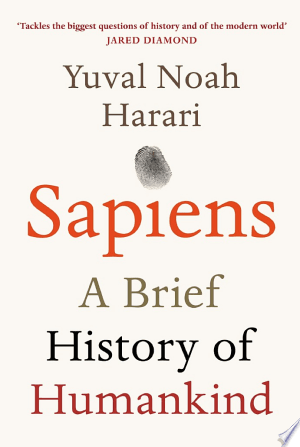
Sapiens cover
Archivist's Choice

Sapiens

Yuval Noah Harari (2014)

Genre

History / Science / Philosophy

Reading Time

10-15 hours (approx. 450 pages at average reading speed)

Key Themes

See below

Track Your Reading

Sign in to track this book

Sapiens traces Homo sapiens' journey from an ordinary ape to Earth's dominant species, examining the shared fictions and myths that built our civilizations and now shape our future.

Core Idea

Sapiens states that Homo sapiens' unique ability to create and believe in shared fictions (imagined orders) is the main reason for our species' success and the course of human history. From the cognitive revolution, which brought complex language and myth-making, through the agricultural revolution, which led to a cycle of labor, to the scientific revolution and the rise of capitalism, these collective fictions have allowed us to cooperate in large groups. This has shaped our societies, economies, and even our idea of happiness. The book suggests that while these imagined realities have built civilizations, they have also caused much suffering and raise questions about our future as a species able to redesign life itself. The book challenges common ideas by suggesting that progress is not always good and that many key human moments, like the agricultural revolution, harmed individual well-being. It looks at how biology, culture, and technology interact, questioning the meaning of happiness and the ethical issues of our increasing power in the 21st century.
Reading time
10-15 hours (approx. 450 pages at average reading speed)
Difficulty
Medium
✓ Read this if...
You are interested in a sweeping, multidisciplinary overview of human history, from pre-history to the present, with a focus on big ideas and philosophical questions rather than specific dates or events. You enjoy challenging established notions about progress, religion, capitalism, and human nature.
✗ Skip this if...
You are looking for a detailed, chronological history book with deep dives into specific historical periods or figures. You prefer a less speculative approach to history or find broad generalizations about human experience unconvincing.

Core idea

The central argument and framework that powers the entire book.

Sapiens states that Homo sapiens' unique ability to create and believe in shared fictions (imagined orders) is the main reason for our species' success and the course of human history. From the cognitive revolution, which brought complex language and myth-making, through the agricultural revolution, which led to a cycle of labor, to the scientific revolution and the rise of capitalism, these collective fictions have allowed us to cooperate in large groups. This has shaped our societies, economies, and even our idea of happiness. The book suggests that while these imagined realities have built civilizations, they have also caused much suffering and raise questions about our future as a species able to redesign life itself.

The book challenges common ideas by suggesting that progress is not always good and that many key human moments, like the agricultural revolution, harmed individual well-being. It looks at how biology, culture, and technology interact, questioning the meaning of happiness and the ethical issues of our increasing power in the 21st century.

At a glance

Reading time

10-15 hours (approx. 450 pages at average reading speed)

Difficulty

Medium

Read this if...

You are interested in a sweeping, multidisciplinary overview of human history, from pre-history to the present, with a focus on big ideas and philosophical questions rather than specific dates or events. You enjoy challenging established notions about progress, religion, capitalism, and human nature.

Skip this if...

You are looking for a detailed, chronological history book with deep dives into specific historical periods or figures. You prefer a less speculative approach to history or find broad generalizations about human experience unconvincing.

Key Takeaways

1

The Cognitive Revolution: Our Secret Weapon

The ability to create and believe in fictions propelled Sapiens to global dominance.

Quote

Any large-scale human cooperation – whether a modern state, a medieval church, an ancient city or an archaic tribe – is rooted in common myths that exist only in people’s collective imagination.

Harari says the Cognitive Revolution, about 70,000 to 30,000 years ago, was not just about language. It was about sharing information about things that do not exist, 'fictions.' This ability allowed Sapiens to work together in large groups, something other species could not do because they were limited to communicating about real things or strict social structures. These shared myths, such as gods, nations, money, and human rights, allowed for complex societies beyond the 'Dunbar's Number' limit of about 150 individuals. This shared b...

Supporting evidence

Harari contrasts Sapiens with Neanderthals, who possessed impressive cognitive abilities but lacked the capacity for large-scale, flexible cooperation based on shared myths. He cites the rapid spread of Sapiens across continents and the extinction of other hominid species as evidence of this revolutionary advantage.

Apply this

When trying to understand or influence large groups, recognize the underlying 'fictions' that bind them. To foster cooperation, identify or create compelling shared narratives and symbols that resonate with collective imagination, rather than relying solely on logical arguments or individual self-interest.


cognitive-revolutionshared-mythscollective-imaginationflexible-cooperation
2

The Agricultural Revolution: A Historic Deception

What seemed like progress was, for many, a step backward in quality of life.

Quote

The Agricultural Revolution was history’s biggest fraud.

Harari suggests the Agricultural Revolution, while greatly increasing population, was a bad deal for the average person. Hunter-gatherers had more varied diets, better nutrition, less work, and fewer diseases. Farming meant hard, repetitive work, relying on a few crops (making people vulnerable to famine), and more diseases due to crowded living and close contact with farm animals. The 'progress' was mostly in the number of humans, not their quality of life. Humans became tied to the land and their crops, trading freedom and diverse f...

Supporting evidence

He cites archaeological evidence suggesting that early farmers were often shorter, had worse teeth, and suffered from more skeletal deformities and infectious diseases than their hunter-gatherer ancestors. The example of wheat 'domesticating' humans rather than the other way around is a key illustration.

Apply this

Challenge narratives of 'progress' and 'innovation.' Evaluate the true costs and benefits, especially for the individual, when considering new technologies or societal shifts. Does it genuinely improve well-being, or merely enable growth at the expense of quality of life? Look beyond immediate perceived benefits to long-term consequences.

agricultural-revolutionhistorical-fraudhunter-gatherer-lifestylequality-of-life
3

The Power of Imagined Orders

Societies are built on shared beliefs in things that don't physically exist.

Quote

There are no gods, no nations, no money, no human rights, no laws, and no justice outside the common imagination of human beings.

Harari points out that most human social structures, from legal systems and governments to markets and religious rules, are 'imagined orders.' These are not natural or objective but shared ideas that exist because we all believe in them. This collective belief allows millions of strangers to work together within a shared framework. When these imagined orders fail, society does too. Understanding their created nature helps us see their power and potential for change, as well as their weakness.

Supporting evidence

He uses examples like money (a universal belief in its value), nations (shared stories and symbols defining a group), and human rights (a moral consensus, not a biological reality) to illustrate how these fictions enable cooperation and order on a massive scale.

Apply this

To understand social dynamics, identify the underlying imagined orders at play. To advocate for change, understand that these orders are mutable; they can be challenged and rewritten if enough people collectively shift their beliefs. Don't mistake a widely accepted convention for an immutable natural law.

imagined-ordersintersubjectivitysocial-constructscollective-belief
4

The Unification of Humankind

Empires, money, and religions have progressively brought disparate groups together.

Quote

The past 10,000 years have seen the gradual unification of humankind into a single global empire.

Despite constant conflicts, Harari states that history shows humanity moving toward unity. Money, empires, and universal religions have driven this process. Money created a common way to exchange goods, allowing different cultures to trade and trust each other. Empires brought diverse populations under single political and cultural rule. Universal religions (like Christianity or Islam) went beyond tribal limits, offering shared values and identities to many people. Each of these 'unifiers' reduced local differences and encouraged a se...

Supporting evidence

He traces the evolution of money from bartering to coinage to modern finance, showing its increasing power to connect distant economies. He details how empires, despite their brutality, spread common laws, languages, and technologies. He explains how universal religions offered a common spiritual framework across vast geographical areas.

Apply this

When analyzing global trends, look for patterns of integration and standardization. Recognize that seemingly independent systems (economic, political, cultural) often contribute to a larger narrative of global interconnectedness. Consider the ethical implications of unification processes, which often involve the suppression of local diversity.

unification-of-humankindempiresmoneyuniversal-religionsglobalization
5

The Scientific Revolution: Ignorance as Power

Acknowledging ignorance was the key to unprecedented knowledge and technological growth.

Quote

The Scientific Revolution was not a revolution of knowledge but, more importantly, a revolution of ignorance.

Before the Scientific Revolution (starting about 500 years ago), people thought all important knowledge was already known or in old texts. Harari argues that the real breakthrough of the Scientific Revolution was admitting ignorance, the belief that there are important things we do not know and that we can gain new knowledge through careful observation and experiments. This willingness to say 'I don't know' and to actively seek new information, combined with a belief in progress, led to a surge in scientific study, new technology, and...

Supporting evidence

He contrasts pre-modern knowledge systems, which sought to interpret existing texts, with the scientific method's emphasis on empirical observation and mathematical models. The invention of the telescope and microscope, revealing previously unseen worlds, perfectly exemplifies this shift in mindset.

Apply this

Cultivate intellectual humility and embrace the unknown. Recognize that true progress often begins with acknowledging what you *don't* know. Foster environments that encourage questioning, experimentation, and continuous learning rather than resting on perceived expertise or established dogma.

scientific-revolutionignorance-as-powerscientific-methodempirical-observationprogress
6

Capitalism: The Engine of Growth and Its Dark Side

The belief in future prosperity fueled economic and scientific expansion, often at a steep cost.

Quote

Credit is the economic engine of the world. Without it, there could be no growth, no progress, no innovation.

Harari describes capitalism as a system based on future trust, believing that tomorrow will be better than today. This makes it logical to invest resources now for greater returns later. This faith in future growth allowed for credit, which funded scientific research, technology, and colonial ventures. However, this growth engine has a dark side: it often puts profit and expansion before ethics, leading to exploitation (like slavery in colonies) and environmental damage. The constant drive for growth is an imagined order that powers m...

Supporting evidence

He details how European empires were financed by capitalist ventures and how the slave trade was an integral, albeit horrific, part of this economic expansion. The Dutch East India Company serves as a prime example of a capitalist entity wielding immense political and military power.

Apply this

Critically analyze economic systems and their underlying assumptions about growth and value. Understand that 'progress' often comes with hidden costs, and that economic decisions are rarely purely rational, but often driven by shared beliefs about the future. Seek sustainable and ethically sound alternatives to unchecked growth.

capitalismcrediteconomic-growthexploitationsustainability
7

The Hedonic Treadmill: Happiness is Elusive

Material progress doesn't guarantee increased happiness, due to our adaptive nature.

Quote

Perhaps happiness is not about getting what you want, but rather about wanting what you get.

Despite having more material wealth, longer lives, and less violence, Harari asks if modern Sapiens are actually happier than their ancestors. He talks about the 'hedonic treadmill,' where humans quickly adjust to new situations, good or bad. A new car, a promotion, or a cure for a disease gives a temporary happiness boost, but our usual emotional state soon returns. This suggests that objective conditions play a smaller role in long-term happiness than subjective expectations and internal feelings. Our biology sets a 'happiness range...

Supporting evidence

He cites studies on lottery winners and accident victims, showing that while initial reactions are extreme, both groups tend to return to their pre-event happiness levels after a period. He also discusses how our expectations constantly rise with improvements, negating much of the potential for increased contentment.

Apply this

Shift focus from external achievements and material acquisition to internal states and relationships. Practice gratitude and mindfulness to appreciate what you have rather than constantly striving for more. Understand that sustained happiness is less about changing your circumstances and more about changing your perspective and expectations.

hedonic-treadmillhappinesssubjective-wellbeingadaptationexpectations
8

The End of Homo Sapiens?

Biotechnology and AI could fundamentally alter human nature, leading to new forms of existence.

Quote

We are acquiring the ability to design not only the world around us, but also the world within us.

Harari ends by considering the future, saying that Sapiens are close to going beyond their biological limits through biotechnology, artificial intelligence, and genetic engineering. We might soon be able to redesign ourselves, creating 'superhumans' or new forms of consciousness that are no longer strictly 'Sapiens.' This raises ethical questions about inequality, what it means to be human, and the possibility of unintended results. The species that conquered the world by creating fictions may now use science to rewrite its own biolog...

Supporting evidence

He points to advancements in genetic engineering (e.g., CRISPR), brain-computer interfaces, and AI development as harbingers of this transformative era. He discusses the potential for 'designer babies' and the creation of non-organic intelligence.

Apply this

Engage in critical discussions about emerging technologies and their ethical implications. Advocate for responsible innovation and consider the long-term societal and existential consequences of altering human nature. Reflect on what it means to be human and what values we wish to preserve or cultivate in a post-Sapiens future.

biotechnologyartificial-intelligencegenetic-engineeringpost-humanismtranshumanism
9

The God-like Sapiens

From insignificant apes to masters of the planet, now on the cusp of self-creation.

Quote

We are more powerful than ever before, but have little idea what to do with all that power.

Harari highlights the remarkable path of Homo Sapiens: from an unknown African ape to the dominant species on Earth, able to change the planet's climate and ecosystems. Our collective power, driven by the ability to create and believe in fictions, has made us 'god-like' in our capacity to create and destroy. However, this power comes with a lack of understanding about our ultimate goals or what truly makes for well-being. We have mastered 'how' but largely lack understanding of 'why,' creating a dangerous imbalance where our technolog...

Supporting evidence

He highlights our impact on global climate change, mass extinctions, and the potential to engineer life itself as evidence of our god-like capabilities, contrasting it with our continued struggles with war, inequality, and subjective unhappiness.

Apply this

Cultivate a deeper sense of responsibility commensurate with our collective power. Prioritize ethical considerations and long-term consequences over short-term gains. Encourage philosophical inquiry and collective deliberation on humanity's purpose and values as we gain increasing control over our own evolution and the planet's destiny.

god-like-powerhuman-impacttechnological-prowesswisdomexistential-questions

Critical analysis

Notable Quotes

The Agricultural Revolution was history's biggest fraud.

Harari argues that while seemingly beneficial, agriculture led to a worse quality of life for the average human.

We did not domesticate wheat. It domesticated us.

Explaining the impact of agriculture, Harari suggests that humans became slaves to the crops they cultivated.

Sapiens rule the world because we are the only animal that can cooperate flexibly in large numbers.

Harari identifies the unique human ability for large-scale, flexible cooperation as key to our dominance.

Any large-scale human cooperation—whether a modern state, a medieval church, an ancient city or an archaic tribe—is rooted in common myths that exist only in people’s collective imagination.

Harari emphasizes the role of shared fictions and myths in enabling human cooperation and complex societies.

Culture tends to argue that it forbids only that which is unnatural. But from a biological perspective, nothing is unnatural. Whatever is possible is by definition natural.

Challenging the concept of 'unnatural' in cultural norms, Harari highlights the biological perspective.

Money is the most universal and most efficient system of mutual trust ever devised.

Harari discusses money as a powerful tool for building trust and enabling trade across diverse groups.

The real difference between us and chimpanzees is the mysterious glue that enables millions of humans to cooperate effectively.

Reiterating the theme of cooperation, Harari points to it as the crucial differentiator for human success.

Even today, despite two centuries of astounding technological achievements, we are still not sure of our goals.

Harari questions the ultimate purpose of human progress, suggesting a lack of clear direction despite advancements.

History is something that has been constructed by humans for humans.

Harari emphasizes the subjective and human-centric nature of historical narratives.

The imagined order is not an evil conspiracy or a worthless delusion. Rather, it is the only way large numbers of humans can cooperate effectively.

Clarifying that 'imagined orders' (like nations or religions) are functional and necessary for society.

We are consequently much more powerful than any other creature, but we don’t really know what to do with all that power.

Harari reflects on humanity's immense power and the ethical dilemma of its direction and use.

The truly unique trait of Sapiens is our capacity for creating and believing fictions.

Highlighting the core argument about shared myths and stories as fundamental to human society.

One of the few iron laws of history is that luxuries tend to become necessities and to spawn new obligations.

Harari observes how perceived luxuries quickly become essential, leading to increased demands and work.

Happiness does not depend on objective conditions of either wealth, health or even community. Rather, it depends on the correlation between objective conditions and subjective expectations.

Discussing the nature of happiness, Harari argues it's less about external factors and more about internal perceptions.

Quiz

Test Your Knowledge

Ready to see how well you understood this book? Take our interactive quiz with 10 questions.

10
Questions
~5
Minutes
?
Best Score

Key Questions (FAQ)

Sapiens argues that the ability of Homo sapiens to create and believe in shared fictions, such as gods, nations, and money, allowed us to cooperate flexibly in large numbers and dominate other species, shaping the course of history.

About the author