BookBrief
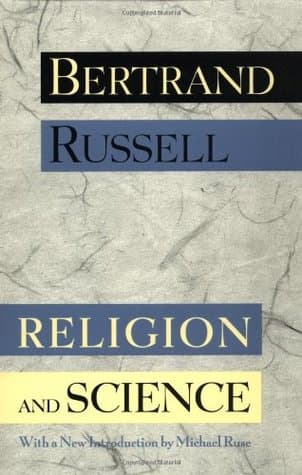
Religion and Science cover
Archivist's Choice

Religion and Science

Bertrand Russell (1935)

Genre

History / Spirituality / Science / Philosophy

Reading Time

12 Minutes

Key Themes

See below

Track Your Reading

Sign in to track this book

Bertrand Russell traces the historical conflict between scientific discovery and religious dogma, showing how rigid faith often gave way to reason's pursuit of truth.

Core Idea

Bertrand Russell's "Religion and Science" explores the historical and philosophical conflicts and points of contact between religious belief and scientific inquiry. Russell argues that while science aims for objective truth through empirical evidence and logical reasoning, religion often relies on dogma, tradition, and subjective experience. He meticulously examines how scientific advancements have consistently challenged traditional religious cosmologies and ethical frameworks, advocating for a worldview grounded in reason and humanistic ethics rather than supernatural revelation. Russell does not dismiss the human need for meaning but suggests that science offers a more reliable path to understanding the universe and our place within it, ultimately arguing for a separation where science addresses factual claims and religion, if it persists, addresses subjective moral or spiritual comfort without making claims about the objective world.
Difficulty
Medium

Core idea

The central argument and framework that powers the entire book.

Bertrand Russell's "Religion and Science" explores the historical and philosophical conflicts and points of contact between religious belief and scientific inquiry. Russell argues that while science aims for objective truth through empirical evidence and logical reasoning, religion often relies on dogma, tradition, and subjective experience. He meticulously examines how scientific advancements have consistently challenged traditional religious cosmologies and ethical frameworks, advocating for a worldview grounded in reason and humanistic ethics rather than supernatural revelation. Russell does not dismiss the human need for meaning but suggests that science offers a more reliable path to understanding the universe and our place within it, ultimately arguing for a separation where science addresses factual claims and religion, if it persists, addresses subjective moral or spiritual comfort without making claims about the objective world.

At a glance

Difficulty

Medium

Key Takeaways

1

The Shifting Sands of Authority

Science consistently erodes religious dogma by offering empirically verifiable explanations for phenomena previously attributed to divine intervention.

Quote

The conflict between religion and science is a conflict between tradition and observation, between dogma and free inquiry, between revelation and reason.

Russell argues that the historical tension between religion and science is a battle over who gets to say what is true. Early religious doctrines, especially Christian ones, often explained the natural world, from creation to cosmology. As scientific methods improved, particularly after the Copernican revolution, observable facts and testable ideas increasingly challenged these explanations. The Church’s early resistance to heliocentrism, like Galileo's condemnation, was not just about a planet's orbit. It was about keeping its sole po...

Supporting evidence

The Galileo affair, where the Church condemned Galileo for advocating Copernican heliocentrism, directly contradicting biblical interpretations of an Earth-centered universe.

Apply this

When encountering contemporary debates where religious and scientific claims clash, identify the underlying conflict over which framework holds greater explanatory power for the specific phenomenon in question. Prioritize evidence-based reasoning.

2

The Retreat of God into the Gaps

As science explains more of the natural world, the domain attributed to divine action shrinks, leading to a 'God of the gaps' phenomenon.

Quote

Whenever a scientific explanation has been found for some phenomenon which was previously attributed to God, the religious opponents of science have first resisted, and then, when resistance became hopeless, have declared that the new explanation was not inconsistent with religion.

Russell notes a common pattern: religious explanations often fill the gaps in scientific understanding. Before germ theory, epidemics were divine punishments; before evolutionary biology, species were special creations. Once science provides a testable, mechanical explanation, the divine reason often retreats. Theologians then reinterpret scripture or adopt a more metaphorical view. This is not necessarily a criticism of religion itself, but an observation of how it adapts to scientific progress. The argument's limit is that it does n...

Supporting evidence

The shift in Christian thought regarding creationism as evolutionary theory gained dominance, moving from literal six-day creation to various forms of theistic evolution or intelligent design that accommodate scientific findings.

Apply this

Be wary of arguments that invoke divine intervention solely to explain phenomena currently beyond scientific understanding. Recognize that such gaps are often temporary and may eventually yield to scientific explanation.

3

Moral Authority and Scientific Neutrality

While religion traditionally claimed moral authority, science, by its nature, is descriptive rather than prescriptive, creating a vacuum that neither fully fills.

Quote

Science, as such, has nothing to say about values. It can tell us how to achieve a given end, but it cannot tell us what ends to pursue.

Russell points out a key difference: religion often offers a framework for ethics and morality, telling us what we 'should' do. Science primarily describes what 'is.' Science can explain the biological basis of empathy or the results of actions, but it cannot say if an action is 'good' or 'evil.' This creates a complex problem in a world becoming less religious. Religious moral codes face questions about their origins and sometimes their strictness, but science offers no clear replacement for guiding human values. This argument has li...

Supporting evidence

The development of atomic weapons, a product of scientific advancement, clearly demonstrates science's capacity to provide means without dictating the moral ends to which those means should be applied.

Apply this

Recognize that scientific progress, while powerful, does not automatically resolve ethical dilemmas. Engage in critical moral reasoning, drawing from various philosophical traditions, to establish personal and societal values beyond purely scientific facts.

4

The Evolution of Religious Belief

Religion itself adapts and reinterprets its doctrines to accommodate scientific findings, often shifting from literal to metaphorical interpretations.

Quote

The triumph of science is not complete, but it is continuous. As each new scientific discovery is made, religion retreats, and often reinterprets its ancient texts to show that they always meant what science has now discovered.

Russell explains how religious institutions, when faced with clear scientific evidence, have historically softened their positions or reinterpreted scripture. The literal six-day creation story, for example, has largely given way to metaphorical interpretations or ideas like theistic evolution in many Christian groups. This is not just giving up but an evolution for religion, allowing it to stay relevant and appealing. Russell notes that this flexibility, while helping religion survive, also shows how religious beliefs can change when...

Supporting evidence

The gradual acceptance of evolutionary theory by many mainstream Christian denominations, moving away from strict young-earth creationism towards various forms of 'theistic evolution' where God guides the evolutionary process.

Apply this

Observe how religious narratives and interpretations evolve over time, particularly in response to scientific advancements. Understand that this adaptation is a natural consequence of the ongoing dialogue between faith and reason.

5

Beyond the Conflict: Areas of Coexistence

While direct conflicts are prominent, Russell acknowledges domains where science and religion do not inherently clash, such as personal faith or aesthetic experience.

Quote

The sphere of religion is primarily concerned with human values and aspirations, while that of science is concerned with the factual structure of the world.

Even with his focus on conflict, Russell acknowledges that not all parts of religion oppose science. Personal spiritual experience, the search for meaning, or enjoying the universe's beauty are areas where science offers no direct contradiction or confirmation. Science describes 'how' things work but does not necessarily address 'why' in a purpose-driven way. This leaves room for religious or philosophical frameworks to provide purpose. This idea, though not explicitly developed as a 'solution' by Russell, shows the limits of scientif...

Supporting evidence

Russell doesn't deny the subjective experience of faith or the comfort religion provides, even if he questions its objective claims about reality. He focuses on areas where claims are made about the natural world.

Apply this

Distinguish between scientific claims about the observable universe and personal, subjective, or metaphysical claims that fall outside the domain of scientific verification. Recognize that these different categories of claims may coexist without inherent conflict.

6

The Practical Impact of Science on Human Welfare

Scientific advancements, often opposed by religious dogma, have consistently led to tangible improvements in human health and well-being.

Quote

The triumphs of science have been triumphs of reason over prejudice, of observation over tradition, and of humanity over suffering.

Russell describes cases where scientific progress, first met with religious disapproval, greatly improved human life. Anesthesia for childbirth, vaccinations against diseases like smallpox, and better sanitation were all viewed with suspicion or outright condemnation by some religious authorities. These authorities saw them as interfering with divine will or natural order. Yet, these innovations clearly reduced suffering and extended lives. This highlights a practical argument for scientific inquiry: its practical uses clearly benefit...

Supporting evidence

The historical opposition to inoculation (e.g., smallpox vaccines) and anesthesia by some religious groups, who viewed them as unnatural or interfering with God's will, despite their clear benefits to public health.

Apply this

When evaluating new scientific or medical advancements, prioritize their potential for human welfare, understanding that initial cultural or religious resistance may not reflect their ultimate benefit.

7

The Role of Fear and Superstition

Religious adherence has historically been bolstered by fear of the unknown and superstitious beliefs that science gradually dispels.

Quote

Fear is the main source of superstition, and one of the main sources of cruelty. To conquer fear is the beginning of wisdom.

Russell suggests that a large part of historical religious power came from its ability to explain frightening natural events (lightning, disease, death) and offer comfort or control through ritual. As science explains the natural workings behind these events, the fear-driven basis for certain religious beliefs decreases. Understanding weather patterns replaces fear of divine anger; germ theory replaces belief in curses. This is a strong point, showing how scientific knowledge can lead to a more rational and less fearful worldview, thu...

Supporting evidence

The historical reliance on prayer and religious rituals to ward off plagues and natural disasters, which gradually gave way to scientific understanding and preventative measures like sanitation and medicine.

Apply this

Cultivate scientific literacy to understand natural phenomena, reducing reliance on superstitious explanations. Promote critical thinking to differentiate between natural causes and supernatural attributions.

8

Science's Self-Correcting Nature vs. Dogmatic Rigidity

Science thrives on revision and falsification, a stark contrast to the often unyielding and tradition-bound nature of religious dogma.

Quote

The scientific spirit is one of perpetual inquiry, of constant revision, of readiness to abandon old beliefs in the face of new evidence.

A main strength of science, as Russell suggests, is its built-in way to correct itself. Ideas are tested, theories are refined, and even established models can be changed by new evidence (e.g., Newtonian physics giving way to relativity). This ongoing process, driven by skepticism and factual checking, contrasts sharply with religious dogma. Dogma often emphasizes eternal truths and resists fundamental change. While religious doctrines can be reinterpreted, their core beliefs are usually considered unchangeable. This difference in met...

Supporting evidence

The falsification of Ptolemaic geocentric cosmology by Copernican heliocentrism, and later the refinement of Newtonian physics by Einstein's theories of relativity, demonstrating science's capacity for paradigm shifts.

Apply this

Embrace a mindset of critical inquiry and openness to revising beliefs in light of new evidence, applying this not only to scientific matters but also to personal and societal convictions.

9

The Retreat of Ecclesiastical Power

The historical conflict between science and religion has been, in part, a struggle for societal power, with science gradually diminishing the Church's temporal authority.

Quote

The power of the Church has diminished as men have come to rely more on their own reason and less on priestly authority.

Russell's historical review is not just about abstract ideas; it is about power dynamics. The Church, especially in pre-modern Europe, held great political, social, and intellectual power. Scientific discoveries that challenged established doctrines were not just theological disputes but threats to this deep-rooted power structure. The persecution of figures like Galileo was not only about cosmology but about the Church's determination to control knowledge and interpretation. As scientific understanding grew and became more accessible...

Supporting evidence

The historical role of the Inquisition in suppressing scientific ideas that challenged Church doctrine, illustrating the Church's use of its temporal power to maintain intellectual control.

Apply this

Analyze contemporary debates involving science and other institutions (political, economic, religious) through the lens of power dynamics, recognizing that challenges to established knowledge often involve challenges to existing authority structures.

Critical analysis

Notable Quotes

Quiz

Test Your Knowledge

Ready to see how well you understood this book? Take our interactive quiz with 10 questions.

10
Questions
~5
Minutes
?
Best Score

Key Questions (FAQ)

The book examines the historical conflicts between scientific advances and traditional religious doctrines, particularly Christian interpretations, over the past four centuries. Russell explores how scientific discoveries have challenged and reshaped our systems of belief.

About the author

Bertrand Russell

Bertrand Russell was a Nobel Prize-winning philosopher, logician, and social critic. A prolific writer, his works spanned logic, epistemology, metaphysics, ethics, and political philosophy. Notable books include 'The Problems of Philosophy,' 'A History of Western Philosophy,' and 'The Conquest of Happiness.' His contributions significantly influenced analytic philosophy and mathematics.