BookBrief
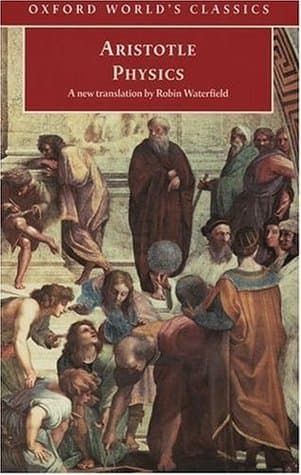
Physics cover
Archivist's Choice

Physics

Aristotle (1472)

Genre

History / Science / Philosophy

Reading Time

1200 min

Key Themes

See below

Track Your Reading

Sign in to track this book

Aristotle's basic exploration of nature, motion, and cause, a work that shaped scientific thinking for millennia and still clarifies the origins of Western thought.

Core Idea

Aristotle's "Physics" examines the principles that guide natural change and motion. It proposes that all natural bodies have an internal source of motion and rest, which sets them apart from human-made objects. The book introduces the Four Causes (material, formal, efficient, and final) as a way to understand natural events, arguing that nature itself is a cause and has a purpose. Motion is defined as the realization of potential, not just a change of location. This leads to the idea of an Unmoved Mover as the first cause of all motion in the universe. Through this analysis, Aristotle explains the structure and dynamics of the physical world, blending observation with philosophy.
Reading time
1200 min
Difficulty
Hard
✓ Read this if...
You are a student of ancient philosophy, classical science, or the history of ideas, seeking to understand the foundational concepts of Western thought regarding nature, change, and causality directly from one of its primary sources.
✗ Skip this if...
You are looking for a modern scientific textbook on physics or a light, accessible introduction to philosophical concepts, as this text requires careful, deliberate reading and a tolerance for ancient Greek philosophical argumentation.

Core idea

The central argument and framework that powers the entire book.

Aristotle's "Physics" examines the principles that guide natural change and motion. It proposes that all natural bodies have an internal source of motion and rest, which sets them apart from human-made objects. The book introduces the Four Causes (material, formal, efficient, and final) as a way to understand natural events, arguing that nature itself is a cause and has a purpose. Motion is defined as the realization of potential, not just a change of location. This leads to the idea of an Unmoved Mover as the first cause of all motion in the universe. Through this analysis, Aristotle explains the structure and dynamics of the physical world, blending observation with philosophy.

At a glance

Reading time

1200 min

Difficulty

Hard

Read this if...

You are a student of ancient philosophy, classical science, or the history of ideas, seeking to understand the foundational concepts of Western thought regarding nature, change, and causality directly from one of its primary sources.

Skip this if...

You are looking for a modern scientific textbook on physics or a light, accessible introduction to philosophical concepts, as this text requires careful, deliberate reading and a tolerance for ancient Greek philosophical argumentation.

Key Takeaways

1

Nature as an Internal Principle

Understanding 'nature' not as an external force, but an inherent drive for change and rest.

Quote

Nature is a source or cause of being moved and of being at rest in that to which it belongs primarily, in virtue of itself and not accidentally.

Aristotle defines 'nature' (phusis) as an internal source of motion and rest within a thing itself, rather than an outside force. This idea is central to his system, as it distinguishes natural objects from artificial ones. Natural things, like plants, animals, or elements, have an internal drive to change and develop based on their specific form and matter. A tree grows because its nature tells it to; a stone falls because its nature is to move towards its natural place. This inherent principle makes a thing 'what it is' and guides i...

Supporting evidence

Aristotle contrasts natural objects (which have an internal principle of motion and rest) with artifacts (which derive their motion from an external craftsman or user). A bed, for instance, has no inherent principle to grow or move itself; its 'nature' as wood, however, would still cause it to rot or burn.

Apply this

When analyzing any phenomenon, consider whether its observed behavior stems from an inherent property or an external influence. This helps in classifying and understanding the underlying causes of change and stability, moving beyond superficial observations to essential characteristics.
phusismotionrestintrinsic-principle
2

The Four Causes

Unpacking reality through material, formal, efficient, and final causes.

Quote

We do not think we know a thing until we are acquainted with its primary causes or first principles, and have carried our analysis as far as its elements.

Aristotle's theory of the Four Causes is perhaps his most lasting contribution to understanding the world, offering a complete way to explain any event. The Material Cause is 'that out of which' something is made (e.g., bronze for a statue). The Formal Cause is 'the form or pattern' of a thing, its essence or definition (e.g., the shape of the statue). The Efficient Cause is 'the primary source of the change or rest' (e.g., the sculptor). The Final Cause (telos) is 'the end, that for the sake of which' a thing exists or acts (e.g., th...

Supporting evidence

Aristotle uses the example of a house: its material cause is bricks and timber; its formal cause is the blueprint; its efficient cause is the builder; and its final cause is to provide shelter. He applies this framework to everything from biological growth to the movement of celestial bodies.

Apply this

When trying to understand a complex system or event, systematically ask: What is it made of? What is its form/structure? What brought it into being? What is its purpose? This structured inquiry can reveal overlooked insights and provide a holistic perspective.

material-causeformal-causeefficient-causefinal-causeteloscausality
3

Motion as Actualization

Motion is not just displacement, but the fulfillment of potential.

Quote

Motion is the actuality of that which is in potentiality, insofar as it is in potentiality.

For Aristotle, motion (kinēsis) is more than just a change of place. It is defined as the 'actualization of potentiality as potentiality.' This means motion is the process by which something moves from a state of potential to a state of actual existence. A builder, for instance, has the potential to build a house; the act of building is the realization of that potential. A seed has the potential to become a tree; its growth is the realization of that potential. This definition applies to all forms of change: creation and destruction, ...

Supporting evidence

Aristotle illustrates this with the example of 'buildable' material. The motion of building is the actualization of the buildable material's potential to become a house. This motion ceases once the house is built, as the potential has been fully actualized.

Apply this

Instead of viewing change merely as a shift, consider it as a process of unfolding potential. This perspective encourages understanding the inherent capabilities and trajectories of things, rather than just their current state or external forces acting upon them.

kinēsispotentialityactualitychangebecoming
4

The Unmoved Mover

The ultimate, eternal cause of all motion, itself unmoving.

Quote

There is, then, something which is always moved with an unceasing motion, and this motion is circular; and this is plain not merely to argument, but as a matter of fact.

Aristotle's argument about the cosmos ends with the idea of the Unmoved Mover. Observing the constant motion in the universe, especially the eternal, circular motion of the celestial bodies, he concludes that there must be a first cause of all motion that itself does not move. An endless chain of movers is impossible, as every moved mover would still need an explanation for its own motion. This Unmoved Mover causes motion not through direct physical contact, but as a final cause, by being an object of desire or love — like a beloved o...

Supporting evidence

The eternal, uniform circular motion of the heavens (as understood in ancient Greek astronomy) serves as the primary empirical evidence for the need for an eternal, continuous source of motion, which cannot itself be moved by anything prior.

Apply this

When tracing causal chains, consider if there's an ultimate, non-contingent origin. This encourages seeking fundamental principles rather than getting lost in endless intermediate causes, prompting deeper metaphysical questions about existence and purpose.

unmoved-moverfirst-causecosmologyeternal-motionfinal-cause
5

Place and the Void

Place is a boundary, and a void is an impossibility.

Quote

Place is the innermost motionless boundary of what contains.

Aristotle rejects the idea of a void (kenon) and defines 'place' (topos) very specifically. For him, place is not an empty container or an abstract coordinate system, but the innermost motionless boundary of the containing body. A fish is 'in' the water, not because it occupies an empty space, but because it is bounded by the water. This definition means that a body's place is always relative to another body. He argues against the existence of a void mainly because it would make natural motion impossible to explain. If there were a vo...

Supporting evidence

Aristotle argues that if a void existed, there would be no reason for a body to move in one direction rather than another, nor would there be a medium to offer resistance, implying infinite speed for any moving object, which he finds absurd.

Apply this

When considering spatial relationships, think about how objects are bounded and contained by others, rather than just occupying 'empty space.' This encourages a relational understanding of position and environment, emphasizing the interactions between entities.

toposkenonplacevoidplenumnatural-motion
6

Time as an Aspect of Motion

Time is the 'number of motion in respect of before and after'.

Quote

Time is just this: the number of motion in respect of 'before' and 'after'.

Aristotle does not see time as a separate thing or an endless container, but rather as a feature of motion itself. Time is the measure or 'number' of change, specifically in terms of sequence — 'before' and 'after.' We perceive time precisely because we perceive motion and change. If nothing changed, there would be no way to understand time. This means time is linked to the existence of physical processes and is not a separate dimension that could exist without them. Also, because motion is continuous, time is also continuous, but alw...

Supporting evidence

Aristotle illustrates that if we perceive no change, we would not perceive time passing. If we slept through an entire day without dreams or sensations of change, we would not know that time had elapsed.

Apply this

Reflect on how your perception of time is intrinsically linked to events and changes around you. This can foster an appreciation for the dynamic nature of existence and how our experience of time is shaped by our engagement with processes.

timemotionbefore-and-aftercontinuitynow
7

Continuity and Infinity

Continuity is divisibility, and true infinity is only potential.

Quote

A thing is continuous when the limits of the two parts in which it is divided are one and the same.

Aristotle considers the ideas of continuity and infinity, especially in relation to Zeno's paradoxes. He defines continuity as that which is divisible into parts that share a common boundary. A line, for instance, is continuous because any point on it can be seen as the shared boundary of two smaller lines. Regarding infinity, Aristotle rejects actual infinity in the physical world. He argues that true infinity exists only as a potential (e.g., the endless possibility of dividing a line or adding numbers), never as a completed, actual...

Supporting evidence

Aristotle addresses Zeno's paradox of Achilles and the Tortoise by arguing that while a distance can be infinitely divided, it is not composed of an actual infinite number of points that must be traversed individually. Motion is continuous, not a series of jumps between discrete points.

Apply this

When encountering seemingly infinite problems or tasks, distinguish between an actual, completed infinity (which Aristotle would argue is impossible) and a potential, ongoing process of division or extension. This can help reframe challenges and avoid logical impasses.

continuityinfinitypotential-infinityactual-infinityZeno's-paradoxes
8

Natural vs. Violent Motion

Objects move towards their natural place unless compelled by force.

Quote

Everything that is in motion must be moved by something.

A main idea of Aristotelian physics is the difference between natural motion and violent (or unnatural) motion. Natural motion is inherent to an object's nature and moves towards its 'natural place' in the cosmos. Earthy objects (like stones) naturally move downwards to the center of the universe; fiery objects move upwards. Celestial bodies have their own perfect, circular natural motion. Violent motion, conversely, is caused by an external force making an object move against its nature, like throwing a stone upwards. Such motion req...

Supporting evidence

A stone falling to the ground is natural motion; throwing the stone upwards is violent motion. The stone's nature dictates it wants to go down, so throwing it up requires an external force, and it will eventually fall back down once that force is exhausted.

Apply this

Observe the inherent tendencies of systems or individuals. Are they acting in alignment with their intrinsic nature, or are they being pushed by external pressures? Understanding this distinction can help predict behaviors and identify root causes of resistance or harmony.

natural-motionviolent-motionnatural-placemoverelements
9

The Interconnectedness of Physics and Metaphysics

Physics is the study of being-in-motion, a prelude to pure being.

Quote

The student of nature must know about soul, and must treat of it, if he is to treat of nature as a whole.

Aristotle's 'Physics' is not just a scientific text in the modern sense; it is deeply philosophical, serving as a basic text for his metaphysics. The study of 'physics' (natural philosophy) is the investigation of 'being as being in motion' — that is, entities that have an internal source of change. This is a key step before moving to 'first philosophy' or metaphysics, which studies 'being as being' — pure being, not affected by motion, ending with the Unmoved Mover. The ideas developed in 'Physics' — matter, form, potential, actualit...

Supporting evidence

The entire 'Physics' builds towards the discussion of the Unmoved Mover in Book VIII, which directly bridges to his 'Metaphysics' by identifying the ultimate, immaterial principle of reality.

Apply this

Recognize that seemingly disparate fields of study, especially science and philosophy, are often deeply interconnected. A holistic understanding of a subject may require delving into its foundational philosophical assumptions and implications, not just its empirical data.

metaphysicsnatural-philosophyfirst-philosophyontologybeing

Critical analysis

Notable Quotes

Nature does nothing uselessly.

A general principle of natural philosophy.

Motion is the actuality of the potentiality of that which is in potentiality, qua potentiality.

Aristotle's definition of motion.

Everywhere and always, change is from something to something.

Discussing the nature of change and transformation.

The void is that in which there is no body, and therefore no place.

Arguing against the existence of a void.

Rest is the privation of motion.

Defining rest in relation to motion.

All things that are moved are moved by something else.

The principle of efficient causation for motion.

Time is the number of motion in respect of 'before' and 'after'.

Aristotle's definition of time.

The infinite is never actual but always potential.

Discussing the concept of infinity.

Nature is a principle or cause of being moved and of being at rest in that to which it belongs primarily, in virtue of itself and not accidentally.

Defining nature as an internal principle of change and rest.

Some things are by nature, and others are by other causes.

Distinguishing between natural and artificial things.

The heavy moves downwards, and the light upwards, not because they are pushed, but because they have a natural tendency to do so.

Explaining natural motion of elements.

The continuum is that which is divisible into parts always divisible.

Defining the concept of a continuum.

We must not only state the 'that' but also the 'why'.

Emphasizing the importance of explaining causes in inquiry.

Place is the innermost motionless boundary of what contains.

Aristotle's definition of place.

Quiz

Test Your Knowledge

Ready to see how well you understood this book? Take our interactive quiz with 10 questions.

10
Questions
~5
Minutes
?
Best Score

Key Questions (FAQ)

Aristotle's 'Physics' is a foundational text in natural philosophy, exploring fundamental concepts such as motion, change, causality, time, and space. It served for centuries as the essential starting point for the study of natural sciences.

About the author

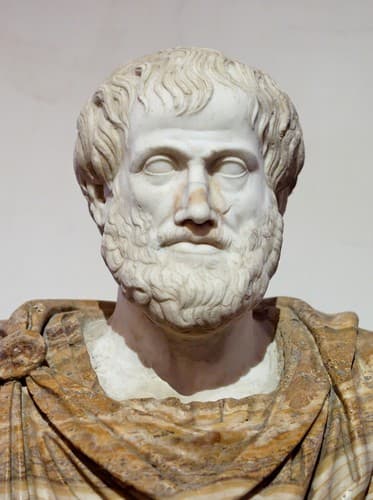
Aristotle

Aristotle was a Greek philosopher and polymath whose writings covered many subjects, including physics, ethics, politics, and art. He is renowned for his seminal works such as "Physics," "Poetics," and "Politics," which laid the groundwork for Western philosophy and scientific inquiry. A student of Plato and tutor to Alexander the Great, Aristotle's intellectual contributions continue to influence thought across numerous disciplines.