BookBrief
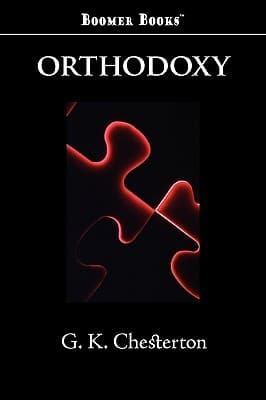
Orthodoxy cover
Archivist's Choice

Orthodoxy

G.K. Chesterton (1874)

Genre

Spirituality / Philosophy

Reading Time

180 min

Key Themes

See below

Track Your Reading

Sign in to track this book

Chesterton describes his intellectual journey, finding that the Christian faith perfectly answers the riddles he discovered through his own reasoning.

Core Idea

Chesterton argues that Christianity is the most exciting, logical, and satisfying philosophy for understanding the world and human nature. He says that orthodox Christian belief provides the best way to resolve life's paradoxes, offering a strong worldview that includes joy and wonder. He states that other philosophies often lead to contradictions or sadness. Chesterton uses paradoxes and witty arguments to defend the rationality and imagination of traditional Christian faith against modern skepticism, saying that orthodoxy gives true freedom and wonder.
Reading time
180 min
Difficulty
Hard
✓ Read this if...
You are interested in a highly original, witty, and deeply philosophical defense of traditional Christian thought, or you enjoy grappling with paradoxes and seeing common assumptions turned on their head.
✗ Skip this if...
You prefer a purely academic or historical analysis of religion, are easily frustrated by dense, metaphorical prose, or are not open to a vigorous, often provocative, argument for Christian orthodoxy.

Core idea

The central argument and framework that powers the entire book.

Chesterton argues that Christianity is the most exciting, logical, and satisfying philosophy for understanding the world and human nature. He says that orthodox Christian belief provides the best way to resolve life's paradoxes, offering a strong worldview that includes joy and wonder. He states that other philosophies often lead to contradictions or sadness. Chesterton uses paradoxes and witty arguments to defend the rationality and imagination of traditional Christian faith against modern skepticism, saying that orthodoxy gives true freedom and wonder.

At a glance

Reading time

180 min

Difficulty

Hard

Read this if...

You are interested in a highly original, witty, and deeply philosophical defense of traditional Christian thought, or you enjoy grappling with paradoxes and seeing common assumptions turned on their head.

Skip this if...

You prefer a purely academic or historical analysis of religion, are easily frustrated by dense, metaphorical prose, or are not open to a vigorous, often provocative, argument for Christian orthodoxy.

Key Takeaways

1

The Madman's Logic

Sanity is about balance, not just internal consistency.

Quote

The madman is not the man who has lost his reason. The madman is the man who has lost everything but his reason.

Chesterton says that modern philosophies, by focusing on one truth, often become unbalanced. A madman's argument might be logical, but it fails to account for the complex reality of human experience. True sanity, he argues, involves holding different, even opposing, truths together. Orthodoxy, for Chesterton, offers this balance by embracing paradox and mystery, reflecting existence's complex nature instead of simplifying it. This idea questions the Enlightenment's trust in reason as the only judge of truth, suggesting that too much r...

Supporting evidence

Chesterton uses the analogy of a straight line, which is perfectly logical but fails to capture the curvy, unpredictable reality of a landscape. He contrasts the madman's perfectly logical but narrow worldview with the sane person's ability to see the whole, often contradictory, picture.

Apply this

When evaluating ideas or beliefs, look beyond internal consistency. Ask if the system adequately explains the full spectrum of human experience, including its paradoxes and complexities. Be wary of philosophies that simplify reality too much or dismiss contradictory evidence as illogical. Embrace intellectual humility and the capacity to hold multiple, seemingly opposing truths simultaneously.

paradoxreason-vs-realityholistic-thinking
2

The Romance of Orthodoxy

Tradition offers adventure and freedom, not constraint.

Quote

Tradition means giving votes to the most obscure of all classes, our ancestors. It is the democracy of the dead.

Chesterton sees orthodoxy as a grand adventure, not a stifling tradition. He argues that rejecting past wisdom for newness is not freedom, but a limited way of thinking. Tradition is a conversation across generations, offering proven paths and wisdom that keeps humanity from repeating mistakes. It is a 'romance' because it connects us to a larger story, giving meaning and purpose that individualistic newness often lacks. This view shows tradition as empowering, not limiting, providing a base for exploration and innovation.

Supporting evidence

He likens tradition to a map drawn by countless explorers before us, which, while not dictating our destination, helps us avoid pitfalls and discover new territories more effectively. He also uses the metaphor of 'the democracy of the dead' to illustrate how tradition expands, rather than limits, our collective wisdom and input.

Apply this

Before dismissing traditional ideas or practices, engage with them deeply. Understand the historical context and the wisdom they might contain. Consider how historical precedents can inform present challenges. Seek to understand why certain traditions have endured, rather than assuming they are merely outdated. Embrace the adventure of discovering ancient truths.

tradition-reimaginedwisdom-of-agesanti-progressivism
3

The Joy of Limits

True creativity and happiness thrive within boundaries.

Quote

Art consists of limitation. The most beautiful part of every picture is the frame.

Chesterton suggests that true joy and creativity come from working within limits. He argues that endless possibilities lead to inaction and meaninglessness. A defined framework provides the structure needed for meaningful action and artistic expression. Just as a child enjoys drawing within lines, people find purpose and delight in working within given rules. Orthodoxy, with its beliefs, offers these 'frames' for life, giving boundaries that allow for greater freedom and deeper experiences. This challenges the modern focus on 'unlimit...

Supporting evidence

He uses the example of a game, which is enjoyable precisely because it has rules and boundaries. A game without rules is not more fun; it ceases to be a game. Similarly, art finds its beauty and impact through its chosen medium and its inherent limitations.

Apply this

Identify and embrace the 'frames' in your own life—whether they are personal commitments, professional constraints, or spiritual disciplines. Instead of resenting limitations, view them as opportunities for focused creativity and deeper joy. Recognize that true freedom is often found in choosing a path and committing to its inherent boundaries.

creative-constraintsfreedom-through-disciplinemeaning-in-limits
4

The Paradox of Humility

To see reality clearly, one must first admit ignorance.

Quote

It is exactly in so far as I have been a Christian that I have discovered that the world is not a place that can be understood by merely being a Christian.

Chesterton promotes humility as the foundation of true wisdom. He argues that modern intellectuals often think they are seeing reality with fresh eyes, but they might be repeating old errors or forcing their own limited ideas onto a complex world. Christian humility, by contrast, starts with acknowledging human failings and intellectual limits. This is not self-abasement, but a freeing recognition that one's personal view is incomplete. It prepares the mind to accept truths that might challenge one's existing ideas, including the seem...

Supporting evidence

He describes how his own intellectual journey led him to 'invent' Christian doctrines, only to find they had existed for centuries. This personal experience of intellectual discovery followed by the humbling realization of its ancient pedigree underscores his point.

Apply this

Cultivate intellectual humility. Before asserting your own understanding, genuinely seek to understand other perspectives, especially those that have stood the test of time. Be open to the possibility that your 'original' ideas might have historical precedents. Approach learning with a beginner's mind, even when engaging with familiar subjects.

intellectual-humilitybeginner's-mindopenness-to-truth
5

The World's Unending Wonder

Existence itself is a miracle, not a given.

Quote

The thing I like about the universe is that it is a thing, not a thought. It is a thing that has been thought about.

Chesterton revives a sense of wonder at existence, a wonder he believes modern thought has dulled. He rejects the idea that the universe is a simple, mechanical system. Instead, he says its continued existence is a constant miracle, a sustained act of creation. He compares God not to a watchmaker who winds up a clock, but to a child who asks 'Do it again!' for every sunrise. This view gives ordinary things extraordinary meaning, turning everyday reality into a display of divine art. It challenges the scientific reductionism that often...

Supporting evidence

He uses the analogy of a child's delight in repetition, seeing each instance of a familiar action (like a ball bouncing) as a fresh, delightful event, rather than a mere mechanical recurrence. This reflects the continuous 'choice' for existence.

Apply this

Practice daily gratitude for the simple fact of existence. Cultivate a sense of awe and wonder at the natural world and the intricate workings of the universe. Resist the urge to explain away mystery through reductionism. See each day, each breath, each sunrise as a fresh gift, not an inevitable occurrence.

existential-wondergratitude-for-beinganti-reductionism
6

The Thrill of Dogma

Creeds provide clarity and a fixed point for adventure.

Quote

The Christian faith has not been tried and found wanting. It has been found difficult and left untried.

Dogma, often seen as rigid, is shown by Chesterton as an exciting and freeing force. He argues that beliefs are not chains, but a compass and map, guiding the human soul through life's complexities. Without fixed beliefs, the mind drifts, constantly questioning basic truths. Dogma, by setting certain principles, frees the mind to explore, innovate, and live purposefully within a defined universe. It is the 'thrill' of knowing where you stand, allowing for intellectual and spiritual adventures without getting lost. This view counters t...

Supporting evidence

He compares dogma to a man who wants to travel around the world but must first choose a direction and a starting point. Without that fixed point, he cannot begin his journey. Similarly, a ship needs a rudder and a fixed destination to sail effectively.

Apply this

Don't shy away from exploring the core tenets of belief systems. Understand that clarity on fundamental principles can be empowering, not restrictive. Consider how clearly defined values or beliefs in your own life provide direction and enable you to pursue your goals with greater conviction. Seek out what you believe to be true and stand by it.

dogma-redefinedclarity-in-belieffoundational-truths
7

The Cosmic Patriotism

Love for the world begins with accepting its creator.

Quote

The modern man says, 'Let us leave all these creeds and systems and go back to nature.' But if he means going back to the beginning, he must go back to God, for God made nature.

Chesterton introduces 'cosmic patriotism' – a deep love for the universe as it is and as it was intended. He criticizes the modern tendency to love humanity or nature while rejecting their divine source. To truly love the world, he argues, one must first accept its givenness, its design, and its Creator. This is not passive acceptance, but an active, joyful affirmation of all existence, including its flaws. It is a patriotism that goes beyond national borders, embracing all creation with a sense of belonging and gratitude. This challe...

Supporting evidence

He contrasts the 'modern man' who wants to love nature but not God, with the Christian who, by loving God, finds a deeper and more consistent reason to love all of creation, even its imperfections.

Apply this

Seek to understand the ultimate source or meaning behind the things you love. Cultivate a sense of belonging and gratitude for the world as a whole, rather than just its convenient parts. Consider how a foundational belief in a benevolent creator might deepen your appreciation for life and the natural world.

divine-creationlove-for-existencespiritual-belonging
8

The Peril of Progress

Unchecked 'progress' can lead to a loss of essential truths.

Quote

The whole modern world has been engaged in a grand effort to make the universe intelligible, but it has only succeeded in making it unintelligible.

Chesterton questions the strong belief in 'progress,' arguing that constantly seeking newness and discarding old wisdom often leads to intellectual and spiritual emptiness. He suggests that many modern innovations are not true advancements but a rediscovery of old errors or a rejection of important truths. The danger is assuming that newer is always better, which leads to a cycle of reinvention without real improvement. True progress, for Chesterton, involves building on established foundations, not destroying them. He warns that by a...

Supporting evidence

He observes that many modern heresies are merely ancient heresies recycled, and that the 'new' philosophies often lead to the very same dilemmas that older, more robust systems had already addressed and resolved.

Apply this

Approach claims of 'progress' with a critical mind. Before embracing the new, understand the old. Question whether a new idea genuinely solves problems or merely replaces one set of challenges with another. Cultivate a historical perspective to discern genuine advancement from cyclical error or superficial change.

critique-of-progresshistorical-perspectivewisdom-of-ages
9

The Balance of Truths

Christianity's strength lies in its ability to reconcile opposites.

Quote

Christianity has not been tried and found wanting; it has been found difficult and left untried.

A main idea of 'Orthodoxy' is Chesterton's view that Christianity uniquely brings together seemingly contradictory truths, holding them in a dynamic balance. While other philosophies might overemphasize one virtue at the expense of another (e.g., self-denial over joy), Christianity, he argues, embraces both sides of these paradoxes. It calls for both humility and courage, self-denial and celebration, tradition and revolution, logic and mystery. This 'balance' makes it strong, complete, and sane. It avoids the one-sided excesses of oth...

Supporting evidence

He illustrates this with numerous examples, such as the Christian emphasis on both the meekness of Christ and the warrior spirit of saints, or the call to both self-sacrifice and abundant life. He sees the Incarnation itself as the ultimate paradox.

Apply this

Look for the nuanced balance in complex issues, rather than rushing to extreme positions. Recognize that truth often lies not in 'either/or' but in 'both/and.' When faced with seemingly opposing values, consider how they might be reconciled or held in creative tension, rather than choosing one to the exclusion of the other.

paradoxical-truthchristian-balanceholistic-philosophy
10

The Personal Riddle Solved

Individual experience finds its echo in universal truth.

Quote

I had no sooner discovered humanity than I had discovered orthodoxy.

Chesterton's book is a personal intellectual journey, a 'riddle and its answer.' He describes how his own solitary thoughts, his attempts to build a philosophy from scratch, consistently led him to 'invent' ideas and conclusions that he later found were core parts of orthodox Christianity. This personal story suggests that Christianity's fundamental truths are not arbitrary beliefs imposed from outside, but deep insights into reality that can be discovered through honest inquiry. His 'surprise' at finding his own thoughts in ancient b...

Supporting evidence

The entire book serves as this evidence, detailing his intellectual wanderings and the repeated, surprising coincidences where his 'original' thoughts aligned with ancient Christian doctrines, from the nature of free will to the necessity of paradox.

Apply this

Engage in genuine self-reflection and philosophical inquiry, allowing your own sincere questions to guide you. Be open to the possibility that your deepest intuitions and observations about life might align with established spiritual or philosophical traditions. Approach these traditions not as rigid rules, but as potential answers to your own internal questions.

personal-revelationtruth-discoveryintellectual-journey

Critical analysis

Notable Quotes

The Christian ideal has not been tried and found wanting. It has been found difficult; and left untried.

Critiquing modern attitudes toward Christianity.

The madman is not the man who has lost his reason. The madman is the man who has lost everything except his reason.

Discussing sanity and imagination.

Angels can fly because they take themselves lightly.

On humility and joy.

Tradition means giving votes to the most obscure of all classes, our ancestors. It is the democracy of the dead.

Defending tradition against modern arrogance.

The poet only asks to get his head into the heavens. It is the logician who seeks to get the heavens into his head. And it is his head that splits.

Contrasting poetic wonder with rigid logic.

The whole modern world has divided itself into Conservatives and Progressives. The business of Progressives is to go on making mistakes. The business of Conservatives is to prevent mistakes from being corrected.

Satirizing political divisions.

Fairy tales do not tell children the dragons exist. Children already know that dragons exist. Fairy tales tell children the dragons can be killed.

On the moral purpose of fairy tales.

The riddles of God are more satisfying than the solutions of man.

Embracing mystery over simplistic answers.

A man who has faith must be prepared not only to be a martyr, but to be a fool.

On the demands of genuine faith.

The object of opening the mind, as of opening the mouth, is to shut it again on something solid.

Critiquing aimless open-mindedness.

The cosmos is about the smallest hole that a man can hide his head in.

On the limitations of materialism.

The man who lives in a small community lives in a much larger world. He knows much more of the fierce varieties and uncompromising divergences of men.

Defending localism against cosmopolitanism.

There is a great man who makes every man feel small. But the real great man is the man who makes every man feel great.

On true greatness and humility.

The modern philosopher had told me again and again that I was in the right place, and I had still felt depressed even in acquiescence. But I had heard that I was in the wrong place, and my soul sang for joy, like a bird in spring.

Describing his conversion to Christianity.

Quiz

Test Your Knowledge

Ready to see how well you understood this book? Take our interactive quiz with 10 questions.

10
Questions
~5
Minutes
?
Best Score

Key Questions (FAQ)

'Orthodoxy' is Chesterton's personal account of how he came to believe in Christianity, presented as a response to critics of his earlier book 'Heretics'. It explores his philosophical journey and how Christian theology unexpectedly resolved his intellectual doubts, framing it as a 'riddle and its answer'.

About the author