BookBrief
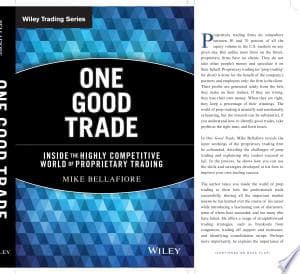
One Good Trade cover
Archivist's Choice

One Good Trade

Mike Bellafiore (2010)

Genre

Finance

Reading Time

240 min

Key Themes

See below

Track Your Reading

Sign in to track this book

An insider's guide to proprietary trading, revealing the techniques and mental strength needed to consistently profit and master challenging markets.

Core Idea

One Good Trade promotes a disciplined, process-driven approach to discretionary equity trading. It argues that consistent profitability comes from carefully executing one well-researched and managed trade at a time. The book suggests that successful trading is a learnable skill, not luck. It is built on mastering 'reading the tape,' finding 'stocks in play,' strict risk management, and maintaining good trading psychology. It offers a practical way to develop these skills in a structured, mentorship-focused setting, emphasizing continuous learning and adapting a personal trading playbook.
Reading time
240 min
Difficulty
Medium
✓ Read this if...
You are an aspiring or novice day trader looking for a detailed, practical guide on developing a disciplined trading methodology, mastering tape reading, and managing risk in active equity markets.
✗ Skip this if...
You are not interested in active day trading or prefer algorithmic/systematic trading strategies over discretionary, tape-reading approaches.

Core idea

The central argument and framework that powers the entire book.

One Good Trade promotes a disciplined, process-driven approach to discretionary equity trading. It argues that consistent profitability comes from carefully executing one well-researched and managed trade at a time. The book suggests that successful trading is a learnable skill, not luck. It is built on mastering 'reading the tape,' finding 'stocks in play,' strict risk management, and maintaining good trading psychology. It offers a practical way to develop these skills in a structured, mentorship-focused setting, emphasizing continuous learning and adapting a personal trading playbook.

At a glance

Reading time

240 min

Difficulty

Medium

Read this if...

You are an aspiring or novice day trader looking for a detailed, practical guide on developing a disciplined trading methodology, mastering tape reading, and managing risk in active equity markets.

Skip this if...

You are not interested in active day trading or prefer algorithmic/systematic trading strategies over discretionary, tape-reading approaches.

Key Takeaways

1

The One Good Trade Philosophy

Focus on executing a single, well-researched, and disciplined trade perfectly.

Quote

The foundation of all successful trading is the ability to consistently make one good trade.

Bellafiore's main idea is that trading mastery is not about big strategies or large profit swings, but about consistently making 'one good trade.' This means each trade must be well-planned, entered with confidence based on clear market signals, managed by a set risk profile, and exited based on objective rules. It is a detailed approach that prioritizes process over outcome for any single trade, trusting that many well-executed trades will lead to overall profit. This carefulness builds the discipline and mental strength needed for l...

Supporting evidence

Bellafiore consistently refers to the training regimen at SMB Capital, where new traders spend weeks, if not months, simply perfecting the entry, management, and exit of a single, high-probability setup before scaling up volume or complexity.

Apply this

Before entering any trade, define your entry criteria, stop-loss, and profit target. During the trade, stick to your plan without emotional interference. After the trade, review its execution rigorously, regardless of profit or loss, to learn and refine your process.

process-oriented-trading
2

Mastering Reading the Tape

Develop the ability to interpret real-time order flow and price action for immediate market insights.

Quote

Reading the tape is the heartbeat of active trading. It tells you what's happening now.

In a time of complex algorithms and indicators, Bellafiore supports the skill of 'reading the tape' – watching the bid/ask spread, volume, and time & sales data to understand immediate supply and demand. This is not about lagging indicators; it is about understanding the current struggle between buyers and sellers, finding areas of liquidity, and sensing changes in momentum. It takes intense focus and practice to filter out noise and see important patterns, but it gives traders a key advantage in predicting short-term price movements,...

Supporting evidence

Bellafiore describes how SMB Capital traders spend hours, even days, just watching the Level II and Time & Sales screens, identifying patterns like 'offer getting hit' or 'bid holding firm' in specific high-volume stocks during earnings season.

Apply this

Practice observing Level II data and Time & Sales for a specific stock during active trading hours. Look for patterns such as large orders appearing and disappearing, consistent buying or selling pressure, and how price reacts to specific bid/ask levels. Don't trade, just observe and try to predict the next few ticks.

order-flow-analysislevel-ii-trading
3

The Power of 'Stocks In Play'

Concentrate trading efforts on stocks exhibiting unusual volume and volatility due to a catalyst.

Quote

The best trades happen in the stocks that are 'in play.' Don't chase mediocrity.

A key insight from Bellafiore is the importance of trading 'Stocks In Play.' These are stocks with much higher than average volume and volatility, usually because of a specific event like an earnings report, news, or an analyst upgrade/downgrade. Such stocks offer the best chances for intraday traders because they show clear trends, predictable support/resistance levels (once set), and enough liquidity to enter and exit positions easily. Trying to trade 'dead' stocks with low volume and small ranges often leads to frustration and poor...

Supporting evidence

Bellafiore recounts numerous examples of traders making significant profits by focusing solely on a handful of stocks that had just released earnings or were subject to major news, leading to predictable, high-volume moves throughout the day.

Apply this

Each morning, before the market opens, scan for stocks with pre-market news, significant price gaps, and high pre-market volume. Create a watchlist of 3-5 'Stocks In Play' and prioritize your trading ideas around these names, rather than trying to trade every stock.

catalyst-driven-tradingvolatility-trading
4

Trading is a Skill, Not a Gamble

Approach trading as a continuous learning process requiring deliberate practice and refinement.

Quote

Talent is overrated. Deliberate practice and the right mindset are what truly separate the great traders from the rest.

Bellafiore firmly states that trading is a skill, like a professional sport or playing music, not a gamble. This view changes the focus from hoping for luck to actively developing ability. It requires continuous learning, strict self-assessment, and deliberate practice of specific trading setups and techniques. Just as an athlete reviews game footage, a trader must review their trades, find weaknesses, and work on improving those areas. This mindset builds resilience and stops traders from getting discouraged by losses, seeing them as...

Supporting evidence

The book details SMB Capital's extensive training program, where new traders are put through simulations, drills, and daily performance reviews, emphasizing skill development over immediate profit generation. It highlights the 'chalk talks' where successful traders break down their thought processes.

Apply this

Maintain a detailed trading journal. For every trade, record your rationale, entry/exit points, emotions, and lessons learned. Regularly review your journal to identify recurring mistakes and successful patterns. Practice specific setups in a simulator until you can execute them flawlessly.

deliberate-practicetrading-psychology
5

The Importance of Trading Psychology

Mastering emotions and maintaining discipline are as crucial as strategy and analysis.

Quote

Your worst enemy in trading sits between your ears. Control your mind, control your trades.

Bellafiore gives much attention to the psychological side of trading, arguing that even the best strategies are useless without emotional control. Fear, greed, impatience, and overconfidence are constant enemies that can cause impulsive decisions, straying from trading plans, and ultimately, losses. Successful traders develop strong mental frameworks, self-awareness, and discipline to follow their rules, manage risk, and recover from losses without letting emotions control their actions. This mental toughness is built through self-ref...

Supporting evidence

The book features anecdotes of traders who, despite having profitable strategies, failed due to emotional breakdowns – chasing losses, overtrading, or freezing up during critical moments. Bellafiore emphasizes the role of a trading mentor in helping traders identify and overcome these psychological hurdles.

Apply this

Before trading, define your emotional state. If you're feeling overly confident, anxious, or angry, take a break. During trades, recognize emotional triggers (e.g., fear when a trade goes against you) and use pre-defined rules (like hard stop-losses) to override impulsive reactions. Practice mindfulness or meditation to improve focus and emotional regulation.

emotional-controlrisk-management-psychology
6

Risk Management Above All Else

Protecting capital is the primary objective; profits are a secondary outcome.

Quote

You can't make money if you don't have money. Risk management is the ultimate survival tool.

Bellafiore stresses the essential rule of strict risk management. For a proprietary trading firm, protecting capital is most important, as it is the firm's core. This means strict position sizing, clear stop-losses for every trade, and a firm commitment to cutting losses quickly. He argues that focusing on protecting capital naturally leads to better decision-making and ensures a trader can last long enough to use profitable chances. Traders who prioritize profit over risk eventually lose their accounts. It is about surviving to trade...

Supporting evidence

Bellafiore frequently cites examples of new traders who, despite showing promise, were quickly removed from the desk due to poor risk management, often taking oversized positions or failing to honor their stop-losses, resulting in substantial losses for the firm.

Apply this

Before every trade, determine your maximum acceptable loss (stop-loss) and position size such that this loss represents only a small percentage (e.g., 1-2%) of your total trading capital. Never deviate from your stop-loss. If a trade hits your stop, exit immediately, no questions asked.

capital-preservationstop-loss-strategy
7

The Value of Mentorship and Community

Learning from experienced traders and a supportive environment accelerates growth.

Quote

Trading is not a solitary endeavor if you want to accelerate your learning. Find a mentor, find a community.

While trading can feel lonely, Bellafiore highlights the great benefits of a structured mentorship program and a collaborative trading community. At SMB Capital, new traders work with experienced mentors, take part in daily 'chalk talks,' and learn from the group's knowledge. This setting gives immediate feedback, exposure to different trading styles, and important psychological support. It helps traders avoid common mistakes, learn best practices faster, and develop a strong understanding of market dynamics that would take years to g...

Supporting evidence

Bellafiore details the success stories of traders who thrived under the direct guidance of senior traders, learning specific setups, risk management techniques, and emotional control through daily interaction and review sessions. He contrasts this with solo traders who often struggle for years.

Apply this

Seek out experienced traders, either online or in person, who are willing to share their knowledge. Join a trading community or forum where you can discuss ideas, review trades, and receive constructive criticism. Be open to feedback and actively ask questions.

trading-educationpeer-learning
8

The Trader's Playbook

Document and refine your personal library of high-probability trading setups.

Quote

Every successful trader has a playbook. It's their unique edge, refined over countless hours.

A key lesson is the idea of building a personal 'playbook' – a written collection of specific, high-probability trading setups that a trader has thoroughly researched, backtested, and successfully used. This is not just a general strategy; it is a personalized library of patterns and conditions that match a trader's strengths and market understanding. Each 'play' in the playbook details entry rules, stop-loss, profit targets, and specific market conditions where it works best. This systematic approach removes guesswork, builds confide...

Supporting evidence

Bellafiore describes how SMB Capital traders are encouraged to develop and document their own 'go-to' setups, often naming them (e.g., 'the strong open reversal' or 'the earnings gap fade'). These plays are refined over time through performance review and shared insights.

Apply this

Identify 2-3 trading setups that you find consistently profitable. For each setup, document the precise criteria for entry, exit, stop-loss, and profit target. Review your trades against these documented plays and refine your playbook based on actual performance.

trading-strategy-developmentpattern-recognition

Critical analysis

Notable Quotes

The market doesn't care what you think. It cares what you do.

Emphasizing the importance of action and execution over mere analysis or opinion in trading.

You can be right about the direction and still lose money if your execution is poor.

Highlighting that correct market prediction is not enough; flawless execution, including entry, exit, and risk management, is crucial.

Risk is not a four-letter word; it's the price of admission.

Framing risk not as something to avoid entirely, but as an inherent and necessary component of trading.

The best traders are not necessarily the smartest, but the most disciplined.

Suggesting that consistent discipline in following a trading plan often outweighs raw intellect in achieving success.

One good trade can make your day, but one bad trade can ruin your month.

Illustrating the asymmetric impact of good versus bad trades on overall performance and the need for strict risk control.

Don't marry your positions. The market is not interested in your commitment.

Advising against emotional attachment to trades, which can lead to holding losing positions too long.

Your edge is not what you trade, but how you trade it.

Emphasizing that a trader's unique advantage comes from their systematic approach, risk management, and execution, rather than specific instruments.

Preparation is not just about knowing what to do, but also knowing what not to do.

Expanding on the concept of preparation to include identifying and avoiding potential pitfalls and bad habits.

The market is a never-ending learning laboratory.

Encouraging a continuous learning mindset, as market conditions and dynamics are always evolving.

Cut your losses quickly, let your winners run.

A classic trading adage that Bellafiore reinforces as a core principle for managing risk and maximizing profit.

Every trade is a new opportunity to make a good trade or a bad trade.

Reminding traders to approach each new trade with a fresh perspective, free from the influence of past outcomes.

Consistency over heroics.

Prioritizing steady, repeatable performance over aiming for large, infrequent wins that often come with higher risk.

The process is the product. Focus on your process, and the profits will follow.

Advocating for a strong emphasis on developing and adhering to a sound trading process, rather than solely fixating on the monetary outcome.

You don't need to be right all the time, just more often than you are wrong, and with bigger winners than losers.

Explaining that profitability doesn't require a perfect win rate, but rather a combination of win rate and reward-to-risk ratio.

Quiz

Test Your Knowledge

Ready to see how well you understood this book? Take our interactive quiz with 10 questions.

10
Questions
~5
Minutes
?
Best Score

Key Questions (FAQ)

Proprietary trading involves professionals trading the firm's capital with the sole aim of generating profits consistently from the markets. Traders' income and livelihood are directly tied to their ability to profit, making it a highly challenging yet potentially rewarding field.

About the author