BookBrief
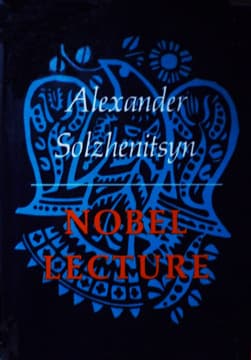
Nobel Lecture cover
Archivist's Choice

Nobel Lecture

Aleksandr Solzhenitsyn

Genre

History

Reading Time

90 min

Key Themes

See below

Track Your Reading

Sign in to track this book

In his Nobel Lecture, Solzhenitsyn condemns totalitarianism and defends the individual's moral duty to speak truth, shaped by his time in the Soviet gulag.

Core Idea

Aleksandr Solzhenitsyn's Nobel Lecture argues that art, especially literature, can cross national and political lines, acting as a universal moral guide. In a world full of violence and lies, artists must confront these falsehoods with truth to build understanding and empathy. He believes a single honest voice, amplified by art, shows how human suffering and hopes connect us, uniting people against injustice and preventing the moral compromises that cause global disasters.
Reading time
90 min
Difficulty
Medium
✓ Read this if...
You are interested in the moral responsibility of art and artists, the power of truth against totalitarianism, or Solzhenitsyn's philosophical underpinning for his literary work.
✗ Skip this if...
You prefer practical how-to guides or light, entertaining reads without deep philosophical engagement.

Core idea

The central argument and framework that powers the entire book.

Aleksandr Solzhenitsyn's Nobel Lecture argues that art, especially literature, can cross national and political lines, acting as a universal moral guide. In a world full of violence and lies, artists must confront these falsehoods with truth to build understanding and empathy. He believes a single honest voice, amplified by art, shows how human suffering and hopes connect us, uniting people against injustice and preventing the moral compromises that cause global disasters.

At a glance

Reading time

90 min

Difficulty

Medium

Read this if...

You are interested in the moral responsibility of art and artists, the power of truth against totalitarianism, or Solzhenitsyn's philosophical underpinning for his literary work.

Skip this if...

You prefer practical how-to guides or light, entertaining reads without deep philosophical engagement.

Key Takeaways

1

Art as a Moral Compass

True art possesses an inherent moral force, transcending propaganda.

Quote

The artist is a small man who can give to the world a new and different image of the world.

Solzhenitsyn states that true art is more than entertainment or political messaging; it is a moral tool. It can reveal truth, expose lies, and thus shape humanity's ethical outlook. Unlike changing political ideas or scientific theories, art's truth lasts across generations and cultures, acting as a constant guide. It illuminates rather than dictates, helping people see the world with more clarity and a stronger sense of justice. This moral weight of art makes it a powerful, though often underestimated, force for good in a world often...

Supporting evidence

Solzhenitsyn's entire lecture is a testament to this, implicitly contrasting the truthful power of art with the deceptive nature of Soviet propaganda he personally experienced.

Apply this

Seek out and engage with art that challenges your perspectives and deepens your understanding of human nature and morality, rather than merely confirming existing biases.

moral-authoritytruth-in-artart-and-ethics
2

The Power of One Voice

Even a single, honest voice can pierce through the loudest lies.

Quote

One word of truth shall outweigh the whole world.

This statement shows Solzhenitsyn's belief that truth, even from one person, has an unchanging strength that can overcome any structure of lies, no matter how large or established. In a time of state propaganda and silenced dissent, Solzhenitsyn, through his own life and work, showed this principle. He believed that artists, because of their commitment to truth and their unique ability to share it, become important witnesses against injustice. This single voice, free from power or fear, can deeply affect human conscience, waking other...

Supporting evidence

Solzhenitsyn's own experience as a dissident writer in the Soviet Union, where his single voice (through works like 'The Gulag Archipelago') exposed vast state crimes.

Apply this

Do not underestimate the impact of speaking your truth, even when it feels insignificant against overwhelming opposition. Your conviction can inspire others.

individual-agencydissentmoral-couragetruth-vs-power
3

Violence and Lies

Violence inherently relies on lies for its sustenance and justification.

Quote

Violence has nothing to cover itself with but lies, and lies can be maintained only by violence.

Solzhenitsyn describes a terrible link between violence and falsehood. He argues that no act of violence, especially on a large scale, can last without a made-up story to justify it. Oppressive governments, for example, must create complex lies about their enemies, their goals, or the need for their actions to get compliance or stop opposition. In turn, these lies can only continue through the threat or use of violence, as truth-tellers would otherwise expose the deception. This creates a cycle where violence leads to more lies, and l...

Supporting evidence

The systematic use of propaganda and state terror in the Soviet Union, which Solzhenitsyn lived through and documented, exemplifies this relationship.

Apply this

When confronted with injustice or conflict, critically examine the narratives presented. Identify the lies that are being used to justify harmful actions and challenge them directly.

propagandatotalitarianismstate-violencedeception
4

The Universal Human Experience

Art transcends national borders by speaking to universal human experiences.

Quote

Art has the capacity to convey the entire human experience, regardless of national boundaries.

Solzhenitsyn supports art as a strong connection between different cultures and peoples. He states that while political systems and national interests often divide humanity, true art speaks to basic, shared parts of the human condition—love, loss, hope, despair, courage, and fear. A great novel or play, no matter where it comes from, can create empathy and understanding in audiences worldwide because it connects to these universal feelings. This makes art a unique tool for building global unity and mutual understanding, especially in ...

Supporting evidence

The international resonance of classic literature and music, which speaks to people across different languages and historical contexts.

Apply this

Actively seek out art, literature, and films from diverse cultures to broaden your empathy and understanding of the global human experience.

global-humanitycross-cultural-understandingempathyuniversal-themes
5

The Artist's Burden and Gift

Artists bear the unique responsibility and privilege of conveying truth to humanity.

Quote

The artist is a small man who can give to the world a new and different image of the world.

Solzhenitsyn sees the artist not just as an entertainer but as an important channel for truth and understanding. This role brings both a heavy responsibility and a unique talent. The responsibility is the huge duty to see and state reality, especially its more uncomfortable or hidden parts, without compromise. The talent is the special ability to simplify complex truths into forms that others can easily understand and feel. Through their art, they can offer humanity a new way of seeing, challenge old beliefs, and show the hidden parts...

Supporting evidence

Solzhenitsyn's own life as a writer who felt compelled to expose the atrocities of the Gulag, despite immense personal risk.

Apply this

Support artists who bravely challenge norms and expose uncomfortable truths. If you are an artist, embrace your role as a truth-teller.

artistic-responsibilitytruth-tellercreative-couragesocietal-role-of-art
6

Rejecting the Lie

The simplest act of resistance is to refuse to participate in falsehood.

Quote

The simplest and most accessible key to our liberation is: personal non-participation in lies!

In a world full of propaganda and intentional misinformation, Solzhenitsyn offers a simple yet powerful way to resist: the personal choice to avoid participating in lies. This is not about actively fighting every falsehood (though that is also important), but about a personal, inner commitment to honesty. It means refusing to repeat untruths, to sign false statements, to pretend to believe things you know are false, or to stay silent when your silence implies agreement with a lie. While seemingly small, this individual act of not part...

Supporting evidence

Solzhenitsyn's own practice of refusing to compromise his literary integrity or beliefs even under severe Soviet pressure, which he advocated for others.

Apply this

Identify areas in your life where you might be tacitly supporting or repeating falsehoods (e.g., gossip, political rhetoric, corporate spin) and consciously choose to refrain.

moral-autonomypassive-resistanceintegritytruthfulness
7

The World is Interconnected

The suffering of one part of the world affects all humanity.

Quote

There are no longer any internal affairs on our crowded Earth.

Solzhenitsyn, writing during the Cold War, clearly stated the idea of a globally connected humanity, long before the internet made this common. He argued that suffering, injustice, or oppression in any one nation or area cannot be dismissed as just an 'internal matter' because its effects will spread globally. Moral outrage, economic instability, refugee crises, or the spread of dangerous ideas are not stopped by national borders. This view calls for a stronger sense of global responsibility, urging individuals and nations to see thei...

Supporting evidence

The global impact of the Cold War itself, and how events in one superpower directly affected lives across the world.

Apply this

Educate yourself about global issues and support organizations working on international human rights and aid, recognizing that these efforts contribute to overall global stability and well-being.

global-solidarityinterdependencehuman-rightsglobal-responsibility
8

The Artist's Plea for Peace

Art can foster peace by cultivating empathy and mutual understanding.

Quote

And the task of the writer is to bring the truth to the people, and to show them how to live.

Solzhenitsyn sees the artist as an important force for peace, not through political action, but through building empathy and understanding. By showing the complexities of human experience, the details of suffering, and the shared hopes of people across different cultures, art can break down barriers of prejudice and ignorance. When a reader or viewer deeply connects with characters from a foreign land or a different background, their ability to empathize grows, making it harder to demonize or dehumanize 'the other.' This emotional and...

Supporting evidence

The way literature can humanize 'enemies' or bridge cultural divides, fostering understanding that political rhetoric often fails to achieve.

Apply this

Engage with art and literature that presents diverse perspectives, particularly those that challenge preconceived notions about other cultures or groups, to cultivate deeper empathy.

empathy-buildingcultural-exchangepeace-through-arthumanizing-the-other
9

Escaping the 'Spirit of Munich'

Appeasement of evil only emboldens it; moral courage is essential.

Quote

The spirit of Munich is a sickness of the will of successful people.

Solzhenitsyn critically refers to the 'Spirit of Munich,' a term that now means the failed policy of giving in to aggressive totalitarian governments. He argues that the desire for comfort and avoiding conflict, especially among wealthy nations, can lead to a dangerous moral weakness where evil is allowed or even rewarded for the sake of peace. This 'sickness of the will' ultimately encourages aggressors, leading to greater suffering later. Solzhenitsyn, having seen the results of such policies, calls for steady moral courage and a re...

Supporting evidence

The historical context of the Munich Agreement (1938) where Western powers appeased Hitler, which Solzhenitsyn uses as a cautionary tale.

Apply this

Be wary of arguments for appeasement when confronted with clear injustices or aggressions. Support policies and leaders who demonstrate moral courage and principled stands.

appeasementmoral-couragetyranny-resistancehistorical-lessons

Critical analysis

Notable Quotes

One word of truth outweighs the whole world.

A central theme of the lecture, highlighting the power of truth.

Violence does not live alone and is not capable of living alone: it is necessarily intertwined with falsehood. Between them lies the most intimate, most natural, and most fundamental connection.

Solzhenitsyn's analysis of the relationship between violence and lies.

The simple step of a courageous individual is not to take part in the lie. Let the lie come into the world, let it even triumph. But not through me.

His call for individual moral resistance against state-sponsored falsehoods.

Art is a revelation, it is a sudden, unexpected discovery of a world where there seemed to be none.

Discussing the role and nature of art.

The artist is an assistant to God. He is not a competitor.

Defining the humble yet profound role of the artist.

We are told that the world is too complicated, that it has split into too many different parts, and that it is beyond the power of literature to grasp all these parts and synthesize them.

Addressing the fragmentation of modern knowledge and the challenge to art.

And the writer's task is just this: to grasp the whole picture, to grasp it in its entirety, as if it were a single, living, breathing organism.

Contrasting the modern view with the true purpose of the writer.

For violence has nothing to cover itself with but lies, and lies can be maintained only by violence.

Reinforcing the symbiotic relationship between violence and falsehood.

The only substitute for experience is art.

Highlighting the unique power of art to convey understanding beyond direct experience.

But the truth is that the artist's mission is not to invent a new world, but to rediscover the old one.

Emphasizing the timeless nature of artistic truth.

The great books, the great works of art, are not just about their time; they are about all time.

Speaking to the enduring relevance and universality of great art.

The writer is not a judge, but a witness.

Defining the ethical stance and role of the writer in society.

And the writer, if he is truly a writer, is the only one who can explain to us what is happening to us.

Asserting the unique capacity of the writer to offer insight into human condition.

It is not the artist's business to set up the world in a new order, but to tell us about the order that already exists.

Further elaborating on the artist's role as an interpreter of reality.

Quiz

Test Your Knowledge

Ready to see how well you understood this book? Take our interactive quiz with 10 questions.

10
Questions
~5
Minutes
?
Best Score

Key Questions (FAQ)

Solzhenitsyn's Nobel Lecture primarily explores the power of art and literature to transcend national borders and political systems, advocating for a universal understanding of truth and justice. He argues that the writer's duty is to combat lies and violence through the unique ability of art to convey human experience authentically.

About the author

Aleksandr Solzhenitsyn

Aleksandr Isayevich Solzhenitsyn was a Russian writer. A prominent Soviet dissident, Solzhenitsyn was an outspoken critic of communism and helped to raise global awareness of political repression in the Soviet Union, in particular the Gulag system.