BookBrief
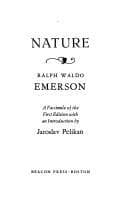
Nature cover
Archivist's Choice

Nature

Ralph Waldo Emerson

Genre

Spirituality / Philosophy

Reading Time

90 min

Key Themes

See below

Track Your Reading

Sign in to track this book

Emerson's "Nature" invites readers to a spiritual awakening through an American communion with the natural world, showing the divine in every tree and star.

Core Idea

Emerson's "Nature" says the natural world is more than resources or objects. It is a direct, divine expression of God, offering spiritual and philosophical lessons. Through conscious engagement with nature, people can achieve self-realization, move beyond society's limits, and reconnect with the universal spirit. The book claims true wisdom, moral insight, and a sense of the sublime come only when one sheds societal artifice and embraces the direct experience of nature, recognizing its spiritual language and power.
Reading time
90 min
Difficulty
Medium
✓ Read this if...
You are interested in the foundational texts of American Transcendentalism, exploring nature as a source of spiritual insight, philosophical growth, and self-reliance, or seeking a deeper, more intuitive connection with the natural world.
✗ Skip this if...
You prefer empirically-driven philosophy, find highly abstract or poetic prose challenging, or are looking for a practical guide rather than a philosophical treatise on spirituality and nature.

Core idea

The central argument and framework that powers the entire book.

Emerson's "Nature" says the natural world is more than resources or objects. It is a direct, divine expression of God, offering spiritual and philosophical lessons. Through conscious engagement with nature, people can achieve self-realization, move beyond society's limits, and reconnect with the universal spirit. The book claims true wisdom, moral insight, and a sense of the sublime come only when one sheds societal artifice and embraces the direct experience of nature, recognizing its spiritual language and power.

At a glance

Reading time

90 min

Difficulty

Medium

Read this if...

You are interested in the foundational texts of American Transcendentalism, exploring nature as a source of spiritual insight, philosophical growth, and self-reliance, or seeking a deeper, more intuitive connection with the natural world.

Skip this if...

You prefer empirically-driven philosophy, find highly abstract or poetic prose challenging, or are looking for a practical guide rather than a philosophical treatise on spirituality and nature.

Key Takeaways

1

Embrace the Transparent Eyeball

Dissolve into nature's embrace to truly perceive reality.

Quote

I become a transparent eyeball; I am nothing; I see all; the currents of the Universal Being circulate through me; I am part or parcel of God.

Emerson's 'transparent eyeball' idea asks us to remove the ego and intellectual biases that filter our view of nature. It means not just observing nature, but merging with it, letting the self disappear into the larger whole. This state of open receptivity allows for a direct experience of the divine order in nature. Here, the individual stops being a separate entity and becomes a channel for universal consciousness. This is not just poetic language; it is a method for spiritual insight and a deeper understanding of one's place in the...

Supporting evidence

Emerson describes his experience in the woods, where he feels himself become this 'transparent eyeball,' suggesting a personal, almost mystical, encounter rather than a purely theoretical construct.

Apply this

Spend time in nature with the explicit intention of letting go of your thoughts and sense of self. Focus on sensory input without judgment or categorization. Practice mindful walking or sitting, aiming to feel less like an observer and more like an integrated part of the environment.
transcendentalismego-deathpantheism
2

Nature as Divine Scripture

The natural world is God's primary revelation, more direct than any written text.

Quote

The world is emblematic. Parts of speech are metaphors, because the whole of nature is a metaphor of the human mind. The laws of moral nature answer to those of matter as face to face in a glass.

Emerson says nature is not just a pretty background, but the living expression of the divine. He argues that true understanding of God, morality, and universal laws comes from observing and interpreting nature, rather than only from religious texts. Every tree, stone, and natural event has symbolic meaning, reflecting spiritual truths and how the human mind works. This view makes nature a primary scripture, a direct message from the Creator. It questions traditional religious authority by suggesting that direct experience with nature ...

Supporting evidence

Emerson's extensive use of natural metaphors throughout 'Nature' to explain philosophical concepts, such as the 'circle' representing the fluidity of thought and creation, demonstrates his belief in nature's symbolic language.

Apply this

View natural phenomena (a storm, a blooming flower, a flowing river) not just scientifically, but as having deeper, symbolic meanings related to life, change, or spiritual principles. Journal about these interpretations.

natural-theologysymbolismrevelation
3

Solitude as a Gateway to Wisdom

True insight into nature and self requires escaping the distractions of society.

Quote

To go into solitude, a man needs to retire as much from his chamber as from society. I am not solitary whilst I read and write, though nobody is with me. But if a man would be alone, let him look at the stars.

Emerson champions solitude not just as being physically alone, but as a deliberate step back from the noise of human society, including its thoughts, opinions, and material concerns. He separates being physically alone from achieving true solitude, which involves mental and spiritual detachment. In this deep quiet, especially in nature, one can shed societal conditioning and hear the 'unspoken' truths of the universe and the inner self. Looking at the stars, for example, offers a perspective so vast it makes human concerns small, crea...

Supporting evidence

Emerson contrasts the superficiality of social interaction with the profound experience of contemplating the vastness of the night sky, emphasizing the need for an internal, not just external, retreat.

Apply this

Regularly seek out quiet natural spaces where you can be undisturbed. Leave your phone behind. Focus on observing without judgment, allowing your mind to quiet and your perceptions to deepen, rather than filling the silence with internal monologue.

contemplationintrospectionmindfulness
4

Nature's Transformative Power

Immersion in nature rejuvenates the spirit and restores moral clarity.

Quote

In the woods, too, a man casts off his years, as the snake his slough, and at whatever period of life, is always a child. In the woods, is perpetual youth.

Emerson describes nature's power to refresh the human spirit. He argues that the woods, in particular, are a sanctuary where one can shed the burdens of age, societal expectations, and tiredness. This change is not just physical; it is a spiritual rebirth, a return to a state of childlike wonder. Nature's constant renewal mirrors and helps renew the self, letting individuals tap into an eternal source of youth and energy. This idea suggests that modern life, with its stresses, drains our energy, and nature offers the cure. It is a pla...

Supporting evidence

The vivid metaphor of 'casting off years, as the snake his slough,' directly illustrates the idea of shedding old burdens and rejuvenating in nature.

Apply this

Schedule regular 'nature prescriptions' – dedicated time in natural settings specifically for mental and spiritual rejuvenation, not just exercise. Notice how your mood and perspective shift after these experiences.

ecotherapyrenewalspiritual-healing
5

The Utility of Beauty

Nature's aesthetic appeal is not superficial, but serves a profound spiritual purpose.

Quote

Beauty in nature is not ultimate but mediate. It is the herald of an inward and eternal beauty, and is not to be admired for its own sake, but as a hint and an earnest of that which is higher.

Emerson questions the idea that beauty in nature is just a pleasant sensory experience. He says its aesthetic appeal holds a deeper, spiritual meaning. For Emerson, the beauty of a landscape, a flower, or a sunset is a 'herald'—a messenger—of a deeper, 'inward and eternal beauty.' It is a way to understand the divine order and the universe's inherent goodness. This means that appreciating natural beauty is not an end in itself, but a way to higher spiritual perception. It stirs the soul, awakens imagination, and points to the sublime,...

Supporting evidence

Emerson clearly states that beauty is 'mediate,' not 'ultimate,' meaning it acts as a medium or a signpost to something greater, rather than being the final destination itself.

Apply this

When encountering something beautiful in nature, don't just admire it passively. Ask yourself: 'What deeper truth or feeling does this beauty evoke in me? What is it trying to communicate about the order of the universe or my own spirit?'

aestheticssublimespiritual-perception
6

Man's Alienation from Nature

Modern society disconnects us from our inherent spiritual home.

Quote

The sun shines to-day also. There is more splendor in the grass, than in the most luxurious city. I think that the city is a prison, where we are confined by our own inventions.

While Emerson's 'Nature' focuses on the positive aspects of engaging with nature, it implicitly criticizes humanity's growing separation from its natural origins due to industrialization and city life. He suggests that society, with its artificial structures, material pursuits, and abstract ideas, creates a barrier between individuals and the direct, vital experience of nature. This disconnect leads to spiritual emptiness, where people lose touch with their intuitive wisdom and the divine source nature embodies. The 'prison' of the ci...

Supporting evidence

Emerson’s lament that 'few adults can see nature' implies a societal conditioning that diminishes our natural perception, contrasting with the child's unmediated view.

Apply this

Consciously identify aspects of your daily life (technology, social media, urban environments) that create a barrier to direct natural experience. Actively seek to reduce these barriers and prioritize time in genuine natural settings.

urbanizationdisconnectionspiritual-impoverishment
7

The Interconnectedness of All Things

Every element of nature reflects and is connected to every other part, and to humanity.

Quote

The laws of moral nature answer to those of matter as face to face in a glass. The whole of nature is a metaphor of the human mind.

Emerson's philosophy emphasizes a deep unity between humanity and nature, and within nature itself. He argues that the same universal laws that govern the physical world also govern our moral and spiritual lives. There is a basic link between the outer world of nature and the inner world of the human spirit. This means that by understanding nature, we gain insight into ourselves, and vice-versa. The intricate relationships in an ecosystem, the cycles of growth and decay, all reflect deeper truths about existence. This connection is no...

Supporting evidence

Emerson's assertion that 'every man's condition is a solution in hieroglyphic to those questions which he would put to the spheres' directly links individual human experience to universal laws reflected in nature.

Apply this

When observing a natural phenomenon (e.g., a tree's growth, a river's flow), consciously draw parallels to your own life, emotions, or societal patterns. Reflect on how natural processes might offer lessons for human behavior or spiritual development.

holismcorrespondenceunity
8

Language Rooted in Nature

All abstract thought and language ultimately derive from natural phenomena.

Quote

Every word which is used to express a moral or intellectual fact, if traced to its root, is found to be borrowed from some material appearance. Right originally means straight; wrong means twisted.

Emerson makes a strong case for the natural origins of human language and, by extension, abstract thought. He argues that all our intellectual and moral concepts, when traced back to their roots, show connections to concrete things in nature. Words like 'right' (straight) or 'wrong' (twisted) are not random but are deeply tied to our physical experience of the world. This suggests that our ability for abstract reasoning is not separate from nature, but grows from our interaction with it. It supports the idea that nature is the primary...

Supporting evidence

Emerson provides specific etymological examples, such as 'spirit' meaning 'wind,' 'supercilious' relating to 'raising the eyebrow,' to demonstrate the material origins of abstract words.

Apply this

When using abstract words, pause to consider their potential natural or physical origins. This can deepen your understanding of the word and your connection to the underlying natural concept. Encourage children to describe things using natural metaphors.

etymologymetaphorlinguistics
9

Self-Reliance Through Nature

Nature empowers the individual to trust their intuition and inner wisdom.

Quote

Man is fallen; he can no longer breathe in the free air of nature, but is dependent on the opinions of other men, and is ruled by their laws.

While 'Nature' came before Emerson's essay 'Self-Reliance,' the ideas of that philosophy are clearly here. Emerson subtly argues that deep engagement with nature promotes true self-reliance. By immersing oneself in nature, away from societal pressures and common ideas, an individual learns to trust their own perceptions and intuitions. Nature, as a direct expression of the divine, provides a pure source of truth that bypasses human institutions and rules. This direct access to universal wisdom empowers the individual to think independ...

Supporting evidence

The entire premise of the 'transparent eyeball' experience, where one becomes 'part or parcel of God,' implies a direct, unmediated access to truth that bypasses societal intermediaries, fostering self-trust.

Apply this

When facing a personal dilemma or societal pressure, seek counsel not just from others, but also from quiet contemplation in nature. Allow the stillness and clarity of the natural world to help you access your inner wisdom and make decisions aligned with your authentic self.

individualismintuitionauthenticity
10

The Perpetual Miracle

Nature's everyday phenomena are constant sources of wonder and spiritual insight.

Quote

The sun shines to-day also. There is more splendor in the grass, than in the most luxurious city. I think that the city is a prison, where we are confined by our own inventions.

Emerson asks us to rediscover the miraculous in nature's everyday aspects. He laments that while 'the sun shines today also,' most adults fail to truly see it, having lost the child's fresh perception. For Emerson, the sunrise, a plant's growth, a bird's flight—these are not ordinary occurrences but constant expressions of divine power and intricate design. They are 'perpetual miracles' that can awaken our spiritual senses if we approach them with awe and attention. This view challenges the tendency to seek wonder only in the extraord...

Supporting evidence

Emerson's stark contrast between the child's unmediated view of nature ('few adults can see nature') and the adult's jaded perception highlights the need to recover a sense of wonder in the everyday.

Apply this

Practice 're-seeing' common natural elements (a tree outside your window, a cloud, a puddle) as if for the first time. Spend a few minutes observing details you usually overlook, fostering a sense of wonder and appreciation for their existence.

awewonderenchantment

Critical analysis

Notable Quotes

I become a transparent eyeball; I am nothing; I see all; the currents of the Universal Being circulate through me; I am part or parcel of God.

Describing the experience of losing oneself in nature and connecting with the divine.

To go into solitude, a man needs to retire as much from his chamber as from society.

Emphasizing that true solitude involves stepping away from all human constructs, not just people.

Nature always wears the colors of the spirit.

Suggesting that our perception of nature is deeply influenced by our internal emotional and spiritual state.

The greatest delight which the fields and woods minister, is the suggestion of an occult relation between man and the vegetable.

Highlighting the mystical, hidden connection between humanity and the plant world.

Every man's condition is a solution in hieroglyphic to those questions he would put.

Implying that an individual's life circumstances hold the answers to their deepest philosophical inquiries.

The sun shines to-day also. There is more wool and flax in the fields. There are new lands, new men, new thoughts.

Encouraging a fresh perspective and rejecting the tendency to dwell on the past or past achievements.

Infancy is the perpetual Messiah, which comes into the world to restore us to paradise.

Reflecting on the purity and uncorrupted perception of children as a model for spiritual renewal.

We are as much gainers by finding a property in the universe as if it were a piece of private property.

Suggesting that recognizing our spiritual connection and ownership of the universe is as valuable as material wealth.

The charming landscape which I saw this morning, is indubitably made up of some twenty or thirty farms.

Observing that a beautiful natural scene is often comprised of elements that are also practical and man-made.

All science has one aim, namely, to find a theory of nature.

Stating the overarching goal of scientific inquiry as understanding the fundamental principles of the natural world.

The moral law lies at the centre of nature and radiates to the circumference.

Positing that ethical principles are inherent in the structure of the universe, not just human constructs.

Man is an analogist, and studies relations in all objects.

Describing humanity's innate tendency to seek patterns and connections between different aspects of reality.

Build therefore your own world. As fast as you conform your life to the pure idea in your mind, that will unfold its great proportions.

A call for individuals to create their reality based on their inner ideals and principles.

Quiz

Test Your Knowledge

Ready to see how well you understood this book? Take our interactive quiz with 10 questions.

10
Questions
~5
Minutes
?
Best Score

Key Questions (FAQ)

Emerson's Nature explores the profound spiritual and philosophical connection between humanity and the natural world, arguing that nature serves as a source of divine inspiration, self-discovery, and moral truth. He posits that by engaging with nature, individuals can achieve a deeper understanding of themselves and the universe.

About the author

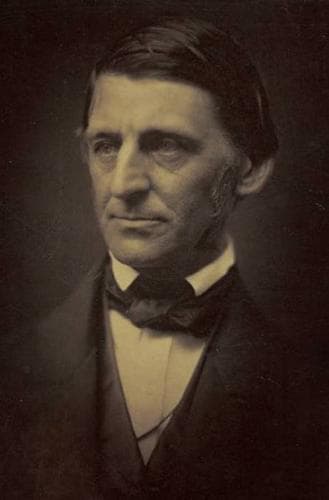
Ralph Waldo Emerson

Ralph Waldo Emerson, who went by his middle name Waldo, was an American essayist, lecturer, philosopher, abolitionist, and poet who led the transcendentalist movement of the mid-19th century. He was seen as a champion of individualism and a prescient critic of the countervailing pressures of society. Friedrich Nietzsche considered him "the most gifted of the Americans" and Walt Whitman referred to him as his "master".