“For the whole of Greece, my child, gazes on you, and for you the fleet is gathered, and for you, if you are sacrificed, Troy will be sacked.”
— Agamemnon explains to Iphigenia why her sacrifice is necessary.


Euripides (1831)
Genre
History
Reading Time
90 min
Key Themes
See below
Sign in to track this book
To launch a thousand ships, King Agamemnon must silence a daughter's scream, twisting a heroic war into a heart-wrenching family sacrifice.
“For the whole of Greece, my child, gazes on you, and for you the fleet is gathered, and for you, if you are sacrificed, Troy will be sacked.”
— Agamemnon explains to Iphigenia why her sacrifice is necessary.
“It is not for us, women, to contend with men in arms.”
— Clytemnestra laments her powerlessness against Agamemnon and the army.
“But if I die, I shall leave behind me a glory which will never perish.”
— Iphigenia, having accepted her fate, finds nobility in it.
“Oh, my child, a bitter marriage this, a bitter return from Troy!”
— Clytemnestra mourns the impending sacrifice of Iphigenia, seeing it as a tragic outcome of the Trojan expedition.
“It is right that Greeks should rule barbarians, but not barbarians Greeks.”
— Achilles, initially defending Iphigenia, echoes a common Greek sentiment about cultural superiority.
“For it is not just to kill a virgin at the altar.”
— Achilles argues against the sacrifice, highlighting its moral transgression.
“What is terrible is not death, but the fear of death.”
— Iphigenia, in a moment of acceptance, reflects on her impending doom.
“My father, you were my life, and now you are my death.”
— Iphigenia confronts Agamemnon about his decision to sacrifice her.
“A man must obey the will of the gods, even if it is bitter.”
— Agamemnon justifies his decision, citing divine will and necessity.
“For a woman, silence is a crown.”
— A common ancient Greek proverb, implicitly reflected in the limited agency of female characters.
“The army has the power, not I.”
— Agamemnon expresses his helplessness against the demands of the assembled Greek forces.
“It is a noble thing to die for one's country.”
— Iphigenia embraces the idea of her sacrifice as a patriotic act.
“Oh, what a bitter thing is necessity!”
— Clytemnestra laments the unavoidable circumstances driving the tragedy.
“Better to marry a good man than to be sacrificed to the winds.”
— Clytemnestra expresses a mother's desire for her daughter's normal life over a brutal death.
Ready to see how well you understood this book? Take our interactive quiz with 10 questions.
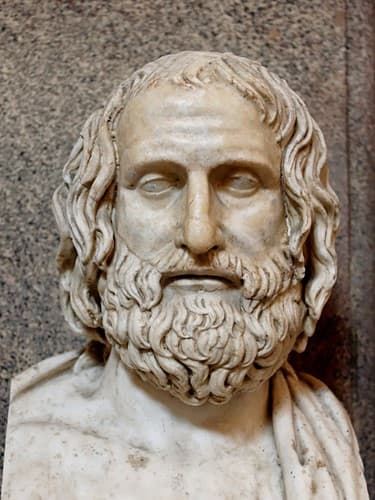
Euripides was a tragedian of classical Athens. Along with Aeschylus and Sophocles, he is one of the three ancient Greek tragedians for whom any plays have survived in full. Some ancient scholars attributed ninety-five plays to him, but the Suda says it was ninety-two at most. Of these, eighteen or nineteen have survived more or less complete. There are many fragments of most of his other plays. More of his plays have survived intact than those of Aeschylus and Sophocles together, partly because his popularity grew as theirs declined—he became, in the Hellenistic Age, a cornerstone of ancient literary education, along with Homer, Demosthenes, and Menander.

Michael S. Heiser
4.5

Winston S. Churchill
4.5

Will Durant
4.4

Sigurd F. Olson
4.4
Thomas Sowell
4.4

Emmanuel Guibert
4.3

W.E.B. Du Bois
4.3

Joseph Campbell
4.3