BookBrief
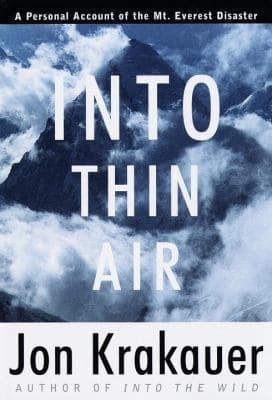
Into Thin Air: A Personal Account of the Mount Everest Disaster cover
Archivist's Choice

Into Thin Air: A Personal Account of the Mount Everest Disaster

Jon Krakauer (1997)

Genre

Lifestyle / Biography / Memoir / History

Reading Time

12 Minutes

Key Themes

See below

Track Your Reading

Sign in to track this book

On May 10, 1996, ambition and a sudden, violent storm turned Mount Everest into a deadly trap, leaving Jon Krakauer to tell the harrowing story of a disaster that took lives and shattered climbers' dreams.

Core Idea

Jon Krakauer's "Into Thin Air" is a harrowing first-person account of the tragic 1996 Mount Everest climbing season, focusing on the disastrous events of May 10-11. As a journalist on assignment for Outside magazine, Krakauer was part of one of the commercial expeditions that aimed to summit Everest. The book meticulously reconstructs the chain of events, human errors, and environmental factors that led to the deaths of multiple climbers, including experienced guides, during a severe blizzard. Krakauer delves into the psychological pressures, competitive drive, and inherent dangers of high-altitude mountaineering, questioning the commercialization of Everest and the ethical responsibilities of expedition leaders.
Difficulty
Medium

Core idea

The central argument and framework that powers the entire book.

Jon Krakauer's "Into Thin Air" is a harrowing first-person account of the tragic 1996 Mount Everest climbing season, focusing on the disastrous events of May 10-11. As a journalist on assignment for Outside magazine, Krakauer was part of one of the commercial expeditions that aimed to summit Everest. The book meticulously reconstructs the chain of events, human errors, and environmental factors that led to the deaths of multiple climbers, including experienced guides, during a severe blizzard. Krakauer delves into the psychological pressures, competitive drive, and inherent dangers of high-altitude mountaineering, questioning the commercialization of Everest and the ethical responsibilities of expedition leaders.

At a glance

Difficulty

Medium

Key Takeaways

1

The Allure and Peril of Everest

Everest's mystique draws individuals, often blinding them to its inherent, brutal dangers.

Quote

Climbing Everest is an intrinsically irrational act—a triumph of desire over sensibility.

Krakauer shows that Everest is a test of human ambition, where the line between wanting to succeed and destroying oneself blurs. The book details the complex reasons climbers go—from personal glory to escaping ordinary lives—and how these desires often override good judgment about risk. This is the book's strongest idea, showing how the mountain's famous status creates a strong psychological pull, leading people to ignore clear dangers. The extreme physical and mental strain, combined with the harsh environment, turns what seems like ...

Supporting evidence

Krakauer's own initial excitement and subsequent disillusionment, as well as the diverse backgrounds of the climbers, all drawn to the same perilous peak.

Apply this

Before embarking on high-stakes endeavors, rigorously assess motivations and potential blind spots, ensuring ambition doesn't overshadow objective reality.

2

Commercialization's Corrosive Impact

The commodification of Everest access diluted safety standards and increased risk.

Quote

The problem, in a nutshell, is that the very things that make Everest such an irresistible challenge—its remoteness, its extreme altitude, its unforgiving climate—also make it an extremely dangerous place to do business.

Krakauer examines how commercial guiding changed Everest climbing. The pressure to get clients to the top, no matter their experience or the weather, created a dangerous situation. Guides, motivated by money and reputation, often pushed too far, while clients, paying a lot, felt they deserved to reach the summit. This shift from experienced mountaineers leading expeditions to a client-service model brought inexperienced climbers into a deadly place, overloading the system and weakening the group's safety standards. The book argues tha...

Supporting evidence

The multiple expeditions (Adventure Consultants, Mountain Madness) operating simultaneously, the fixed ropes becoming overcrowded, and the varying skill levels of clients.

Apply this

When evaluating commercial services in high-risk environments, scrutinize their safety protocols, guide-to-client ratios, and the actual experience level of staff, prioritizing safety over perceived value.

3

Leadership Failures and Flawed Decisions

Even experienced leaders succumbed to summit fever and poor judgment under pressure.

Quote

On Everest, there were no second chances, no opportunities to learn from your mistakes. It was too late once you made a bad decision.

A key part of the story is the series of leadership errors that added up, each one leading to the disaster. Krakauer explains how even experienced guides like Rob Hall and Scott Fischer made serious mistakes. These included sticking to summit deadlines despite bad weather, not enforcing turnaround times enough, and being too confident in their ability to control things. The book suggests that the huge pressure to succeed, along with the effects of altitude, hurt their decision-making. This point is especially sad because it shows that...

Supporting evidence

Rob Hall's decision not to turn back despite the late hour and worsening weather, and Scott Fischer's deteriorating health and inability to lead effectively.

Apply this

In high-stakes leadership roles, cultivate a culture of open communication where dissent is encouraged, establish clear contingency plans, and prioritize well-being over arbitrary deadlines.

4

The Treachery of Altitude

High altitude profoundly impairs judgment, exacerbating risks and blurring reality.

Quote

At 29,028 feet, the world is a different place. The air is so thin that the brain is starved of oxygen, and even the simplest tasks become monumental endeavors.

Krakauer describes the bad effects of high altitude, especially above 8,000 meters, called the 'Death Zone.' He details how lack of oxygen, dehydration, and exhaustion severely harm thinking, judgment, memory, and movement. This physical toll makes good decision-making very hard, leading to mistakes that would be impossible at lower heights. The book argues that the mountain itself, through its extreme conditions, becomes an enemy, weakening climbers' ability to protect themselves. This idea is important for understanding why seemingl...

Supporting evidence

Krakauer's own struggles with clear thought on the summit, the disorientation experienced by various climbers, and the slow, deliberate movements required for even simple actions.

Apply this

In any physically demanding or high-stress environment, recognize and account for the physiological limitations on cognitive function, implementing protocols to mitigate impaired judgment.

5

The Unpredictability of Nature

Despite planning, nature's raw power can render human efforts tragically futile.

Quote

No matter how much we wanted it, how badly we thought we deserved it, the mountain had the final say.

A main idea is that nature is more powerful than human ambition. The book explains that even with good equipment, careful planning, and experienced guides, a sudden, violent change in weather can cancel all preparations. The deadly blizzard on May 10th was largely unexpected in its strength, catching many expeditions off guard. Krakauer's story stresses that while human errors contributed to the disaster, the sheer, uncaring power of Everest's weather was the main cause of the many deaths. This argument is a strong reminder of how vul...

Supporting evidence

The sudden and devastating blizzard that descended on the mountain, trapping climbers high on the slopes and making descent impossible.

Apply this

Always build significant buffers and contingency plans for natural variables in any outdoor or complex project, recognizing that some elements are beyond human control.

6

The Subjectivity of Truth

Trauma and differing perspectives create fragmented, conflicting accounts of shared events.

Quote

Memory, I’ve learned, is an incredibly unreliable narrator.

Krakauer, a journalist there during the disaster, deals a lot with how faulty memory can be and how hard it is to write an objective story. He admits his own biases, how trauma affected his memories, and the different stories from other survivors. This layer of self-reflection is one of the book's most interesting parts, showing that even witnesses struggle to put together a clear truth, especially under extreme stress. This argument has big implications for understanding historical events and personal stories, showing how individual ...

Supporting evidence

Krakauer's detailed footnotes and postscripts addressing discrepancies between his initial reporting and later revelations, particularly regarding Anatoli Boukreev's actions.

Apply this

When evaluating complex events or personal narratives, be critical of single perspectives, seek multiple sources, and acknowledge the inherent subjectivity influenced by experience and memory.

7

Moral Dilemmas in the Death Zone

Survival instincts clash with ethical obligations, forcing impossible choices.

Quote

The line between helping and endangering oneself was perilously thin at 28,000 feet.

The book puts readers into the difficult ethical choices climbers faced in the Death Zone. Krakauer tells about times when people had to decide whether to help a struggling friend, possibly risking their own survival, or to prioritize their own descent. The extreme conditions strip away normal social rules, revealing basic human instincts. This is a strong look at the limits of helping others and the brutal calculations of survival. While some acts of amazing bravery and self-sacrifice happened, the story also shows the sad fact that,...

Supporting evidence

The abandonment of various climbers, including Doug Hansen, and the subsequent guilt experienced by those who survived, as well as Anatoli Boukreev's controversial decision to descend without clients.

Apply this

In extreme situations, anticipate moral conflicts and consider pre-established ethical guidelines, understanding that human behavior under duress can deviate significantly from normal standards.

8

The Illusion of Control

Human attempts to conquer nature are often met with nature's ultimate, humbling power.

Quote

We were not conquering the mountain, we were merely guests, permitted to trespass for a brief, terrifying interval.

This point summarizes the book's main message: the arrogance of thinking humans can 'conquer' Everest. Krakauer details the careful preparations, advanced gear, and huge financial investment, yet ultimately shows that these only create a fragile idea of control. The mountain, with its unpredictable weather, extreme altitude, and harsh terrain, stays untamable. The disaster is a clear reminder that while humans can climb to great heights, they do so with the mountain's permission, not by dominating it. This is a strong comment on the h...

Supporting evidence

Despite all the preparation and technology, the storm overwhelmed the climbers, demonstrating the limits of human control over the elements.

Apply this

Approach ambitious projects, especially those involving powerful natural forces, with humility and a deep respect for external variables, rather than assuming complete mastery.

9

Grief, Guilt, and Lingering Trauma

Survivors carry profound psychological scars, grappling with loss and their role in the tragedy.

Quote

I had been spared, and I felt a crushing burden of guilt.

Beyond the immediate physical dangers, Krakauer explores the severe psychological damage the disaster caused its survivors. He openly discusses his own crippling guilt, survivor's remorse, and the difficulty of processing such a traumatic event. The book shows how the experience left lasting scars, affecting relationships and mental health long after the descent. This part is important for understanding the full human cost of such expeditions, going far beyond the deaths. It highlights that 'survival' on the mountain often turns into ...

Supporting evidence

Krakauer's personal struggle with guilt and depression, the strained relationships among survivors, and the lasting impact on families of the deceased.

Apply this

In the wake of traumatic events, prioritize mental health support for survivors, recognizing that psychological wounds can be as debilitating as physical ones and require dedicated attention.

10

The Media's Role and Responsibility

Media presence on Everest complicates events and shapes public perception, sometimes inaccurately.

Quote

I was there as a journalist, and that role, I quickly discovered, was a double-edged sword.

Krakauer's unique role as both a participant and a journalist offers a critical look at how media influences big events. He was initially sent by Outside magazine to report on Everest's commercialization, a role that gave him access but also created an ethical problem. His presence, and that of other media, added more pressure to the expeditions. Also, his first reports, written under extreme stress and based on incomplete information, contributed to public stories that later proved to be disputed or wrong. This self-critical look a...

Supporting evidence

Krakauer's initial article for Outside magazine and his subsequent efforts to correct and expand upon it in the book, addressing discrepancies and criticisms.

Apply this

As media consumers, be aware of the context and pressures under which news is gathered, especially in high-stress or remote environments, and seek out diverse perspectives for a more complete understanding.

Critical analysis

Notable Quotes

Quiz

Test Your Knowledge

Ready to see how well you understood this book? Take our interactive quiz with 10 questions.

10
Questions
~5
Minutes
?
Best Score

Key Questions (FAQ)

Into Thin Air is Jon Krakauer's firsthand account of the disastrous 1996 Mount Everest climbing season. It details the harrowing events of a severe storm that trapped climbers on the summit, leading to multiple fatalities and near-death experiences.

About the author