BookBrief
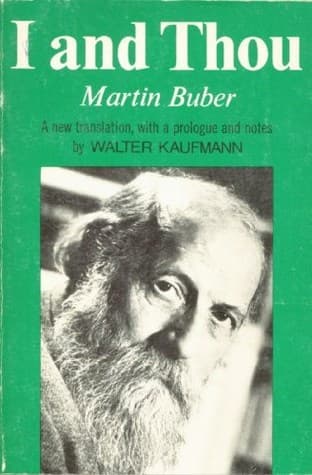
I and Thou cover
Archivist's Choice

I and Thou

Martin Buber

Genre

Psychology / Spirituality / Philosophy

Reading Time

240 min

Key Themes

See below

Track Your Reading

Sign in to track this book

True meaning comes from 'I-Thou' relationships, not detached observation, leading to connection with the Divine.

Core Idea

Martin Buber's 'I and Thou' explains that human life involves two basic ways of relating: I-It and I-Thou. The I-It way treats others, objects, and experiences as things to use or understand. The I-Thou way, however, is a direct meeting where the other is seen as a whole, unique being. This 'dialogical' idea states that real life, meaning, and spirituality are found only in I-Thou meetings, which are marked by shared presence and a full focus on the other. The book says that while the I-It world of daily life is necessary, living only in I-It leads to feeling alone and without purpose. Real humanity and the path to the 'Eternal Thou' (God) come from having I-Thou relationships.
Reading time
240 min
Difficulty
Hard
✓ Read this if...
You are interested in the philosophical and spiritual foundations of human relationships, seeking a deeper understanding of genuine encounter versus objectification, or exploring a unique perspective on the nature of God and self.
✗ Skip this if...
You prefer empirical psychology, a linear narrative, or a light read. This book is dense, poetic, and requires careful, reflective engagement.

Core idea

The central argument and framework that powers the entire book.

Martin Buber's 'I and Thou' explains that human life involves two basic ways of relating: I-It and I-Thou. The I-It way treats others, objects, and experiences as things to use or understand. The I-Thou way, however, is a direct meeting where the other is seen as a whole, unique being. This 'dialogical' idea states that real life, meaning, and spirituality are found only in I-Thou meetings, which are marked by shared presence and a full focus on the other. The book says that while the I-It world of daily life is necessary, living only in I-It leads to feeling alone and without purpose. Real humanity and the path to the 'Eternal Thou' (God) come from having I-Thou relationships.

At a glance

Reading time

240 min

Difficulty

Hard

Read this if...

You are interested in the philosophical and spiritual foundations of human relationships, seeking a deeper understanding of genuine encounter versus objectification, or exploring a unique perspective on the nature of God and self.

Skip this if...

You prefer empirical psychology, a linear narrative, or a light read. This book is dense, poetic, and requires careful, reflective engagement.

Key Takeaways

1

The Two Fundamental Attitudes: I-It vs. I-Thou

Existence is experienced through objectification or genuine encounter.

Quote

The world as experience belongs to the primary word I-It. The primary word I-Thou establishes the world of relation.

Buber says there are two basic ways to relate to the world: I-It and I-Thou. The I-It way is about experience and use, where 'It' is an object, idea, or thing that can be sorted, studied, and handled. It is a world where things are means to an end, and even people can be treated as 'Its' – tools for our goals or subjects for our observation. In contrast, the I-Thou way is a direct, immediate meeting where the 'Thou' is not just an object but a unique, whole being met completely. This relationship involves shared presence and a full fo...

Supporting evidence

Buber's entire philosophical framework is built upon this foundational distinction, illustrating it through examples ranging from relating to a tree, an animal, or another human being.

Apply this

Become acutely aware of your current mode of relating. When interacting with others, pause and consciously choose to see them not as a role or a means to an end, but as a unique, whole 'Thou.' Practice truly listening without an agenda, allowing the other to reveal themselves.
i-iti-thoudialogical-principle
2

Genuine Life Resides in Relationship

Meaning and fulfillment emerge from authentic I-Thou encounters, not isolated experience.

Quote

Meaning is to be found in the between.

Buber strongly argues that individual experience or thinking alone cannot lead to a full and meaningful life. True meaning, he says, is not an inner state or a solo pursuit but comes from the 'between' – in the space of real meeting and relationship. The 'I' only truly becomes 'I' in relation to a 'Thou.' This is not just social interaction, but a deep, mutual turning of beings toward each other, where each sees the other's unique existence without reducing them to an object. Life's richness is in these moments of presence, where the ...

Supporting evidence

Buber emphasizes that even our relationship with nature or art can be an I-Thou, and that these encounters bring 'meaning into the world.' He often uses the example of a person truly seeing a tree, not as a botanical specimen but as a unique, living presence.

Apply this

Actively seek out opportunities for genuine connection. Prioritize face-to-face interactions where you can be fully present. Engage in activities that foster mutuality and shared creation, rather than just consumption or individual achievement. Reflect on moments of deep connection and identify what made them 'meaningful.'

the-betweenmutualityauthenticity
3

The Eternal Thou: God as Ultimate Relationship

All I-Thou relations are ultimately glimpses of the divine, the 'Eternal Thou.'

Quote

Every particular Thou is a glimpse through to the Eternal Thou.

For Buber, God is not a distant idea but the 'Eternal Thou' – the ultimate, always-present partner in dialogue. While we have I-Thou relationships with specific beings (people, nature, art), these are not ends in themselves but act as 'gateways' or 'glimpses' into the endless relationship with the Eternal Thou. Every real I-Thou meeting, with its directness, wholeness, and mutuality, connects with the divine. It is through these limited relationships that we become aware of the infinite, the 'Thou' that can never become an 'It.' This ...

Supporting evidence

Buber explicitly states that 'God is the great Thou whom we never cease to address, whom we never cease to meet.' He argues that even those who reject the concept of God still encounter the 'Eternal Thou' in moments of profound, unmediated connection.

Apply this

When you experience a truly profound I-Thou moment with another person, nature, or art, pause and consider its sacred dimension. Recognize that these moments are not isolated but connected to a larger, universal 'Thou.' Cultivate an attitude of reverence and openness in all your relationships, seeing them as potential pathways to the divine.

eternal-thoudivine-encounterrelational-theology
4

The Necessity of Turning: From It to Thou

Genuine encounter requires a conscious shift from objectification to openness.

Quote

The primary word I-Thou can only be spoken with the whole being.

Moving from an I-It to an I-Thou relationship is not passive; it requires a conscious and active 'turning' of one's whole self. This turning means letting go of old ideas, categories, and useful intentions that make the other an object. It means giving up the urge to analyze, control, or own, and instead, opening oneself completely to the other's unique presence. The 'It' world is one we experience and use, while the 'Thou' world is one we enter with our whole self, without holding back. This turning is a risk, as it involves being op...

Supporting evidence

Buber illustrates this 'turning' with the example of observing a tree: one can analyze its species, height, and economic value (I-It), or one can 'be seized' by its presence, encountering it as a unique, whole being (I-Thou). The latter requires a complete shift in attitude.

Apply this

Before a significant conversation or interaction, take a moment to 'turn' your being towards the other. Release your agenda, judgments, and expectations. Practice truly seeing and hearing the other without immediately categorizing or responding. Be present with your whole self, not just your analytical mind.

turningpresencevulnerability
5

I-It is Necessary, But Not Sufficient

The world of objects and experience is essential for survival, but not for meaning.

Quote

Man cannot live without It, but he who lives only with It is not a man.

Buber does not suggest completely abandoning the I-It relationship. He acknowledges that the 'It' world – the world of experience, analysis, categorization, and use – is necessary for practical life, survival, and society. We need to categorize objects, plan actions, and interact with the world in a useful way to live daily life. However, the danger is in making the I-It the only way of relating. When people, nature, or even ideas are always treated as 'Its,' life loses its depth, meaning, and basic humanity. The I-It provides the s...

Supporting evidence

Buber explains that science, technology, and all forms of objective knowledge operate within the I-It realm. While invaluable, they cannot provide ultimate meaning or genuine connection.

Apply this

Recognize the appropriate domains for I-It. When performing routine tasks, problem-solving, or acquiring knowledge, embrace the efficiency of I-It. However, consciously create space in your life for I-Thou moments, especially in your most important relationships. Don't let the practical demands of the 'It' world eclipse the need for genuine connection.

instrumentalityalienationpragmatism
6

Language Reflects Relational Mode

Our words reveal whether we are engaging with an 'It' or a 'Thou.'

Quote

The primary word I-Thou can only be spoken with the whole being. The primary word I-It can never be spoken with the whole being.

Buber states that the structure of language shows our basic ways of relating. The 'primary words' are not single words but pairs: I-Thou and I-It. The 'I' of 'I-Thou' is different from the 'I' of 'I-It.' When we speak 'I-Thou,' our whole self is involved, and the language is direct, present, and mutual. It is language that recognizes the other's unique existence. When we speak 'I-It,' our 'I' is separate, observing, and categorizing, and the language is descriptive, analytical, and useful. This idea shows how deeply our way of relatin...

Supporting evidence

Buber's choice of 'Thou' for the genuine relation, despite its archaic nature, was deliberate in the original German to emphasize a direct, personal address distinct from the objective 'It.' Kaufmann's translation clarifies this nuance.

Apply this

Pay close attention to your own language and the language of others. Do your words reflect genuine engagement and respect for the other's wholeness, or do they objectify, categorize, or manipulate? Practice using direct, personal language that acknowledges the other as a unique individual, fostering an I-Thou atmosphere in your conversations.

dialogical-languagecommunication-modesauthenticity-in-speech
7

The Inevitable Fall Back to It

I-Thou moments are transient; the 'Thou' must inevitably become an 'It.'

Quote

Every Thou in our world is doomed to become an It.

A key, and perhaps sad, part of Buber's philosophy is that I-Thou relationships are not permanent. A 'Thou' cannot stay a 'Thou' forever; it naturally 'falls back' into being an 'It.' This is not a failure of the relationship but a basic part of human life. Once a meeting has passed, the 'Thou' becomes an object of memory, thought, or analysis – an 'It' that can be recalled, studied, or added to our experience. This cycle from Thou to It and the constant chance for new Thou meetings is life's rhythm. The challenge is not to stop the f...

Supporting evidence

Buber uses the example of a finished work of art: while its creation might have been an I-Thou process, once complete, it becomes an 'It' that can be analyzed, admired, or sold. The same applies to relationships that evolve over time.

Apply this

Cherish moments of genuine I-Thou connection, knowing they are precious and fleeting. Don't cling to them, but allow them to transform into memories (Its) that enrich your life. Cultivate an ongoing openness to new encounters, understanding that the 'Thou' will always emerge from the 'It' in unexpected ways.

transiencecyclical-existencememory
8

The Dangers of a World of Pure It

When all becomes 'It,' humanity faces alienation, meaninglessness, and spiritual death.

Quote

If a man is content with 'experience' and does not want to transcend it, he will be crushed by it.

Buber warns about the results of a society dominated by the I-It mode. When everything, including people, is reduced to an object of experience, analysis, or use, people become deeply lonely. Relationships become transactions, without real connection. Meaning disappears, replaced by a constant search for acquiring and controlling. This leads to spiritual emptiness, where individuals feel alone even in crowds, and life loses its inherent value. The 'It' world, while efficient, cannot provide the 'between' where true meaning lies. A wor...

Supporting evidence

Buber's work, written in the shadow of two world wars, implicitly critiques the instrumentalization of human beings and the rise of totalitarian regimes that treated entire populations as 'Its.' He saw the consequences of a world without 'Thou.'

Apply this

Actively resist the temptation to reduce people, nature, or even yourself to mere 'Its.' Challenge systems and ideologies that promote objectification. Advocate for human connection, empathy, and dialogue in your personal and professional life. Recognize the symptoms of an 'It'-dominated society and consciously choose to foster 'Thou' relations.

dehumanizationexistential-crisissocietal-critique
9

The Universal Call to Relation

The capacity for I-Thou is innate and essential to being human.

Quote

The inborn Thou is realized in the actual Thou.

Buber suggests that the ability for I-Thou relationships is not just learned but an inborn human drive, an 'inborn Thou.' From birth, humans seek connection and meeting, trying to move beyond mere experience to real relationship. This natural desire for connection is what makes us truly human. While society and individual choices can suppress this ability, the potential for dialogue and mutual meeting remains. It is a basic part of who we are, a universal call to engage with the world and others not just as objects, but as fellow bein...

Supporting evidence

Buber discusses the development of a child, noting their initial direct, undifferentiated relation to the world (a nascent 'Thou') before the gradual emergence of the 'It' world through experience and categorization.

Apply this

Trust your innate desire for genuine connection. Actively nurture and protect your capacity for empathy and openness. Recognize this drive in others, even when obscured by layers of 'It' behavior. Seek out environments and practices that foster the 'inborn Thou' in yourself and your community.

innate-drivehuman-naturepotential-for-relation
10

The Risk and Grace of Encounter

I-Thou is a leap of faith, a gift that transforms, not a predictable outcome.

Quote

The Thou meets me through grace – it is not found by seeking.

Entering an I-Thou relationship is an act of deep risk and openness. It means dropping defenses, giving up control, and opening oneself to the unknown. There is no guarantee that the 'Thou' will respond in kind, or that the meeting will be what we expect. Yet, Buber stresses that the 'Thou' is also a gift, a moment of 'grace' that cannot be forced or demanded, but only received. It is not 'found by seeking' in a useful way, but appears when we are truly present and open. This element of grace highlights the unpredictable, almost mirac...

Supporting evidence

Buber repeatedly uses terms like 'grace' and 'meeting' to describe the 'Thou' encounter, highlighting its spontaneous and unbidden quality, contrasting it with the deliberate 'experience' of the 'It' world.

Apply this

Embrace vulnerability in your interactions, understanding that genuine connection requires openness and a willingness to be affected. Release the need to control outcomes in relationships. Approach encounters with an attitude of receptive presence, allowing the 'Thou' to reveal itself as a gift, rather than something you must achieve or extract.

gracevulnerabilityleap-of-faith

Critical analysis

Notable Quotes

The I-Thou relation has its living effective fullness in the present. The I-It relation, on the other hand, is rooted in the past.

Distinguishing between the two fundamental modes of human existence.

The Thou meets me through grace—it is not found by seeking. But it is by my stepping forth that I enter into the relation with it.

Describing the nature of encountering the Thou and the role of human agency.

All real living is meeting.

A concise summary of Buber's core philosophy on the essence of life.

The primary word I-Thou can only be spoken with the whole being. The primary word I-It can never be spoken with the whole being.

Highlighting the commitment and totality required for genuine encounter.

Through the Thou a man becomes I.

Emphasizing that self-discovery and true identity are forged through relation.

The extended lines of relations meet in the eternal Thou.

Suggesting that all particular I-Thou encounters point towards a transcendent, ultimate Thou.

Man's world is not a world of things but a world of relations.

Challenging a purely object-oriented view of reality.

Without It man cannot live. But he who lives with It alone is not a man.

Acknowledging the necessity of the I-It world for practical living, while warning against its exclusive embrace.

The relation to the Thou is direct. No system of ideas, no set of feelings, no tradition needs to stand between I and Thou.

Stressing the unmediated nature of the I-Thou encounter.

Every 'Thou' is destined to become an 'It.'

Describing the inevitable movement from encounter to objectification in human experience.

The true community is not a community of common ideals, but a community of common relations.

Redefining the basis of genuine human community.

Where there is no longer a Thou, there is no longer an I.

Underscoring the reciprocal and co-dependent nature of self and other in relation.

Love is a cosmic force. For those who stand in love, and for them alone, the world is not a thing but a reality.

Connecting love to the capacity for genuine I-Thou encounter and perceiving true reality.

The soul knows its Thou when it knows itself as I.

Linking self-awareness to the capacity for genuine encounter with the other.

Quiz

Test Your Knowledge

Ready to see how well you understood this book? Take our interactive quiz with 10 questions.

10
Questions
~5
Minutes
?
Best Score

Key Questions (FAQ)

The core idea is that humans relate to existence in two fundamental ways: as 'I-It' (experiencing or using an object) or as 'I-Thou' (entering into a boundless, mutual relationship). Meaningful life, Buber argues, is found in the 'I-Thou' relationship.

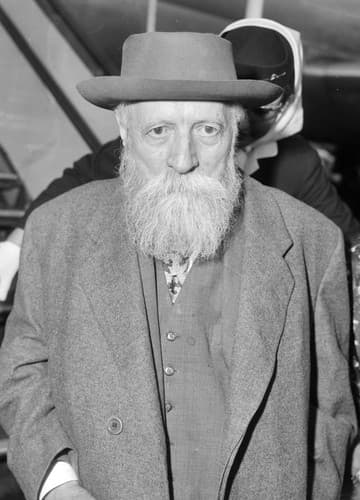
About the author