BookBrief
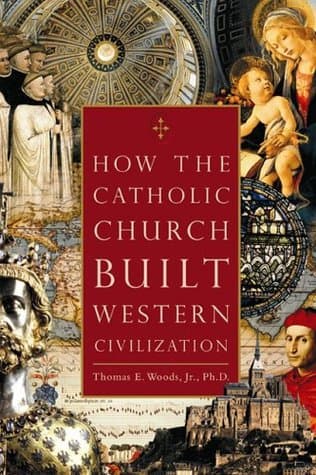
How the Catholic Church Built Western Civilization cover
Archivist's Choice

How the Catholic Church Built Western Civilization

Thomas E. Woods Jr. (2005)

Genre

History / Spirituality

Reading Time

6-8 hours

Key Themes

See below

Track Your Reading

Sign in to track this book

Beyond corruption, discover how the Catholic Church, often overlooked, actually laid the foundational stones for Western civilization's greatest achievements, from modern science and free-market economics to universities and human rights.

Core Idea

This book argues that the Catholic Church, far from hindering progress, built and preserved Western Civilization. It removes common misconceptions by showing the Church's contributions across many fields, including universities, scientific methods, international law, economic thought, classical knowledge, charity, and art. Woods states that many parts of modern Western society come directly from Catholic intellectual and practical work.
Reading time
6-8 hours
Difficulty
Medium
✓ Read this if...
You are interested in a revisionist history of the Catholic Church's role in Western development, seeking to understand its positive contributions to science, education, law, and culture.
✗ Skip this if...
You prefer a secular-centric view of history, are not open to arguments challenging conventional narratives about the Church, or are looking for a critical examination of its controversies.

Core idea

The central argument and framework that powers the entire book.

This book argues that the Catholic Church, far from hindering progress, built and preserved Western Civilization. It removes common misconceptions by showing the Church's contributions across many fields, including universities, scientific methods, international law, economic thought, classical knowledge, charity, and art. Woods states that many parts of modern Western society come directly from Catholic intellectual and practical work.

At a glance

Reading time

6-8 hours

Difficulty

Medium

Read this if...

You are interested in a revisionist history of the Catholic Church's role in Western development, seeking to understand its positive contributions to science, education, law, and culture.

Skip this if...

You prefer a secular-centric view of history, are not open to arguments challenging conventional narratives about the Church, or are looking for a critical examination of its controversies.

Key Takeaways

1

Science's Unsung Midwife

The Catholic Church, not its enemy, fostered the birth of modern science.

Quote

Far from being an enemy of science, the Church was its primary patron and inspiration, providing the intellectual framework and institutional support necessary for its development.

A common idea shows the Catholic Church as an enemy of scientific progress, especially in post-Enlightenment stories. Woods strongly challenges this, arguing the Church not only tolerated but actively helped start modern science. The medieval scholastic tradition, rooted in Catholic thought, stressed reason and the universe's order, seeing it as God's rational creation. This theological idea provided the belief that the natural world could be studied and understood through systematic inquiry. The Church's universities, its promotion o...

Supporting evidence

Woods highlights figures like Roger Bacon and Robert Grosseteste, medieval scholars and clerics who championed experimental methods and mathematical reasoning. He also points to the Church's establishment of universities, which became centers of scientific inquiry, and the theological argument that a rational God created a rational universe, thus making scientific investigation a form of divine understanding.

Apply this

When evaluating historical narratives, question prevailing assumptions about the relationship between faith and reason. Recognize that institutions often play complex, multifaceted roles that defy simplistic categorization. Seek out primary sources and diverse perspectives to form a more nuanced understanding of historical developments, particularly those with strong ideological biases.

scholasticismmedieval-universitiesfaith-and-reason
2

The University's Holy Roots

The university, a cornerstone of Western education, was a Catholic invention.

Quote

The university, an institution that became the model for higher education worldwide, was a distinctively European and, more specifically, a distinctively Catholic invention.

The modern university, with its departments, degrees, and structured courses, comes directly from institutions the Catholic Church started in the High Middle Ages. Before the Church, organized higher learning was often limited to monastic schools or informal apprenticeships. Universities arose from the need for systematic theological and legal training but quickly grew to include arts, medicine, and other subjects. These institutions supported intellectual freedom (within limits) and the search for truth through reasoned inquiry, crea...

Supporting evidence

Woods details the founding of early universities like Bologna, Paris, and Oxford, emphasizing their origins in cathedral schools and the papal bulls that granted them charters, privileges, and autonomy. He notes the development of academic degrees (bachelor's, master's, doctorate) and the collegiate system.

Apply this

Appreciate the historical depth of educational institutions. Understand that even seemingly secular pillars of society can have profound religious origins. Support institutions that prioritize intellectual inquiry and the pursuit of truth, recognizing the long tradition they uphold. Consider how foundational values, even if no longer explicitly religious, continue to shape modern educational practices.

medieval-educationacademic-freedomcathedral-schools
3

Pre-Smithian Economics

Catholic scholars developed sophisticated economic theories centuries before Adam Smith.

Quote

Long before Adam Smith, Catholic thinkers were developing sophisticated economic theories, including concepts of just price, private property, and even the laws of supply and demand.

The usual story often credits Adam Smith with starting modern economics in the 18th century. Woods, however, shows that a strong tradition of economic thought existed within the Catholic Church, especially among the Scholastics, centuries earlier. Thinkers like the School of Salamanca carefully analyzed concepts such as fair price, interest, private property, and the subjective theory of value, predicting many ideas later given to classical economists. Their work was driven by moral theology, aiming to understand economic activity wit...

Supporting evidence

Woods cites the School of Salamanca (16th century), particularly figures like Francisco de Vitoria and Martín de Azpilcueta Navarrus, who explored concepts such as the subjective nature of value, the quantity theory of money, and the moral implications of market activity, influencing later economic thought.

Apply this

Challenge the idea of sudden intellectual breakthroughs; often, ideas evolve over centuries. Recognize the interdisciplinary nature of early thought, where theology, philosophy, and economics were not siloed. Appreciate the ethical dimensions inherent in economic systems and decisions, drawing lessons from historical attempts to integrate morality with market principles.

school-of-salamancajust-priceeconomic-history
4

The True Galileo Affair

The Galileo affair was a complex dispute, not a simple battle of science vs. faith.

Quote

The Galileo affair, often presented as the quintessential clash between science and faith, was in fact a much more complicated story involving personalities, politics, and proper scientific method.

The trial of Galileo Galilei is often used as proof of conflict between the Catholic Church and science. Woods carefully breaks down this simple story, revealing a more detailed reality. The conflict was less about the Church stopping scientific truth and more about Galileo's strong personality, his theological interpretations (he wrote about scripture without permission), and the lack of clear proof for heliocentrism at the time. Many Church scientists supported Galileo's work initially, and the Church itself had a long history of as...

Supporting evidence

Woods details the lack of definitive proof for heliocentrism during Galileo's time, the theological implications Galileo himself introduced, and the political maneuvering involved. He points out that many Jesuit astronomers supported Galileo's observations and that the Church's initial stance was to allow heliocentrism as a mathematical hypothesis.

Apply this

Avoid reductionist interpretations of historical events, especially those used to support contemporary ideological battles. Research the full context, including the personalities, political climate, and scientific understanding of the era. Understand that 'truth' is often a process of gradual discovery, and institutions, like individuals, can make mistakes within complex circumstances.

galileo-galileiscientific-revolutionhistorical-revisionism
5

Law's Ecclesiastical Roots

Western legal traditions, including human rights, emerged from Church canon law.

Quote

The sophisticated legal system of the Catholic Church, canon law, served as a vital model and direct contributor to the development of Western secular law and the very concept of human rights.

The creation of complex legal systems is often seen as a sign of advanced civilization. Woods argues that the Catholic Church's canon law was not just a separate system but a foundational influence on Western secular law. Canon law provided precedents for ideas like due process, fairness, and the rights of the accused. Moreover, the Church's constant emphasis on human dignity, from theological principles, slowly entered legal thought, laying groundwork for later ideas of human rights and the rule of law. This challenges the idea that ...

Supporting evidence

Woods discusses the comprehensive nature of canon law, its systematic organization, and its influence on secular legal systems through legal scholars and courts. He points to the Church's advocacy for the poor, the sanctity of marriage, and the protection of vulnerable populations as examples of its humanizing influence on law.

Apply this

Recognize the deep historical roots of modern legal systems and human rights, understanding that they are not purely secular inventions. Appreciate the enduring influence of moral and religious frameworks on the development of justice. Advocate for legal systems that uphold human dignity and fairness, drawing inspiration from historical precedents that prioritized these values.

canon-lawwestern-lawhuman-rights-history
6

Charity: A Christian Innovation

Organized charity as a virtue and social institution was largely a Catholic contribution.

Quote

The systematic and institutionalized practice of charity, beyond mere individual acts of benevolence, was a distinctively Christian innovation that profoundly humanized Western society.

While individual acts of kindness existed in all societies, Woods states that the idea of organized, systematic charity as a basic social virtue and institution was a unique contribution of Christianity, especially through the Catholic Church. The early Church started hospitals, orphanages, and poorhouses, driven by the theological command to care for the vulnerable and follow Christ's compassion. This was a big change from the often harsh and indifferent social structures of the pagan world. This institutionalization of charity not o...

Supporting evidence

Woods cites the establishment of early hospitals (xenodochia), orphanages, and the role of monastic orders in caring for the sick and poor during the Middle Ages. He contrasts this with the limited and often self-serving charity in pre-Christian societies.

Apply this

Recognize the historical evolution of social welfare and humanitarianism. Appreciate the profound impact of faith-based motivations on the development of social justice. Support and participate in organized charitable efforts, understanding their deep historical and ethical roots. Consider how a society's treatment of its most vulnerable reflects its core values.

christian-charitysocial-welfarehospitals-history
7

Art & Music's Sacred Patron

The Church's patronage fueled the creation of much of Western civilization's greatest art and music.

Quote

The Catholic Church, through its consistent and immense patronage, became the primary engine for the creation of Western civilization's most enduring and beautiful works of art, architecture, and music.

From grand cathedrals to masterful paintings and complex polyphony, the Catholic Church was the single greatest supporter of the arts in Western history. Woods stresses that without this continuous support, much of what we consider the best of Western art would not exist. The Church provided the themes, the money, and the institutional structure for artists, architects, and musicians to develop their skills and create works of great beauty and spiritual depth. This support was not just decorative; it helped express theological truths ...

Supporting evidence

Woods points to Gothic cathedrals, Renaissance masterpieces by Michelangelo and Raphael, Gregorian chant, and the development of polyphony, all directly commissioned or fostered by the Church. He highlights the sheer volume and quality of artistic output driven by religious devotion and patronage.

Apply this

When appreciating art and music, consider the historical context and the motivations of its creators and patrons. Recognize the profound influence of religious belief on cultural production. Support the arts, understanding their capacity to elevate the human spirit and express deep truths, echoing centuries of sacred patronage.

church-patronagegothic-architecturesacred-musicrenaissance-art
8

Monks Preserving Wisdom

Monastic orders were crucial in preserving classical knowledge during the Dark Ages.

Quote

While often overlooked, the monastic orders performed the indispensable task of preserving the intellectual heritage of classical antiquity, without which much of Western knowledge would have been lost forever.

Beyond the dramatic tales of empire and conquest, the quiet work of monks in scriptoria played a very important role in saving Western civilization from intellectual loss during the chaotic post-Roman period. Woods argues that while often acknowledged, the full extent of this contribution is frequently underestimated. Monasteries became key learning centers, where ancient Greek and Roman texts were carefully copied, studied, and preserved. This was not just rote copying; monks often added comments, developed new writing styles, and ma...

Supporting evidence

Woods details the role of Benedictine monasteries, particularly their scriptoria, in copying and preserving classical texts, medical treatises, and philosophical works throughout the early Middle Ages. He highlights figures like Cassiodorus and Benedict of Nursia.

Apply this

Appreciate the importance of preservation and scholarship, even in seemingly 'dark' periods of history. Recognize the often unsung heroes who meticulously maintain and transmit knowledge across generations. Support libraries, archives, and educational institutions as modern-day inheritors of this vital role.

monasticismscriptoriadark-agesclassical-preservation
9

Humanizing the Barbarians

The Church played a pivotal role in civilizing the barbarian tribes of Europe.

Quote

The Catholic Church undertook the immense and often dangerous task of evangelizing and civilizing the Germanic barbarian tribes, transforming them from destructive forces into the foundational peoples of medieval Europe.

After the fall of the Western Roman Empire, Europe faced chaos from barbarian tribes. Woods argues that the Catholic Church was the main force that gradually converted, educated, and brought these groups into a new European civilization. Through missionary efforts, the Church introduced not only Christian doctrine but also Roman law, literacy, and more settled farming practices. It provided a common moral framework and institutional structure that went beyond tribal loyalties, laying the groundwork for kingdoms and eventually nation-s...

Supporting evidence

Woods recounts the conversion of various barbarian kings and tribes, such as Clovis and the Franks, and the role of missionaries like St. Patrick and St. Boniface. He emphasizes how the Church introduced literacy, monastic farming techniques, and a shared moral code to these previously nomadic or tribal societies.

Apply this

Understand the transformative power of shared values and institutions in shaping societies. Recognize the long and often difficult process of cultural assimilation and development. Appreciate the role of moral and religious frameworks in fostering social cohesion and order, even amidst significant cultural differences.

barbarian-invasionschristianization-of-europeearly-middle-ages
10

The Enduring Legacy

Western Civilization's core tenets are deeply indebted to Catholic contributions.

Quote

Many of the defining features of Western Civilization – its science, law, art, economics, and humanitarian spirit – are not merely coincidentally linked to the Catholic Church but are profoundly indebted to its direct contributions and foundational principles.

Woods's main argument concludes that the very structure of Western Civilization, from its intellectual traditions to its social structures, shows the clear mark of the Catholic Church. This is not just about isolated contributions, but a widespread influence that shaped the basic values and institutions that define the West. The emphasis on reason, individual dignity, systematic inquiry, organized charity, and the pursuit of beauty all have deep roots in Catholic thought and practice. To ignore or downplay this connection is to misund...

Supporting evidence

This takeaway synthesizes all previous points, drawing on the evidence presented for the Church's role in science, universities, economics, law, charity, and art. Woods's entire book is a comprehensive argument for this enduring legacy.

Apply this

Engage in critical historical analysis, questioning narratives that simplify complex relationships between institutions and cultural development. Recognize the multi-faceted origins of modern society and avoid presentism. Foster an appreciation for the historical contributions of diverse groups and institutions, even those with which one may not personally identify.

western-civilizationcultural-heritagehistorical-influence

Critical analysis

Notable Quotes

It is simply a fact that the Church has been a patron of the arts, a preserver of classical learning, a founder of universities, a pioneer in charitable work, a shaper of international law, and a tireless advocate for peace and justice.

Introduction, summarizing the Church's broad contributions.

The claim that the Church suppressed science is one of the most persistent myths of modern times. The truth is precisely the opposite: the Church was the greatest single patron of science in history.

Chapter on science, directly refuting a common misconception.

Without the monasteries, much of classical learning would have been lost forever.

Discussing the role of monasticism in preserving ancient texts during the Dark Ages.

The university, as an institution, is a creation of medieval Christian Europe.

Highlighting the Church's foundational role in the development of higher education.

The Church’s teaching on the dignity of the human person, created in God’s image, laid the groundwork for the modern concept of human rights.

Explaining the theological basis for human dignity and rights.

The Gregorian Chant, an enduring masterpiece of sacred music, is a testament to the Church's contribution to the arts.

Discussing the Church's influence on music and artistic expression.

Charity, in the Christian sense, was not merely an act of kindness but a duty flowing from the love of God and neighbor, institutionalized by the Church.

Explaining the unique Christian concept of charity and its institutionalization.

The Church did not merely preserve classical learning; it also absorbed, transformed, and built upon it, creating something new and distinctly Christian.

Emphasizing the dynamic and transformative role of the Church, not just a passive preservation.

The very idea of a 'just war' theory, seeking to limit the horrors of armed conflict, was developed by Christian thinkers.

Discussing the Church's contribution to ethical considerations of warfare.

When we speak of the West, we are speaking of a civilization whose heart and soul were shaped by the Catholic Church.

A powerful summary statement about the profound and pervasive influence of the Church on Western identity.

The Church's emphasis on reason, derived from its theological tradition, was crucial for the development of scientific inquiry.

Countering the myth of conflict between faith and reason, showing how faith fostered reason.

The concept of 'rule of law,' so central to Western political thought, has deep roots in Catholic legal tradition.

Exploring the Church's influence on legal and political systems.

From the development of hospitals to the care of the poor and sick, the Church pioneered social welfare institutions long before the state assumed such responsibilities.

Illustrating the Church's proactive role in social welfare and healthcare.

The aesthetic beauty of Gothic cathedrals is not merely architectural genius but a profound theological statement in stone.

Connecting architectural achievements to their underlying spiritual and theological meaning.

Quiz

Test Your Knowledge

Ready to see how well you understood this book? Take our interactive quiz with 10 questions.

10
Questions
~5
Minutes
?
Best Score

Key Questions (FAQ)

The book argues that the Catholic Church, far from being solely associated with corruption, was the fundamental force behind the development of numerous cornerstones of Western Civilization, including modern science, free-market economics, universities, and the rule of law.

About the author