“When the fox hears the rabbit scream, he comes a-runnin', but not to help.”
— Clarice Starling's internal thought about the nature of predators and those who exploit weakness.

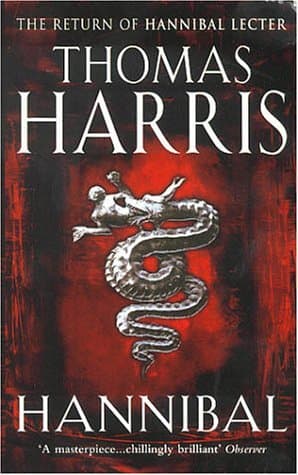
Thomas Harris (1999)
Genre
History / Historical Fiction
Reading Time
12-15 hours
Key Themes
See below
Sign in to track this book
Years after eluding the FBI, Dr. Hannibal Lecter, now a respected curator in Florence, finds his cultured life threatened by a disgraced Clarice Starling, a greedy Italian detective, and the monstrously disfigured Mason Verger, who seeks to feed Lecter to his own ravenous eels as twisted revenge.
FBI Special Agent Clarice Starling leads a botched raid on a rural drug lab in West Virginia. The operation, intended to capture a major drug trafficker, spirals out of control when the suspect, Evelda Drumgo, uses her infant as a human shield before Starling kills her. The incident results in multiple casualties and a public relations nightmare for the FBI. Paul Krendler, a high-ranking official within the Justice Department and Starling's long-standing adversary, uses this opportunity to discredit her. He leaks information to the press, paints Starling as reckless, and orchestrates her suspension from active duty, effectively sidelining her career and leaving her vulnerable.
Meanwhile, Dr. Hannibal Lecter has been living a luxurious and cultured life in Florence, Italy, for seven years, under the assumed identity of Dr. Fell, a brilliant but reclusive scholar and curator of the Capponi Library. He has immersed himself in Renaissance art, classical music, and fine dining, attending operas and meticulously preparing elaborate meals. Lecter enjoys the intellectual stimulation of his new life, engaging in sophisticated discussions and maintaining a meticulously crafted facade of respectability. He rarely kills, preferring to observe and manipulate from a distance, but his dark impulses are never far beneath the surface, occasionally surfacing in his private thoughts and actions.
Across the Atlantic, Mason Verger, a grotesquely disfigured and quadriplegic millionaire, nurses an unquenchable thirst for revenge against Hannibal Lecter. Years ago, Lecter had drugged Verger during a therapy session and convinced him to carve off his own face and feed it to his dogs. Verger survived, but is now confined to a respirator and wheelchair, his only active limb a crab-like hand. He inherited a vast fortune and uses his immense resources to meticulously plan Lecter's capture and a horrifying, drawn-out death. Verger's ultimate fantasy is to feed Lecter alive to his specially bred, monstrous moray eels, a symbol of his own twisted desires.
Amidst her suspension, Clarice Starling receives a cryptic, perfumed letter from Hannibal Lecter, containing a coded message and a drawing of the Duomo in Florence. The letter, seemingly a taunt, reinvigorates her. The FBI, under pressure from Verger's political influence and the public's fascination with Lecter, is forced to re-evaluate Starling's position. Krendler, despite his animosity, is compelled to reinstate her, albeit with a limited mandate: she is to track down Lecter, using her unique understanding of his psychology. This assignment, while a lifeline, also places her directly in Krendler's crosshairs, as he continues to seek her downfall.
In Florence, Inspector Rinaldo Pazzi, an ambitious but corrupt detective, investigates the disappearance of a library curator, Dr. Fell. During his investigation, Pazzi interviews the new curator, Dr. Lecter, and becomes suspicious of his unusual knowledge and refined demeanor. Pazzi eventually cross-references fingerprints and old FBI files, confirming that Dr. Fell is, in fact, the notorious Hannibal Lecter. Driven by greed and the promise of a substantial bounty offered by Mason Verger for Lecter's capture, Pazzi decides to pursue Lecter himself, bypassing official channels and endangering himself and his wife, Allegra.
Pazzi, desperate for Verger's reward, arranges a meeting with Lecter under the pretense of a rare book appraisal. His plan is to drug Lecter and deliver him to Verger's operatives. However, Lecter, ever-perceptive, senses Pazzi's treachery. He cleverly manipulates the situation, turning the tables on the inspector. During a tense confrontation in the Palazzo Capponi, Lecter corners Pazzi, revealing his knowledge of the inspector's corrupt intentions and his ancestors' historical treachery. Lecter then brutally dispatches Pazzi, hanging him from the window of the palazzo, mirroring the fate of Pazzi's ancestor, a clear message to anyone who would betray him.
Following Pazzi's gruesome death, Mason Verger dispatches a team of heavily armed operatives, led by his trusted associate Cordell, to Florence. They are tasked with capturing Lecter alive. Clarice Starling, having deduced Lecter's location from his letter, is also en route, but arrives too late to prevent Lecter's escape. Lecter, aware of the impending danger, meticulously plans his departure, utilizing his knowledge of the city and his cunning to evade Verger's men. He leaves behind a trail of subtle clues and misdirections, continuing his psychological game with Starling, even as he flees. The chase intensifies, shifting from the ancient streets of Florence to the United States.
Hannibal Lecter successfully makes his way back to the United States, carefully covering his tracks. He assumes a new identity and seeks refuge in a secluded estate, continuing his refined lifestyle. His return ignites a renewed fervor within the FBI, and Clarice Starling is once again at the forefront of the hunt. Lecter, however, seems to be orchestrating a subtle magnetic pull, drawing Starling closer to him. He sends her another cryptic message, hinting at his presence and inviting her to engage in their unique intellectual and psychological dance. Starling, despite the professional and personal risks, feels an undeniable compulsion to pursue him.
Mason Verger's vast estate, Muskrat Farm, becomes the stage for the final confrontation. Verger has bred a monstrous, intelligent wild boar, meticulously trained to devour human flesh. He plans to lure Lecter to the farm and feed him to the boar, a spectacle he intends to witness firsthand. Verger's agents successfully capture Lecter, bringing him to the farm. Clarice Starling, having tracked Lecter, arrives at Muskrat Farm, realizing the extent of Verger's depravity. She finds herself in a perilous situation, caught between Lecter's captors and the imminent danger to both herself and Lecter.
As Verger prepares to unleash the boar, Clarice Starling intervenes, creating chaos. In the ensuing struggle, she manages to free Lecter, who then turns on his captors. Lecter, with Starling's unexpected assistance, orchestrates Verger's demise, pushing him into the boar pit where he is devoured. The event is a gruesome ballet of violence and survival. Starling, injured and disoriented, finds herself in a precarious position, having inadvertently saved the very man she was sworn to capture. This shared experience creates a profound and unsettling bond between them, blurring the lines of their previous adversarial relationship.
Following the events at Muskrat Farm, Lecter takes Starling to a secluded mansion. He nurses her back to health, but his intentions are far from benevolent. Lecter begins a disturbing process of psychological manipulation, attempting to 're-educate' Starling, to strip away her conventional morality and embrace a more primal, self-serving view of the world. This culminates in a grotesque dinner party where Lecter serves Paul Krendler, Starling's nemesis, who has been drugged and lobotomized, his brain partially removed and cooked. Lecter forces Starling to participate in this horrific meal, a twisted ritual designed to break her down and bind her to him.
The final chapters depict Clarice Starling, having seemingly succumbed to Lecter's influence, abandoning her past and embracing a new identity alongside him. The novel concludes with Starling and Lecter living together in a luxurious hideaway, having become lovers. Their relationship is depicted as a complex, disturbing symbiosis, where Starling, once the embodiment of law and order, has now joined Lecter in his world of refined cruelty and intellectual superiority. They are last seen attending an opera, their future ambiguous but undeniably intertwined, a chilling example of Lecter's ultimate victory in corrupting his most formidable adversary.
The Antagonist/Protagonist
Lecter evolves from a reclusive, cultured killer in Florence to actively engaging with Clarice Starling, ultimately corrupting her and forming a symbiotic relationship.
The Protagonist
Starling begins as a dedicated FBI agent, becomes a target of internal politics, and ultimately succumbs to Lecter's influence, abandoning her former life for a shared existence with him.
The Antagonist
Verger's arc is one of sustained, elaborate revenge plotting, culminating in his own gruesome death orchestrated by Lecter and Starling.
The Supporting/Antagonist
Krendler consistently works to undermine Starling, only to become a victim of Lecter's ultimate, grotesque 'justice'.
The Supporting
Pazzi's arc is one of escalating greed and miscalculation, leading to his brutal and humiliating death at Lecter's hands.
The Supporting
Cordell remains a steadfast enforcer for Verger until his own demise during the final confrontation at Muskrat Farm.
The Mentioned
Allegra's arc is minimal, serving mainly to illustrate the domestic context of Rinaldo Pazzi's life and the consequences of his actions.
The novel explores how prolonged exposure to evil, particularly Hannibal Lecter's unique brand of sophisticated depravity, can erode an individual's moral compass. Clarice Starling, initially a beacon of integrity and law, is gradually drawn into Lecter's worldview. Her transformation, culminating in her participation in Krendler's lobotomy and her subsequent life with Lecter, illustrates the insidious nature of this corruption. Mason Verger's all-consuming revenge also demonstrates how a desire for retribution can turn a victim into a monster, mirroring the very evil they despise.
“He knew her, all right. Knew her, and knew her with a terrible intimacy that transcended the physical.”
The book contrasts conventional legal justice, which often fails (as seen in Krendler's machinations and Verger's initial escape from serious punishment), with personal, often brutal, revenge. Mason Verger's elaborate plot for Lecter's death is a prime example of personal vengeance, as is Lecter's 'justice' against Pazzi and Krendler. The novel questions the effectiveness and morality of official systems, suggesting that in some cases, a more primal, individual form of retribution takes precedence, particularly in Lecter's worldview where he acts as judge, jury, and executioner.
“What is the point of being a well-read cannibal if you don't have good table manners?”
A central theme is the constant shifting of roles between hunter and hunted, particularly between Lecter and Starling. While Starling is ostensibly the hunter, Lecter often manipulates her, drawing her into his games and eventually making her his willing companion. This dynamic is also evident in the relationship between Lecter and Pazzi, where the hunter becomes the prey. The novel suggests that the line between these roles is fluid and that true power lies in the ability to dictate the terms of engagement, often turning the tables on an unsuspecting adversary.
“Starling did not choose to be in Lecter’s orbit, but once there, she found it difficult to leave.”
Hannibal Lecter embodies the disassociation of aesthetic appreciation from moral behavior. He is a connoisseur of fine art, classical music, gourmet food, and sophisticated conversation, yet he commits horrific acts of violence and cannibalism. This theme explores the idea that refinement and intelligence do not necessarily equate to goodness or empathy. Lecter's ability to live a life of cultural richness while indulging in extreme depravity highlights a disturbing split in human nature, suggesting that beauty and horror can coexist within the same individual, often in a chillingly symbiotic relationship.
“He preferred the company of the dead, who were, after all, more interesting than the living, and had less to say.”
Lecter's most potent weapon is not physical strength, but his deep understanding of the human psyche. He expertly manipulates individuals like Pazzi and Starling, exploiting their desires, fears, and vulnerabilities. His ability to craft elaborate psychological traps and subtly guide others towards his desired outcomes is a recurring motif. This theme highlights the fragility of the human mind and the terrifying potential for one individual to exert absolute control over another through psychological means, culminating in Starling's eventual 'conversion'.
“He could feel the soft places in her, the places where she was still a child.”
An object or goal that drives the plot, but is not inherently important itself.
Initially, the 'MacGuffin' of the story is Hannibal Lecter's whereabouts. Clarice Starling is tasked with finding him, and Mason Verger is obsessed with capturing him. While Lecter is a character, his physical location and capture serve as the primary external plot driver for much of the novel. The pursuit of Lecter is what brings the various characters into conflict and moves the narrative forward, even as Lecter himself actively participates in the 'game' rather than simply being a passive target.
Hints or clues about future events, often with ironic significance.
The story employs significant foreshadowing through the character of Rinaldo Pazzi and his historical family. Lecter's knowledge of the Pazzi conspiracy and the gruesome fate of Rinaldo's ancestor, who was hanged from a window, directly foreshadows Inspector Pazzi's own death. This device not only adds a layer of historical depth and irony but also underscores Lecter's meticulous nature and his tendency to draw parallels between past and present, using history as a template for his own 'justice'.
A narrator whose credibility has been compromised.
While not a first-person narrative, the ending of the novel employs a form of unreliable storytelling regarding Clarice Starling's transformation. The reader is left to interpret the extent to which Starling has genuinely succumbed to Lecter's influence versus acting under duress or a more complex psychological shift. The ambiguity surrounding her final choices and emotional state leaves open questions about the true nature of her relationship with Lecter, making the reader question the 'reality' of her character's development and the finality of her corruption.
Objects or ideas representing something else, often with deeper meaning.
The moray eels and the wild boar at Mason Verger's farm are powerful symbols. The eels, with their predatory nature and grotesque appearance, symbolize Verger's own twisted desire for revenge and his monstrous inner self. The wild boar, a creature of primal ferocity, represents untamed, brutal violence and raw instinct. These animals are not just plot devices for Lecter's capture and Verger's demise; they reflect the characters' inner depravity and the savage undercurrents that run through the narrative, highlighting the animalistic aspects of human nature.
“When the fox hears the rabbit scream, he comes a-runnin', but not to help.”
— Clarice Starling's internal thought about the nature of predators and those who exploit weakness.
“Nothing makes us so lonely as our secrets.”
— Hannibal Lecter's observation to Clarice Starling about the isolating nature of hidden truths.
“He's a monster. A pure monster. And I'm going to find him, and I'm going to kill him.”
— Pazzi's determination to capture Hannibal Lecter for the bounty.
“The world is so much more interesting than you think.”
— Hannibal Lecter's philosophical statement, inviting Clarice Starling to broaden her perspective.
“Memory, like a house, has many rooms.”
— Hannibal Lecter's metaphor for the complexity and structure of memory.
“People don't want to be told. They want to be shown.”
— Clarice Starling's understanding of how to communicate effectively, particularly in law enforcement.
“The greatest pleasure is to vanquish your enemies and chase them before you, to ride their horses and take away their possessions, to see the faces of those who were dear to them stained with tears, and to clasp their wives and daughters in your arms.”
— A quote attributed to Genghis Khan, reflecting Hannibal Lecter's own predatory philosophy.
“All good things pass away, and the best things are the first to go.”
— A melancholic reflection on the transient nature of beauty and goodness.
“He ate her heart with fava beans and a nice Chianti.”
— A subtle, internal reference to the iconic line from 'The Silence of the Lambs' within Hannibal's thoughts.
“When you have the means, you have the duty.”
— Clarice Starling's internal ethical code, believing in the responsibility that comes with ability.
“There are two kinds of people in the world: those who have to be told, and those who know.”
— Hannibal Lecter's divisive view of humanity, distinguishing between the perceptive and the ignorant.
“The world is a dangerous place, not because of those who do evil, but because of those who look on and do nothing.”
— A variation of an often-quoted sentiment, reflecting on complicity and inaction.
“You can't save someone who doesn't want to be saved.”
— A pragmatic realization about the limits of intervention and help.
Ready to see how well you understood this book? Take our interactive quiz with 10 questions.

William Thomas Harris III is an American writer, best known for a series of suspense novels about his most famous character, Hannibal Lecter. The majority of his works have been adapted into films and television, most notably The Silence of the Lambs, which became only the third film in Academy Awards history to sweep the Oscars in major categories.
Michael S. Heiser
4.5

Winston S. Churchill
4.5
Will Durant
4.4
Sigurd F. Olson
4.4
Thomas Sowell
4.4

Emmanuel Guibert
4.3

W.E.B. Du Bois
4.3
Joseph Campbell
4.3