BookBrief
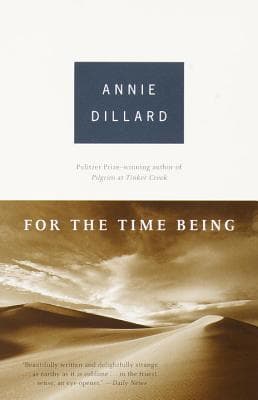
For the Time Being cover
Archivist's Choice

For the Time Being

Annie Dillard (1999)

Genre

Memoir / History / Spirituality / Philosophy

Reading Time

240 min

Key Themes

See below

Track Your Reading

Sign in to track this book

Annie Dillard's "For the Time Being" explores the terrifying grandeur of existence, from bird-headed dwarfs and ancient emperors to desert mystics and swirling clouds, all in a search for meaning in life's paradoxes.

Core Idea

Annie Dillard's "For the Time Being" is a meditation on the improbability and mystery of existence. It places the vastness of cosmic time and natural history against the intimate, often strange, details of human lives. Through a fragmented, essayistic style, Dillard addresses the paradoxes in faith and doubt, the weight of collective memory, and the elusive nature of truth. She encourages readers to find wonder and meaning not in clear answers, but in attentive observation of the world's brutal beauty and its vast, indifferent processes. The book shows the power of human consciousness to perceive and question its brief moment in an ancient, complex universe.
Reading time
240 min
Difficulty
Hard
✓ Read this if...
You are drawn to lyrical, philosophical prose that meditates on existence, time, nature, and humanity's place within it, and appreciate a non-linear, associative narrative style.
✗ Skip this if...
You prefer straightforward narrative, definitive answers, or an optimistic, less challenging view of life's complexities and suffering.

Core idea

The central argument and framework that powers the entire book.

Annie Dillard's "For the Time Being" is a meditation on the improbability and mystery of existence. It places the vastness of cosmic time and natural history against the intimate, often strange, details of human lives. Through a fragmented, essayistic style, Dillard addresses the paradoxes in faith and doubt, the weight of collective memory, and the elusive nature of truth. She encourages readers to find wonder and meaning not in clear answers, but in attentive observation of the world's brutal beauty and its vast, indifferent processes. The book shows the power of human consciousness to perceive and question its brief moment in an ancient, complex universe.

At a glance

Reading time

240 min

Difficulty

Hard

Read this if...

You are drawn to lyrical, philosophical prose that meditates on existence, time, nature, and humanity's place within it, and appreciate a non-linear, associative narrative style.

Skip this if...

You prefer straightforward narrative, definitive answers, or an optimistic, less challenging view of life's complexities and suffering.

Key Takeaways

1

The Grand Improbability of Existence

Life's sheer unlikely persistence against cosmic indifference and decay.

Quote

We are here for a time being. For the time being, we are here.

Dillard confronts the vastness of geological time and the universe, contrasting it with the fragile spark of individual human life. She acknowledges the statistical improbability of any organism, let alone consciousness, existing. This emphasizes the preciousness and mystery of our temporary existence, arguing that understanding this briefness should lead not to despair, but to a greater appreciation for the 'time being' we have. It is a call to marvel at life's presence against a backdrop of entropy and oblivion.

Supporting evidence

Dillard's recurring meditations on the vastness of geological time, the 'ten thousand terra-cotta figures' representing a fleeting human attempt at immortality, and the dizzying variety of clouds as transient forms.

Apply this

Cultivate a 'cosmic perspective' in daily life, allowing the awareness of life's improbability to foster gratitude and a sense of wonder for the present moment. Engage more deeply with the natural world, recognizing its fleeting beauty.


cosmic-perspectiveephemeralityexistentialism
2

Finding Wonder in the Grotesque and Mundane

Beauty and meaning can be found in the most unexpected and often unsettling places.

Quote

Beauty and horror, grace and disgust, often reside in the same place.

Dillard finds insights from seemingly different and often unsettling observations. She challenges readers to look beyond common ideas of beauty, suggesting that true wonder often lies in the 'darkest corners' and 'grotesque' aspects of existence—from birth defects to natural decay. This is not a morbid interest, but an open spiritual and intellectual approach that refuses to filter reality. It is about recognizing the complex, sometimes horrifying, patterns that govern all life and death, and finding a deeper, more complex meaning wit...

Supporting evidence

Her detailed descriptions of 'bird-headed dwarfs in the standard reference of human birth defects,' the 'terra-cotta figures' as a macabre replacement for human sacrifice, and the relentless, indifferent cycles of nature.

Apply this

Practice 'unfiltered observation': intentionally seek out details in your environment that might initially seem unpleasant or ordinary, and contemplate their deeper significance or place in the larger scheme of things. Journal about these observations.

grotesque-beautyunfiltered-observationparadox
3

The Weight of Human History and Memory

Our present is inextricably linked to the forgotten lives and endeavors of the past.

Quote

The past is not dead. It's not even past.

Dillard respects the layers of human history that shape our present. She examines ancient civilizations, forgotten customs, and the silent stories of countless people who lived before us. This is not just historical recounting, but an empathetic connection to the human condition across millennia. This point highlights how our self-understanding is enriched, and often humbled, by acknowledging the vast human experience that precedes us, and how past aspirations and struggles resonate in our lives today. It is a reminder that we are par...

Supporting evidence

The vivid recounting of the creation of the 'ten thousand terra-cotta figures' for the Chinese emperor, juxtaposed with the lives of the artisans who created them and the emperor's own mortality.

Apply this

Research the history of your local area or a specific object you own, trying to imagine the lives and intentions of those who came before. Visit historical sites not as a tourist, but as a contemplative observer of human endeavor.

collective-memoryhistorical-consciousnesslegacy
4

The Elusiveness of Truth and Meaning

Answers to life's biggest questions remain perpetually beyond our full grasp.

Quote

Why do we exist? Where did we come from? How can one person matter?

Dillard's search for answers to fundamental questions ('Why do we exist? Where did we come from? How can one person matter?') is persistent. Yet, she ultimately embraces the 'terrifying grandeur of all that remains tantalizingly and troubling beyond our understanding.' This point is important: Dillard does not offer easy answers. Instead, she shows intellectual and spiritual humility, suggesting that the search itself, the continuous questioning and observation, is more vital than any clear resolution. The elusiveness of truth is not ...

Supporting evidence

Her journey with Teilhard de Chardin, a paleontologist and theologian, who sought to reconcile science and faith but ultimately faced profound questions about the universe's purpose. The book's very structure, moving between disparate topics, reflects this searching.

Apply this

Embrace intellectual curiosity without demanding immediate answers. Engage with complex questions through reading, discussion, and contemplation, allowing for ambiguity and mystery rather than seeking simplistic resolutions.

epistemologyexistential-inquiryspiritual-humility
5

The Interconnectedness of All Things

Seemingly disparate elements of the universe are woven into a single, complex fabric.

Quote

Everything is connected. Your breath is the wind that blows through the trees.

Dillard's writing style itself shows this idea, combining observations of micro-organisms, ancient history, theological debates, and personal reflections. She shows how one cloud formation can suggest geological processes, human art, and spiritual contemplation. This point emphasizes that nothing exists alone; every detail, no matter how small, is part of a larger, intricate web of existence. Understanding this interconnectedness creates a deeper sense of belonging and responsibility within the natural and historical world.

Supporting evidence

Her ability to link the 'dizzying variety of clouds' to both scientific phenomena and human imagination, or the 'terra-cotta figures' to both individual artistic effort and a vast historical empire. The constant cross-referencing of natural and human history.

Apply this

Practice 'systems thinking': when observing an event or phenomenon, consider all the upstream and downstream factors that influence it and are influenced by it. Trace connections between seemingly unrelated elements in your daily life.

systems-thinkingholismecological-consciousness
6

The Power of Observation and Attention

Diligent, intentional looking reveals the hidden wonders and truths of existence.

Quote

The world is on fire. You must look.

Dillard pays close attention. She observes with an intensity that makes the ordinary extraordinary. This point highlights the idea that insights and spiritual revelations are not just for grand, mystical experiences, but are accessible through sustained observation of the world. By training ourselves to truly 'see' details—the patterns in clouds, the forms of life, the remnants of history—we gain a richer understanding of our place in the universe. It is an argument for slowing down and engaging deeply with sensory experience.

Supporting evidence

Her minute descriptions of natural phenomena, her deep dive into historical artifacts, and her meticulous recounting of scientific and theological concepts. Her writing itself is a testament to the power of precise language born from careful observation.

Apply this

Dedicate a set amount of time each day to 'deep looking' at one specific object or scene, noticing every detail without judgment. Keep an observation journal, focusing on sensory input and the thoughts it provokes.

mindfulnesssensory-awarenessphenomenology
7

Embracing the Paradox of Faith and Doubt

Spiritual understanding often emerges from the tension between belief and skepticism.

Quote

Faith is not the absence of questioning, but the courage to question in the presence of awe.

Dillard addresses complex spiritual and theological topics with both reverence and intellectual skepticism. She does not present a simple faith, but one formed through doubt, paradox, and the unsettling realities of the world. This point shows her willingness to grapple with contradictions—nature's simultaneous beauty and brutality, creation's grandeur alongside human suffering. For Dillard, true spiritual depth is not about having all the answers, but about maintaining an open, questioning stance, allowing mystery to deepen rather th...

Supporting evidence

Her engagement with the work of Teilhard de Chardin, who sought to bridge science and spirituality, and her own candid reflections on the difficulty of reconciling a benevolent God with a universe full of suffering and indifference.

Apply this

Engage in reflective practices that allow for both belief and doubt. Read spiritual texts alongside scientific ones, looking for points of tension and synthesis. Journal about your own spiritual questions without seeking immediate closure.

spiritual-questtheological-reflectionagnosticism
8

The Individual's Unique Place in the Vastness

Despite cosmic insignificance, each life holds an irreplaceable uniqueness.

Quote

The individual's relatively inconsequential but ever so unique place in it.

While Dillard often reminds us of our brief presence against eternity, she also affirms the 'unique' value of each individual life. This is not a contradiction, but a paradox. Our insignificance, when understood, does not lessen us; it sharpens our awareness of how precious our singular experience is. The point is that despite the universe's grand scale, our subjective experience, our capacity for wonder, thought, and connection, makes each 'time being' a unique and irreplaceable phenomenon, deserving of full engagement and appreciati...

Supporting evidence

Her focus on specific historical figures, even unknown artisans, and her own personal reflections interwoven with grander cosmic themes, highlighting the individual's unique lens on the universe.

Apply this

Reflect on your own unique perspective and experiences. Engage in creative expression (writing, art, music) to articulate your individual 'time being.' Seek out and appreciate the unique stories of others.

individualityself-awarenessexistential-value

Critical analysis

Notable Quotes

How we spend our days is, of course, how we spend our lives.

A reflection on the cumulative nature of daily choices and the passage of time.

The great books are not in a hurry. They are there. They have been there for a long time, and they will be there for a long time.

Considering the timelessness and enduring presence of significant literature.

The soul is a living thing, and it must be fed. If it is not fed, it will starve. And if it starves, it will die.

Emphasizing the necessity of spiritual or intellectual nourishment for the human spirit.

Our life is a faint tracing on the surface of mystery.

A poetic statement on the limited human understanding of the vastness of existence.

We are not in a hurry. We have all the time in the world. We are timeless.

A paradoxical thought about human perception of time versus a broader, eternal perspective.

The present is a stop on the way to the future, and the future is a stop on the way to the past.

A contemplation of the linear progression and cyclical nature of time.

The world is a holy mystery, and we are part of it.

Reflecting on the sacred and interconnected nature of the universe and humanity's place within it.

Death is a door, not a wall.

A metaphorical view of death as a transition rather than an absolute end.

We are born into a world that is already old, and we will die in a world that is still young.

Contemplating the brief span of human life against the backdrop of the Earth's enduring existence.

The mind is a restless thing, always seeking, always questioning.

An observation on the inherent curiosity and inquisitive nature of the human intellect.

There is a light that shines in the darkness, and the darkness has not overcome it.

A hopeful statement about enduring good or truth in the face of adversity, possibly echoing biblical themes.

Every moment is a gift, and every breath is a miracle.

An appreciation for the preciousness of life and the present moment.

The past is a story we tell ourselves, and the future is a dream we imagine.

A reflection on the subjective and constructed nature of our perception of time.

Quiz

Test Your Knowledge

Ready to see how well you understood this book? Take our interactive quiz with 10 questions.

10
Questions
~5
Minutes
?
Best Score

Key Questions (FAQ)

Annie Dillard's 'For the Time Being' is a profound meditation on existence, time, and humanity's place in the universe. It explores deep philosophical and spiritual questions through a series of vivid images and historical anecdotes, inviting readers to find wonder in both life's beauty and its inherent paradoxes.

About the author

Annie Dillard

Annie Dillard is a Pulitzer Prize-winning author celebrated for her lyrical prose and profound explorations of nature, faith, and the human condition. Her notable works include "Pilgrim at Tinker Creek," "An American Childhood," and "The Writing Life." Dillard's essays and books often blend personal reflection with philosophical inquiry, earning her a significant place in contemporary American non-fiction.