BookBrief
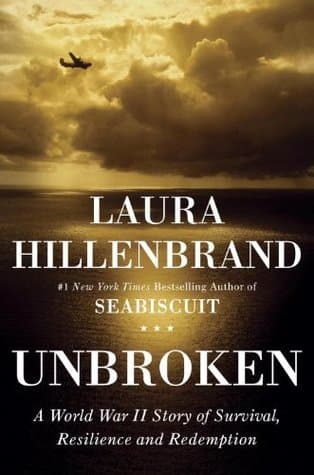
Unbroken: A World War II Story of Survival, Resilience and Redemption cover
Archivist's Choice

Unbroken: A World War II Story of Survival, Resilience and Redemption

Laura Hillenbrand (2010)

Genre

Biography / Memoir / History

Reading Time

12 Minutes

Key Themes

See below

Track Your Reading

Sign in to track this book

Louis Zamperini's incredible World War II odyssey transforms him from a rebellious youth and Olympic runner into a survivor of a plane crash, shark-infested waters, and brutal Japanese POW camps, only to find redemption through forgiveness.

Core Idea

Unbroken tells the incredible true story of Louis Zamperini, an Olympic runner whose life took a dramatic turn with the outbreak of World War II. Shot down over the Pacific, he endured a harrowing 47 days adrift at sea on a raft, only to be captured by the Japanese Navy. He then spent over two years in brutal prisoner-of-war camps, subjected to unimaginable torture and starvation, particularly at the hands of the sadistic guard known as 'The Bird.' The book chronicles his extraordinary will to survive against impossible odds, his physical and psychological endurance through extreme suffering, and his difficult, yet ultimately successful, post-war journey to overcome trauma and find redemption through faith.
Difficulty
Medium

Core idea

The central argument and framework that powers the entire book.

Unbroken tells the incredible true story of Louis Zamperini, an Olympic runner whose life took a dramatic turn with the outbreak of World War II. Shot down over the Pacific, he endured a harrowing 47 days adrift at sea on a raft, only to be captured by the Japanese Navy. He then spent over two years in brutal prisoner-of-war camps, subjected to unimaginable torture and starvation, particularly at the hands of the sadistic guard known as 'The Bird.' The book chronicles his extraordinary will to survive against impossible odds, his physical and psychological endurance through extreme suffering, and his difficult, yet ultimately successful, post-war journey to overcome trauma and find redemption through faith.

At a glance

Difficulty

Medium

Key Takeaways

1

The Malleability of Character

Delinquency can be a crucible for resilience, not a predictor of failure.

Quote

Louie Zamperini, a 'holy terror' as a child, channeled his prodigious energy and defiance into running, transforming from a notorious delinquent into an Olympic athlete.

Hillenbrand shows that character is not fixed. Louie Zamperini started as a rebellious child, stealing and fighting. Yet, these same traits—his cleverness, stubbornness, and distrust of authority—helped him survive later. This idea challenges the belief that childhood behavior predetermines one's future, suggesting that destructive tendencies can become strong survival tools if redirected. His childhood ability to evade pursuers became a skill for resisting his captors, proving that the same drive can either destroy or build.

Supporting evidence

Zamperini's childhood escapades, including riding the rails and evading police, directly foreshadow his resourcefulness in the raft and his defiance in POW camps.

Apply this

Parents and educators should look beyond surface misbehavior to identify and redirect underlying traits like determination, cleverness, and independence into constructive outlets.


2

The Power of the Human Will

Survival in extremity is ultimately a testament to an unyielding spirit.

Quote

'His fate, whether triumph or tragedy, would be suspended on the fraying wire of his will.'

This is arguably the book's most powerful idea: the immense power of human will. Zamperini faced starvation, thirst, shark attacks, enemy fire, and extreme torture, but he never gave up. His mental strength, fueled by a refusal to die or to let his captors see him defeated, was his strongest weapon. Hillenbrand stresses that while physical toughness matters, psychological resolve to endure impossible odds truly defines survival in such dire situations. This argument might not fully acknowledge that not everyone has such extraordinary ...

Supporting evidence

Zamperini's 47 days adrift at sea, his resistance to 'The Bird's' psychological and physical torture, and his consistent defiance in POW camps.

Apply this

Cultivating mental toughness and a refusal to yield in the face of adversity can be a powerful tool for overcoming personal and professional challenges.

3

The Dehumanizing Nature of Captivity

Prisoner of war camps were designed to strip individuals of their humanity and identity.

Quote

The Japanese POW camps were 'laboratories of misery,' meticulously designed to break men through starvation, disease, and relentless physical and psychological torture.

Hillenbrand details the horrific conditions and systematic brutality in Japanese POW camps. The goal was not just to hold prisoners but to destroy their sense of self, dignity, and hope. The story vividly shows how starvation, disease, forced labor, and random violence—often by sadistic guards like 'The Bird'—aimed to reduce men to their most basic instincts, creating distrust and despair. This system of cruelty highlights how important it is to keep one's identity and moral compass, even when everything around tries to break it, a ch...

Supporting evidence

Descriptions of the Kwajalein 'Execution Island,' Omori, and Naoetsu camps, including the 'punishment by humiliation,' starvation diets, and rampant disease.

Apply this

Understanding the psychological tactics of dehumanization can help individuals recognize and resist similar, albeit less extreme, pressures in modern contexts that seek to control or diminish individuality.

4

The Scars of Trauma and the Path to Redemption

Survival is only the beginning; healing requires confronting the lingering ghosts of trauma.

Quote

Upon returning home, Louie found that 'the war had followed him.' The physical wounds healed, but the psychological torment, especially the nightmares of 'The Bird,' continued to plague him.

Hillenbrand dedicates much of the book to Zamperini's post-war struggles, showing that his suffering did not end with his captivity. Plagued by severe PTSD, alcoholism, and an obsession for revenge against 'The Bird,' Zamperini's life fell apart. This points to a key aspect often missed in survival stories: the deep and lasting psychological impact of extreme trauma. His eventual recovery, found through faith and forgiveness, is presented not as a quick fix but as a difficult journey of facing his inner demons. This part of the story ...

Supporting evidence

Zamperini's alcoholism, violent outbursts, and recurring nightmares, particularly his vivid visions of strangling 'The Bird,' leading to marital strain.

Apply this

Recognizing that trauma has long-term effects and that healing is a journey, not an event, can foster empathy and support for those recovering from profound experiences.

5

The Role of Hope and Ingenuity

In desperate situations, resourcefulness and a flicker of hope are essential for survival.

Quote

'To be able to endure, the prisoner had to find some way to make the world a little more bearable. He had to find something to cling to, some reason to keep going.'

Throughout his ordeal, Zamperini showed remarkable resourcefulness and a persistent, though sometimes fragile, hope. From catching birds and sharks while lost at sea to finding ways to steal food in the camps, his ingenuity was vital. Equally important was his ability to find small reasons to keep going: memories of home, thoughts of loved ones, even just planning an escape. This takeaway shows that survival is not only about physical strength but also mental agility and the ability to imagine a future, no matter how distant or unlike...

Supporting evidence

Louie and Phil's methods for catching fish and birds on the raft, their attempts to signal planes, and Louie's various schemes to pilfer food in the camps.

Apply this

Encouraging creative problem-solving and fostering a resilient, hopeful mindset can equip individuals to navigate challenging situations in their own lives.

6

The Indelible Bond of Shared Suffering

Comradeship forged in extremity can be a lifeline, even amidst profound despair.

Quote

The bond between Louie and Phil on the raft, and later with other POWs, became a vital source of strength, enabling them to endure what they could not alone.

Hillenbrand powerfully shows how shared suffering can create strong bonds between people. Louie's relationship with his pilot, Phil, on the life raft, and later with his fellow POWs, was vital for his survival and mental health. These connections provided mutual support, shared hope, and collective resistance against their tormentors. Even in the most dehumanizing conditions, acts of solidarity—sharing meager rations, offering encouragement, or simply witnessing each other's pain—were crucial for keeping some sense of humanity. This p...

Supporting evidence

The mutual support and conversations between Louie and Phil on the raft; POWs covering for each other, sharing information, and resisting collectively against guards.

Apply this

Recognizing the importance of community and mutual support in times of crisis can help build stronger, more resilient social structures.

7

The Unpredictability of Fate

Life's trajectory can be dramatically altered by a series of seemingly random events.

Quote

Louie's entire odyssey, from Olympic runner to airman to castaway to POW, was a chain of 'improbable coincidences' and twists of fate.

A recurring idea in 'Unbroken' is the unpredictability of Louie Zamperini's life. From almost running a four-minute mile before the war, to the specific mechanical failure that caused his plane crash, to the chance encounter with a Japanese patrol boat, his journey was shaped by a series of seemingly random, yet very important, events. This highlights how fragile human plans are and the powerful role of chance in shaping destiny. It is a sobering reminder that even the most carefully planned lives can be changed irrevocably by externa...

Supporting evidence

The technical failures of the Green Hornet, the 'bad luck' of being spotted by a Japanese patrol plane, and the specific prison camps he was sent to.

Apply this

Embracing adaptability and accepting that not everything is within one's control can help manage expectations and build resilience against unforeseen challenges.

8

The Nature of Evil and Forgiveness

True forgiveness is not about condoning evil, but liberating oneself from its lingering grip.

Quote

Louie realized that 'the only way to be free of the Bird was to forgive him.'

Mutsuhiro Watanabe, 'The Bird,' is a chilling example of sadism and random cruelty. Hillenbrand presents him as a man driven by a deep need to dominate and destroy. Zamperini's post-war obsession with 'The Bird' shows how evil, even when physically gone, can continue to imprison its victims psychologically. His eventual decision to forgive, influenced by Billy Graham's message, is shown as a profound act of self-liberation rather than a weak surrender. This difference is key: forgiveness is not for the tormentor, but for the tormented...

Supporting evidence

The relentless and arbitrary torture inflicted by 'The Bird' on Louie and other POWs, and Louie's later attempts to meet and forgive Watanabe.

Apply this

Exploring the concept of forgiveness as a tool for personal healing and emotional freedom, even when justice is elusive, can be beneficial for those struggling with past wrongs.

9

The Athlete's Mindset in Survival

Discipline, goal-setting, and endurance training provide an unexpected advantage in extremity.

Quote

Louie's 'runner's mind' – his ability to compartmentalize pain, set small goals, and visualize success – proved invaluable in his struggle for survival.

Hillenbrand draws a clear link between Zamperini's athletic training and his ability to survive. The discipline needed for Olympic-level running—pushing past pain, breaking down big tasks, and staying focused despite exhaustion—directly helped him endure on the raft and in the camps. His competitive drive, honed on the track, fueled his defiance against 'The Bird' and his refusal to be broken. This suggests that skills developed in one area, especially those requiring mental and physical strength, can transfer remarkably to entirely d...

Supporting evidence

Louie's mental strategies during his long-distance runs, such as focusing on a single step, were mirrored in his efforts to survive day-by-day in extreme conditions.

Apply this

Applying principles of athletic training, such as goal-setting, perseverance, and mental visualization, can enhance performance and resilience in various life challenges.

10

The Enduring Legacy of War

War's impact extends far beyond the battlefield, shaping generations and individual destinies.

Quote

The war 'stole' the best years of Louie's life, but it also forged him into a symbol of resilience, forever intertwining his personal story with a global conflict.

"Unbroken" is not just Louie Zamperini's story; it shows the widespread and lasting impact of World War II. The book details how a global conflict permanently changed countless lives, from soldiers on the front lines to their families at home. The suffering endured by POWs like Zamperini, the moral compromises made, and the long road to recovery highlight the immense human cost of war. Hillenbrand uses Louie's personal story as an example for the experiences of many, reminding readers of the deep and often invisible scars left by such...

Supporting evidence

The collective experience of POWs, the global scale of the conflict, and the long-term societal and individual impacts of WWII on veterans and their families.

Apply this

Reflecting on historical conflicts and their human costs can foster a deeper understanding of current global events and the importance of peace and empathy.

Critical analysis

Notable Quotes

Quiz

Test Your Knowledge

Ready to see how well you understood this book? Take our interactive quiz with 10 questions.

10
Questions
~5
Minutes
?
Best Score

Key Questions (FAQ)

Unbroken tells the incredible true story of Louis Zamperini, an Olympic runner who became a bombardier in World War II. After his bomber crashes in the Pacific, he survives a harrowing ordeal at sea and endures immense suffering as a prisoner of war.

About the author