BookBrief
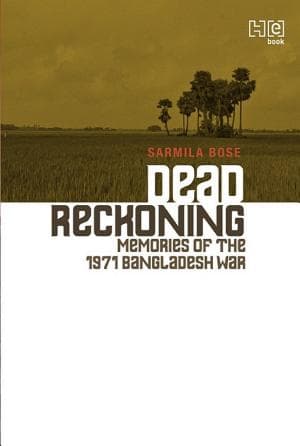
Dead Reckoning cover
Archivist's Choice

Dead Reckoning

Sarmila Bose (2012)

Genre

History

Reading Time

600 min

Key Themes

See below

Track Your Reading

Sign in to track this book

Through fragmented memories from all sides, 'Dead Reckoning' reconstructs the 1971 South Asian war, dissecting partisan myths and revealing its human cost.

Core Idea

Sarmila Bose's "Dead Reckoning" challenges the common, one-sided story of the 1971 Bangladesh Liberation War. It argues that many accounts of genocide and victimhood are exaggerated, politically influenced, and lack strong evidence. Through careful research, including interviews with combatants and civilians from all sides and a close look at primary sources, Bose shows a more complex and brutal civil war. She finds that many groups committed atrocities, not just the Pakistan Army. The book claims that history has been selectively presented to demonize one side and glorify another, keeping alive a biased memory that prevents a full understanding of the conflict's real human cost and the motives of those involved.
Reading time
600 min
Difficulty
Hard
✓ Read this if...
You are interested in a revisionist history of the 1971 Bangladesh Liberation War, seeking to challenge established narratives and explore the conflict with a critical, evidence-based perspective that questions official accounts.
✗ Skip this if...
You prefer historical accounts that align with the widely accepted narrative of the 1971 war, or if you are uncomfortable with a book that critically examines and potentially refutes claims of genocide and one-sided victimhood.

Core idea

The central argument and framework that powers the entire book.

Sarmila Bose's "Dead Reckoning" challenges the common, one-sided story of the 1971 Bangladesh Liberation War. It argues that many accounts of genocide and victimhood are exaggerated, politically influenced, and lack strong evidence. Through careful research, including interviews with combatants and civilians from all sides and a close look at primary sources, Bose shows a more complex and brutal civil war. She finds that many groups committed atrocities, not just the Pakistan Army. The book claims that history has been selectively presented to demonize one side and glorify another, keeping alive a biased memory that prevents a full understanding of the conflict's real human cost and the motives of those involved.

At a glance

Reading time

600 min

Difficulty

Hard

Read this if...

You are interested in a revisionist history of the 1971 Bangladesh Liberation War, seeking to challenge established narratives and explore the conflict with a critical, evidence-based perspective that questions official accounts.

Skip this if...

You prefer historical accounts that align with the widely accepted narrative of the 1971 war, or if you are uncomfortable with a book that critically examines and potentially refutes claims of genocide and one-sided victimhood.

Key Takeaways

1

Unveiling the 'Truth' of 1971

Challenging monolithic narratives through diverse perspectives

Quote

The story of 1971 has so far been dominated by the narrative of the victorious side. All parties to the war are still largely imprisoned by wartime partisan mythologies.

Bose's 'Dead Reckoning' is an important contribution to the history of the 1971 Bangladesh Liberation War. It challenges the common, often simple, stories that have dominated discussions, especially the triumphant Bengali nationalist account. By gathering testimonies from all sides—Bengalis, West Pakistanis, Biharis, and other minorities—Bose exposes the deep-seated partisan myths that continue to shape public memory and political talk. This approach shows a much more complex and morally unclear conflict than usually presented, where ...

Supporting evidence

Bose's extensive interviews conducted in both Bangladesh and Pakistan, alongside analysis of published and unpublished reminiscences in multiple languages, foreign media reports, and official documents, serve as the primary evidence for her re-evaluation.

Apply this

When encountering historical accounts, actively seek out multiple perspectives, especially from marginalized or defeated groups, to gain a more nuanced understanding. Challenge narratives that present history as a clear-cut struggle between 'good' and 'evil.'

historical-revisionismpost-conflict-memorynationalist-mythology
2

The Brutality of Civil War

Beyond state-on-state conflict: internal violence and communal strife

Quote

The war was not merely a conflict between two states but also a bitter civil war within Pakistan, marked by widespread communal violence and atrocities committed by all sides.

While often seen as a war between India and Pakistan, Bose highlights the internal dimension of the 1971 conflict. It was a civil war within Pakistan, marked by immense brutality and communal violence that went beyond official state actors. The book documents atrocities by the Pakistani military, but also points out significant violence by Bengali nationalists and their allies against non-Bengali groups, especially Biharis and West Pakistanis living in East Pakistan. This focus on internal violence breaks the illusion of a clear liber...

Supporting evidence

Bose recounts specific incidents of violence against Biharis and West Pakistanis by Bengali forces, drawing on survivor testimonies and reports, alongside well-documented atrocities by the Pakistani army against Bengalis.

Apply this

Recognize that wars, especially those with an internal or civil component, often involve widespread violence by all parties, and that victimhood and perpetration are rarely confined to one side. Be wary of narratives that oversimplify the dynamics of conflict.

civil-warcommunal-violenceethnic-cleansingwartime-atrocities
3

The 'Genocide' Debate: Numbers and Narratives

Deconstructing the contested casualty figures and their political implications

Quote

The numbers of dead have become an integral part of the political narrative, often inflated or downplayed for strategic purposes, obscuring the human tragedy itself.

One of the most debated aspects of the 1971 war is the discussion around casualty figures, particularly the claim of three million Bengalis killed, which is central to Bangladeshi national identity. Bose examines these numbers, showing that while immense atrocities happened, the exact figures are highly disputed and often lack verifiable evidence. She argues that exaggerated numbers, while serving a strong political purpose in stirring nationalist feeling and condemning Pakistan, can unintentionally overshadow individual human sufferi...

Supporting evidence

Bose analyzes various reports and official statements regarding casualty figures, comparing them with demographic data and eyewitness accounts to highlight inconsistencies and the lack of robust evidence for the highest estimates.

Apply this

When confronted with large-scale casualty figures in historical conflicts, exercise critical thinking. Question the sources, understand the motivations behind specific numbers, and seek out scholarly analyses that delve into the methodologies and limitations of such estimates.

genocide-studieshistorical-statisticsnational-memorypolitical-narratives
4

The Human Cost of Partisan Memory

How one-sided narratives perpetuate animosity and hinder reconciliation

Quote

All parties to the war are still largely imprisoned by wartime partisan mythologies.

Bose shows how deeply ingrained partisan memories continue to affect the region, preventing true reconciliation and fostering ongoing hostility. By presenting accounts from many voices, she exposes how each side has built a story that absolves itself of guilt while demonizing the other. This 'imprisonment' by myths means that the complexities of the conflict, the shared suffering, and the atrocities committed by all actors are often suppressed or denied. The result is a continuation of blame and resentment, where historical grievances...

Supporting evidence

Bose's interviews reveal how individuals from different communities hold vastly different, often irreconcilable, memories of the same events, each shaping their understanding of justice and reconciliation.

Apply this

In personal and collective historical reflections, actively challenge the tendency to create 'pure' narratives of victimhood or heroism. Encourage dialogue that acknowledges the complexities and moral ambiguities of past conflicts, fostering empathy for all affected parties.

reconciliationcollective-memoryhistorical-traumaintergenerational-conflict
5

The Role of External Actors

Unpacking the geopolitical chess match and its local impact

Quote

The 1971 war was not merely a local conflict but deeply intertwined with the Cold War dynamics, with global powers backing opposing sides.

Bose places the 1971 war within its wider global context, highlighting the important, and often harmful, roles played by outside powers. The Cold War rivalry between the Soviet Union (supporting India) and the United States and China (supporting Pakistan) greatly influenced the conflict's path, length, and intensity. This international aspect meant that local grievances and ethnic tensions were made worse by global power struggles, turning East Pakistan into a proxy battleground. The book subtly reveals how the self-interests of these...

Supporting evidence

Bose references diplomatic cables, foreign media reports, and geopolitical analyses to demonstrate how US, Soviet, and Chinese policies impacted the conflict's progression and the support received by various belligerents.

Apply this

When analyzing contemporary conflicts, always consider the role of external state and non-state actors. Understand how their strategic interests, alliances, and interventions can shape the conflict's dynamics, outcomes, and humanitarian consequences.

cold-war-proxygeopoliticsinternational-relationsforeign-intervention
6

Military Conduct and Rules of Engagement

Examining the breakdown of discipline and the perpetration of atrocities

Quote

The conduct of all armed groups, whether state or non-state, often descended into a brutal disregard for human life and established rules of warfare.

Bose details the actions of various armed groups during the 1971 war, showing a widespread breakdown of discipline and atrocities by all sides. While the Pakistani military's brutal actions are well-documented, Bose also shows instances of severe misconduct by Bengali nationalist forces, including executions, torture, and targeting of non-Bengali civilians. This even-handed critique is vital because it moves beyond simple stories of 'good' and 'bad' armies. It shows that the horrors of war often lead to a universal loss of moral bound...

Supporting evidence

Bose presents numerous testimonies from victims and perpetrators, recounting specific incidents of violence, torture, and extrajudicial killings by both Pakistani soldiers and Bengali Mukti Bahini/auxiliary forces.

Apply this

When evaluating military actions, always scrutinize claims of moral superiority and investigate the conduct of all armed groups. Advocate for accountability mechanisms and international humanitarian law, even in seemingly 'just' wars, to prevent and punish atrocities.

war-crimesmilitary-ethicshumanitarian-lawaccountability
7

The Subtlety of Victimhood

Acknowledging the suffering of all communities, not just the 'victors'

Quote

The suffering of minority groups, particularly the Biharis, often gets erased or minimized in the dominant narrative of Bengali victimhood.

A major contribution of 'Dead Reckoning' is its clear acknowledgment of the many kinds of victimhood in 1971. While the immense suffering of Bengalis at the hands of the Pakistani military is clear, Bose ensures that the voices and experiences of other victim groups, especially the Biharis and West Pakistanis trapped in East Pakistan, are also heard. These communities faced severe persecution, massacres, and displacement by Bengali nationalists, yet their plight is often ignored in mainstream historical accounts. By bringing these sto...

Supporting evidence

Bose includes poignant interviews with Bihari survivors who recount massacres and persecution by Bengali forces, highlighting their displacement and ongoing struggle for recognition and justice.

Apply this

In any historical or contemporary conflict, actively seek out and amplify the voices of all victim groups, especially those who are marginalized or whose suffering is downplayed by dominant narratives. Resist the urge to create hierarchies of suffering.

minority-rightshuman-rightsdisplaced-personsempathy
8

History as a Weapon

How historical narratives are deployed to serve political agendas

Quote

The 1971 war is still playing out in the region, largely through the continued weaponization of its history.

Bose suggests that the history of 1971 is not just a record of past events but a strong political tool, constantly reinterpreted and used to serve current goals in Bangladesh, Pakistan, and India. The book shows how specific stories, casualty figures, and assignments of blame are carefully built and maintained to support national identities, justify political actions, and keep animosity alive between nations and communities. This 'weaponization' of history hinders regional cooperation and prevents a true reckoning with the past. 'Dead...

Supporting evidence

The contrasting official histories and public discourse in Bangladesh and Pakistan regarding the war's causes, perpetrators, and outcomes provide strong evidence of history being used as a political tool.

Apply this

Be critically aware of how historical narratives are used in political discourse. Question the motivations behind specific historical claims, especially when they are used to justify contemporary policies or demonize other groups. Support independent historical research.

political-historypropagandaidentity-politicshistorical-revisionism
9

The Imperative of Nuance

Rejecting simplistic binaries for a richer, more accurate understanding

Quote

Contextualising and humanising the war reveals what the events truly expose about the nature of the conflict itself.

The main lesson from 'Dead Reckoning' is the need for nuance in understanding complex historical events, especially wars. Bose's work rejects simple 'good vs. evil' stories, instead embracing the messy, contradictory, and often morally ambiguous realities of human conflict. By humanizing all participants—soldiers, civilians, victims, or perpetrators—she forces the reader to face the difficult truth that war rarely has clear heroes and villains. This nuanced approach, though challenging to accepted national myths, is ultimately more tr...

Supporting evidence

The entire structure of the book, which systematically presents competing testimonies and challenges established 'facts' from all sides, serves as evidence for the necessity of nuance.

Apply this

Cultivate intellectual humility and a willingness to engage with complex, uncomfortable truths. Avoid reducing historical events or social issues to overly simplistic, black-and-white explanations. Seek out diverse perspectives and embrace ambiguity.

critical-thinkinghistorical-complexitymoral-ambiguityintellectual-humility
10

Beyond Blame: Towards a Shared History

The potential for healing through collective acknowledgement of suffering

Quote

Her book challenges assumptions about the nature of the conflict, and exposes the ways in which the 1971 war is still playing out in the region.

While 'Dead Reckoning' is not explicitly about reconciliation, its rigorous and even-handed approach sets the stage for it. By moving beyond partisan blame and acknowledging the suffering and fault of all sides, Bose implicitly offers a path toward a more shared, though painful, history. This shared history, built on verifiable facts and inclusive memory, is the first step toward breaking the cycle of resentment that continues to affect the region. The book suggests that true healing can only begin when societies are willing to face t...

Supporting evidence

The book's methodology of giving voice to individuals from all communities and its critical analysis of all narratives, rather than simply validating one, serves as evidence for this potential path.

Apply this

Actively support initiatives that promote inter-communal dialogue and shared historical research in post-conflict societies. Advocate for educational curricula that present multi-faceted accounts of historical conflicts, fostering empathy and critical thinking rather than nationalist dogma.

historical-dialoguepeacebuildingcollective-memorytransitional-justice

Critical analysis

Notable Quotes

The war was not a civil war, but a war of liberation against an occupying army.

Bose's central thesis on the nature of the 1971 conflict.

History, like memory, is often contested terrain.

Reflecting on the differing narratives and interpretations of the past.

The narrative of a one-sided genocide has obscured the complexities and reciprocal violence of the conflict.

Challenging the dominant historical account of the atrocities.

Every war generates its own myths, and the Bangladesh War was no exception.

Discussing the creation and persistence of popular stories surrounding the conflict.

The 'truth' of 1971 is not a monolithic entity, but a mosaic of individual experiences and perspectives.

Emphasizing the multiplicity of viewpoints in understanding the past.

To ignore the violence perpetrated by all sides is to distort history and deny agency to many victims.

Arguing for a more comprehensive and balanced account of the conflict's brutalities.

The role of international actors, often presented as purely humanitarian, was frequently more complex and self-interested.

Critiquing the simplistic portrayal of external involvement in the war.

Nationalist narratives, while unifying, often simplify and sanitize the past for political ends.

Examining how nationalism shapes historical memory and omits inconvenient truths.

The absence of reliable data has allowed speculation and politically motivated claims to flourish.

Highlighting the challenges of historical research in the face of incomplete or biased records.

Understanding 1971 requires moving beyond the victor's narrative to embrace a more nuanced and challenging truth.

Advocating for a critical re-examination of the war's outcome and its portrayal.

The human cost of war is rarely captured by statistics alone; individual stories reveal its true horror.

Emphasizing the personal impact of conflict over abstract numbers.

Reconciliation can only begin when all sides acknowledge their roles in the violence.

Discussing the preconditions for healing and moving forward after conflict.

The past is not dead; it continues to shape the present and influence future trajectories.

Reflecting on the enduring legacy of historical events.

Quiz

Test Your Knowledge

Ready to see how well you understood this book? Take our interactive quiz with 10 questions.

10
Questions
~5
Minutes
?
Best Score

Key Questions (FAQ)

'Dead Reckoning' challenges the prevailing, often partisan, narratives of the 1971 war in South Asia. Sarmila Bose argues that the conflict was more complex than commonly portrayed, moving beyond the victor's story to explore the experiences and perspectives of all sides.

About the author