BookBrief
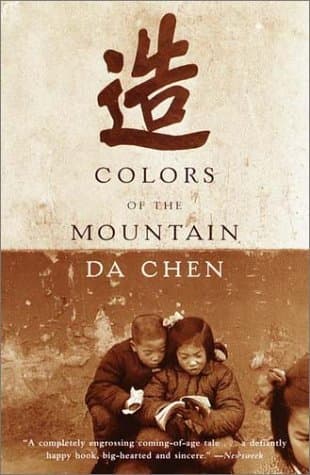
Colors of the Mountain cover
Archivist's Choice

Colors of the Mountain

Da Chen (2000)

Genre

Biography / Memoir / History

Reading Time

420 min

Key Themes

See below

Track Your Reading

Sign in to track this book

In a memoir of resilience and mischievous defiance, Da Chen navigates the brutal Cultural Revolution in rural China, transforming the scorn of his 'landlord' heritage into a quest for education and a hopeful future.

Core Idea

Da Chen's "Colors of the Mountain" is a memoir that portrays the author's childhood in rural China during the Cultural Revolution. The book argues that even with extreme political oppression, class discrimination, and poverty, people can find resilience through family bonds, education, and a sense of mischief and hope. Chen presents this through personal stories of starvation, public humiliation, and constant surveillance, alongside the love of his family, his drive to excel in school, and small acts of defiance that maintained his dignity. Readers should understand the impact of historical events on individual lives, the strength of people, and the hunger for dignity and opportunity, even when society denies it.
Reading time
420 min
Difficulty
Medium
✓ Read this if...
You are interested in personal stories of resilience during the Chinese Cultural Revolution, enjoy coming-of-age memoirs, or want to understand the human cost of political upheaval through an intimate lens.
✗ Skip this if...
You prefer books with a fast-paced plot over reflective personal narratives, or find detailed accounts of poverty and political oppression too challenging.

Core idea

The central argument and framework that powers the entire book.

Da Chen's "Colors of the Mountain" is a memoir that portrays the author's childhood in rural China during the Cultural Revolution. The book argues that even with extreme political oppression, class discrimination, and poverty, people can find resilience through family bonds, education, and a sense of mischief and hope. Chen presents this through personal stories of starvation, public humiliation, and constant surveillance, alongside the love of his family, his drive to excel in school, and small acts of defiance that maintained his dignity. Readers should understand the impact of historical events on individual lives, the strength of people, and the hunger for dignity and opportunity, even when society denies it.

At a glance

Reading time

420 min

Difficulty

Medium

Read this if...

You are interested in personal stories of resilience during the Chinese Cultural Revolution, enjoy coming-of-age memoirs, or want to understand the human cost of political upheaval through an intimate lens.

Skip this if...

You prefer books with a fast-paced plot over reflective personal narratives, or find detailed accounts of poverty and political oppression too challenging.

Key Takeaways

1

The Scars of Class Identity

How inherited social status dictated a family's suffering and survival in Maoist China.

Quote

We were landlords, and that was a stain that could never be washed away, a curse passed down through generations.

Da Chen's memoir shows the impact of inherited class identity during China's Cultural Revolution. Born into a family labeled 'landlords'—a once privileged but now reviled class—his life was marked by suspicion and persecution. This label was a sentence. It meant his father and grandfather were subjected to public humiliation, beatings, and forced labor, not for individual actions, but for their family line. The family was denied opportunities, their possessions confiscated, and their children ostracized. This shows how ideological pur...

Supporting evidence

The constant beatings and public shaming of his father and grandfather, the confiscation of their property, and the family's struggle to find work or food due to their landlord status.

Apply this

Reflect on how modern societies still grapple with inherited social or economic disadvantages, and advocate for policies that prioritize individual merit and opportunity over historical labels or systemic biases.


cultural-revolutionclass-struggleinherited-trauma
2

Resilience Forged in Adversity

The human spirit's capacity to find humor, hope, and determination amidst extreme hardship.

Quote

Laughter was a weapon, a shield against the endless despair, a way to reclaim a piece of our humanity.

Despite facing poverty, political persecution, and violence, Da Chen and his family show resilience. This is not just quiet endurance, but an active will to survive and even thrive. Chen's story has a mischievous spirit and an eye for the absurd, finding moments of joy and rebellion in grim circumstances. His mother's love, his father's dignity, and Chen's resourcefulness—whether stealing chickens or excelling in school—all contribute to this theme. It suggests that while external conditions can be crushing, hope, humor, and family bo...

Supporting evidence

Da Chen's mischievous pranks, his dedication to studying despite lacking proper materials, his mother's unwavering support, and the family's shared laughter even during difficult meals.

Apply this

Cultivate a 'growth mindset' during personal challenges, actively seeking out humor, maintaining strong social connections, and focusing on small, actionable steps towards long-term goals.

human-resilienceadversity-quotientoptimism-bias
3

The Power of Education as Escape

How academic excellence became the sole pathway to freedom and a new life.

Quote

School was my escape, my weapon, the only way out of the mountain and into a future I could call my own.

For Da Chen, education was a lifeline, a strategic tool for survival and mobility. Trapped by his family's class status in a rural village, the competitive national college entrance exams were his only way to escape poverty and political oppression. His dedication to his studies, often in challenging conditions—scribbling notes in the dirt or studying by moonlight—shows the value placed on academic achievement as a transformative force. This emphasizes how, in societies with rigid social structures, education can be the equalizer, off...

Supporting evidence

Da Chen's intense preparation for the college entrance exams, his success in gaining admission to a prestigious university in Beijing, and the farewell scene where he leaves his village for higher education.

Apply this

Recognize education as a continuous process for personal and professional growth, and actively seek out learning opportunities, regardless of formal settings, to broaden perspectives and open new doors.

social-mobilitymeritocracyeducational-equity
4

The Ambiguity of Authority

Exploring the capricious and often contradictory nature of power during the Cultural Revolution.

Quote

The rules changed with the wind, and the men who enforced them changed even faster. What was right yesterday was wrong today.

Da Chen's memoir captures the arbitrary and often absurd nature of authority during the Cultural Revolution. Officials, from local cadres to Red Guards, had power, but their actions were often driven by personal vendettas, shifting political winds, or whim, rather than consistent ideology or justice. This created constant uncertainty and fear, where a family could be punished one day for 'landlord' affiliations and the next for a perceived lack of revolutionary fervor. This takeaway shows the corrosive effect of unchecked power and th...

Supporting evidence

The varying treatment of his family by different officials, the unpredictable nature of public denunciations, and the sudden shifts in policy that could elevate or condemn individuals without clear reason.

Apply this

Cultivate critical thinking skills to question authority and challenge narratives, and support systems that ensure accountability and transparency in governance to prevent abuses of power.

authoritarianismpolitical-instabilitypower-dynamics
5

Family as the Ultimate Sanctuary

In a world of betrayal and danger, the unbreakable bonds of family offered solace and strength.

Quote

In a world that wanted to tear us apart, our family was the only thing that held us together, our fortress against the storm.

Amidst the chaos and cruelty of the Cultural Revolution, Da Chen's family is the most important source of support, love, and protection. Despite external pressures to denounce one another, and the suffering inflicted upon his father and grandfather, the family remained loyal. His mother's efforts to feed and protect her children, his siblings' camaraderie, and the strength of his elders provided an emotional and physical sanctuary. This shows the importance of family bonds, especially during social upheaval. It demonstrates how, when ...

Supporting evidence

His mother's resourcefulness in finding food, the children's solidarity in facing bullies, and the emotional goodbyes shared when Da Chen leaves for college, signifying their enduring connection.

Apply this

Prioritize nurturing strong family relationships (chosen or biological) as a fundamental source of emotional support and resilience, especially during challenging life transitions.

family-bondssocial-supportemotional-resilience
6

The Hunger for Dignity

Beyond physical sustenance, the struggle to maintain self-respect and honor in dehumanizing conditions.

Quote

They could take our land, our food, even our freedom, but they could not take our dignity, not if we refused to give it up.

While the Chen family battled physical hunger, the memoir also shows a hunger for dignity and self-respect. His father, despite being publicly humiliated and beaten, carries himself with quiet pride. His grandfather, even in forced labor, keeps a sense of his past wisdom. Da Chen himself, through his academic achievements and his refusal to be broken by circumstance, fights to assert his worth. This highlights that people need more than just basic survival; they need to feel respected, to have agency, and to maintain self-worth. In co...

Supporting evidence

His father's stoic endurance during public struggle sessions, his grandfather's stories and quiet wisdom, and Da Chen's determination to excel in school despite mockery and deprivation.

Apply this

Actively seek opportunities to affirm your own and others' inherent worth, and challenge systems or behaviors that seek to diminish dignity or agency.

human-dignityself-respectexistential-resilience
7

The Bittersweet Nature of Departure

Leaving home for a better future entails both hope and profound loss.

Quote

As the bus pulled away, I felt a wrench in my chest – a pulling between the future I craved and the past I was leaving behind, a past that shaped every fiber of my being.

The memoir ends with Da Chen's departure from his village to attend college in Beijing, a moment of triumph and hope. Yet, this victory has sadness and a sense of loss. Leaving his family and the harsh landscape of his childhood marks a break with his past. This explores the complex emotions of 'leaving home' for personal advancement. It suggests that even when moving towards a brighter future, there is a bittersweetness—a recognition of the sacrifices made, the people left behind, and the mark of one's origins. It is a universal huma...

Supporting evidence

The emotional farewell scene with his family, particularly his father, as he boards the bus to Beijing, reflecting on the arduous journey that led him to that moment.

Apply this

Acknowledge and process the full range of emotions—both joy and sadness—when embarking on significant life transitions, and maintain connections with your roots while embracing new opportunities.

personal-growthemigration-experiencenostalgia-for-home
8

The Indelible Mark of History

How the political upheavals of a nation profoundly scar individual lives and communities.

Quote

The revolution was not just in the cities; it was in every home, every heart, twisting lives until they were unrecognizable.

Da Chen's personal story is tied to the Cultural Revolution. His family's suffering, his struggles, and his triumph are consequences of the political fervor that swept the nation. This emphasizes that history is not just dates and events; it is a lived experience that marks individuals and generations. The memoir shows how political movements become human dramas, dictating fates, shaping identities, and leaving long-lasting scars. It reminds us that we are products of our historical context, and understanding personal stories is impor...

Supporting evidence

The constant references to Mao's decrees, the presence of Red Guards, the public struggle sessions, and the pervasive fear that dictated daily life in the village.

Apply this

Study history not just as facts, but as a means to understand the human impact of past events, informing current perspectives on social justice, political systems, and collective memory.

historical-traumacollective-memorypolitical-impact
9

The Spirit of Mischief as Resistance

Small acts of defiance and humor offered a psychological escape from oppression.

Quote

Sometimes, the only way to stay sane was to be a little bit crazy, to laugh at the very things that threatened to crush you.

Amidst the brutal realities of his life, Da Chen recounts episodes of mischief, pranks, and irreverence that act as psychological resistance. Whether stealing chickens, outsmarting bullies, or finding humor in absurd situations, these acts of defiance allowed him to reclaim agency and maintain his spirit. This highlights how even in oppressive environments, the human desire for freedom and self-expression can appear in subtle, often humorous, ways. These small acts of rebellion, though not overturning the system, provided emotional ou...

Supporting evidence

Da Chen's various adventures in stealing food, his clever comebacks to bullies, and his ability to find joy and play even in impoverished circumstances.

Apply this

In challenging situations, find healthy outlets for humor and creativity, recognizing that maintaining a sense of playfulness can be a powerful tool for stress reduction and mental resilience.

psychological-resistancehumor-as-copingindividual-agency

Critical analysis

Notable Quotes

The mountain was my first teacher, and it taught me that life is a climb, not a race.

Reflecting on his childhood in rural China and the lessons from nature.

In the silence of the fields, I learned to listen to the whispers of my own heart.

Describing solitary moments working in the countryside during the Cultural Revolution.

Red was the color of revolution, but for me, it was the color of fear.

Commenting on the pervasive influence of Communist ideology in his youth.

My father's hands, calloused from labor, held more wisdom than any book in the village.

Paying tribute to his father's resilience and practical knowledge.

We were poor in things, but rich in stories that echoed through the valleys.

Recalling the oral traditions and folklore shared in his community.

Education was a forbidden fruit, and I was determined to take a bite.

Expressing his determination to pursue learning despite political restrictions.

The river did not ask for permission to flow; it simply carved its path through stone.

Using nature as a metaphor for resilience and overcoming obstacles.

In the eyes of the Party, we were specks of dust, but in our hearts, we were mountains.

Contrasting the dehumanizing view of the government with personal dignity.

Every harvest was a small victory against the hunger that gnawed at our bellies.

Describing the struggle for survival and the importance of farming.

The colors of the mountain changed with the seasons, but its spirit remained unbroken.

Reflecting on the constancy and endurance of the natural world.

To dream was to risk, but to not dream was to already be dead inside.

Explaining his motivation to aspire for a better life despite dangers.

Our laughter was a rebellion against the grayness that sought to swallow us whole.

Highlighting how joy and humor served as resistance to hardship.

The old tales said the phoenix rises from ashes; I believed we could too.

Drawing on mythology to express hope for renewal after suffering.

In the shadow of the Great Wall, we built our own walls of silence for protection.

Describing the need for secrecy and caution under an oppressive regime.

Key Questions (FAQ)

'Colors of the Mountain' is Da Chen's memoir about growing up during China's Cultural Revolution as part of a persecuted landlord family. It chronicles his childhood of poverty and political danger, his resilience in the face of adversity, and his journey to eventually attend college in Beijing.

About the author

Da Chen

Da Chen is a Chinese-American author known for his memoir, "Colors of the Mountain." The book offers a vivid account of his childhood in rural China during the Cultural Revolution, providing readers with a personal and historical perspective on a tumultuous period. Chen's writing is celebrated for its authenticity and evocative storytelling.