BookBrief
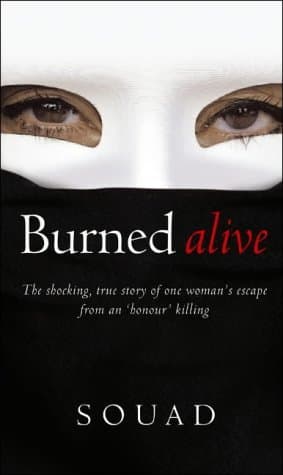
Burned Alive cover
Archivist's Choice

Burned Alive

Souad

Genre

Biography / Memoir / Spirituality

Reading Time

8-10 hours

Key Themes

See below

Track Your Reading

Sign in to track this book

A true story of survival, 'Burned Alive' tells of Souad's escape from an honor killing and her quest to expose the practice.

Core Idea

Souad's memoir, "Burned Alive," is a first-person account of surviving an attempted honor killing in a West Bank village and her journey to recovery and advocacy. The book shows the reality of 'honor crimes' as a systemic issue rooted in patriarchal control and community involvement, not isolated acts. It argues that survival and healing are possible through outside help, compassionate care, and breaking silence. It redefines family and belonging beyond biological ties to find a new purpose in fighting for justice for other victims.
Reading time
8-10 hours
Difficulty
Medium
✓ Read this if...
You want a raw, unflinching, and deeply personal account of surviving extreme violence, understanding the mechanics of 'honor crimes,' and witnessing the power of human resilience and international aid.
✗ Skip this if...
You are highly sensitive to graphic descriptions of violence, child abuse, and trauma, or prefer a more academic, less personal exploration of human rights issues.

Core idea

The central argument and framework that powers the entire book.

Souad's memoir, "Burned Alive," is a first-person account of surviving an attempted honor killing in a West Bank village and her journey to recovery and advocacy. The book shows the reality of 'honor crimes' as a systemic issue rooted in patriarchal control and community involvement, not isolated acts. It argues that survival and healing are possible through outside help, compassionate care, and breaking silence. It redefines family and belonging beyond biological ties to find a new purpose in fighting for justice for other victims.

At a glance

Reading time

8-10 hours

Difficulty

Medium

Read this if...

You want a raw, unflinching, and deeply personal account of surviving extreme violence, understanding the mechanics of 'honor crimes,' and witnessing the power of human resilience and international aid.

Skip this if...

You are highly sensitive to graphic descriptions of violence, child abuse, and trauma, or prefer a more academic, less personal exploration of human rights issues.

Key Takeaways

1

The Brutality of 'Honor Crimes'

Unveiling the cultural justifications for extreme violence against women.

Quote

In her village, as in so many others, sex before marriage was considered a grave dishonour to one's family and was punishable by death. This was her crime.

Souad's story exposes 'honor crimes,' a practice in patriarchal societies where a woman's perceived sexual transgression brings 'shame' upon her family. The book shows how these acts of violence, often murder, are not only accepted but are often seen as a 'respectable duty' or even heroism within the community. The 'crime' is not against the woman, but against the family's honor, making the victim the perpetrator in the eyes of her society. This logic allows for cruelty, as shown by Souad's attempted immolation, carried out by her bro...

Supporting evidence

Souad's attempted murder by her brother-in-law, who poured petrol over her and set her alight, was considered a legitimate act to restore family honor, with no expectation of prosecution within her community.

Apply this

Challenge and question cultural narratives that normalize violence against women under the guise of tradition, religion, or honor. Support organizations working to educate communities and provide refuge for victims of honor-based violence.
honor-killingspatriarchycultural-violence
2

Survival Against All Odds

Souad's miraculous endurance in the face of abandonment and severe injury.

Quote

Miraculously, Souad survived rescued by the women of her village, who put out the flames and took her to a local hospital.

Souad's survival after being set on fire is a miracle, showing the human will to live even when everything seems lost. The immediate rescue by the women of her village, despite the community's broader involvement, highlights empathy that sometimes emerges even in oppressive environments. However, her subsequent abandonment by her family and community after the 'punishment' shows their adherence to societal norms over family bonds. Her survival shows the resilience of the human spirit, demonstrating that even when ostracized and left f...

Supporting evidence

Souad was rescued by village women who extinguished the flames and took her to a local hospital, but was subsequently abandoned by her family and community, left to die from her horrific burns.

Apply this

Recognize and support the resilience of survivors of violence. Advocate for medical and psychological support systems for victims who are often left without any family or community aid.

resiliencesurvivalabandonment
3

The Power of External Intervention

How a single aid worker became Souad's lifeline to a new life.

Quote

It was only the intervention of a European aid worker that enabled Souad to receive the care and sanctuary she so desperately needed and to start her life again.

Souad's story illustrates the role of outside help in saving lives and offering recovery for victims of extreme violence, especially when local systems fail. The arrival of a European aid worker changed Souad's path from certain death or despair to healing and hope. This highlights the limits of community mechanisms in addressing ingrained human rights abuses and the need for international humanitarian efforts. Without this outside help, Souad would have remained abandoned, her suffering unseen. It shows the impact an individual or or...

Supporting evidence

A European aid worker found Souad, ensured she received critical medical care for her severe burns, and facilitated her escape from her village to a place of sanctuary, enabling her to rebuild her life.

Apply this

Support international aid organizations and humanitarian workers who operate in regions where human rights abuses are prevalent. Volunteer or donate to groups providing refuge and support to victims of violence.

humanitarian-aidinterventionrefuge
4

Breaking the Silence

Souad's courageous decision to speak out against honor killings.

Quote

She has now decided to tell her story and uncover the barbarity of honour killings, a practice which continues to this day.

Souad's decision to tell her story is an act of courage and a step in combating the silence surrounding honor killings. These crimes continue in secrecy, often unreported and unprosecuted due to cultural taboos and community involvement. By sharing her testimony, Souad is reclaiming her voice and shining a light on a global issue that affects thousands of women each year. Her narrative is a call to action, urging others to acknowledge the existence and brutality of these practices, and to break the societal silence that allows them to...

Supporting evidence

Souad's memoir 'Burned Alive' explicitly states her intention to 'uncover the barbarity of honour killings' and 'break the taboo of silence' surrounding the practice.

Apply this

Amplify the voices of survivors and advocates against gender-based violence. Engage in discussions and share information to raise awareness about honor killings and similar human rights abuses.

advocacystorytellingtaboo
5

The Global Scope of Honor Violence

Understanding that these atrocities are not isolated incidents.

Quote

More than five thousand cases of such honour killings are reported around the world each year and many more take place that we hear nothing about.

The book highlights that honor killings are not confined to a single region or culture but are a global phenomenon, with 'more than five thousand cases... reported around the world each year' and many others going undocumented. This statistic is chilling and shows the urgent need for international attention and coordinated efforts. Souad's story, while personal, is a microcosm of a larger, systemic issue. It challenges the misconception that such violence is rare or geographically isolated, showing instead a widespread pattern of gend...

Supporting evidence

The book explicitly states that 'more than five thousand cases of such honour killings are reported around the world each year and many more take place that we hear nothing about,' indicating the widespread nature of the problem.

Apply this

Support international human rights organizations that track and report on honor violence globally. Advocate for universal human rights standards that supersede cultural practices that harm individuals.

global-violencehuman-rightsstatistics
6

The Complicity of Community

How societal norms enable violence through inaction and acceptance.

Quote

An execution for a 'crime of honour' was a respectable duty unlikely to bring about condemnation from others. It certainly would not have provoked calls for his prosecution.

Souad's narrative exposes the complicity of entire communities in continuing honor violence. The book shows that perpetrators of honor crimes often face no condemnation, let alone prosecution, from their peers or local authorities. Instead, their actions are often seen as upholding community values, turning them into 'heroes.' This societal acceptance creates an environment where victims are brutalized and denied justice, as the very structures meant to protect them are corrupted by cultural norms. This collective silence and endorsem...

Supporting evidence

Souad's brother-in-law, who set her on fire, was considered a 'hero' within their community, and his actions would not have 'provoked calls for his prosecution,' illustrating the community's acceptance.

Apply this

Challenge and condemn community-level justifications for violence. Advocate for legal reforms and enforcement that prosecute honor crimes as severe criminal offenses, regardless of cultural context.

social-normscollective-silencejustice-system
7

Trauma and the Path to Healing

The long and arduous journey of physical and psychological recovery.

Quote

Horrifically burned, and abandoned by her family and community, it was only the intervention... that enabled Souad to receive the care and sanctuary she so desperately needed and to start her life again.

Souad's journey goes beyond her physical survival; it explores the psychological and emotional trauma inflicted by such an act of violence and abandonment. The book touches on the difficulty of rebuilding a life when one has been literally and figuratively burned alive. Healing is not just about medical treatment for physical wounds, but also about overcoming the deep scars of betrayal, fear, and ostracization. Her ability to 'start her life again' speaks to the long-term process of therapy, support, and finding a new identity and pur...

Supporting evidence

The narrative details Souad's severe burns and her subsequent need for 'care and sanctuary' to 'start her life again,' implying extensive physical and psychological recovery.

Apply this

Support mental health services for survivors of trauma and violence. Understand that healing is a process that requires sustained support, empathy, and resources.

trauma-recoverypsychological-healingrebuilding-life
8

Redefining Family and Belonging

Finding new connections and a sense of self outside of traditional ties.

Quote

abandoned by her family and community, it was only the intervention of a European aid worker that enabled Souad to receive the care and sanctuary she so desperately needed and to start her life again.

Souad's experience forces a redefinition of 'family' and 'belonging.' Having been betrayed and abandoned by her biological family and community, her survival and subsequent life depend entirely on the kindness and intervention of strangers. This highlights how chosen families and supportive networks can become a lifeline for those ostracized by their original kin. It challenges the idea that blood ties are always sacred or safe, demonstrating that true belonging comes from acceptance, care, and respect, rather than genetic relation or...

Supporting evidence

Her abandonment by her biological family and community, contrasted with the life-saving intervention and care provided by a European aid worker, demonstrates a shift in her source of support and belonging.

Apply this

Foster inclusive communities that welcome and support individuals who may be estranged from their biological families. Recognize the importance of chosen families and support networks for healing and integration.

chosen-familybelongingidentity-formation
9

The Power of Testimony

How one woman's story can ignite global conversations and change.

Quote

It is also a call to break the taboo of silence that surrounds this most brutal of practices and which ignores the plight of so many other women who are also victims of traditional violence.

Souad's memoir shows the power of individual testimony. By bravely sharing her personal and traumatic experience, she transforms her suffering into a catalyst for global awareness and advocacy. Her story goes beyond personal tragedy, becoming a rallying cry against a widespread human rights abuse. It reminds us that behind every statistic of honor violence, there is an individual with a horrifying story. This act of telling is not just therapeutic for Souad but is a tool to 'break the taboo of silence,' force uncomfortable conversatio...

Supporting evidence

The book itself, 'Burned Alive,' is Souad's testimony, published with the explicit goal of 'uncover[ing] the barbarity of honour killings' and serving as 'a call to break the taboo of silence.'

Apply this

Support and encourage platforms for survivors of violence to share their stories safely. Understand that personal narratives are potent tools for social change and policy reform.

advocacyhuman-rightssocial-change

Critical analysis

Notable Quotes

I was born into a society where women are worthless, where they are treated like animals, where they are burned alive if they bring shame upon their family.

Souad reflecting on the brutal realities of her birth and upbringing in a patriarchal society.

My own mother had poured the petrol over me. My own sisters had held me down. My own father had watched.

Souad recounting the horrific moment she was set on fire by her family.

The pain was immense, an inferno that consumed every part of me. But even greater than the physical pain was the realization that my own family wanted me dead.

Souad describing the immediate aftermath of being burned.

I survived. I don't know why, but I survived. And with survival came a faint glimmer of hope.

Souad expressing her initial astonishment and emerging will to live after the attack.

In our village, a woman's honor is everything. It is a fragile thing, easily broken, and when it is, only blood can wash away the stain.

Souad explaining the cultural justification for honor killings in her community.

I was a ghost, a living dead. My face was gone, my body a mass of scars. But inside, a small flame refused to be extinguished.

Souad describing her physical state and inner spirit during her recovery.

It was in the hospital, in the kindness of strangers, that I first learned that not all people were cruel, that there could be compassion in the world.

Souad experiencing care and empathy from medical staff, a stark contrast to her family.

They tried to silence me, to bury my story with my body. But I would not be silent. I would speak for all the voiceless women.

Souad's determination to share her experience and advocate for others.

My faith was tested, but it did not break. Instead, it transformed. I found God not in fear and judgment, but in love and forgiveness.

Souad reflecting on her spiritual journey and evolving understanding of faith.

The scars on my body are a constant reminder of what I endured, but they are also a testament to my survival, to my will to live.

Souad viewing her physical scars as symbols of strength rather than shame.

Freedom is not just about escaping a place; it is about freeing your mind, your spirit, from the chains of the past.

Souad's deeper understanding of true freedom beyond physical escape.

To forgive is not to forget, but to release yourself from the burden of hatred. It is a gift you give to yourself.

Souad's perspective on the complex process of forgiveness.

I am not just Souad, the burned woman. I am Souad, the survivor, the advocate, the woman who found her voice.

Souad asserting her identity beyond her trauma.

Quiz

Test Your Knowledge

Ready to see how well you understood this book? Take our interactive quiz with 10 questions.

10
Questions
~5
Minutes
?
Best Score

Key Questions (FAQ)

Burned Alive is the harrowing true story of Souad, a young woman from a village where premarital sex is punishable by death. After becoming pregnant, she was set on fire by her brother-in-law in an 'honor killing' attempt, miraculously surviving to tell her story.

About the author

Biography coming soon.