BookBrief
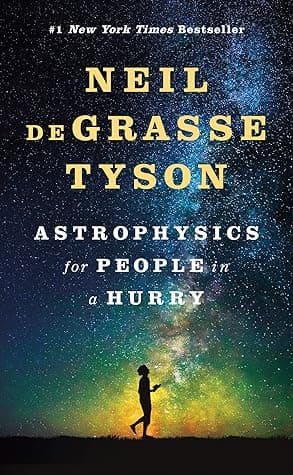
Astrophysics for People in a Hurry cover
Archivist's Choice

Astrophysics for People in a Hurry

Neil deGrasse Tyson (2017)

Genre

History / Science

Reading Time

180 min

Key Themes

See below

Track Your Reading

Sign in to track this book

Neil deGrasse Tyson explains the universe's biggest questions, from the Big Bang to dark energy, in a short and engaging cosmic tour for busy readers.

Core Idea

Neil deGrasse Tyson makes modern astrophysics understandable in a clear, brief way. He wants to give busy readers a basic grasp of how the universe began, changed, and will end. The book presents key science ideas in short chapters, building a sense of wonder about our place in space and the mysteries that remain. It encourages readers to appreciate the universe's scale and our link to its basic parts.
Reading time
180 min
Difficulty
Easy
✓ Read this if...
You want a quick, engaging, and authoritative primer on the major concepts of astrophysics without getting bogged down in complex mathematics or jargon.
✗ Skip this if...
You are already deeply familiar with fundamental astrophysics or are looking for an in-depth, academically rigorous treatment of the subject.

Core idea

The central argument and framework that powers the entire book.

Neil deGrasse Tyson makes modern astrophysics understandable in a clear, brief way. He wants to give busy readers a basic grasp of how the universe began, changed, and will end. The book presents key science ideas in short chapters, building a sense of wonder about our place in space and the mysteries that remain. It encourages readers to appreciate the universe's scale and our link to its basic parts.

At a glance

Reading time

180 min

Difficulty

Easy

Read this if...

You want a quick, engaging, and authoritative primer on the major concepts of astrophysics without getting bogged down in complex mathematics or jargon.

Skip this if...

You are already deeply familiar with fundamental astrophysics or are looking for an in-depth, academically rigorous treatment of the subject.

Key Takeaways

1

Cosmic Address & Perspective

Understanding our place in the vast, expanding universe.

Quote

The universe is under no obligation to make sense to you.

Tyson makes the vast cosmos understandable, showing our small place in the observable universe. We live on a small planet around an average star, in a galaxy among billions. This view does not lessen humanity but grounds us in a key truth: we come from the universe, made of its basic parts. Seeing this scale encourages both humility and wonder, making us appreciate the conditions that allow life on Earth. It helps counter human-centered thinking, putting human efforts into a much larger cosmic story. The universe does not care about o...

Supporting evidence

Tyson describes the hierarchical structure of the cosmos: Earth, Solar System, Milky Way Galaxy, Local Group, Virgo Supercluster, Observable Universe. He frequently references Edwin Hubble's discovery of an expanding universe and the implications for our cosmic address.

Apply this

Cultivate a 'cosmic perspective' when facing everyday challenges. Regularly reflect on the scale of the universe to reframe problems and appreciate the uniqueness of Earth. Engage with astronomy and space exploration to maintain this broader view.

cosmic-addressobservable-universeanthropocentrism
2

The Big Bang & Cosmic Evolution

Tracing the universe's origin from a singularity to its current complexity.

Quote

The universe began with a bang. Not a bang that anyone heard, but a bang that continues to resonate through every particle of matter.

The universe did not just appear; it grew from a hot, dense state, the Big Bang. Tyson explains the universe's first moments, from the early expansion to the creation of basic particles, then atoms, and finally the first stars and galaxies. This cosmic growth is not just a history; it helps us understand why the universe is the way it is. The elements in our bodies, from carbon in DNA to iron in blood, were made in stars that lived and died billions of years ago. We are literally stardust, a direct result of this grand process, showin...

Supporting evidence

The existence of the Cosmic Microwave Background (CMB) radiation, discovered by Penzias and Wilson, is presented as compelling evidence for the Big Bang. Tyson also discusses nucleosynthesis, the formation of light elements like hydrogen and helium in the early universe, and the subsequent formation of heavier elements in stars.

Apply this

Appreciate the deep history embedded in all matter around you, recognizing that the atoms in your body have a cosmic origin. Support scientific research into cosmology and particle physics to further unravel the universe's origins.

big-bangcosmic-microwave-backgroundnucleosynthesisstardust
3

Dark Matter & Dark Energy

Unveiling the invisible forces dominating the universe's structure and fate.

Quote

If we were to scoop up all the dark matter and dark energy and dark things, there'd be very little room for us.

Tyson explains that most of the universe's mass and energy are invisible and unknown. Dark matter, an unseen substance, provides the gravity that holds galaxies together, explaining why galaxies spin faster than visible matter alone would suggest. Dark energy, an even more mysterious force, causes the universe's expansion to speed up, pushing galaxies apart faster. These 'dark' parts challenge our physics, showing how much we still do not know about the cosmos. It reminds us that our current understanding, based on visible matter, onl...

Supporting evidence

Evidence for dark matter comes from galactic rotation curves (Vera Rubin's work) and gravitational lensing. Evidence for dark energy comes from observations of distant supernovae, which showed the universe's expansion is accelerating.

Apply this

Maintain intellectual humility, recognizing that scientific knowledge is always evolving and that fundamental mysteries still exist. Foster curiosity about unexplained phenomena, understanding that breakthroughs often come from challenging current paradigms.

dark-matterdark-energycosmic-expansiongravitational-lensing
4

The Fabric of Spacetime

Exploring Einstein's revolutionary view of space and time as an interconnected entity.

Quote

Space tells matter how to move; matter tells space how to curve.

Einstein's theory of General Relativity changed our view of gravity. It is not a force pulling things together, but a result of mass and energy curving spacetime. Tyson explains how large objects like stars and planets bend spacetime around them, guiding the paths of other objects, including light. This idea of spacetime means that space and time are linked, forming a changing, four-dimensional whole. This curvature is what we see as gravity. It has big implications for black holes, the universe's expansion, and even the idea of time ...

Supporting evidence

Tyson discusses the bending of starlight around the Sun observed during a solar eclipse (Eddington's experiment) as a key early verification of General Relativity. He also mentions gravitational waves, predicted by Einstein and recently detected, as ripples in spacetime.

Apply this

When considering motion or gravity, visualize spacetime as a flexible fabric rather than an empty stage. Appreciate the profound interconnectedness of space and time in the universe, moving beyond Newtonian intuitions.

spacetimegeneral-relativitygravityblack-holesgravitational-waves
5

Cosmic Rays & Quantum Weirdness

The universe is full of high-energy particles and operates on non-intuitive quantum rules.

Quote

The universe is not only stranger than we imagine, it is stranger than we can imagine.

Beyond what we can see, the universe is full of high-energy events, including cosmic rays, which are fast particles hitting Earth constantly. These particles, from supernovae, black holes, and other violent cosmic events, show the universe's active and often extreme nature. Tyson also talks about the quantum world, where regular physics rules do not apply. Particles can exist in many states at once (superposition), and their properties are uncertain rather than fixed. This 'quantum strangeness' is not just theory; it is the basic real...

Supporting evidence

Tyson describes cosmic rays impacting Earth's atmosphere and their origins. He briefly touches on quantum mechanics concepts like wave-particle duality and the probabilistic nature of quantum events, essential for understanding atomic structure and stellar fusion.

Apply this

Embrace the counter-intuitive nature of scientific discovery, accepting that the universe doesn't always conform to common sense. Be open to new ways of thinking that challenge established notions, particularly in physics.

cosmic-raysquantum-mechanicssuperpositionwave-particle-duality
6

The Multiverse Hypothesis

Exploring the mind-bending possibility of universes beyond our own.

Quote

The universe as we know it might simply be one of an infinite number of universes in a larger multiverse.

Tyson introduces the idea of the multiverse, which is interesting but still speculative. It comes from various cosmic theories, especially inflationary cosmology. The idea suggests that our universe might be one 'bubble' in a much larger 'cosmic foam,' with other universes possibly having different physical laws, dimensions, or basic constants. While we cannot test it yet, the multiverse idea offers solutions to problems like why our universe seems so perfectly suited for life. It suggests that if there are endless universes, some are...

Supporting evidence

Tyson explains how the theory of cosmic inflation, which explains the uniformity and flatness of our universe, can naturally lead to the idea of eternal inflation, where new 'bubble' universes are continuously formed.

Apply this

Engage in thought experiments about ultimate reality, recognizing that our current understanding of the universe might be incomplete. Maintain an open mind to speculative but scientifically grounded theories, even if they lack direct empirical evidence currently.

multiverseinflationary-cosmologyfine-tuningcosmic-foam
7

The Cosmic Calendar

Compressing the universe's 13.8 billion-year history into a single year.

Quote

The entire history of the universe, from the Big Bang to the present, compressed into a single calendar year.

To truly understand the vastness of cosmic history, Tyson uses Carl Sagan's 'Cosmic Calendar' comparison. By putting the universe's 13.8 billion-year existence into one calendar year, it becomes clear how recently humanity appeared. The Big Bang is on January 1st, our Milky Way forms in May, our Sun and Solar System in September, and Earth's life begins in October. Dinosaurs live in late December, and all of recorded human history, from pyramids to the internet, happens in the last few seconds of December 31st. This comparison powerfu...

Supporting evidence

The 'Cosmic Calendar' is a direct analogy popularized by Carl Sagan and used by Tyson to illustrate cosmic timescales. He lists key events like the formation of the Milky Way, the Solar System, the first life, dinosaurs, and human civilization on this calendar.

Apply this

Use the Cosmic Calendar as a mental model to contextualize human history and achievements. Develop a deeper appreciation for the long evolutionary processes that led to our existence, fostering patience and long-term thinking.

cosmic-calendarcosmic-timescalehuman-historyevolution
8

The End of the Universe

Contemplating the various scenarios for the ultimate fate of the cosmos.

Quote

The universe will continue to expand, cool, and dilute, until it becomes a cold, dark, empty place.

Just as the universe began, it will end, though how it ends is still being studied. Tyson describes the main theories: the 'Big Crunch,' where gravity pulls everything back together; the 'Big Rip,' where dark energy intensifies and tears apart everything, even atoms; and the most likely scenario, the 'Big Freeze' or 'Heat Death,' where the universe keeps expanding, growing colder and emptier as stars die, black holes disappear, and all usable energy runs out. Thinking about the universe's end, while a bit grim, shows that everything i...

Supporting evidence

Tyson discusses the role of dark energy in accelerating expansion and how this makes the 'Big Freeze' the most probable fate. He also mentions the theoretical alternatives like the 'Big Crunch' and 'Big Rip,' based on different assumptions about dark energy's behavior.

Apply this

Reflect on the impermanence of existence and the vastness of cosmic timescales, which can foster a deeper appreciation for life and the present moment. Support scientific endeavors that seek to understand the fundamental forces governing the universe's ultimate fate.

big-crunchbig-ripheat-deathcosmic-fatedark-energy
9

Cosmic Ignorance & Wonder

Embracing the vastness of what we don't know as a source of inspiration.

Quote

We are part of this universe; we are in this universe, but perhaps more important than both of those facts is that the universe is in us.

Tyson often points out that despite our great scientific progress, our knowledge of the universe is still very limited. From the mysteries of dark matter and dark energy to the origins of life and consciousness, much remains unknown. However, this lack of knowledge is not a reason for sadness but a strong reason for wonder and continued exploration. The universe's refusal to fit our expectations, its 'strangeness,' is exactly what makes it so endlessly fascinating. By admitting what we do not know, we stay open to new discoveries and ...

Supporting evidence

Throughout the book, Tyson highlights unanswered questions like the exact nature of dark matter/energy, the full implications of quantum mechanics, and the potential for life beyond Earth, framing them as exciting areas for future research.

Apply this

Cultivate a 'beginner's mind' and an attitude of continuous learning. Be comfortable with uncertainty and the unknown, viewing it as an opportunity for discovery rather than a deficit. Foster curiosity in yourself and others, especially in scientific exploration.

scientific-ignorancecosmic-wonderdiscoverycuriosity
10

The Cosmic Connection

Recognizing our profound material and intellectual link to the universe.

Quote

We are not simply in the universe; the universe is in us.

Perhaps the most important idea is the deep link between humanity and the cosmos. We are not just watchers but active parts and results of cosmic change. The atoms in our bodies—carbon, oxygen, iron—were made in ancient stars and spread across the galaxy by supernovae. Our very existence shows the universe's ability to create order and complexity. Also, our ability to understand and question the universe means that the cosmos is, in a way, becoming aware of itself through us. This idea gives human life a special meaning, not as privil...

Supporting evidence

Tyson repeatedly emphasizes the 'stardust' concept, detailing how elements heavier than hydrogen and helium are synthesized in stars and distributed. He also highlights humanity's unique capacity for scientific inquiry and cosmic contemplation.

Apply this

Feel a deep sense of belonging and responsibility towards the universe and Earth. Use this cosmic connection as motivation for environmental stewardship and for pursuing knowledge that benefits all of humanity.

stardustcosmic-origininterconnectednessenvironmental-stewardship

Critical analysis

Notable Quotes

The universe is under no obligation to make sense to you.

Introducing the vastness and often counter-intuitive nature of the cosmos.

Not only are we in the universe, the universe is in us.

Discussing the origins of elements in stars and their presence within living beings.

We are part of this universe; we are in this universe, but perhaps more important, the universe is in us.

Emphasizing the connection between cosmic elements and human existence.

When we look out to the universe, we are looking back in time.

Explaining the finite speed of light and its implications for observing distant objects.

The cosmic perspective is a humbling yet uplifting experience.

Reflecting on the dual impact of understanding humanity's place in the vast cosmos.

In the beginning, nearly fourteen billion years ago, all the space and all the matter and all the energy of the known universe was contained within a volume less than one-trillionth the size of the period that ends this sentence.

Describing the initial conditions of the Big Bang.

The atoms of our bodies are traceable to the crucibles of stars that were born and died long before the birth of our solar system.

Highlighting the stellar origins of the elements that make up life.

Dark matter is the most prominent ingredient in the universe that we know little or nothing about.

Introducing the mystery and prevalence of dark matter.

The Big Bang was not an explosion of matter in space, but rather an expansion of space itself.

Clarifying a common misconception about the Big Bang.

If you are a living organism, you are a chemical processor.

Connecting biological life to fundamental chemical and physical processes.

For the first few minutes of the universe, the entire cosmos was a nuclear fusion factory.

Describing the nucleosynthesis that occurred shortly after the Big Bang.

The most astounding fact is the one that you just heard, the one about the chemical elements of the universe being forged in the interiors of stars.

Emphasizing the profound implications of stellar nucleosynthesis.

The future of the universe is still up for grabs.

Discussing the potential fates of the universe based on current cosmological understanding.

Quiz

Test Your Knowledge

Ready to see how well you understood this book? Take our interactive quiz with 10 questions.

10
Questions
~5
Minutes
?
Best Score

Key Questions (FAQ)

This book offers a concise and accessible overview of fundamental astrophysical concepts, from the Big Bang to dark energy, designed for readers with limited time. Neil deGrasse Tyson distills complex ideas into digestible chapters, making the cosmos understandable and engaging.

About the author