“The school was the last rampart of your ancestors, but you have thrown it down. The new school has taken its place. From it you will learn to build and to destroy.”
— The Diallobé chief reflects on the impact of the French school.

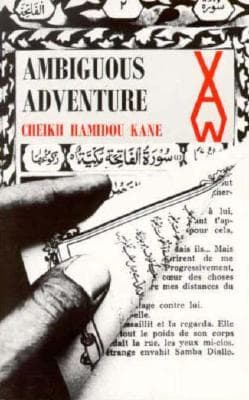
Cheikh Hamidou Kane (1963)
Genre
Spirituality / Philosophy
Reading Time
240 min
Key Themes
See below
Sign in to track this book
Torn between his Senegalese spiritual heritage and French rational education, Samba Diallo faces a crisis of faith and identity, struggling to choose between his soul and his intellect.
“The school was the last rampart of your ancestors, but you have thrown it down. The new school has taken its place. From it you will learn to build and to destroy.”
— The Diallobé chief reflects on the impact of the French school.
“We are the hybrids, children of a double birth, with a double nature, who feel in our innermost selves the conflict of these two worlds.”
— Samba Diallo describes the predicament of his generation.
“God is not the light. He is the sun which gives the light, and the moon which gives the night.”
— The teacher Thierno explains a nuanced view of God to young Samba Diallo.
“To conquer is to love. To love is to die. We die to ourselves to be reborn in the other.”
— A philosophical reflection on conquest and self-sacrifice.
“The word is a living thing, a breath, a light, a sound, a song, a silence, an echo, a shadow, a presence, an absence, a memory, a forgetting.”
— A rich description of the nature and power of language.
“I am not a country. I am a man. And if you want to understand me, you must understand my soul, not my frontiers.”
— Samba Diallo expresses his individual identity beyond national or cultural boundaries.
“The West is the left hand of God. The East is the right hand of God. And man is the heart of God.”
— A symbolic representation of the interconnectedness of East and West, and humanity's central role.
“We are walking towards God, but we are walking on the road of men.”
— A reflection on the journey of faith within the human experience.
“The problem is not to choose between two gods, but to choose the God who is in both.”
— Samba Diallo grapples with the synthesis of different spiritual paths.
“What are we going to do with our hands, if they are no longer able to touch the earth?”
— A lament about the loss of connection to traditional ways and the land.
“The path of knowledge is a path of suffering.”
— A concise statement about the arduous nature of intellectual and spiritual pursuit.
“We have seen the triumph of the machine over the spirit, of matter over the soul.”
— A critique of Western industrialization and its impact.
“To be oneself, one must be the other. To be the other, one must be oneself.”
— A paradox illustrating the interdependent nature of identity and alterity.
“The most difficult thing is to be a man, not a Muslim, not a Christian, not a Jew, but a man.”
— Samba Diallo's ultimate aspiration for universal humanity.
Ready to see how well you understood this book? Take our interactive quiz with 10 questions.

Cheikh Hamidou Kane is a Senegalese novelist, known for his seminal work "Ambiguous Adventure" (L'Aventure ambiguë). This novel, published in 1961, explores the cultural and spiritual clashes faced by Africans during the colonial era. Kane's writing is celebrated for its philosophical depth and nuanced portrayal of identity in a rapidly changing world.
Thomas Sowell
4.4
Stormie Omartian
4.3
Jerry Bridges
4.3
Walter Brueggemann
4.3
Brother Lawrence
4.3
George S. Clason
4.3

Joseph Campbell
4.3
Unknown
4.3