BookBrief
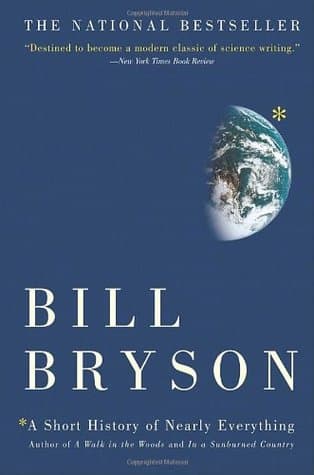
A Short History of Nearly Everything cover
Archivist's Choice

A Short History of Nearly Everything

Bill Bryson (2003)

Genre

History / Science / Philosophy

Reading Time

12-15 hours (approx. 544 pages at 45 pages/hour)

Key Themes

See below

Track Your Reading

Sign in to track this book

Bill Bryson journeys from the Big Bang to human civilization, blending humor and insight to explain the universe's biggest questions by talking to top scientists.

Core Idea

Bill Bryson's "A Short History of Nearly Everything" shows that the universe, Earth, and life result from an improbable series of events, discoveries, and natural forces, often driven by dedicated, sometimes eccentric, scientists. The book argues that understanding deep time, how natural systems connect, and the often accidental path of science reveals the wonder and fragility of our existence. It makes complex topics clear and celebrates the ongoing mysteries that shape our knowledge.
Reading time
12-15 hours (approx. 544 pages at 45 pages/hour)
Difficulty
Easy
✓ Read this if...
You are curious about the origins of the universe, Earth, and life, and want a highly accessible, engaging, and often humorous overview of science and history without getting bogged down in technical jargon. Perfect for general readers and those looking to reignite their sense of wonder about the natural world.
✗ Skip this if...
You are a specialist looking for deep, granular scientific detail, academic rigor, or an exhaustive treatise on a single scientific discipline. This book prioritizes breadth and entertainment over specialized depth.

Core idea

The central argument and framework that powers the entire book.

Bill Bryson's "A Short History of Nearly Everything" shows that the universe, Earth, and life result from an improbable series of events, discoveries, and natural forces, often driven by dedicated, sometimes eccentric, scientists. The book argues that understanding deep time, how natural systems connect, and the often accidental path of science reveals the wonder and fragility of our existence. It makes complex topics clear and celebrates the ongoing mysteries that shape our knowledge.

At a glance

Reading time

12-15 hours (approx. 544 pages at 45 pages/hour)

Difficulty

Easy

Read this if...

You are curious about the origins of the universe, Earth, and life, and want a highly accessible, engaging, and often humorous overview of science and history without getting bogged down in technical jargon. Perfect for general readers and those looking to reignite their sense of wonder about the natural world.

Skip this if...

You are a specialist looking for deep, granular scientific detail, academic rigor, or an exhaustive treatise on a single scientific discipline. This book prioritizes breadth and entertainment over specialized depth.

Key Takeaways

1

The Improbable Existence of Everything

Our universe, Earth, and life itself are products of an astounding series of unlikely events.

Quote

It is, in short, a good deal harder to be here than you might think.

Bryson shows that the existence of the universe, our planet, and life is due to an almost miraculous string of improbable events. From the precise conditions of the Big Bang to the perfectly set fundamental constants, small changes would have prevented stars, planets, or life from forming. Earth's ideal distance from the sun, a large moon stabilizing its axis, plate tectonics for nutrient cycling, and the timely appearance of oxygen-producing life were all cosmic wins. This highlights the fragility and uniqueness of our existence, mak...

Supporting evidence

Bryson details the specific challenges of planetary formation, the necessity of a specific elemental composition (carbon, oxygen, hydrogen, nitrogen), and the 'Goldilocks zone' for liquid water. He cites the fine-tuning of cosmological constants as a key factor.

Apply this

Cultivate a deeper sense of wonder and humility about our place in the cosmos. Recognize the extraordinary privilege of existence and the incredible unlikelihood of 'being here' at all. This perspective can foster greater environmental stewardship and a renewed appreciation for scientific discovery.

anthropic-principlecosmic-fine-tuningplanetary-formation
2

The Unsung Heroes of Science

Much of our understanding comes from overlooked, eccentric, or unlucky scientists.

Quote

Science, it turns out, is a good deal more human than we tend to imagine.

Bryson often points out the overlooked individuals who made major scientific breakthroughs. He reveals that many key discoveries came from people not recognized at the time, or whose work was later overshadowed. These unsung heroes often faced doubt, ridicule, or simply bad luck in being ahead of their time or lacking connections. Their stories show the often messy, collaborative, and sometimes unfair nature of scientific progress. They remind us that science is not always a clear, linear path by 'great men' but a complex story made b...

Supporting evidence

Bryson discusses figures like Alfred Wegener, whose theory of continental drift was initially dismissed, or the numerous geologists and paleontologists whose painstaking work built the foundation for Darwin, often without receiving due credit. He also highlights the often-competitive and sometimes petty rivalries that shaped scientific discovery.

Apply this

Seek out diverse perspectives and acknowledge the collective effort behind major achievements. When learning about scientific history, delve beyond the most famous names to understand the broader context and the contributions of those who might have been marginalized. This fosters a more nuanced and appreciative view of knowledge creation.

history-of-sciencescientific-discoveryintellectual-property
3

Catastrophe as a Creative Force

Mass extinctions and geological violence have repeatedly reshaped life and Earth.

Quote

Every time there has been a mass extinction, life has not just recovered, but has recovered in new and often more interesting ways.

Against a peaceful view of evolution, Bryson stresses that Earth's history includes huge, life-changing catastrophes. From asteroid impacts and supervolcanoes to global ice ages and oxygen crises, these events repeatedly wiped out much of life. However, these disasters were not just destructive; they reset evolution, creating new ecological spaces and driving new life forms. The dinosaurs' extinction, for example, made way for mammals. This challenges the idea of slow, peaceful evolution, showing instead a dynamic, often violent inter...

Supporting evidence

Bryson vividly describes the five major mass extinctions, particularly the Permian-Triassic extinction (the 'Great Dying') and the Cretaceous-Paleogene event that killed the dinosaurs. He also details the 'Snowball Earth' hypothesis and the role of plate tectonics in shaping continents and climate.

Apply this

Understand that change, even disruptive change, can be a catalyst for new opportunities and adaptations. In personal or professional life, view setbacks not as endpoints, but as potential turning points that necessitate new approaches and foster resilience. Appreciate the deep time perspective required to understand Earth's processes.

mass-extinctiongeological-timeevolutionary-bottleneck
4

The Vastness of Deep Time

Human existence is an infinitesimally brief flicker in the grand sweep of cosmic and geological history.

Quote

If you imagine the Earth’s life to be a forty-six-hundred-mile journey, then we have travelled but a hundred yards from the last step.

Bryson uses vivid comparisons to explain the enormous scale of geological and cosmic time. He makes it clear that human civilization, and even our species, takes up a tiny fraction of Earth's history. He shows how billions of years passed before multicellular life appeared, and how most life forms that ever existed are now extinct. This perspective is humbling, making us face our brief presence against eons. It emphasizes the huge processes that happened long before us and will continue long after, shifting our focus from humanity to ...

Supporting evidence

Bryson frequently employs metaphors like the 'football field' or 'arm's length' to represent Earth's age, demonstrating that human history is barely a scratch at the end. He emphasizes the billions of years of microbial life before the Cambrian Explosion.

Apply this

Adopt a long-term perspective in decision-making, recognizing the impact of actions across generations and geological timescales. Cultivate patience and a sense of humility about our place in the universe. This can reduce immediate anxieties and foster a greater appreciation for the ancient processes that shaped our world.

geological-time-scaledeep-timeanthropocene
5

The Perilous Nature of Scientific Inquiry

The pursuit of knowledge is often fraught with danger, accident, and even death.

Quote

The world is a dangerous place, and nowhere more so than in the pursuit of knowledge.

Bryson describes the real dangers faced by early (and even modern) scientists. Explorers died in harsh environments, geologists fell into cracks, chemists were poisoned by experiments, and paleontologists worked in remote, unforgiving places. The search for understanding often required extreme personal sacrifice. This highlights the bravery and dedication of those who pushed the limits of knowledge, reminding us that science involves not just intellect but also immense courage and a willingness to face significant, sometimes fatal, ri...

Supporting evidence

Bryson recounts stories of scientists like Marie Curie suffering from radiation exposure, explorers like Robert Falcon Scott perishing in Antarctica, and geologists facing perilous conditions in the field. He also mentions the dangers of early atomic research and the countless anonymous individuals who died in mining accidents, contributing to geological understanding.

Apply this

Appreciate the sacrifices made by those who advanced human knowledge, and recognize that progress often comes at a cost. When engaging with complex or potentially risky fields, prioritize safety and ethical considerations. Foster respect for the practical challenges and personal risks inherent in scientific fieldwork and experimentation.

scientific-explorationoccupational-hazardsscientific-ethics
6

The Unseen Architects of Our World

Microbes, bacteria, and single-celled organisms are the fundamental drivers of Earth's systems and life.

Quote

We are, in a word, a microbial world.

Bryson argues that despite our focus on large, complex organisms, the microbial world is the true designer and engine of Earth. For billions of years, single-celled life forms ruled the planet, shaping its atmosphere, geology, and eventually everything that followed. They are still the planet's most numerous inhabitants, performing vital functions from nutrient cycling and decomposition to oxygen production. This radically shifts our human-centered view, showing that we are complex, multicellular communities completely dependent on an...

Supporting evidence

Bryson details the role of cyanobacteria in the Great Oxygenation Event, the critical function of bacteria in soil and ocean ecosystems, and the fact that our own bodies are teeming with microbial life essential for our survival. He highlights the sheer biomass and metabolic diversity of microorganisms.

Apply this

Develop a greater appreciation for the microscopic world and its indispensable role in sustaining life. Understand the interconnectedness of all life forms, from the smallest bacteria to the largest animals. This can inform decisions about health, environmental policy, and even personal hygiene, fostering a more holistic ecological perspective.

microbiologyextremophilessymbiosis
7

The Enduring Mysteries of Science

Despite vast knowledge, fundamental questions about the universe and life remain unanswered.

Quote

We are surrounded by things that are beyond our understanding.

One of Bryson's key messages is that despite all our scientific progress, humanity still faces huge, basic mysteries. We don't fully understand the origins of life, the exact workings of consciousness, the nature of dark matter and dark energy, or if life exists elsewhere. He often admits scientific uncertainty, reminding us that every answer often leads to more questions. This promotes intellectual humility and highlights the ongoing, dynamic nature of scientific inquiry, stressing that the boundaries of knowledge are still vast and ...

Supporting evidence

Bryson repeatedly points out the lack of a definitive answer to the origin of life, the 'missing' 95% of the universe (dark matter/energy), and the challenges in understanding complex biological systems like the brain. He often ends chapters or sections with a sense of wonder about what we *don't* know.

Apply this

Embrace curiosity and the comfort of not knowing everything. Maintain an open mind to new discoveries and challenge dogmatic thinking. Recognize that the pursuit of knowledge is an ongoing journey, not a destination, and that unanswered questions are opportunities for future exploration and innovation.

unanswered-questionsscientific-frontierepistemology
8

The Accidental Triumph of Humanity

Our species' survival and dominance are a result of immense luck and fortuitous circumstances.

Quote

We are here because, on a cosmic scale, nothing went catastrophically wrong.

Bryson makes it clear that the rise of Homo sapiens was not certain. Our lineage survived many near-extinctions, huge environmental changes, and strong competition from other hominin species. The conditions that allowed for complex brains, tool-making, and civilization needed a precise combination of factors—geological stability, climate shifts, and the right evolutionary pressures—that could easily have gone differently. This challenges human arrogance, suggesting that our current position is not destiny but a remarkable stroke of ...

Supporting evidence

Bryson details the various hominin species that existed alongside and predated *Homo sapiens*, many of which went extinct. He discusses the relatively recent emergence of modern humans and the precariousness of early human existence, including the Toba supervolcano event that may have nearly wiped out our ancestors.

Apply this

Cultivate humility about humanity's place in the natural world. Recognize that our dominance is not guaranteed and requires responsible stewardship of the planet. This perspective can encourage conservation efforts, sustainable practices, and a deeper respect for the delicate balance of ecosystems that allowed us to thrive.

human-evolutionanthropocenesurvival-bias
9

The Interconnectedness of All Systems

Geology, biology, chemistry, and physics are inextricably linked in shaping our world.

Quote

Everything is connected to everything else.

Throughout the book, Bryson connects different scientific fields, showing that the lines between geology, biology, chemistry, and physics are artificial. Plate tectonics (geology) causes volcanoes and mountains, which affects climate (physics), which in turn shapes evolution (biology), and the atmosphere's composition (chemistry) is a product of ancient life. He shows how Earth's core formation impacts its magnetic field, protecting life from solar radiation. This highlights the holistic nature of our planet, revealing a complex, self...

Supporting evidence

Bryson explains how the Earth's molten core creates a magnetic field, how ocean currents distribute heat, how atmospheric composition affects the greenhouse effect, and how the geological cycle of erosion and deposition feeds nutrients back into ecosystems. The entire book is an argument for this interconnectedness.

Apply this

Adopt a holistic, systems-thinking approach to understanding complex problems, whether in environmental science, policy, or personal health. Recognize that isolated solutions often create unforeseen consequences elsewhere. Foster interdisciplinary collaboration and appreciate the value of diverse perspectives in problem-solving.

systems-thinkingearth-systems-scienceinterdisciplinary-research
10

The Joy and Accessibility of Science

Science, when presented well, is not an arcane subject but a captivating human story.

Quote

The great thing about science is that it is an endless story. You never get to the end of it.

Bryson's greatest achievement is making complex scientific ideas not just understandable, but genuinely entertaining and deeply human. He clarifies intimidating fields like cosmology, geology, and evolutionary biology by focusing on the interesting people, lucky discoveries, heated debates, and the pure wonder of the natural world. He proves that science does not have to be dull or hard to access, but can be a compelling story of human curiosity and cleverness. This is a strong argument for good science communication, showing that wit...

Supporting evidence

The entire book serves as evidence, from Bryson's engaging narrative style, his use of humor and personal anecdotes, to his ability to simplify complex ideas without oversimplifying them. His journeys to meet scientists and his candid observations about their quirks make the scientific process relatable.

Apply this

Cultivate a lifelong curiosity about the natural world and scientific discoveries. Seek out well-communicated science resources and encourage others to do the same. Recognize the power of storytelling in making complex subjects accessible and inspiring, applying this principle to your own communication efforts.

science-communicationpublic-understanding-of-scienceintellectual-curiosity

Critical analysis

Notable Quotes

The good news is that to be an atom in the universe is to be, by definition, an atom that has been a part of the most spectacular, if only because it is the only one we know of, show on Earth.

Reflecting on the improbability and wonder of existence, from the perspective of an atom's journey.

It is a slightly arresting thought that if you were to pick yourself up and fly into space, this is what you would see: a tiny, fragile, self-contained world, shimmering with an improbable blue, like a drop of water on a hot skillet.

Describing the Earth from a cosmic perspective, emphasizing its fragility and beauty.

Energy is the ability to do work, which is why when you're tired you don't have any.

A lighthearted, relatable definition of energy.

The universe is a pretty big place. If it's just us, seems like an awful waste of space.

Pondering the vastness of the universe and the possibility of extraterrestrial life.

Life is an odd thing. It is, by definition, a state of not being dead, and yet it is in many ways a preparation for it.

A philosophical musing on the nature of life and its inevitable end.

The past is a foreign country; they do things differently there.

Emphasizing how different past eras were, even in fundamental ways.

To be here, in this moment, is a miracle. To be able to read these words, to understand them, to be part of the grand sweep of existence, is a gift beyond measure.

Reflecting on the profound privilege of consciousness and existence.

It's a wonder that anything gets done at all, given the extraordinary number of ways that things can go wrong.

Commenting on the inherent difficulties and complexities in scientific endeavors and nature.

Geology is to the Earth what forensics is to a crime scene.

Explaining the role of geology in understanding Earth's history.

The world is a much more interesting place if you're prepared to be interested in it.

Encouraging curiosity and an open mind to appreciate the world's wonders.

We are all made of star-stuff.

Highlighting the cosmic origins of the elements that compose all living things.

No one knows how much of the universe is out there, but we know it's big. Really big.

Discussing the immense scale and unknown extent of the universe.

The greatest gift of all is a mind that is open to wonder.

Emphasizing the importance of an inquiring and appreciative mindset.

There are some things that we know we don't know. But there are also unknown unknowns—the ones we don't know we don't know.

Discussing the limits of human knowledge and the existence of unforeseen discoveries.

Quiz

Test Your Knowledge

Ready to see how well you understood this book? Take our interactive quiz with 10 questions.

10
Questions
~5
Minutes
?
Best Score

Key Questions (FAQ)

'A Short History of Nearly Everything' by Bill Bryson is a comprehensive exploration of the universe and human history, from the Big Bang to the present day. Bryson investigates how everything came to be, making complex scientific and historical concepts accessible and entertaining.

About the author