BookBrief
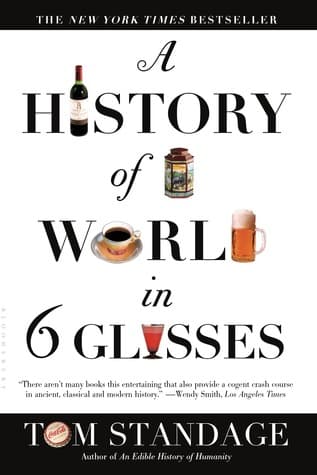
A History of the World in 6 Glasses cover
Archivist's Choice

A History of the World in 6 Glasses

Tom Standage (2005)

Genre

History

Reading Time

7-8 hours

Key Themes

See below

Track Your Reading

Sign in to track this book

Explore human civilization, from ancient Mesopotamia to modern globalization, through the surprising influence of six drinks: beer, wine, spirits, coffee, tea, and cola.

Core Idea

Tom Standage's "A History of the World in 6 Glasses" argues that six specific drinks—beer, wine, spirits, coffee, tea, and cola—have actively shaped human history. They were not just consumed. Each drink, in its time, encouraged new social interactions, led to technological progress, supported empires, enabled scientific thought, and became a symbol of global change. This shows how basic human needs and desires, expressed through what we drink, guide civilization.
Reading time
7-8 hours
Difficulty
Easy
✓ Read this if...
You're interested in an unconventional, accessible, and engaging global history told through the lens of everyday objects, or you want to understand the deep cultural significance of what we drink.
✗ Skip this if...
You prefer a purely chronological or geopolitical history, or you're looking for an in-depth analysis of a single historical period or region.

Core idea

The central argument and framework that powers the entire book.

Tom Standage's "A History of the World in 6 Glasses" argues that six specific drinks—beer, wine, spirits, coffee, tea, and cola—have actively shaped human history. They were not just consumed. Each drink, in its time, encouraged new social interactions, led to technological progress, supported empires, enabled scientific thought, and became a symbol of global change. This shows how basic human needs and desires, expressed through what we drink, guide civilization.

At a glance

Reading time

7-8 hours

Difficulty

Easy

Read this if...

You're interested in an unconventional, accessible, and engaging global history told through the lens of everyday objects, or you want to understand the deep cultural significance of what we drink.

Skip this if...

You prefer a purely chronological or geopolitical history, or you're looking for an in-depth analysis of a single historical period or region.

Key Takeaways

1

Beer: The Cradle of Civilization

How beer's invention drove the transition from nomadic hunter-gatherer to settled agricultural societies.

Quote

The discovery of beer, or at least the discovery of fermentation, was not just an incidental byproduct of agriculture; it was a primary driver for the development of agriculture itself.

Before farming, people lived as nomads, always searching for food. Standage argues that beer was not just a result of farming, but a strong reason for it. The need for a steady supply of grains, mainly barley, to make this nutritious and intoxicating drink encouraged early humans to farm land and create permanent settlements. This change from foraging to farming, driven by beer, set the stage for complex societies. It also led to the invention of writing (for keeping records of grain and beer) and the idea of civilization itself. Beer...

Supporting evidence

The Natufian culture, an early sedentary society in the Near East, shows evidence of large-scale grain processing long before bread-making, suggesting beer production. Mesopotamian cuneiform tablets detail beer rations as wages and its role in religious rituals.

Apply this

When considering societal shifts, look beyond obvious technological advancements to underlying, often overlooked, drivers like fundamental needs or desires. Recognize how seemingly simple innovations can trigger cascades of complex developments.


neolithic-revolutionfermentationmesopotamia
2

Wine: The Greco-Roman Social Fabric

Wine's role in shaping ancient Greek and Roman intellectual discourse, trade, and social hierarchy.

Quote

Wine was a drink that fostered civilization, stimulating philosophy, poetry, and political debate, as well as trade and colonization.

Wine, especially in ancient Greece and Rome, became more than just a drink; it was a central part of social and intellectual life. Unlike beer, often seen as a common drink, wine was linked to sophistication, philosophy, and the elite. Its use was formalized in Greek symposia and Roman convivium, gatherings where diluted wine encouraged philosophical discussion, political debate, and artistic expression. Standage shows how wine export drove Greek maritime trade and colonization, spreading Hellenic culture across the Mediterranean. Its...

Supporting evidence

Greek amphorae, specifically designed for wine transport, found across the Mediterranean, attest to its trade dominance. Plato's 'Symposium' vividly describes the intellectual and social role of wine in Athenian society.

Apply this

Observe how specific cultural practices, even seemingly trivial ones like how a beverage is consumed, can reflect and reinforce deeper societal values, power structures, and intellectual currents.

symposiumroman-empiregreek-philosophy
3

Spirits: Fueling Exploration and Exploitation

Hard liquor's critical, and often dark, role in the Age of Exploration, colonization, and the transatlantic slave trade.

Quote

Strong spirits, particularly rum, were not just a commodity but a crucial lubricant for the gears of empire and enslavement.

Standage reveals the powerful and often unethical role of distilled spirits, especially rum, during the Age of Exploration and colonization. Unlike beer or wine, spirits offered a compact, high-calorie, and long-lasting liquid, making them ideal for long sea voyages. This practical use, however, quickly led to more harmful applications. Spirits became a main currency in the transatlantic slave trade, used to buy enslaved people in Africa and control them on plantations in the Americas. European powers also used them to subdue and expl...

Supporting evidence

The 'triangular trade' routes explicitly showing rum as a key commodity exchanged for enslaved people. Historical accounts of European traders using alcohol to manipulate indigenous communities during land negotiations.

Apply this

Critically examine the hidden costs and ethical implications embedded within historical economic systems. Recognize how seemingly benign commodities can be weaponized in contexts of power imbalance.

age-of-explorationslave-tradecolonialism
4

Coffee: The Enlightenment's Catalyst

How coffeehouses became crucibles of intellectual exchange, fueling the Scientific Revolution and the Enlightenment.

Quote

Coffee provided a new, stimulating alternative to alcohol, which in turn fostered a different kind of social gathering: the coffeehouse, where ideas flowed as freely as the brew.

Coffee's arrival in Europe brought a significant change in social interaction and intellectual atmosphere. Standage argues that coffee's stimulating, non-intoxicating properties contrasted sharply with the widespread consumption of alcohol, which often led to drowsiness and poor judgment. Coffeehouses became lively, democratic spaces where people from all backgrounds (at least, men) could gather, read newspapers, discuss politics, philosophy, and science, and conduct business. These 'penny universities' fostered rational thought, crit...

Supporting evidence

The proliferation of coffeehouses in London, Paris, and Amsterdam during the 17th and 18th centuries, serving as meeting places for figures like Isaac Newton, Voltaire, and the Encyclopedists. The emergence of newspapers and pamphlets distributed and read within these establishments.

Apply this

Consider how physical spaces and the substances consumed within them can dramatically shape the nature of human interaction and intellectual development. Design environments that encourage focused, collaborative thought.

enlightenmentscientific-revolutionpublic-sphere
5

Tea: Empire, Industry, and Identity

Tea's role in shaping British colonial policy, industrialization, and national identity.

Quote

Tea became the very symbol of Britishness, driving economic policy, colonial expansion, and even sparking revolutions.

Tea's journey from an exotic Chinese drink to a classic British institution is a fascinating story of cultural adoption, economic power, and imperial ambition. Standage details how Britain's huge demand for tea led to a large trade imbalance with China, which was eventually 'fixed' through the Opium Wars. Also, the desire to grow its own tea encouraged British imperial expansion into India, leading to vast tea plantations. At home, tea became a staple for the working classes, providing a safe, often boiled, drink that improved public ...

Supporting evidence

The Opium Wars (1839-1842 and 1856-1860), directly linked to Britain's efforts to balance its tea trade deficit with China. The development of tea plantations in Assam, India, by the British East India Company.

Apply this

Analyze how consumer demand for specific goods can drive geopolitical conflicts, shape colonial ventures, and profoundly alter national economies and social customs. Recognize the long-term consequences of seemingly innocuous cultural habits.

british-empireopium-warsindustrial-revolution
6

Cola: Globalization's Sweet Symbol

Coca-Cola's rise as a global icon, representing American influence, consumerism, and cultural homogenization.

Quote

Coca-Cola, more than any other product, became the taste of modernity, the symbol of a globalized world, and often, of Americanization.

Standage ends his historical journey with cola, specifically Coca-Cola, as the defining drink of the 20th and 21st centuries. It represents globalization, American influence, and mass consumerism. Starting as a patent medicine, Coca-Cola became a global brand through smart marketing, wide distribution, and its link to American ideals of freedom and modernity. Its presence almost everywhere, helped by military distribution during World War II and later aggressive marketing, made it an instantly recognizable symbol. The book notes how C...

Supporting evidence

Coca-Cola's distribution to American soldiers worldwide during WWII, establishing its global footprint. The company's massive advertising campaigns, often linking the drink to universal happiness and American values.

Apply this

Reflect on how global brands act as cultural ambassadors, shaping perceptions of nations and influencing consumer behaviors across diverse societies. Consider the dual nature of globalization – connection and homogenization.

globalizationamericanizationconsumerism
7

Drinks as Technological Catalysts

Each drink, beyond its liquid form, acted as a 'technology' that propelled societal and cultural evolution.

Quote

Each of these six drinks was a catalyst for advancing culture, a kind of technology that shaped human interaction and the course of history.

A main point of Standage's work is that these six drinks were not just things to consume but acted as 'technologies' themselves, causing major societal changes. Beer helped create agriculture and city life. Wine enabled complex trade and refined intellectual discussion. Spirits fueled global exploration and, tragically, the slave trade. Coffee stimulated rational thought and public debate during the Enlightenment. Tea supported a vast empire and the industrial revolution. Cola became the symbol of global consumer culture. Each drink, ...

Supporting evidence

The entire structure of the book, dedicating a chapter to each drink and demonstrating its unique 'technological' impact on a specific historical period and its subsequent developments.

Apply this

When analyzing historical or current events, look beyond obvious inventions to identify how common goods, substances, or even rituals function as underlying 'technologies' that enable or constrain human progress.

social-technologycultural-evolutionhistorical-drivers
8

The Interconnectedness of Consumption and Culture

How the production and consumption of beverages are inextricably linked to a society's values, economy, and power structures.

Quote

The stories of these drinks are interwoven with the broader tapestry of human history, reflecting and shaping the societies that consumed them.

Standage consistently shows that what a society drinks, and how it drinks, is never just a random fact. It reflects its values, economic systems, and power structures. From beer rations in ancient Mesopotamia symbolizing social rank and state control, to the British tea ceremony representing gentility and imperial reach, to coffeehouses as democratic spaces for revolutionary ideas, each drink's story is a small picture of its era. The book shows how drinks influence agriculture, trade routes, political policies, social class, and even...

Supporting evidence

The shift from beer to wine as a status symbol in ancient Greece, reflecting changing social values and economic capabilities. The use of spirits as currency in the slave trade, highlighting a deeply exploitative economic system.

Apply this

Examine contemporary consumption patterns (food, media, fashion) to uncover underlying societal values, economic forces, and power structures. Understand that personal choices are often reflections of broader cultural currents.

cultural-anthropologyeconomic-historysocial-structures
9

From Local Staple to Global Commodity

The journey of these drinks from regional delicacies to instruments of global trade and cultural exchange.

Quote

Each drink began as a local curiosity or necessity and, through human ingenuity and ambition, transcended its origins to become a force on the global stage.

A repeated idea in 'A History of the World in 6 Glasses' is how these drinks changed from local items to global goods with wide-ranging impacts. Beer and wine started as staples of specific regions but became important to early trade and cultural spread. Spirits, especially rum, were developed for specific needs (preservation, energy) but quickly became central to global economic exploitation. Coffee and tea, from specific parts of the world, were adopted by different cultures and then drove massive international trade and imperial ex...

Supporting evidence

The spread of viticulture from the Near East to Greece and Rome. The journey of coffee from Ethiopia and Yemen to European coffeehouses. The forced cultivation of tea in India by the British.

Apply this

Trace the origins of common global products and consider how their journey from local to global altered economies, power dynamics, and cultural landscapes. Recognize the historical roots of today's global supply chains.

global-tradecommodity-chainscultural-diffusion
10

The Power of Hydration and Stimulation

The fundamental human need for safe liquids and altered states as a driver of innovation and societal organization.

Quote

Beneath the diverse stories of these drinks lies a common thread: humanity's fundamental need for safe, palatable liquid, and often, for the stimulating or intoxicating effects that accompany it.

Ultimately, Standage's story highlights two basic human needs: the need for safe drinking liquid and the desire for altered states of consciousness or increased alertness. In times when water was often contaminated, fermented or boiled drinks provided vital hydration and calories, literally sustaining populations. Beyond basic survival, the stimulating effects of coffee and tea, and the intoxicating properties of beer, wine, and spirits, met deep-seated human desires for social connection, ritual, creativity, and escape. These desires...

Supporting evidence

The early nutritional value of beer in ancient civilizations. The use of wine in religious ceremonies. The role of coffee in keeping intellectuals awake and focused.

Apply this

Identify the fundamental human needs or desires that underpin modern technologies or societal structures. Consider how addressing these basic impulses often leads to the most significant and transformative innovations.

human-needspsychoactive-substancescultural-rituals

Critical analysis

Notable Quotes

The story of humanity is, in many ways, the story of what we drink.

Introduction, setting the premise of the book.

Beer provided a safe, nutritious, and intoxicating alternative to water, and it quickly became a staple of early diets.

Discussing the role of beer in early civilizations.

Wine became the drink of civilization, the drink of the elite, the drink of philosophy and poetry, and the drink that helped define the classical world.

Describing wine's significance in Greek and Roman societies.

Distilled drinks, or spirits, were originally medicines, elixirs of life, thought to cure all manner of ills.

Introducing the origins of spirits and their initial use.

The rise of the global trade in sugar, and the associated demand for slave labor, made rum the fuel of the British Empire.

Explaining rum's connection to colonialism and slavery.

Coffee fueled the Enlightenment, helping to foster a new culture of intellectual discourse and critical thinking.

Discussing coffee's impact on European intellectual life.

Tea, first a medicine, then a luxury, became a democratic drink, available to all, and a symbol of British identity.

Tracing tea's journey from China to its widespread adoption in Britain.

The industrial revolution was, in many ways, a revolution fueled by water, or rather, by the need to make water safe to drink.

Highlighting the importance of clean water and its connection to industrialization.

Cocoa, once a sacred drink of Mesoamerican rulers, morphed into chocolate, a global commodity and a symbol of indulgence.

Describing the transformation of cocoa from ancient ritual to modern treat.

Soft drinks, particularly Coca-Cola, became potent symbols of American capitalism and cultural influence around the world.

Examining the global spread and symbolic power of modern soft drinks.

Each drink, in its own way, acted as a catalyst for new forms of social interaction, new ideas, and new ways of organizing society.

A concluding reflection on the overarching theme of the book.

The history of beer is thus inseparable from the history of agriculture, urban living, and the very beginnings of civilization.

Further emphasizing beer's foundational role in early human development.

The availability of safe, potable drinks has been a constant preoccupation throughout human history.

Underlining a fundamental human need that drives much of the book's narrative.

The rise of the coffeehouse in the seventeenth century was a pivotal moment in the development of modern public life.

Focusing on the social significance of coffeehouses.

Quiz

Test Your Knowledge

Ready to see how well you understood this book? Take our interactive quiz with 10 questions.

10
Questions
~5
Minutes
?
Best Score

Key Questions (FAQ)

The book explores the historical impact of six specific beverages: beer, wine, spirits, coffee, tea, and cola. Each drink is presented as a defining element of a particular historical era and culture.

About the author