BookBrief
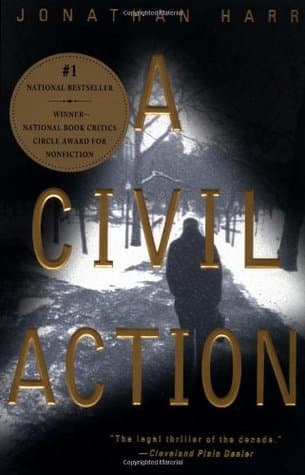
A Civil Action cover
Archivist's Choice

A Civil Action

Jonathan Harr (1995)

Genre

History / Mystery / Science

Reading Time

12-15 hours (based on 512 pages)

Key Themes

See below

Track Your Reading

Sign in to track this book

A lawyer risks everything to fight corporate polluters in a true story about environmental injustice, a poisoned water supply, and childhood leukemia.

Core Idea

A Civil Action tells the story of eight Woburn families who sued W.R. Grace and Beatrice Foods, accusing them of contaminating the town's water and causing childhood leukemia deaths. Following attorney Jan Schlichtmann and his firm, the book shows the high financial and emotional cost of environmental lawsuits. It reveals how hard it is to prove who caused the harm, navigate the legal system, and face powerful corporations. The story highlights how justice can be hard to find when there is scientific uncertainty, corporate secrecy, and flaws in the American jury system. Beyond legal details, the case is a human tragedy. It shows the devastating effects of corporate carelessness on communities and the difficult journey of those seeking resolution. The book examines the American legal system's ability to provide accountability in environmental and public health crises, and its limits, leaving a lasting impact on everyone involved.
Reading time
12-15 hours (based on 512 pages)
Difficulty
Medium
✓ Read this if...
You are fascinated by true crime, legal dramas, environmental justice, or the intricate mechanics of civil litigation and corporate defense. This book is a deep dive into the human and financial costs of pursuing justice against powerful entities.
✗ Skip this if...
You prefer fast-paced thrillers or are looking for a straightforward narrative with clear heroes and villains. The book is dense with legal and scientific detail, and the pursuit of justice is protracted and often frustrating.

Core idea

The central argument and framework that powers the entire book.

A Civil Action tells the story of eight Woburn families who sued W.R. Grace and Beatrice Foods, accusing them of contaminating the town's water and causing childhood leukemia deaths. Following attorney Jan Schlichtmann and his firm, the book shows the high financial and emotional cost of environmental lawsuits. It reveals how hard it is to prove who caused the harm, navigate the legal system, and face powerful corporations. The story highlights how justice can be hard to find when there is scientific uncertainty, corporate secrecy, and flaws in the American jury system.

Beyond legal details, the case is a human tragedy. It shows the devastating effects of corporate carelessness on communities and the difficult journey of those seeking resolution. The book examines the American legal system's ability to provide accountability in environmental and public health crises, and its limits, leaving a lasting impact on everyone involved.

At a glance

Reading time

12-15 hours (based on 512 pages)

Difficulty

Medium

Read this if...

You are fascinated by true crime, legal dramas, environmental justice, or the intricate mechanics of civil litigation and corporate defense. This book is a deep dive into the human and financial costs of pursuing justice against powerful entities.

Skip this if...

You prefer fast-paced thrillers or are looking for a straightforward narrative with clear heroes and villains. The book is dense with legal and scientific detail, and the pursuit of justice is protracted and often frustrating.

Key Takeaways

1

The Elusive Nature of Justice

Justice, especially in environmental cases, is often less about clear-cut right and wrong and more about financial endurance and strategic maneuvering.

Quote

In the end, it was not justice that was served, but a settlement, a compromise born of exhaustion and financial ruin.

The book clearly shows that the American legal system, while meant for justice, often acts as a contest where the side with more money and endurance wins. The Woburn case, despite human suffering and strong circumstantial evidence, became a long fight. Jan Schlichtmann's early hope and moral drive were slowly worn down by the high cost and complexity of suing wealthy corporate defendants. This challenges the romantic idea of the legal system, showing it as a flawed mechanism where procedural obstacles, discovery costs, and the need fo...

Supporting evidence

The protracted discovery process, the immense financial strain on Schlichtmann's firm, and the eventual settlement with W. R. Grace for a fraction of the actual damages sought, all highlight the economic realities that dictated the case's outcome.

Apply this

For those seeking legal redress, especially against powerful entities, understand that the financial and emotional toll can be immense. Prepare for a long, expensive battle and manage expectations regarding the 'perfect' outcome. Consider alternative dispute resolution earlier.
legal-costsenvironmental-justicecorporate-liability
2

The Burden of Proof: A Goliath Task

Proving a direct causal link between corporate pollution and specific illnesses is an almost insurmountable challenge for victims.

Quote

The science was never going to be black and white. It was always going to be a battle of experts, a war of probabilities.

One of the main lessons from 'A Civil Action' is how hard it is to prove direct causation in environmental health cases. The Woburn families had rare diseases like leukemia, and their water was polluted with known carcinogens, but proving that specific chemicals from the defendants caused specific illnesses in specific people was very difficult. The defense could always suggest other causes, argue about dose-response, and point out uncertainties in science. This 'battle of experts' often confuses juries and makes it hard to get justic...

Supporting evidence

The extensive use of expert witnesses by both sides, the detailed discussions of hydrogeology and toxicology during the trial, and the jury's struggle with the scientific evidence, ultimately finding only one defendant (W.R. Grace) liable for a single contaminant (TCE) and not for specific illnesses.

Apply this

For communities facing environmental contamination, focus on robust, independent scientific studies as early as possible. Understand the limitations of current science and prepare for a long fight against well-resourced scientific and legal teams.

causationepidemiologytoxicologyscientific-evidence
3

The Human Cost of Corporate Negligence

Behind every legal battle and corporate balance sheet are real lives irrevocably altered by environmental contamination.

Quote

They were not just plaintiffs; they were mothers, fathers, and children whose lives had been shattered by an invisible poison.

Harr keeps the human stories central, reminding readers that 'A Civil Action' is not just about legal strategies or science, but about the deep suffering of the Woburn families. The sad stories of children like Jimmy Anderson, diagnosed with leukemia, are a constant, painful reminder of what industrial pollution truly means. The book effectively contrasts the cold, procedural legal system with the raw grief, fear, and resolve of the victims, emphasizing that environmental carelessness has a devastating and often permanent effect on pe...

Supporting evidence

The detailed accounts of the children's illnesses and deaths, Anne Anderson's relentless pursuit of answers, and the emotional testimonies of the families during the trial.

Apply this

As consumers and citizens, hold corporations accountable for their environmental impact. Support policies that prioritize public health over corporate profits. Recognize the power of individual stories to drive collective action.

public-healthvictim-advocacycorporate-responsibility
4

The Lawyer's Hubris and Transformation

Jan Schlichtmann's journey exemplifies the evolution from an arrogant, driven attorney to one humbled by the system's complexities and personal sacrifice.

Quote

He had started the case with a fighter pilot's swagger, but the trial had ground him down, stripped him bare.

Jan Schlichtmann is shown as a complex figure: a bright but arrogant personal injury lawyer initially driven by the chance for a big payout and the excitement of a fight. His early lavish spending and confident predictions show a certain pride. However, the Woburn case slowly takes away his financial security, professional confidence, and eventually, his firm. Harr details Schlichtmann's change from a smooth, self-assured lawyer to a man completely absorbed and nearly broken by his pursuit of justice, showing the great personal sacrif...

Supporting evidence

Schlichtmann's initial refusal of the case, his subsequent 'conversion' and lavish spending on discovery, the financial ruin of his firm, and his later, more measured approach to the potential settlement.

Apply this

For aspiring lawyers or those in high-stakes professions, recognize the dangers of overconfidence and the necessity of managing resources. Understand that passion must be tempered with pragmatism and a realistic assessment of the costs involved.

legal-ethicsprofessional-sacrificelitigation-strategy
5

The Power Dynamics of Corporate Defense

Large corporations wield immense resources to delay, obfuscate, and outspend plaintiffs, creating an uneven playing field.

Quote

The defense lawyers were not seeking truth; they were seeking victory, and they had unlimited resources to achieve it.

The book gives a stark look at the power of corporate legal defense. Riley Tannery (Beatrice Foods) and W. R. Grace used skilled, well-funded legal teams whose main goal was to protect their clients, not necessarily to find the truth or help justice. Their methods included aggressive discovery, endless motions, using many expert witnesses to create doubt, and a general strategy of delay. This stands in sharp contrast to the plaintiff's side, which constantly faced financial limits, showing the power imbalance in environmental lawsuits...

Supporting evidence

The sheer number of lawyers and paralegals employed by the defense, the meticulous and often obstructive discovery process, and the ability of the defendants to withstand years of litigation without financial distress.

Apply this

Advocate for legal reforms that level the playing field for plaintiffs in environmental and corporate malfeasance cases, such as stricter discovery rules, greater corporate transparency, and funding mechanisms for public interest law firms.

corporate-lawlegal-defensepower-imbalancediscovery-tactics
6

The Flawed Reality of the Jury System

Even with compelling evidence, juries can struggle with complex scientific and legal arguments, leading to unpredictable outcomes.

Quote

The jury was a microcosm of society, and society wasn't equipped to handle hydrogeology and epidemiology.

While the jury system is a key part of American justice, 'A Civil Action' shows its limits when dealing with very technical and emotional cases. The Woburn jury, made of ordinary citizens, had to understand complex scientific ideas like groundwater flow, chemical toxicology, and statistics, while also dealing with dense legal arguments and conflicting expert testimonies. This complexity often led to confusion and misunderstandings, resulting in a verdict that felt incomplete or unsatisfying to both sides. This shows that the idea of a...

Supporting evidence

The jury's specific findings, holding W. R. Grace liable for TCE contamination but not for the illnesses, and the subsequent interviews with jurors revealing their struggles with the scientific evidence and the overwhelming volume of information.

Apply this

Recognize the need for clearer communication of scientific evidence in legal contexts. Explore alternative jury selection methods or specialized courts for highly technical cases, while preserving the fundamental right to a jury trial.

jury-systemlegal-complexityscientific-literacyverdict-analysis
7

Environmental Activism: A Catalyst for Change

Grassroots activism, even in the face of overwhelming odds, is crucial for bringing corporate environmental abuses to light.

Quote

It began with a mother's grief, and it grew into a movement that forced an entire industry to confront its past.

The Woburn case began because of the hard work of Anne Anderson and other mothers who had lost children. Their initial suspicions, refusal to accept the situation, and organized efforts with affected families were what brought the case to Jan Schlichtmann. Without this community action, the contamination might have stayed hidden, and the corporations might have avoided being held responsible. This highlights the important role of ordinary citizens in starting legal action and social change when government oversight or corporate respon...

Supporting evidence

Anne Anderson's initial research, her efforts to connect with other affected families, and the formation of the 'For a Cleaner Environment' (FACE) group.

Apply this

Empower and support community organizers and environmental advocacy groups. Learn how to effectively document and report environmental concerns in your own community. Understand that collective action can challenge powerful institutions.

grassroots-movementcommunity-organizingenvironmental-advocacycitizen-action
8

The Allure and Illusion of Settlement

Settlements often represent a pragmatic escape from litigation, but they rarely deliver the full measure of justice or closure for victims.

Quote

A settlement is a surrender, a painful compromise. It is the end of the war, but not necessarily the end of the suffering.

After years of difficult legal action and financial ruin, the Woburn case ended in a settlement, first with W. R. Grace and later with Beatrice Foods. While settlements avoid more uncertainty, cost, and emotional strain, they are often unsatisfying. For the victims, the money, though significant, could not replace the loss of their children or their ongoing health worries. For Schlichtmann, the settlements felt like a defeat, a compromise that fell short of the full victory and large award he had first imagined. This shows the mixed f...

Supporting evidence

The specific amounts of the settlements, the mixed reactions of the families to the financial outcomes, and Schlichtmann's lingering sense of dissatisfaction despite the monetary gain.

Apply this

When considering legal action, understand the trade-offs between pursuing a full trial verdict and accepting a settlement. Be prepared for the emotional complexities that come with either outcome, and prioritize healing and recovery beyond the legal process.

legal-settlementdispute-resolutionclosurecompromise
9

The Enduring Legacy of Environmental Contamination

The consequences of industrial pollution extend far beyond the immediate legal case, impacting health, trust, and community for generations.

Quote

The chemicals were gone from the water, but they were not gone from the bodies, nor from the memory of the town.

Even after the legal battles ended and some cleanup happened, the effects of the Woburn contamination remained. The health impacts, both physical and mental, continued to affect the families. Trust in local industries and even government oversight was deeply damaged. The book suggests that environmental damage is not a single event that can be neatly fixed by a legal decision or a financial settlement. It leaves a lasting mark on the land, the health of its people, and the community's social structure, showing the long-term effects of...

Supporting evidence

The ongoing health monitoring of the Woburn community, the lasting emotional trauma described by the families, and the shift in public perception towards the implicated companies.

Apply this

Advocate for robust environmental regulations and proactive prevention strategies rather than solely focusing on reactive cleanup. Support long-term health studies in contaminated areas. Educate future generations on the importance of environmental stewardship.

environmental-legacylong-term-healthcommunity-trustpollution-impact
10

The Unseen Threat: Invisible Poisons

The most dangerous environmental threats are often undetectable by human senses, making them insidious and difficult to combat.

Quote

The poison was odorless, colorless, tasteless. It was there, but you couldn't see it, couldn't feel it, couldn't taste it.

A key part of the Woburn tragedy was that the contaminants – trichloroethylene (TCE) and other volatile organic compounds – were invisible, odorless, and tasteless. This made them especially dangerous, allowing them to pollute the water for years without residents knowing. This 'unseen threat' is important for understanding why the contamination went unnoticed for so long and why proving who caused it was so hard. It highlights how vulnerable communities are to industrial byproducts that do not immediately appear as obvious dangers, e...

Supporting evidence

The initial ignorance of Woburn residents about their water quality, the scientific reports detailing the specific chemicals and their properties, and the difficulty in tracing the exact source of an invisible plume.

Apply this

Support and demand comprehensive environmental monitoring programs. Educate yourself and your community on potential local contaminants. Advocate for stricter regulations on the disposal of industrial chemicals, especially those with no sensory indicators.

water-contaminationinvisible-pollutantsenvironmental-monitoringchemical-safety

Critical analysis

Notable Quotes

The law is a weapon, and like all weapons, it can be used for good or ill.

Reflecting on the nature of legal power.

The truth was not a single, immutable thing, but a collection of facts, each seen through a different lens.

Discussing the subjective nature of truth in a legal case.

There was a certain purity to the scientific method, a relentless pursuit of verifiable facts, that was often absent from the courtroom.

Comparing scientific investigation to legal proceedings.

He understood, finally, that the real victory wasn't in winning, but in the fight itself, in the commitment to a cause larger than oneself.

Jan Schlichtmann's evolving perspective on the Woburn case.

Money was the oxygen of litigation.

Highlighting the financial realities of pursuing a major lawsuit.

The burden of proof was a heavy one, especially when the evidence was buried, literally and figuratively, in the ground.

Referring to the challenges of proving contamination and causation.

It was a story about an ordinary town caught in an extraordinary struggle, a struggle against invisible poisons and powerful corporations.

Describing the core conflict of the Woburn case.

He had believed in the system, in the idea that justice, however slow, would ultimately prevail. Now he wasn't so sure.

Jan Schlichtmann's growing disillusionment with the legal system.

The past was not merely prologue; it was present, still poisoning the lives of the Woburn families.

Emphasizing the lasting impact of the contamination.

The courtroom was a theater, and the lawyers were its actors, each playing a role designed to persuade.

A metaphor for the performative aspect of legal trials.

Ignorance, he realized, was not bliss; it was a luxury that the victims of pollution could not afford.

Reflecting on the importance of awareness regarding environmental hazards.

The human cost, he understood, was immeasurable, far beyond any monetary settlement.

Considering the true impact of the tragedy on the families.

He had started with a clear vision of right and wrong, and ended up in a moral swamp.

Jan Schlichtmann's journey through the ethical complexities of the case.

The science was complex, the law was intricate, and the human story was heartbreakingly simple.

Summarizing the multifaceted nature of the Woburn lawsuit.

Sometimes, the greatest victories were not won in court, but in the quiet, persistent pursuit of truth.

A reflection on the broader meaning of justice beyond legal outcomes.

Quiz

Test Your Knowledge

Ready to see how well you understood this book? Take our interactive quiz with 10 questions.

10
Questions
~5
Minutes
?
Best Score

Key Questions (FAQ)

'A Civil Action' is a non-fiction book by Jonathan Harr that chronicles a landmark environmental lawsuit in Woburn, Massachusetts, during the 1980s. It details how families, led by Anne Anderson, sued major corporations over the contamination of their town's water supply, which they believed caused a cluster of childhood leukemias.

About the author